%20Bold.png)
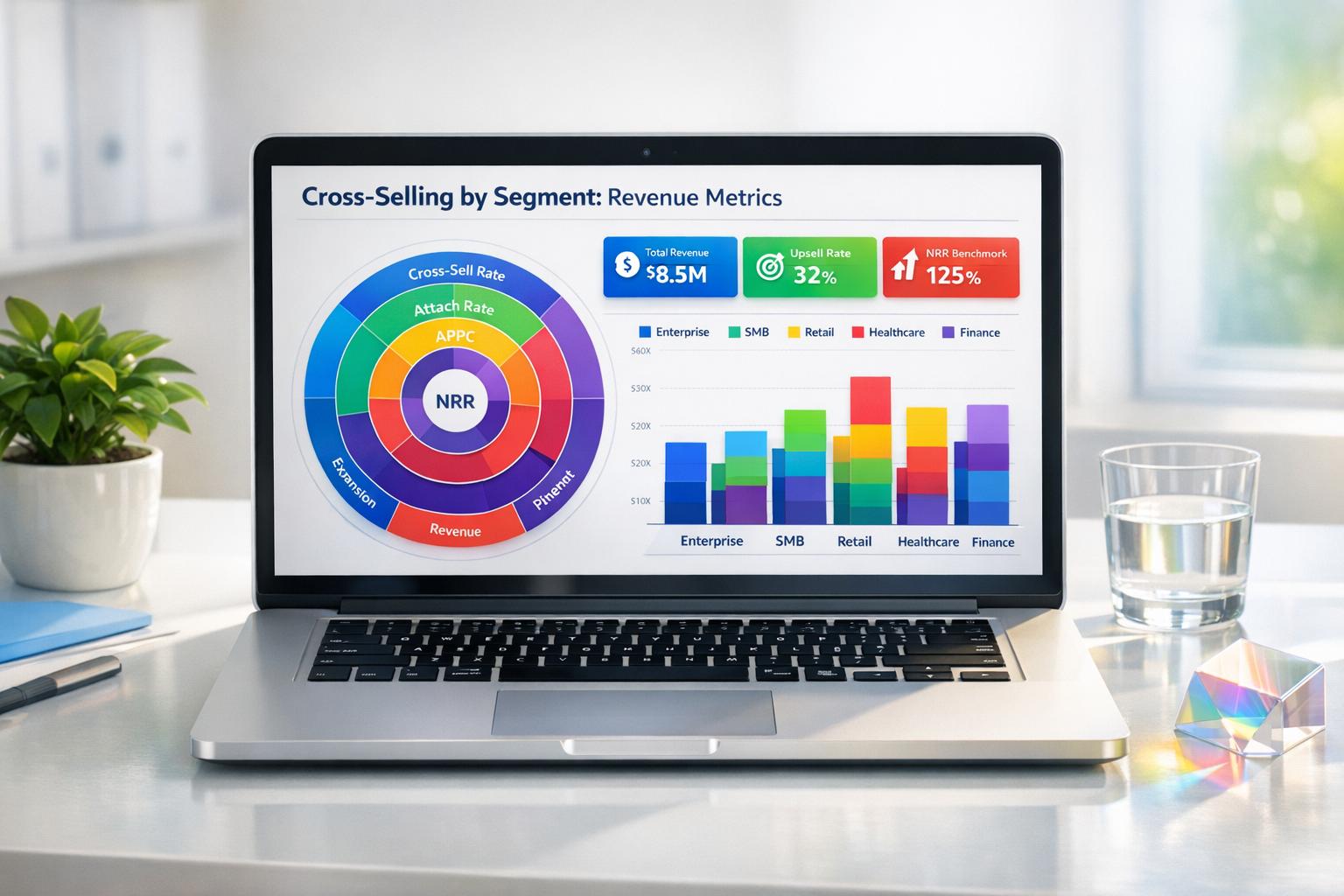
Cross-selling is a proven way to boost revenue and profits by offering customers additional products or services that complement their initial purchase. Selling to existing customers is far more effective than acquiring new ones, with success rates of 60–70% compared to 5–20%. Metrics like cross-sell rates, attach rates, and expansion revenue help measure performance and guide strategies. Segmenting customers by behavior, industry, or company size ensures tailored offers that resonate. For example, SaaS companies often see higher cross-sell rates with enterprise clients due to their complex needs.
Key takeaways:
To measure how effective your cross-selling efforts are, tracking specific metrics by segment is essential. These metrics reveal which customer groups respond best and how cross-selling contributes to your overall revenue. As the ECOSIRE Research and Development Team aptly puts it:
"Upselling and cross-selling to existing customers is the most capital-efficient revenue growth strategy available" [1].
Here’s a closer look at the key metrics that help assess cross-selling performance.
The cross-sell rate indicates how many customers purchase additional products beyond their initial purchase. You can calculate this using two formulas:
For context, SaaS companies typically hit a median cross-sell rate of 30% [3], while top-performing financial service companies reach 40% [3]. A rate above 30% generally signals strong performance, while rates below 10% suggest the need for strategic changes [3]. Performance varies by segment - enterprise customers often show higher cross-sell rates due to larger teams and more complex needs, whereas SMBs tend to convert at lower rates but make decisions faster.
The attach rate measures how many secondary products are sold relative to total orders. It’s calculated as:
A healthy attach rate typically falls between 15% and 30% [1]. This metric helps identify product combinations that naturally work well together and highlights segment-specific trends.
To dive deeper, analyze product affinity using these measures:
For example, if customers frequently buy your core software alongside complementary services, this reflects a high confidence score. Breaking down these patterns by segment can uncover which product pairs resonate with enterprise customers versus mid-market buyers or specific industries.
APPC measures the depth of customer relationships by calculating the total line items divided by total orders [1]. A higher APPC suggests customers see value in multiple offerings and trust your solutions to meet various needs.
APPC varies based on factors like acquisition channel, industry, and lifecycle stage. Customers acquired through direct sales often show a higher APPC since sales teams can identify multiple needs early on. Similarly, enterprise customers typically have a higher APPC due to their complex requirements, while SMBs may have simpler needs. Tracking APPC over time reveals trends - for instance, customers in their first 90 days may start with a lower APPC, but those who stay beyond a year often expand their purchases. Segmenting APPC by acquisition channel or lifecycle stage sharpens your strategy.
Expansion revenue represents the share of total revenue generated through upselling and cross-selling. Benchmarks for expansion revenue typically range from 20% to 35% [1]. Companies like Salesforce, for example, maintain a net revenue retention (NRR) rate above 120%, showcasing the effectiveness of strong expansion strategies [1].
NRR is calculated as:
For SaaS businesses, an NRR above 110% is a good target [1]. Additionally, cross-selling significantly improves the Lifetime Value to Customer Acquisition Cost (LTV/CAC) ratio. Since acquisition costs are already sunk, extra sales directly increase lifetime value. Multi-product customers tend to be more loyal and less likely to churn [6], which boosts retention and LTV. Enterprise accounts often have higher LTV due to broader product adoption and larger teams, while SMBs benefit from lower expansion costs [6] [5].
Together, these metrics - cross-sell rate, attach rate, APPC, expansion revenue, and LTV/CAC - offer a comprehensive view of cross-selling success across different segments.
Segmentation is the backbone of effective cross-selling. By aligning specific products or services with customers most likely to buy, businesses can turn generic offers into tailored revenue opportunities. And the numbers don't lie - personalized experiences can lead to customers spending 38% more on average, while 56% of consumers are more likely to become repeat buyers when they feel their experience is tailored to them [9]. Two key strategies that stand out in segmentation are RFM analysis and behavioral tracking.
RFM analysis is a tried-and-true method for identifying cross-selling opportunities. It works by scoring customers on three factors: Recency (how recently they purchased), Frequency (how often they buy), and Monetary value (how much they spend). A perfect 5-5-5 score signals your top-tier customers [9].
Here’s how RFM segments align with cross-selling strategies:
A real-world example of RFM in action comes from Neptune.AI, which implemented AI-driven RFM segmentation between 2024 and 2025. By targeting high-recency and high-frequency customers with educational content, they achieved a 20% increase in engagement, reduced churn by 15%, and boosted customer lifetime value by 10% [9].
However, RFM alone doesn’t capture every nuance of customer behavior - it accounts for only 40–60% of customer value variation [7]. That’s where behavioral segmentation steps in. By analyzing engagement signals like website visits, email clicks, and product usage, businesses can refine their cross-sell strategies. For instance, when Digital Trawler worked with a B2B SaaS company in 2024, they combined RFM with engagement data to personalize offers. The result? A 15% increase in customer retention and a 10% lift in Average Order Value [9].
AI-powered behavioral segmentation takes things further, improving prediction accuracy by 35–50% over static models [7]. For example, if a loyal customer frequently visits a page for a new product, this could trigger a personalized cross-sell offer. Companies using AI-driven segmentation report 25% better customer acquisition cost efficiency and 30% higher retention rates compared to their peers [7].
To keep your segmentation efforts effective, update RFM scores regularly - monthly for most businesses or weekly for fast-paced industries [8]. This ensures your cross-sell offers stay relevant and timely.
While RFM and behavioral segmentation focus on individual customer behaviors, segmenting by industry and company size helps address broader market trends. B2B cross-selling, in particular, benefits from understanding how industries and company sizes influence buying patterns.
Industry segmentation recognizes that different sectors have unique needs. For example:
Company size segmentation takes into account the unique challenges and opportunities faced by SMBs, mid-market companies, and enterprises. Here’s a breakdown:
| Segment | Champions (High Value) | Loyal Customers |
|---|---|---|
| SaaS B2B (Enterprise) | 15–20% | 30–35% |
| SaaS B2B (Growth) | 10–15% | 25–30% |
| Ecommerce (Mature) | 8–12% | 20–25% |
Enterprise customers often dominate Champion and Loyal segments due to their longer buying cycles, higher switching costs, and more complex product needs. On the other hand, SMBs tend to make faster decisions but have simpler requirements and tighter budgets [11].
Adding intent-based segmentation further sharpens this approach. By monitoring contextual signals - like new executive hires, job postings, or funding announcements - businesses can identify prime cross-selling opportunities. For example, in March 2026, Analytic Partners automated signal tracking for hiring patterns and earnings commentary. This change led to a 40% increase in qualified pipeline year-over-year. Andrew Giordano, VP of Global Commercial Operations, explained:
"We're no longer fishing. We know who the right customers are, and we can qualify them quickly. Salesmotion has had a direct impact on pipeline quality." [10]
Tracking signals like “New CRO” hires within their first 90 days can highlight strong buying windows for B2B cross-selling. This matters because 94% of B2B buying groups finalize their preferred vendor list before even contacting a supplier [10].
Combining first-party data with contextual signals delivers impressive results: 25–35% higher conversion rates and 30–40% shorter sales cycles compared to relying on single-source data [10]. To make the most of this, create a tiered response system:
Keep your segmentation manageable - between 8 and 15 actionable groups. Any more, and the complexity outweighs the benefits [7]. Regularly monitor segment shifts; for instance, if a Loyal customer moves to an At Risk category, act quickly with retention strategies or targeted cross-sell offers. Tailoring your cross-sell efforts by industry and company size can directly improve conversion rates and drive revenue growth.

Cross-Selling Performance Benchmarks by Segment and Metric
To get a clear picture of your cross-selling performance, it’s important to differentiate between customer-based and revenue-based metrics. Let’s break it down:
One key tip: Don’t count every multi-item transaction as a cross-sell. Focus only on cases where a complementary product is added to a primary purchase. To confirm product relationships, calculate Lift - a lift value above 1 indicates a strong correlation between products.
Once you’ve calculated these metrics, compare them to industry benchmarks to see how your performance stacks up.
Aligning your metrics with industry benchmarks is key to refining your cross-selling strategy. Benchmarks can vary widely by sector. For example, SaaS companies typically achieve a median cross-sell rate of 30%, with top performers in financial services reaching up to 40% [3]. Retail, on the other hand, averages closer to 25% [3].
Here’s a quick reference table for interpreting your cross-sell rate:
| Performance Level | Cross-Sell Rate Range | Action Required |
|---|---|---|
| Strong | >30% | Maintain and fine-tune your strategy [3] |
| Acceptable | 20–30% | Review and strengthen engagement efforts [3] |
| Needs Improvement | 10–20% | Reassess product offerings and relevance [3] |
| Critical | <10% | Revamp your sales approach and training [3] |
Segment size also plays a big role. Enterprise customers often show higher cross-sell rates due to longer buying cycles, higher switching costs, and more complex needs. SMBs, by contrast, tend to make quicker decisions but have simpler requirements and tighter budgets.
Successful SaaS companies often maintain a Net Revenue Retention (NRR) above 110%, with expansion revenue (including cross-sells and upsells) contributing 20–35% of total revenue [1]. This highlights the importance of nurturing existing customer relationships. After all, cross-selling to current customers has a conversion rate of 60–70%, compared to just 5–20% for new prospects [1]. Amazon is a prime example of this strategy in action, with 35% of its revenue coming from its recommendation engine [1].
When benchmarking, don’t just look at cross-sell rates. Also consider attach rates and APPC. For example, if your enterprise segment boasts a 35% cross-sell rate but only a 0.15 attach rate, it might signal an opportunity to offer more complementary products per transaction.
These benchmarks and insights can guide targeted improvements, helping you deepen customer relationships and boost your cross-selling success.
When it comes to boosting cross-sell performance, tailoring strategies to specific segments can make all the difference.
Market Basket Analysis is a powerful tool for identifying which products work well together. By analyzing transaction data from the past 12–24 months, you can uncover product pairings with strong synergy. Focus on pairs where Support exceeds 3% and Lift is above 1.5, as these metrics indicate meaningful relationships between products. Skip pairs with a Lift below 1.5 since they often reflect seasonal trends rather than genuine compatibility [1].
A great example of this approach is Amazon, which credits 35% of its total revenue to its recommendation engine, built on similar analysis [1]. Once you’ve identified strong product pairs, try bundling them. Offering bundles priced 15–25% lower than the combined cost of individual items can drive conversions. Experiment with placement - whether on product pages or in the shopping cart - to see where they perform best. This tactic has the potential to boost conversion rates by 20–50% [1].
Segmentation is key when crafting cross-sell strategies. Using RFM (Recency, Frequency, Monetary) analysis, you can identify high-value customer groups like Champions and Potential Loyalists. These groups are ideal for premium offers and targeted upselling. Effective segmentation can reduce acquisition costs by 50% and increase conversion rates by 30% [12].
Timing matters just as much as segmentation. Offer upgrades when customers are nearing plan limits or hitting significant milestones. Avoid pitching additional products after price increases or during customer support issues, as these moments can backfire [1]. Stephanie Yaniga Erickson, Senior Managing Director of Consumer Bank Marketing at Webster Bank, emphasizes the importance of consistency:
"We have found that for cross-sell programs to be truly successful, they need to be always-on" [13].
For B2B companies, keeping an eye on Net Revenue Retention (NRR) is essential. Healthy businesses often maintain an NRR above 110% by expanding existing accounts through modular upgrades and additional services [1]. As Mark Gibson from Capital Performance Group explains:
"The 'marketing ROI' of existing customer cross-sell efforts is typically 10X that of new customer marketing" [13].

Visora offers tailored solutions for U.S.-based B2B companies aiming to refine their cross-selling efforts. Specializing in industries like investment, finance, real estate, and SaaS, Visora combines AI-driven business strategies with private market intelligence to deliver results. Their approach goes beyond basic segmentation, using advanced techniques like behavioral, RFM, and demographic analysis to ensure cross-sell offers are both relevant and personalized.
Visora’s track record speaks volumes. For instance, they helped a corporate finance firm secure a $50 million partnership opportunity in just 45 days and uncovered $20 million in new partnership opportunities for a private equity firm within 180 days. By focusing on segments with the highest cross-sell potential, Visora uses advanced CRM systems and highly targeted outbound campaigns to shift from one-off attempts to systematic, trigger-based programs. These programs dynamically respond to customer milestones and usage patterns, ensuring consistent and meaningful engagement.
Tracking cross-selling revenue metrics by segment plays a key role in achieving consistent growth. The metrics discussed throughout this guide highlight how cross-selling contributes to increased revenue and stronger customer retention.
Instead of relying on broad, one-size-fits-all campaigns, focus on data-driven, segment-specific strategies. Metrics like attach rate, expansion revenue, and Net Revenue Retention (NRR) can reveal which customer segments are most responsive to certain product combinations. This targeted approach not only enhances revenue but also strengthens customer loyalty, as customers with multiple products are typically more engaged and less likely to churn [6]. By adopting this strategy, you can deliver well-timed, personalized offers that resonate with your audience.
Timing is just as important as the offer itself. A product recommendation made during a key milestone - like a renewal window or a usage achievement - can feel helpful and relevant. On the other hand, presenting the same offer during a support issue or right after a price increase can come across as pushy. Use behavioral data to trigger offers at the right moments, ensuring they align with customer needs and context [1][2].
For U.S.-based B2B companies in industries like investment, finance, real estate, SaaS, and consulting, Visora provides tailored revenue advisory services to turn these insights into practical strategies. Start by analyzing your existing customer base, identifying top-performing segments, mapping product affinity trends, and setting up automated triggers for critical milestones. Leverage your data to take action effectively.
When determining the most important cross-sell metric, it all comes down to what you’re aiming to achieve. Some key metrics to keep an eye on include:
By focusing on these metrics, you can identify what’s working, refine your approach, and find the best ways to boost revenue while keeping customers happy.
To identify the best customer segments for cross-sell opportunities, start by digging into customer behavior, preferences, and purchase history. Look for groups that show high engagement, interest in related products, or the potential to bring in more value. By tailoring your offers to match their specific needs and buying patterns, you can increase the chances of a positive response. Focus on segments that not only fit these criteria but also align with your business objectives - this approach can help drive revenue while keeping customers happy.
To nail the timing for cross-sell opportunities, start by collecting data that pinpoints the ideal moments to offer extra products or services. Some of the most important data points include:
You can take this a step further by leveraging AI and analytics tools to analyze real-time signals. For example, external events like funding rounds or hiring spikes can reveal when a customer is primed for an offer. The better your timing and relevance, the higher your chances of turning these moments into successful cross-sell opportunities.
%20(5).png)
