%20Bold.png)

AI is transforming B2B landing pages by personalizing content, predicting user intent, and automating testing. Here's how:
For example, companies using AI tools like Unbounce's Smart Traffic or Lift AI have reported significant gains, with conversion rates jumping from 3–5% to as high as 35%.
AI doesn't just improve landing pages - it saves time by automating repetitive tasks, allowing marketers to focus on strategy. With tools like Visora's Trifecta Program, businesses can implement these systems quickly, driving measurable ROI and stronger pipelines.
AI transforms static landing pages into dynamic, personalized experiences in real time. Instead of showing every visitor the same headline or hero image, AI evaluates signals like referral source, device type, location, and browsing history to craft a tailored experience - all in just 200 milliseconds. This level of personalization not only grabs attention but also sets the stage for the automated testing and optimization strategies discussed later, paving the way for continuous improvement in conversions.
AI breaks down your landing page into modular elements - headlines, calls-to-action (CTAs), testimonials, images - that can be rearranged based on visitor data. For instance, if someone from a large enterprise visits your page, they might see case studies that emphasize scalability and reliability. On the other hand, a small business visitor could be greeted with messaging that highlights affordability and quick ROI.
AI doesn’t stop at just swapping out content. It actively monitors user behavior, such as scroll depth, clicks, and time spent on the page, to gauge intent . If a visitor repeatedly checks your pricing page, the system might automatically display an ROI calculator or offer a personalized demo. AI also identifies potential friction points - like lengthy forms or slow-loading elements - and addresses them by simplifying the mobile experience, repositioning CTAs, or shortening forms . These personalized adjustments ensure visitors see content that feels relevant to their needs, driving higher engagement across different audience segments.
This ability to adapt content in real time lays the groundwork for even more advanced behavioral targeting, where AI hones in on user actions to further refine the experience.
AI takes personalization a step further by analyzing visitor behavior to optimize messaging throughout their journey. It identifies patterns in how users interact with your page and adjusts content accordingly. For example, if a visitor scrolls deep into the page, it might indicate strong interest, prompting AI to showcase relevant case studies or comparison charts. If someone revisits specific sections multiple times, they may see a technical whitepaper offer instead of a generic "Get Started" button.
AI also tackles common issues like cart or quote abandonment by triggering on-page nudges. These might include social proof elements - like testimonials - or interactive options such as chat-to-quote features. For B2B companies, this means AI can distinguish between an information-gathering researcher and a decision-maker ready to convert, ensuring the right content reaches the right person at exactly the right time.
The impact of personalization is clear: Epsilon reports that 80% of consumers are more likely to buy from brands offering tailored experiences . And this trend isn’t limited to consumers - B2B buyers value personalization just as much.
Predictive analytics gives AI the ability to anticipate what visitors might do next. Instead of simply reacting to clicks or actions, AI dives into historical conversion data and real-time behavior - like how far someone scrolls, how long they stay on a page, or the paths they take through your site - to estimate the likelihood of a conversion happening.
This shift from reactive to proactive optimization transforms how B2B teams focus their efforts. By spotting patterns in user behavior tied to past conversions, AI can pick up on subtle engagement cues in just 200 milliseconds. These insights pave the way for real-time lead scoring and help fine-tune conversion funnels.
AI assigns a ranking to every visitor based on their intent signals. For example, actions like repeatedly visiting a pricing page or interacting with an ROI calculator increase a lead’s score. Tools such as HubSpot Predictive Lead Scoring and Lift AI continuously adjust these rankings as visitors engage with your content.
This real-time scoring sharpens targeting and makes sales efforts more efficient. When AI identifies a high-intent visitor, it can automatically offer a tailored experience - like a concierge demo or a comparison table - instead of a generic "Learn More" button. In fact, Salesforce reported a 20% boost in sales efficiency in 2024 after weaving AI-driven predictions into its CRM system.
Predictive models do more than just rank leads - they also pinpoint where users drop off in the conversion funnel. AI examines the entire journey to find friction points. For instance, if mobile users frequently abandon a form, the system might flag the issue and suggest fixes like shortening the form or improving its layout for easier use.
AI also uses "next-best action" algorithms to nudge visitors forward. If it detects signs of hesitation - such as shaky cursor movements or repeated clicks in frustration - it might simplify the section or trigger a chat offer. Goldelucks, an Australian dessert company, used AI-powered popups that responded to real-time abandonment signals with personalized discounts, leading to a 12.27% increase in total orders. This kind of proactive funnel optimization ensures fewer visitors slip away unnoticed.
Traditional A/B testing can feel like a slow-moving process. It often requires weeks of preparation, careful monitoring of traffic, and testing only one variable at a time. Enter AI: instead of testing single elements, AI uses multivariate testing to analyze thousands of combinations in one go. Even better, it automatically directs visitors to the page variant most likely to convert.
What sets AI apart is its speed. With as few as 50 visitors, AI tools can provide insights that typically take much longer to gather through traditional methods. This allows for instant, data-driven adjustments throughout the visitor's journey, making the entire process faster and more efficient.
AI takes automated testing to the next level, ensuring that every element on a landing page is optimized based on visitor behavior. By generating and evaluating multiple page versions at once, AI eliminates the need for manual traffic splitting. Instead, machine learning models analyze visitor data - such as location, referral source, and browsing history - and serve up the page variant most likely to convert.
Take, for example, Taylor Made Marketing. In early 2025, they used Unbounce's AI-powered Smart Traffic tool to optimize their main landing page. By testing multiple designs simultaneously, they boosted their conversion rates from a modest 3–5% to an impressive 35%. Similarly, Cronyx Digital ran an AI-driven test on their HubSpot Portal Audit landing page in September 2025. By simplifying the layout, adding stronger subheadings, and reordering sections to better showcase value, they achieved a 4.8% increase in form completions, a 15% improvement in scroll depth, and a 7% uptick in CTA clicks - all within a month.
AI doesn’t stop at testing - it also fine-tunes live pages based on real-time performance metrics. By monitoring bounce rates, scroll depth, and click patterns, AI can make instant adjustments. For example, if mobile users are abandoning a form more frequently than desktop users, the system might simplify the form or reduce the number of required fields - fixing the issue on the spot without waiting for manual intervention.
Beyond user behavior, AI also keeps an eye on technical issues. It can detect and address problems like broken widgets, slow-loading elements, or content that buries key information below the fold, ensuring visitors have a seamless experience.
Rather than settling on a single "winning" variant, AI treats optimization as a continuous process. It adapts headlines for enterprise visitors, swaps hero images based on industry, and tailors CTAs depending on factors like time of day or traffic source. This constant evolution means landing pages stay relevant and effective, no matter how visitor behavior changes.
Navigating the complexities of AI implementation can be daunting, but Visora's Trifecta Program offers a streamlined, 12-week solution designed to revolutionize B2B lead acquisition. This program combines three key components, creating a system that reshapes how businesses attract and convert leads.
With a proven track record of partnering with over 30 firms, Visora has generated $70M in pipeline revenue, delivered an average increase of $150K per client, and facilitated more than 2,000 qualified calls with C-suite executives and high-net-worth individuals.
At the heart of this system lies the integration of personalized landing pages and proactive lead management, starting with the B2B Vortex Funnel.
The B2B Vortex Funnel introduces AI-powered landing pages that adapt in real-time to each visitor. Instead of presenting a one-size-fits-all page, the system tailors elements like headlines, images, and CTAs based on visitor demographics, traffic sources, and browsing behaviors, ensuring maximum relevance. This level of personalization can boost conversion rates by as much as 200%.
Using predictive analytics, the funnel tracks user interactions - like click paths and scrolling habits - to identify high-conversion potential visitors. It then triggers targeted offers to encourage action. Additionally, the AI pinpoints areas where users hesitate or abandon the page, offering recommendations to refine forms or navigation, making the conversion process as seamless as possible. With 61% of B2B companies already utilizing AI-powered marketing tools, this approach ensures businesses stay ahead in an increasingly competitive landscape.
Once high-intent leads are identified, the system transitions effortlessly to the next phase: appointment setting.
AI Augmented Appointment Setting simplifies the process of nurturing and scheduling leads. By analyzing behavioral signals - like scrolling depth and click activity - the system identifies promising prospects early in the funnel. These leads are then funneled into tailored follow-up sequences, ensuring timely and relevant engagement.
The AI tracks interactions across multiple channels, triggering follow-ups at just the right moment. Instead of relying on static forms, this system integrates embedded calendars and automated scheduling, which has been shown to increase demo requests by over 30%. This seamless handoff ensures businesses can move qualified prospects quickly through the sales pipeline.
The final piece of the program, DD Strategy Consulting, ties everything together by embedding AI insights into broader marketing strategies.
DD Strategy Consulting works with B2B leaders to weave AI-driven strategies into their overall marketing plans, with a focus on increasing revenue. A major component of this involves replacing static templates with hyper-personalized landing pages. These pages dynamically adapt based on factors like visitor location, browsing history, and referral source. This is vital, as 80% of consumers are more likely to engage with brands that prioritize personalization.
The consulting also tackles one of the biggest hurdles in B2B sales: the buying committee. With 4–10 stakeholders typically involved in B2B decisions, Visora helps businesses create tailored landing pages for different personas, such as technical users and executive decision-makers. Each page is designed to address the unique concerns of its intended audience.
By analyzing historical campaign data from similar industries, Visora's team uses predictive intelligence to recommend effective layouts, CTAs, and content strategies. As Heyflow aptly puts it:
"If you're not testing, you're guessing. And in B2B, guesses don't convert – data does."
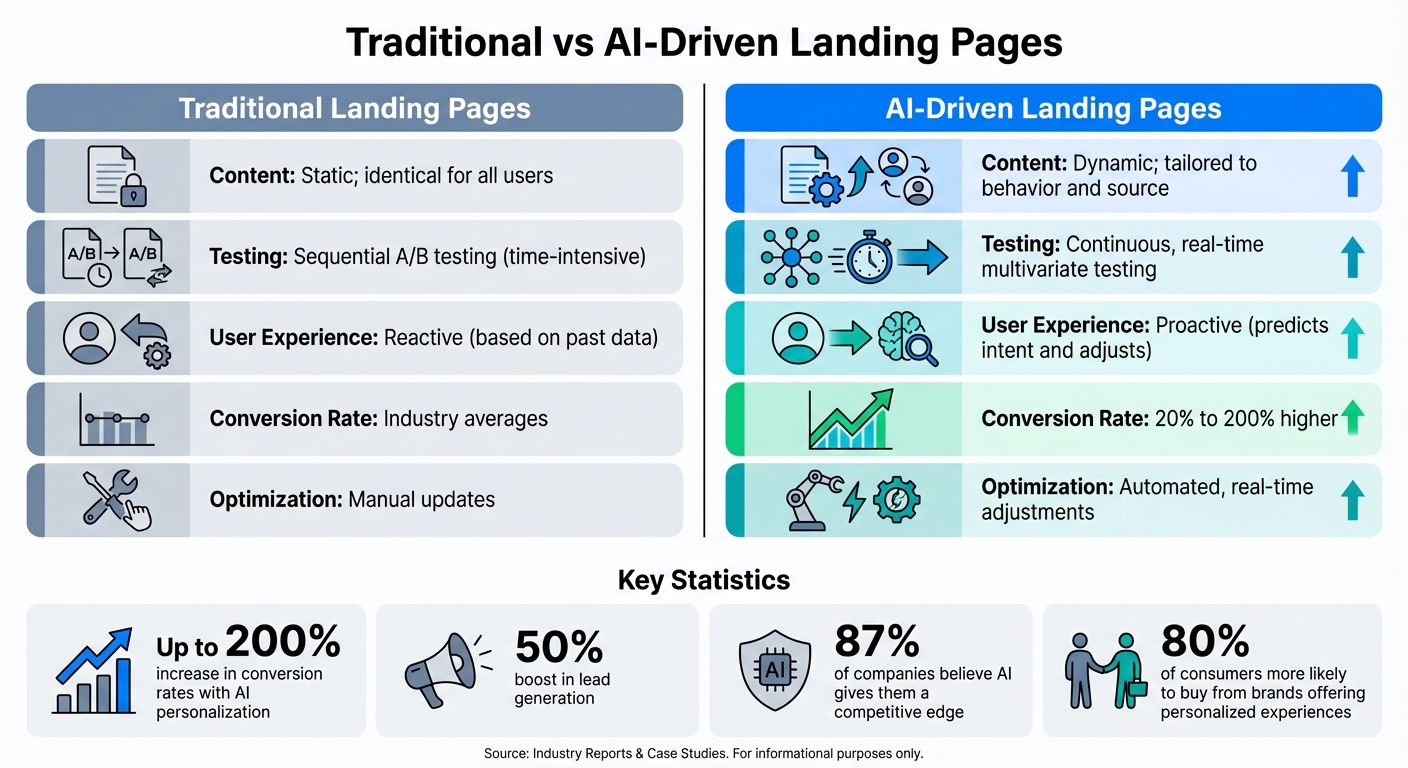
Traditional vs AI-Driven Landing Pages Performance Comparison
AI's ability to personalize and refine landing pages is impressive, but its true value lies in measurable results. To ensure your investment pays off, tracking key performance metrics is essential. Without proper data, it’s impossible to validate your efforts or pinpoint what’s working.
Conversion Rate is one of the most critical metrics. It shows the percentage of visitors who complete a desired action - like signing up for a trial, requesting a quote, or booking a demo. AI-driven personalization has been shown to increase conversion rates by up to 200%.
Bounce Rate reflects how many visitors leave after viewing just one page. A high bounce rate often means your content isn’t resonating. AI can help by offering more relevant and personalized experiences, reducing the likelihood of visitors leaving prematurely.
Average Session Duration and Scroll Depth provide insights into engagement. Longer sessions suggest that your AI-generated content is capturing attention, which can lead to better conversion rates. Scroll depth, on the other hand, helps you see how far users navigate down your page. This is particularly useful for evaluating whether AI-optimized CTAs are grabbing attention.
Cost per Lead (CPL) and Cost per Acquisition (CPA) measure how efficiently your campaigns are performing financially. AI can improve your Quality Score on platforms like Google Ads, which can lower your cost per click. Regularly monitoring these metrics ensures you can quickly address any negative trends.
Form Completion Rate is especially crucial for B2B businesses. AI tools can refine forms by simplifying questions or reordering fields to reduce friction. Tracking completion rates by device type and traffic source can show where AI is making the most significant impact. For example, monitoring mobile-specific performance helps identify and resolve issues like broken widgets that AI might detect.
Once these metrics are established, compare them with your post-AI performance to measure the impact of your AI-driven changes.
To evaluate AI's effectiveness, start by establishing a 30-day baseline of key metrics like conversion rates, bounce rates, and CPL. Then compare these numbers to results after implementing AI.
For instance, in September 2025, Rebecca Young from Cronyxdigital tested an AI-enhanced HubSpot Portal Audit landing page against its original version. The AI-optimized page resulted in a 4.8% boost in form completions, a 15% increase in scroll depth, and a 7% rise in CTA clicks within one month.
Here’s a comparison of traditional and AI-driven landing pages:
| Metric | Traditional Landing Pages | AI-Driven Landing Pages |
|---|---|---|
| Content | Static; identical for all users | Dynamic; tailored to behavior and source |
| Testing | Sequential A/B testing (time-intensive) | Continuous, real-time multivariate testing |
| User Experience | Reactive (based on past data) | Proactive (predicts intent and adjusts) |
| Conversion Rate | Industry averages | Typically 20% to 200% higher |
| Optimization | Manual updates | Automated, real-time adjustments |
To refine your strategy, review heatmaps weekly to see if AI-generated headlines are catching attention. AI-powered behavior analytics can also help track micro-conversions, such as CTA clicks, which often explain changes in overall performance.
For example, the Australian dessert brand Goldelucks used AI-powered Smart Popups from OptiMonk in 2023. These popups adapted to real-time browsing behavior, offering tailored deals based on what visitors were viewing. The result? A 12.27% increase in total orders.
Finally, integrate your AI tools with your CRM system to track not just initial conversions but also long-term lead quality. This dual approach ensures you get a complete picture of how AI is impacting your business.
AI has reshaped B2B landing pages, turning once-static experiences into dynamic, personalized journeys. By tailoring headlines, CTAs, and messaging in real time based on visitor data, AI shifts the focus from reactive adjustments to proactive optimizations. This allows businesses to anticipate potential friction points - like slow load times or overly long forms - before they impact conversion rates.
The impact of AI-driven personalization is hard to ignore. It has been shown to increase conversion rates by up to 200% and boost lead generation by 50%. These numbers highlight how AI is becoming a cornerstone of modern B2B marketing strategies.
"87% of companies believe AI gives them - or helps them maintain - a competitive edge." - MIT Sloan Management Review
The advantage is undeniable. AI enables marketers to launch and refine campaigns in minutes, replacing the tedious process of manual A/B testing. Instead of testing one variable at a time, AI evaluates thousands of combinations simultaneously, directing traffic to the most effective options automatically.
For B2B leaders in industries like real estate, financial services, and professional services, adopting these AI-driven strategies is no longer optional - it’s essential. Platforms such as Visora integrate AI-powered appointment setting, multi-channel traffic targeting based on buyer intent, and strategic consulting. These tools can help businesses implement complete acquisition systems in just 12 weeks, leading to more qualified conversations with decision-makers, stronger pipelines, and measurable ROI - all without inflating ad budgets or increasing team size.
AI brings a new level of precision to B2B landing pages by analyzing visitor data in real time. It looks at factors like the visitor's device type, traffic source, keyword intent, and even how they interact on the page. With machine learning, it can adapt key elements - headlines, copy, images, layout, and CTAs - to match the visitor's preferences on the spot.
This personalized approach ensures that users see content that resonates with them, making it easier for businesses to connect with their audience, boost conversions, and achieve tangible results.
Predictive analytics uses AI-driven data models to pinpoint which visitors are most likely to engage or convert on your landing page. By examining patterns in user behavior and historical data, it predicts potential actions and adjusts your page content on the fly.
This method allows your landing page to adapt in real time, tailoring experiences to match visitor preferences. The payoff? More engagement, happier users, and a noticeable boost in conversion rates.
AI-powered multivariate testing steps up the game by evaluating multiple elements at once, rather than just comparing two versions like traditional A/B testing. In A/B testing, everything from setting up the test to allocating traffic and analyzing results is done manually. With AI, these tasks are fully automated. It can test combinations of headlines, images, copy, layouts, and CTAs - all in real time.
By leveraging historical data, AI predicts which combinations are likely to perform best, adjusts traffic automatically toward the top-performing options, and delivers results much quicker. This not only saves time but also reveals insights that traditional methods might overlook, making it an effective way to fine-tune B2B landing pages.
%20(5).png)
