%20Bold.png)

AI is transforming energy pricing by automating the process, improving accuracy, and boosting profits. Traditional methods struggle with fragmented data, unpredictable renewable energy output, and extreme weather. AI steps in by analyzing real-time data, forecasting demand, and dynamically adjusting prices. Companies using AI have seen revenue increases of up to 19% and profit boosts of 10%. Key benefits include:
AI-driven pricing systems rely on accurate data inputs, including market trends, operational metrics, and environmental factors. They use machine learning techniques like demand forecasting, price elasticity modeling, and constrained optimization to maximize profits while meeting regulatory requirements. Companies like Xcel Energy and AES have already achieved cost savings and operational efficiency by adopting AI.
However, challenges remain. Regulatory compliance, resistance to change, and the need for robust data infrastructure are significant hurdles. Continuous model updates, transparent processes, and risk controls are essential for long-term success. By 2035, AI applications in the energy sector could save up to $110 billion annually, making AI a powerful tool for navigating the complexities of modern energy markets.
AI-driven energy pricing systems rely on three key pillars: pricing models, advanced AI techniques, and comprehensive data inputs. Each plays a critical role in reshaping how energy providers determine prices in real time, forming the foundation for implementing effective AI-based pricing strategies.
In the U.S., energy pricing operates across 25 regional supply markets where rates are calculated using both average and marginal costs. Among the most widely used pricing structures are:
Modern pricing models must also consider factors like distributed energy resources - think rooftop solar panels and battery storage systems - that influence net load requirements during peak periods. These complexities often exceed the capabilities of traditional manual methods, making AI essential for scaling and accuracy.
Once pricing models are established, AI techniques take over to fine-tune pricing decisions. These methods work together to optimize outcomes:
To address market uncertainties, advanced tools like LightGBM and NGBoost are used to generate probabilistic forecasts. Instead of providing a single estimate, these methods offer prediction intervals - such as 5th and 95th percentiles - giving a range of possible outcomes.
AI pricing systems require a diverse array of data sources to function effectively:
To ensure accuracy, these models often rely on 6-hour rolling averages and controlled price experiments, which help refine elasticity measurements. Together, these elements transform outdated pricing methods into agile, AI-powered systems capable of meeting the complexities of today’s energy markets.
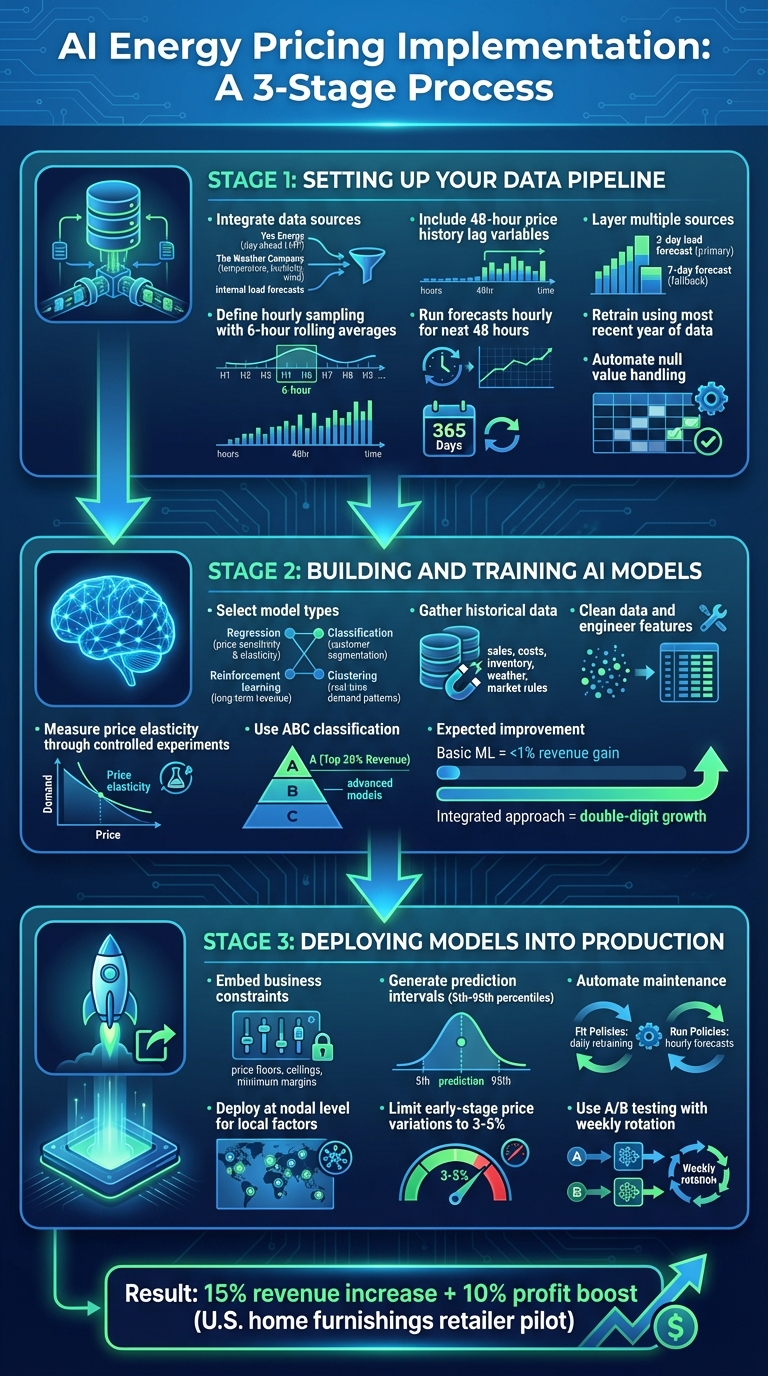
Step-by-Step AI Energy Pricing Implementation Process
Creating a reliable data pipeline begins with identifying and organizing all the relevant data sources. For energy companies, this means integrating inputs from wholesale market providers like Yes Energy (offering day-ahead locational marginal prices and ancillary services), weather services such as The Weather Company (providing data on temperature, humidity, and wind speed), and internal systems that monitor load forecasts and changes in generation mix.
To refine the data, define hourly sampling periods, apply 6-hour rolling averages, and include lag variables (like a 48-hour price history). Additionally, generate time-based features to capture seasonal trends and patterns. Forecasting models should run hourly, delivering predictions for the next 48 hours, with retraining scheduled using the most recent year of data.
To ensure reliability, layer multiple data sources. For instance, use a 2-day load forecast as your primary input, but have a 7-day forecast as a fallback in case of missing data. Automated handling of null values further ensures that models remain operational, even if sensor or market feeds are interrupted. Once this robust data pipeline is in place, the focus shifts to building AI models tailored to these refined inputs.
With a solid data pipeline established, the next step is selecting and training the right AI models to optimize pricing. Different pricing challenges call for different models. Regression models are ideal for estimating price sensitivity and elasticity, while classification models help segment customers and predict their purchasing behavior. For long-term revenue strategies, reinforcement learning adjusts prices based on future outcomes rather than short-term sales. Clustering algorithms, on the other hand, can group customers dynamically based on real-time demand patterns.
The training process involves several steps: gather historical data on sales, production costs, inventory, weather, and market rules. Clean the data, engineer features to capture seasonality and location-specific trends, and validate models using separate datasets. A critical step is measuring price elasticity through controlled experiments before finalizing the optimization logic.
To balance sophistication with scalability, consider an ABC classification approach. Use advanced models for the top 20% of revenue-generating items and simpler models for the rest. Research shows that basic machine-learning models relying only on historical data typically yield revenue improvements of 1% or less. However, integrated approaches that incorporate real-time factors can achieve double-digit growth.
Deploying AI models into production requires embedding business constraints directly into the optimization algorithms. These constraints - such as price floors, ceilings, and minimum profit margins - help prevent unrealistic pricing scenarios. Models should also produce prediction intervals, like the 5th and 95th percentiles, rather than single-point estimates. This approach accounts for market uncertainty and volatility.
Automate model maintenance by defining Fit Policies that retrain models daily with new data, and Run Policies that generate updated forecasts every hour. For energy markets, models should be deployed at the nodal level to address local factors such as congestion, weather variations, and generation mix changes.
When introducing early-stage price adjustments, limit variations to 3% to 5% and use A/B testing to evaluate the impact. Rotate treatment and control groups weekly to account for seasonal changes and market fluctuations.
Once your AI pricing models are up and running, keeping a close eye on their performance is critical. Use automated hourly forecasts and daily retraining to ensure the models stay accurate and effective over time. These practices build on the solid data pipeline and deployment strategies already in place.
Pair automated monitoring with human oversight, especially during unusual market events like extreme weather or unexpected outages. Your pricing team can step in to make adjustments, ensuring that essential business rules - such as maintaining minimum profit margins or adhering to regulatory price caps - are always upheld. This "human-in-the-loop" approach adds a layer of reliability to the system.
To evaluate how well the AI pricing system works, use A/B testing. Divide customer segments into groups, assigning AI-generated prices to one group and traditional pricing to another. Rotate these groups periodically to minimize seasonal distortions. Keep an eye on key metrics like demand forecast accuracy and profit margins. If demand remains stable even with price changes, you may find that frequent adjustments aren't necessary.
This dynamic monitoring approach allows for more precise pricing strategies tailored to different customer needs.
AI offers energy companies the opportunity to move away from generic, one-size-fits-all pricing. Instead, it enables the creation of customized pricing plans for distinct customer groups. For example:
The key is to align pricing models with what each customer segment values most. A startup with unpredictable energy needs might opt for a pay-as-you-go plan, while a manufacturing facility might prefer a fixed-rate contract for stability. To ease the transition to AI-driven pricing, consider offering incentives like "grandfathering" existing contracts or discounts for early adopters. Before launching tailored pricing plans, review your current contracts and run financial simulations to ensure the changes align with your revenue goals.
Here’s a side-by-side look at how AI-driven pricing stacks up against traditional methods:
| Feature | Traditional Static Tariffs | AI-Driven Pricing Models |
|---|---|---|
| Data Handling | Relies on manual processes and tools like Microsoft Excel | Uses automated pipelines to process millions of real-time data points |
| Update Frequency | Adjustments made weekly, monthly, or seasonally | Hourly forecasts with daily retraining |
| Revenue Impact | Modest gains, typically under 1% | Potential increases of 10% to 19% |
| Customer Satisfaction | Predictable but not engaging | Higher satisfaction through personalized pricing |
| Operational Complexity | Simple, with standard billing cycles | Complex, requiring advanced data science capabilities |
| Adaptability | Limited; changes often need regulatory approval | Highly flexible, adapting to demand, weather, and grid conditions |
For instance, a U.S. online home furnishings retailer saw a 15% increase in revenue and a 10% profit boost during a month-long pilot by switching from static pricing to a dynamic AI system that measured price elasticity in real time. However, this performance comes with challenges. AI-driven systems require ongoing investments in data infrastructure, model updates, and team training. According to Boston Consulting Group, successful AI adoption involves allocating resources strategically: 10% to algorithms, 20% to data and technology, and 70% to people and processes.
Energy pricing in the United States operates under strict federal oversight, with the National Energy Modeling System (NEMS) playing a central role. NEMS establishes equilibrium prices by balancing supply and demand across fuel supply, conversion, and end-use consumption modules. AI models used in this space must align with federal mandates, particularly those emphasizing cost-effectiveness in the face of renewable energy variability.
The Department of Energy (DOE) has adopted tools like PermitAI to streamline federal environmental reviews. However, challenges persist. As the International Energy Agency notes:
Various barriers are limiting the extent to which existing AI applications can be implemented... These include unfavourable regulation, lack of access to data, inaccessibility, [and] interoperability concerns.
For companies deploying AI in energy pricing, transparency and explainability are non-negotiable. Regulators need to audit these models effectively, which means maintaining clear documentation of decision-making processes. In the oil and gas industry, AI already helps ensure compliance through automated leak detection and remote operations. Establishing clear audit trails and documenting model decisions are essential steps in meeting regulatory requirements while building trust with oversight bodies. These frameworks also provide the foundation for effective risk management.
Strong risk controls are essential to prevent AI models from making costly or inappropriate pricing decisions. One effective strategy is constrained optimization. By setting hard limits - such as minimum profit margins or price ceilings - you can ensure the model operates within acceptable boundaries. This approach also prevents the system from mimicking competitors' pricing errors or overreacting to extreme market fluctuations.
For example, a Chinese online retailer successfully maintained a 10% margin constraint by tying experimental prices to historical averages, which resulted in an 11% revenue boost. Similarly, anchoring prices to historical levels and limiting variations to 3%–5% can help maintain stability.
Backtesting and stress-testing are equally critical. Use A/B testing with rotated treatment and control groups to separate the effects of your AI model from external factors like seasonality or marketing campaigns. For energy companies, this could involve testing AI-generated prices under different weather conditions or during peak demand periods. Such testing ensures the model can handle stress and deliver reliable results, even during volatile market conditions.
Risk controls are just the starting point. To stay competitive, AI pricing models need continuous improvement to adapt to evolving market conditions. One way to achieve this is by implementing automated retraining schedules. Regularly updating models - ideally daily - using the most recent year of historical data ensures they remain responsive to market shifts, new competitors, and changing consumer behaviors.
Probabilistic forecasting is another valuable tool. By incorporating prediction intervals (e.g., 5th and 95th percentiles), you can better account for uncertainty and risk, especially in volatile wholesale electricity markets. This is particularly useful for managing the growing complexity of the energy grid, where factors like 7-day load forecasts, solar and wind generation, and rolling temperature averages all impact pricing accuracy.
Real-time data integration also plays a critical role. For instance, battery gigafactories generate billions of data points, which can significantly enhance pricing precision when monitored continuously. External factors like weather, grid disruptions, and regulatory changes should also be integrated into your models. Comparing AI techniques - such as LightGBM for direct quantile forecasting versus NGBoost for parametric distribution forecasting - can help identify the best method for capturing price uncertainty in your market.
AI-driven operations have the potential to save up to $110 billion annually by 2035. However, achieving this level of efficiency demands regular updates. At a minimum, models should be retrained every six months to keep pace with shifting market dynamics. This ongoing refinement is essential for maintaining a competitive edge in the fast-changing energy sector.
Transforming energy pricing with AI starts with a clear, step-by-step approach. Begin by conducting thorough data audits to ensure quality, then focus on high-impact areas like demand forecasting and supply optimization. At the same time, models need to be transparent to meet U.S. regulatory standards. Companies that commit to AI adoption could see profit gains between 30% and 70% of EBIT over the next five years.
Take AES as an example. In 2024, the utility company used AI to analyze drone and sensor data for maintenance, cutting customer power outages by 10% and saving $1 million annually. Similarly, Octopus Energy implemented generative AI for customer service, achieving an 80% satisfaction rate compared to 65% for human agents. These examples highlight how AI-driven pricing systems can deliver real, measurable results when deployed effectively.
However, achieving operational excellence requires more than just technology. Rigorous data management, workforce adaptability, and strong compliance practices are essential. Success hinges on regular data quality checks, adherence to regulations, and keeping AI models updated. As Thomas Greene from Tenaris points out, building trust in AI solutions takes time and consistent use. This involves retraining models regularly, setting up risk controls, and monitoring key metrics like forecast accuracy and cost savings.
The U.S. energy market is evolving quickly. By 2035, AI applications in power plant operations could save up to $110 billion annually. But here's the catch: around 70% of successful AI transformations depend on people, processes, and organizational change - not just the technology itself. To stay competitive, companies must invest in upskilling their workforce and building AI-ready systems. The future of energy pricing is here, and those who prepare today will lead tomorrow.
AI is transforming energy demand forecasting by analyzing massive amounts of real-time and historical data to produce sharper, more practical predictions. With machine learning at its core, AI processes inputs such as smart meter data, weather patterns, market prices, and even social behavior. This approach uncovers trends and relationships that traditional forecasting methods often overlook. As a result, utilities can more accurately predict demand fluctuations and fine-tune energy generation or procurement plans.
What sets AI apart is its ability to adapt and deliver updates as new data streams in. This near real-time forecasting supports dynamic pricing strategies and demand-response programs, giving utilities the agility they need to respond quickly to changing conditions. AI also helps manage risk by quantifying uncertainties, making it easier to prepare for extreme scenarios like heatwaves or unexpected dips in renewable energy supply. These capabilities not only cut costs but also improve reliability and enable smarter energy pricing approaches.
Implementing AI in energy pricing isn't without its hurdles. One major issue is the fragmented or incomplete data many energy companies deal with, which makes it harder to train accurate algorithms. On top of that, the energy industry operates under strict regulations, and older systems often don't play well with modern AI tools, slowing down the adoption process.
There's also the challenge of finding enough skilled professionals who can build, test, and maintain AI-based pricing systems. For many companies, this might mean investing in training programs or hiring experts with niche skills. And let's not forget the high computational power AI systems demand - this can lead to increased energy use, which might undercut the efficiency gains AI promises. Tackling these challenges calls for a thoughtful strategy that focuses on better data management, aligning with regulations, and building a capable workforce.
AI-powered pricing models are transforming how energy pricing works, moving away from outdated, static methods to dynamic systems driven by real-time data. Instead of sticking to fixed assumptions or occasional updates, these advanced systems continuously process massive datasets - like real-time energy demand, weather trends, and market fluctuations - to deliver precise and flexible pricing forecasts. This helps energy companies quickly adapt to market shifts and fine-tune their pricing strategies.
Traditional models often rely on manual updates and limited historical data, which can be slow and inefficient. In contrast, AI platforms streamline operations by automating workflows, providing scenario-based forecasts, and even making pricing decisions autonomously when specific conditions are met. This leads to faster decision-making, the ability to scale more effectively, and better profitability for energy firms navigating today’s increasingly complex energy landscape.
%20(5).png)
