%20Bold.png)

Behavioral data integration simplifies how businesses manage customer interaction data by consolidating it into a single system. This allows companies to analyze real-time behaviors - like visits to pricing pages or webinar attendance - and make informed decisions. Tools like Airbyte, Fivetran, Talend, Hevo Data, Informatica IDMC, Domo, and Visora excel at integrating and analyzing this data for actionable insights. Here's what you need to know:
These tools help businesses centralize data, improve lead scoring, and enable real-time personalization, driving better performance and revenue growth.
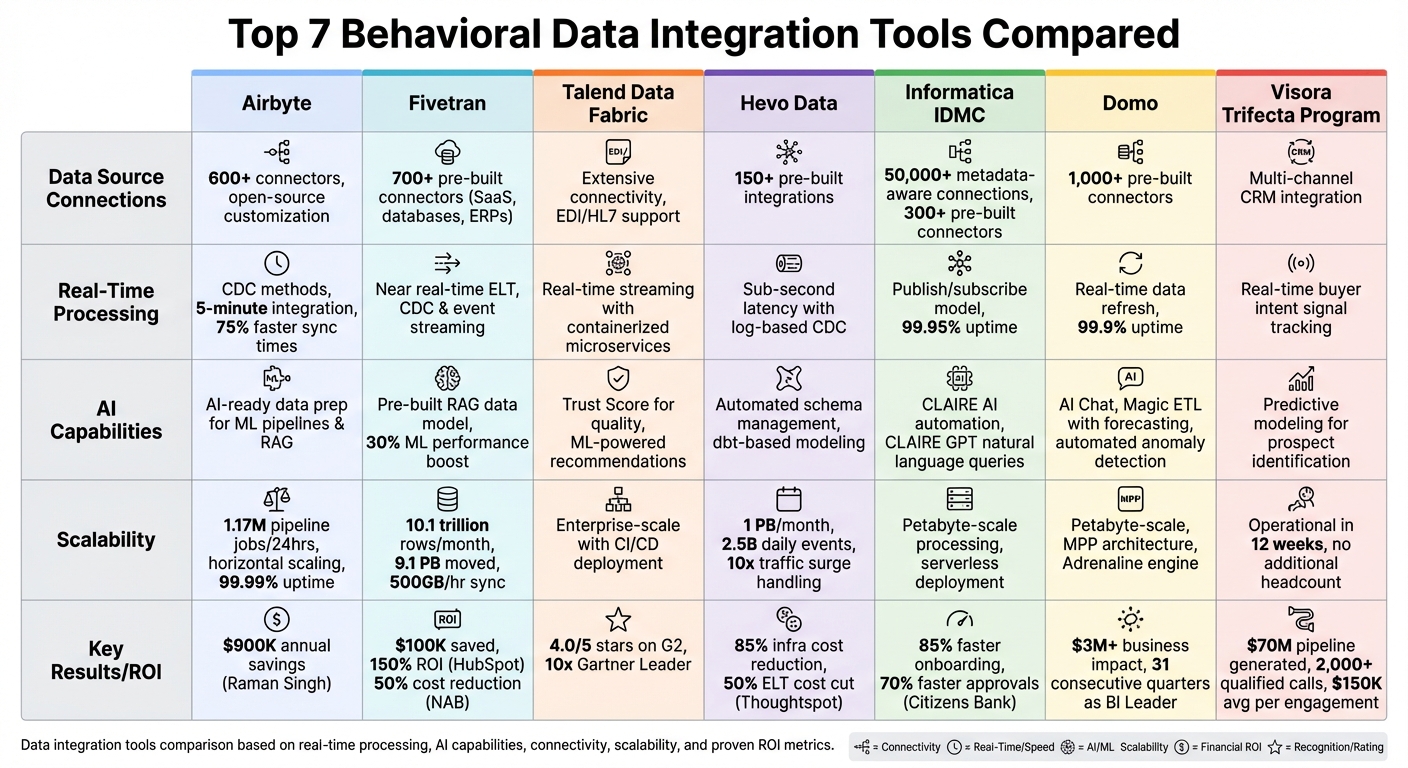
Behavioral Data Integration Tools Comparison: Features and Capabilities
Airbyte enables businesses to integrate behavioral data in under five minutes using Change Data Capture (CDC) methods [6]. This rapid processing is key for tracking critical actions like visits to pricing pages or webinar attendance - situations where even minor delays can reduce the value of these insights.
Raman Singh, a Tech Lead, shared his experience transitioning from a legacy framework that caused processing to grind to a halt whenever a single pipeline failed. With Airbyte's distributed architecture, his team achieved parallel processing, cutting sync times by 75% and saving $900,000 annually [5]. Singh explained:
"With our legacy framework, if one of the pipelines fails for one client, it will stop everything for the rest of our clients. But with Airbyte, things are run in parallel because of the platform's distributed nature" [5].
Airbyte doesn’t just deliver speed - it also ensures broad compatibility. It offers over 600 pre-built connectors, covering essential B2B data sources like HubSpot, Salesforce, Adobe, and various SQL databases [5]. Need something more specific? The low-code Connector Builder and CDK make it easy to create custom integrations in just hours [5]. For example, Franziska Ibscher, Product Manager at Drivepoint, successfully integrated Shopify and Stripe within a week, enabling her team to scale operations from mid-sized companies to billion-dollar enterprises [5].
Airbyte also plays a significant role in preparing data for AI. It processes structured and unstructured data for machine learning pipelines and vector databases such as Pinecone and Weaviate [5]. This makes it an essential tool for workflows like Retrieval-Augmented Generation (RAG), transforming raw behavioral data into AI-ready formats. One notable example: Airbyte synced over 1.17 million pipeline jobs in just 24 hours, demonstrating its ability to handle enterprise-scale demands [5].
Airbyte is built to scale with enterprise needs. Its horizontal scaling capabilities and 99.99% uptime SLAs ensure reliability for large-scale deployments [6]. Sean Carver, Director of Data at Petvisor, used Airbyte to integrate over 20 data sources, achieving productivity gains equivalent to adding a full-time engineer [5]. For industries with strict regulations, Airbyte offers SOC 2, GDPR, and HIPAA compliance through self-managed or hybrid deployments [5]. Pricing begins at around $115 per month for 10GB of data and 1 million Monthly Active Rows, with custom options available for enterprise clients [3].
Fivetran’s ELT architecture is designed to load raw behavioral data into your destination before applying transformations [12]. This method avoids the common pitfalls of traditional ETL tools, such as pipeline failures caused by transformation errors. By leveraging Change Data Capture (CDC) and event streaming, Fivetran enables near-instant data movement from databases and applications, ensuring low-latency integration [11][14].
JetBlue’s Director of Data Engineering, Ashley Van Name, shared how her team set up data pipelines in under two minutes - a process that previously took weeks or even months [11]. What’s more, Fivetran automatically adapts to changes in source data structures, like new fields in CRMs or marketing tools, without disrupting the pipeline [7][9]. Combined with its extensive connector options, this real-time capability ensures a robust and seamless data integration experience.
Fivetran doesn’t just deliver on speed; it also supports a wide range of data sources. With over 700 pre-built connectors, the platform integrates with SaaS tools, databases, ERPs, and file systems [7][8]. Popular connectors include Mixpanel, Adobe Analytics, Google Analytics 4, Heap, Pendo, Amplitude, and Segment [7][10]. This allows businesses to create "Customer 360" views by merging data from web traffic, email marketing, and CRMs like Salesforce and HubSpot [10].
One standout example comes from HubSpot, where Analytics Engineering Manager Sandro Frattura built over 40 data pipelines in under 40 hours using Fivetran. This effort saved the company approximately $100,000 and 1,000 engineering hours in its first year, delivering a 150% ROI and supporting new AI-driven initiatives [7][10]. For sources that aren’t covered by pre-built connectors, Fivetran offers a Python-based Connector SDK and a "By-request" program to build custom pipelines [8][11].
Fivetran also plays a key role in powering AI workflows. Its pre-built RAG (Retrieval-Augmented Generation) data model simplifies the process of loading data into tables optimized for AI search assistants and sentiment analysis tools [13]. At National Australia Bank, Joanna Gurry, Executive of Data Platforms, oversaw the migration of over 200 siloed data sources into a Fivetran and Databricks lakehouse. This project cut data ingestion costs by 50% and boosted machine learning performance by 30%. With CDC feeds, the bank improved fraud detection and reduced AI-led document review time from 45 minutes to just 5, saving around 10,000 hours annually [7][14].
Fivetran is built to handle enterprise-scale demands. The platform syncs an impressive 10.1 trillion rows every month, manages 22.2 million schema changes, and moves over 9.1 petabytes of data [7]. It ensures 99.9% uptime for data pipelines and supports historical sync speeds of over 500 GB/hr [7][11].
For example, Pitney Bowes, a manufacturing and logistics company, uses Fivetran to track over 800 million parcels in real time. Vishal Shah, Data Architect Manager, highlighted how the platform transformed data flow across 16 facilities simultaneously, enabling near real-time synchronization [7][11].
Fivetran’s scalability is complemented by its strong compliance measures, including SOC 1 & 2, GDPR, HIPAA, ISO 27001, and PCI DSS Level 1 certifications. It also offers hybrid deployment options for organizations with stringent security needs [7][11]. Pricing follows a usage-based model calculated by Monthly Active Rows (MAR), with a free tier available for up to 500,000 MAR [15].
Talend Data Fabric brings together ingestion, transformation, cataloging, and compliance into a single platform, streamlining processes and reducing manual effort [17]. By automating scheduled behavioral data collection, the platform eliminates the need for constant human intervention. Its containerized microservices enable fast and efficient data processing, making it ideal for organizations that need to consolidate behavioral data from various sources quickly [17].
What sets Talend apart is its combination of an open-source foundation with enterprise-grade features. This blend gives teams the flexibility to create tailored integration workflows using a visual interface [16]. With this approach, even complex data pipelines - capturing behavioral signals from web analytics, CRM tools, and marketing platforms - can be built without requiring extensive coding expertise. This aligns with earlier discussions on rapid integrations, offering powerful automation for behavioral data workflows.
Talend supports a wide range of data formats, including JSON, AVRO, and XML, and connects seamlessly to both on-premises and cloud-based sources. It also adheres to industry standards like EDI and HL7, simplifying integrations with external partners [17].
"Connect, transform, and govern all in one platform. A unified solution that handles ingestion, transformation, cataloging, and compliance - on-premises or across any cloud environment."
- Talend [17]
The platform’s Smart Discovery feature scans and profiles datasets automatically, identifying formats and patterns without requiring manual setup. This functionality significantly reduces onboarding time for new behavioral data sources, making it easier to integrate information from marketing tools, sales platforms, and customer engagement systems [17].
Talend incorporates AI-powered features like its Trust Score, which evaluates the quality and reliability of datasets [17]. This scoring system helps teams quickly determine which behavioral data sources can be trusted for critical analysis. Additionally, the platform uses machine learning to provide recommendations for correcting inconsistencies, offering rule templates to improve data accuracy [17].
Talend Data Fabric is powered by Qlik, a company recognized by Gartner as a Leader in its Magic Quadrant for Data Integration Tools for 10 consecutive years. Gartner has also named Qlik a Leader in the 2025 Magic Quadrant for Augmented Data Quality Solutions for the sixth time [17]. These accolades highlight the platform’s focus on delivering reliable data as organizations scale their behavioral data operations.
Talend’s real-time integration and AI capabilities make it highly scalable for enterprise-level demands. The platform supports CI/CD deployment and utilizes containerized microservices that adapt to changing workloads [17]. To safeguard sensitive B2B behavioral data, Talend offers role-based access controls and data masking rules, ensuring compliance with regulatory standards [17]. On G2, users rate Talend 4.0 out of 5 stars, emphasizing its ability to handle complex data workflows effectively [16][3].
For large-scale B2B operations, Talend simplifies managing data from multiple partners, clients, and internal systems. Its support for EDI and HL7 standards eliminates the need for custom coding during partner integrations [17]. Additionally, its reusable pipeline architecture allows teams to automate repetitive data preparation tasks, reducing manual work as data volumes grow.
Hevo Data is a standout choice for integrating behavioral data, thanks to its swift, no-code, and fully automated pipeline features.
Hevo Data leverages log-based Change Data Capture (CDC) to deliver updates with sub-second latency. Its intuitive no-code interface lets users create pipelines from over 150 sources - like CRMs and marketing tools - without hassle [18][19]. This means behavioral signals, such as website clicks, form submissions, or email opens, are seamlessly transferred into your analytics platform almost instantly.
The platform’s automated schema management takes care of detecting and updating schema changes - like new fields or tables - on its own [19][20]. This spares users from the tedious task of tracking structural changes across multiple data sources. Additionally, Hevo combines data extraction and loading with dbt-based modeling, transforming raw behavioral data into clean, analysis-ready formats for advanced insights [20].
Hevo connects to a wide range of platforms, making it highly versatile. It supports major B2B tools like Salesforce, HubSpot, NetSuite, Zendesk, and Intercom [21]. It also integrates with databases such as PostgreSQL, MySQL, Oracle, MongoDB, and MS SQL Server [21]. For marketing and analytics, Hevo works with platforms like Google Ads, Facebook Ads, LinkedIn Ads, Google Analytics 4, and Mixpanel [21]. Plus, it offers REST API and webhook connectors for custom applications [21][20].
This flexibility is best summarized by Josh Kennedy, Head of Data & Business Systems, who shared:
"Instead of building a lot of these custom connections, ourselves, Hevo Data has been really flexible... it probably made us 5 to 10 times faster in launching a new customer." - Josh Kennedy [18]
Such adaptability is key to Hevo’s ability to handle demanding B2B use cases.
Hevo’s infrastructure is designed to scale effortlessly. It processes over 1 petabyte of data each month and handles 2.5 billion daily events [20]. With an auto-scaling architecture, it can manage traffic surges up to 10 times the normal load while maintaining 99.9% uptime - no manual adjustments required [19]. Intelligent recovery mechanisms and automatic retries ensure 100% data accuracy [18][20].
The platform’s impact is clear in real-world scenarios. At Thoughtspot, Ramkumar Natarajan, Senior Manager of Data Operations, reported an 85% reduction in infrastructure costs and a 50% cut in ELT tool expenses after adopting Hevo. Internal data usage also increased by 30-35%, thanks to Hevo’s user-friendly design [18]. On G2, Hevo scores 4.5 out of 5 stars from over 250 reviews, with users frequently praising its "set-and-forget" reliability and 24/7 live chat support [19].
For smaller teams or those just getting started, Hevo provides a free plan that includes up to 1 million events per month. This allows small B2B operations to experiment with behavioral data flows before scaling up [19]. The platform’s integration with dbt Core also helps teams clean, standardize, and join behavioral datasets directly in their data warehouse, enabling more precise sales attribution [20].
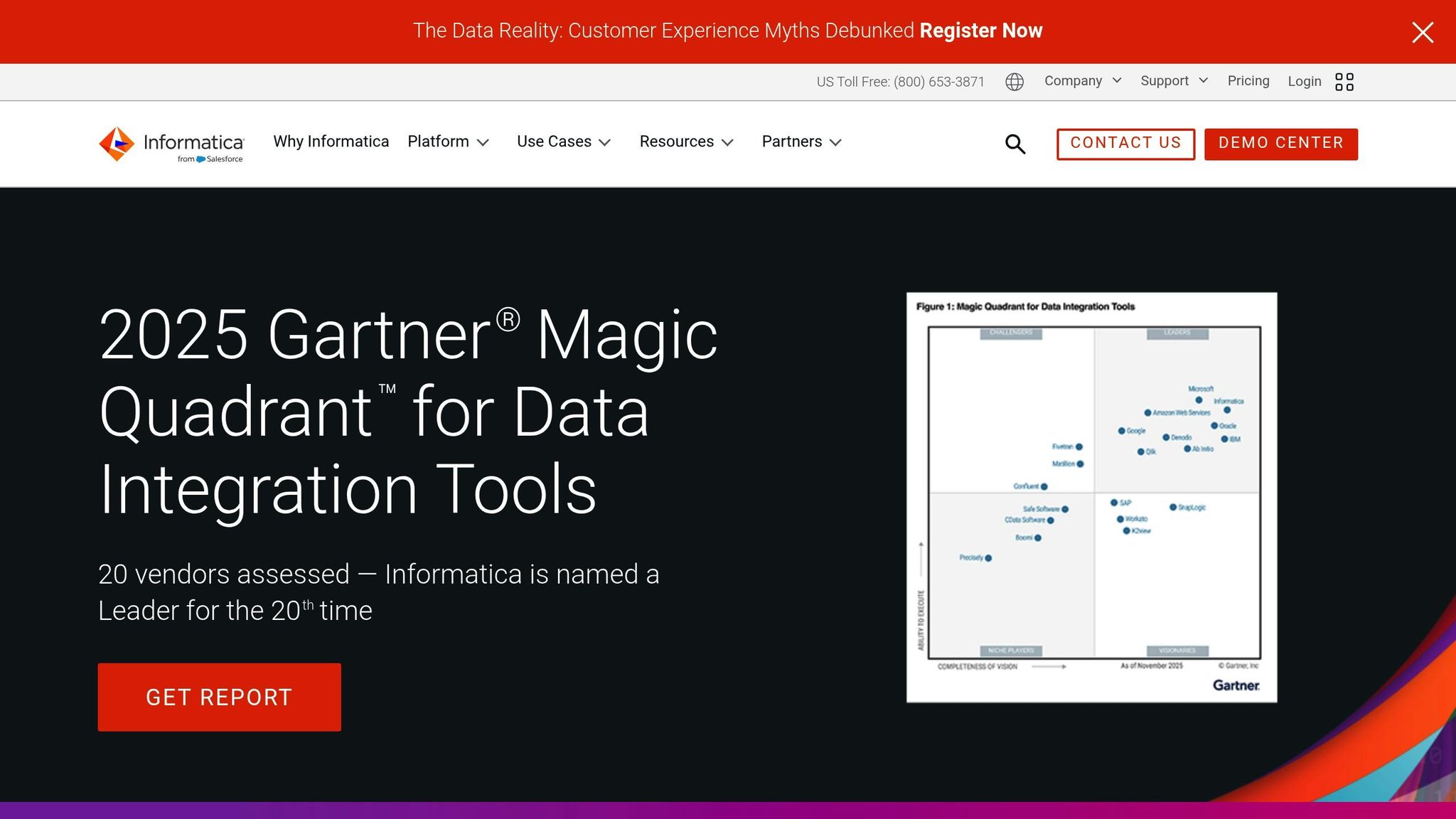
Informatica IDMC (Intelligent Data Management Cloud) is a powerful platform designed for organizations managing massive amounts of behavioral data. For 20 years in a row, it has been recognized as a Leader in the Gartner® Magic Quadrant™ for Data Integration Tools [24]. The platform is built to handle petabyte-scale data without compromising performance [3].
IDMC modernizes data integration by replacing traditional point-to-point setups with a publish/subscribe model, which minimizes latency and boosts resilience for real-time data processing. It supports automated, high-speed ingestion for streaming data, databases, and applications. With its zero-code visual pipeline builder, users can create automated workflows effortlessly. The platform ensures 99.95% uptime and dynamically scales to accommodate fluctuating workloads [24].
For example, Citizens Bank used IDMC to speed up data onboarding by 85% and reduce credit approval times by 70% [24]. Similarly, Petmate saw a 92% improvement in data integration speed after adopting the platform [24].
Beyond quick data ingestion, IDMC uses AI to enhance data quality and generate actionable insights. Its integration with CLAIRE AI automates thousands of data management tasks, offering AI-driven recommendations for smoother data integration. Features like automated data profiling identify issues such as missing values or inconsistent formats before they disrupt analysis.
The CLAIRE GPT feature allows teams to interact with data through natural language queries, making it easier to explore and utilize behavioral data [23]. Additionally, the platform's AI-powered Master Data Management (MDM) unifies fragmented behavioral data across hybrid and multi-cloud environments into a single, reliable source [23].
This functionality has delivered real-world savings, as seen with MABE, which saved over $200,000 by improving data quality through IDMC [24].
IDMC supports more than 50,000 metadata-aware connections across hybrid and multi-cloud setups [23]. It also includes over 300 pre-built connectors for databases, applications, and files, ensuring compatibility with a broad range of B2B technology stacks [22]. A centralized metadata system provides full context for data, simplifying tasks like discovery, governance, and the use of behavioral signals.
"Informatica IDMC stands apart as the first fully cloud-native data management platform with embedded AI and a metadata system of intelligence." - Informatica [23]
IDMC is built to meet the demands of large-scale enterprise operations, handling vast data volumes and complex business logic with ease. Its consumption-based pricing model lets organizations pay only for the data and services they use [24]. For those wanting to explore its potential, a free cloud data integration trial is available [22].
A great example of its scalability is Takeda, which successfully modernized its data infrastructure by migrating 96% of its data to the cloud using Informatica [25]. For industries like financial services, manufacturing, or life sciences, IDMC's serverless deployment options help reduce operational costs while ensuring enterprise-grade reliability.
Domo is a cloud-based platform designed to handle integration, visualization, and predictive modeling. Impressively, it has been recognized as a Leader in BI and analytics for 31 consecutive quarters as of late 2025 [26][29]. With access to over 1,000 pre-built connectors, it simplifies the process of integrating behavioral data from platforms like Salesforce, SAP, BigQuery, and Snowflake - no custom engineering required [26][29].
Domo takes data integration to the next level by offering a unified, real-time view of behavioral data. Its automated dataflow engine ensures that data is refreshed dynamically, providing up-to-the-minute insights and notifications [26][29]. For organizations managing large-scale data, the platform’s federated connectors allow users to query cloud data warehouses directly, avoiding duplication and cutting down on both latency and egress costs [26][29].
For teams focused on tracking metrics like lead conversion or campaign ROI, Domo consolidates data from sources such as Google Ads, LinkedIn, and various CRMs into a single, real-time dashboard [27]. With 99.9% uptime and an MPP architecture powered by the Adrenaline engine, it can process billions of rows simultaneously. This reliability makes it an ideal choice for businesses that require continuous monitoring without constant manual oversight.
Domo’s AI Chat feature allows users to ask straightforward questions to uncover customer behavior trends [31]. Its Magic ETL interface includes built-in tools for tasks like classification, forecasting, and multivariate outlier detection, enabling teams to predict trends without needing to write code [30]. Additionally, AI-powered agents automate workflows and tailor interactions based on real-time data triggers [26].
"We use Domo to track the business impact of our business intelligence team and found that, in the last 12 months, we had a more than $3 million direct impact on the business through cost & time savings, and by identifying revenue opportunities." - Colemen Wilson, Senior Manager of Business Intelligence [26]
For advanced analytics, data scientists can deploy external models or use custom R/Python scripts directly within Domo’s dataflows [30]. The platform also automates schema matching and anomaly detection, helping users identify relationships and inconsistencies in data without manual setup [27].
Beyond its pre-built connectors, Domo provides tools like Domo Workbench [32]. This feature supports both drag-and-drop Magic ETL workflows for non-technical users and SQL-based dataflows for engineers [32][30]. Writeback connectors enable transformed data to be sent back into original systems like CRMs or ERPs [32].
Domo meets stringent security standards, including SOC 1/2, HIPAA, GDPR, and ISO/IEC 27001 compliance, making it a trusted choice for businesses handling sensitive data [26]. Its row-level governance ensures that stakeholders only see the data relevant to their specific roles or regions [32].
Domo’s cloud-native architecture is built to handle petabyte-scale data volumes [28][29]. Features like Cloud Amplifier allow seamless integration with external cloud data warehouses, enabling BI tools to work across all cloud data without the need for physical data transfers [32]. Sandbox environments give organizations the ability to test integrations without disrupting their operations [32].
For businesses interested in exploring the platform, Domo offers a "Try Free" option. Enterprise pricing is customized to align with specific organizational needs [32][29]. For large B2B organizations, federated adapters further reduce costs and mitigate security risks by eliminating the need for data duplication [32].
Visora combines AI-driven appointment setting, a B2B Vortex Funnel, and DD Strategy Consulting to create a fully integrated acquisition system. Instead of offering just a software platform, Visora provides a comprehensive solution tailored for B2B leaders in financial services, commercial real estate, and investor relations. Over 30 partners have already generated more than $70 million in pipeline value, with each engagement adding approximately $150,000 to the pipeline. This system doesn’t just analyze behavioral data - it turns that data into actionable sales insights.
The Trifecta Program uses predictive modeling to analyze buyer signals across multiple channels, identifying high-intent prospects and the best times for outreach [33]. For B2B organizations targeting complex decision-makers - like C-suite executives, founders, and high-net-worth individuals - this approach has led to over 2,000 qualified calls with stakeholders who have the authority to make purchasing decisions.
Visora’s system is up and running in just 12 weeks, cutting out long implementation timelines and the need for extra staff. By integrating intent signals and multi-channel touchpoints directly into existing CRM systems, the program creates a seamless ecosystem for lead scoring and engagement [2]. This setup allows leaders in real estate syndicates and financial services to scale their acquisition efforts without relying heavily on referrals or costly ad campaigns.
At the helm of Visora is founder Danny Kim, whose experience includes driving growth at Deloitte for major players like Meta, Disney, and Amazon. By focusing on buyer-intent data and sales automation, Visora brings the expertise of Fortune 500 strategies to mid-market B2B organizations.
Here's a quick breakdown of how these platforms stack up in terms of real-time processing, AI capabilities, data connectivity, and scalability.
| Tool | Real-Time Processing | AI Capabilities | Data Source Connections | Scalability |
|---|---|---|---|---|
| Airbyte | Batch processing | Limited built-in transformation support | 600+ connectors; open-source customization available [3] | Scales on self-hosted or cloud infrastructure |
| Fivetran | Near real-time processing | – | 700+ pre-built connectors covering SaaS, databases, and ERPs [7] | Enterprise-grade scalability |
| Talend Data Fabric | Supports real-time streaming | Integrated data quality features | Extensive connectivity | Designed for enterprise-scale data volumes |
| Hevo Data | Real-time data ingestion | Automated integration capabilities | Pre-built integrations | Scalable for high-volume data |
| Informatica IDMC | Real-time streaming and batch processing | Robust data governance | Extensive enterprise system coverage | Petabyte-scale processing for complex business logic [7] |
| Domo | Real-time data refresh | Built-in analytics and anomaly detection | Cloud-based connectors | Cloud-native and scales with data volume |
| Visora Trifecta Program | Real-time buyer intent signal tracking | Predictive modeling for prospect identification | Seamless multi-channel CRM integration | Fully operational in 12 weeks without additional headcount |
While most tools focus on technical connectivity and speed, the Visora Trifecta Program stands out by turning behavioral signals into actionable sales results. In just 12 weeks, it generated over 2,000 calls with decision-makers and added $70 million to the pipeline.
Integrating behavioral data isn’t just a tech upgrade - it’s a game-changer for how B2B companies understand and cater to their prospects. By combining CRM firmographics with real-time user behaviors, like visits to pricing pages or whitepaper downloads, businesses can move beyond a one-size-fits-all approach and create experiences that genuinely resonate with individual accounts [1][2].
The numbers speak for themselves: integrated workflows can lead to revenue increases of up to 70% through targeted messaging programs, while behavioral targeting can cut cost per conversion by 33% [4]. Multi-channel campaigns powered by integrated data have shown performance gains of up to 300% [2].
"The age of behavioral analytics is here to stay. B2B marketers who embrace this data-driven approach will be best positioned to thrive in the years to come."
- Daniel Wiener, Oracle and USC Alum [34]
These results highlight why behavioral data integration is a cornerstone of modern B2B strategies. The key is selecting a tool that meets your specific goals, whether it’s lead scoring, account-based marketing, or reducing churn. Prioritize solutions with strong data quality and smooth integration capabilities. When done right, behavioral data integration doesn’t just connect systems - it transforms fragmented data into actionable insights that drive revenue and growth.
Integrating behavioral data gives businesses a clear, real-time view of customer interactions, turning raw information into meaningful insights. This enables teams to tailor experiences, connect with the right audience at the right moment, and pinpoint the signals that drive conversions, engagement, and retention. With these insights, businesses can refine product features, sharpen messaging, and improve key metrics like conversion rates, deal sizes, and customer lifetime value.
Beyond boosting revenue, behavioral data integration breaks down data silos, speeds up decision-making, and fosters better collaboration across marketing, sales, and product teams. Real-time data validation and enrichment make it easier to experiment quickly and forecast more accurately, offering a competitive edge. With Visora’s AI-driven tools and consulting services, companies can implement these systems in just 12 weeks, transforming behavioral data into a powerful growth driver.
Tools such as Airbyte and Fivetran rely on change data capture (CDC) connectors to keep an eye on updates from various data sources. These updates are then streamed to target systems almost instantly, ensuring data replication happens quickly and analytics stay current.
By syncing data as soon as changes take place, these platforms allow businesses to access accurate, real-time insights without unnecessary delays.
When selecting a behavioral data integration tool, focus on its ability to support a wide range of data sources. The ideal tool should seamlessly handle data from web platforms, mobile apps, SDKs, and server-side systems. It should also include connectors for commonly used pipelines, such as CDPs or ELT systems. Make sure it offers both real-time ingestion to capture immediate buyer-intent signals and batch processing for analyzing historical trends. This versatility ensures the tool can adapt as your data needs evolve.
Pay attention to scalability, integration capabilities, and user-friendliness. The tool should efficiently process large volumes of data without lag, provide robust features for cleaning and enriching datasets, and integrate smoothly with your existing tools - whether it’s a CRM, marketing platform, or BI system. Look for solutions that offer low-code interfaces, clear pricing, and strong security compliance. These features help you eliminate manual tracking and prevent data silos, making it easier to scale your operations effectively.
%20(5).png)
