%20Bold.png)

Channel conflict occurs when sales channels - such as direct sales teams, distributors, or online marketplaces - compete for the same customers, leading to pricing disputes, territory clashes, and strained relationships. If not addressed, it can erode profit margins, damage trust, and disrupt operations.
Here’s what you need to know:
The key to managing channel conflict is to act quickly, use data-driven insights, and maintain open communication with partners. By doing so, businesses can protect relationships, improve efficiency, and drive growth.
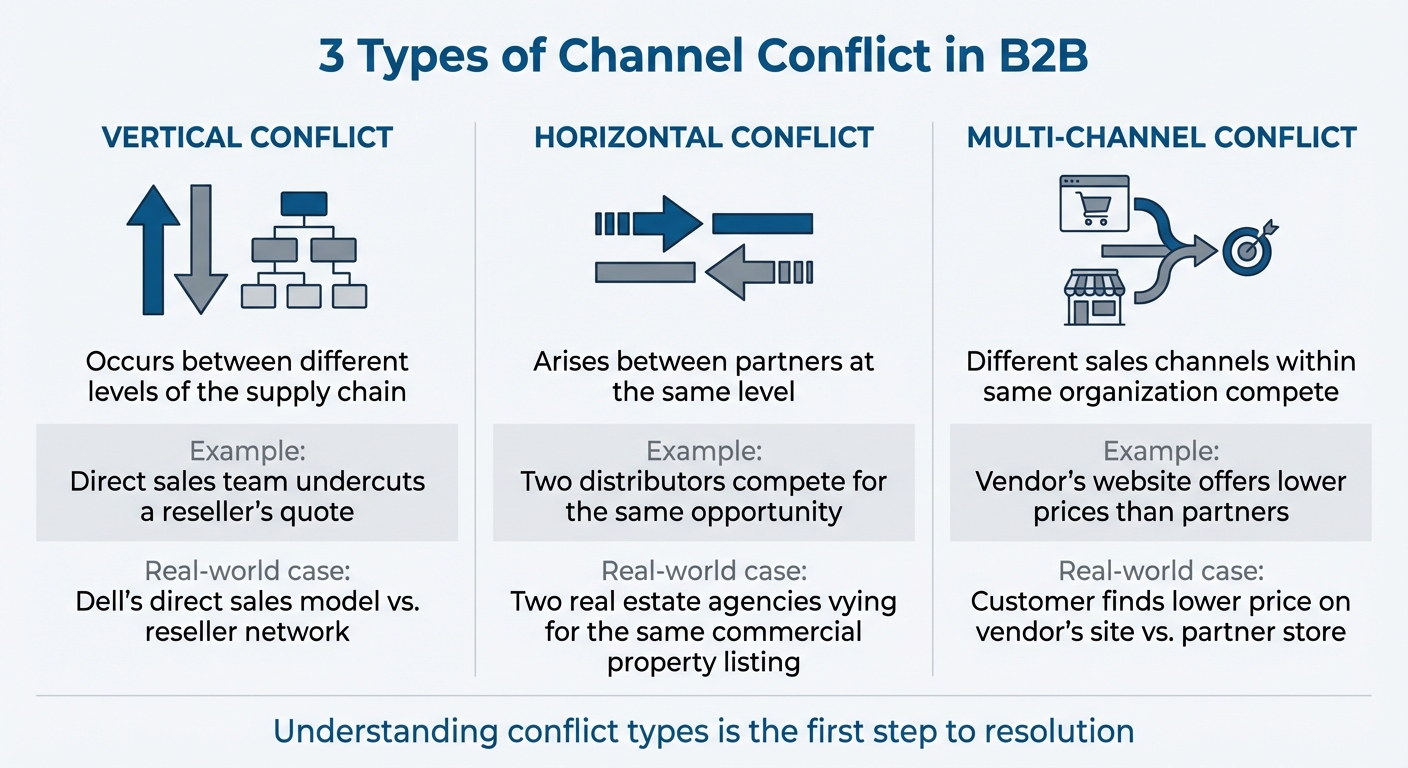
3 Types of B2B Channel Conflict: Vertical, Horizontal, and Multi-Channel
Channel conflict is a structural issue that arises within a company's distribution system. It happens when different sales channels - like direct sales teams, distributors, resellers, or online marketplaces - end up competing for the same customers instead of working together. This kind of internal friction can disrupt business operations and negatively impact the customer experience.
Unlike typical business disputes that might stem from isolated contract disagreements or personality clashes, channel conflict is baked into the way sales channels are structured. For example, it becomes a problem when overlapping territories lead partners to compete directly, when compensation plans create rivalry between direct sales reps and channel partners, or when teams unknowingly chase the same customer account due to poor communication or information gaps[7].
"Channel conflict isn't a people problem. It's a structural problem." - Kris Carter, Founder, Segment8[7]
The effects of channel conflict are tangible and often damaging. Companies may see their profit margins shrink, trust between partners erode, and opportunities slip through the cracks. A real-world example? In January 2022, traditional distributors in Maharashtra, India, protested against Unilever and Colgate-Palmolive after B2B platforms received inventory at lower prices, allowing them to undercut the established distributor network[10].
To better understand how these structural issues surface, let's break down the three primary types of channel conflict.
Recognizing the main types of channel conflict can help businesses address problems before they spiral out of control.
Vertical conflict happens between different levels of the supply chain. For instance, a direct sales team might offer lower prices than what authorized resellers can provide. Dell faced this issue early on when its direct sales model clashed with its reseller network. The company eventually adjusted its strategy, positioning direct sales as a complement to, rather than a competitor of, resellers[11].
Horizontal conflict arises between partners operating at the same level. Think of two real estate agencies vying for the same commercial property listing or two distributors bidding for the same government contract in the same region[2].
Multi-channel or ecosystem conflict occurs when different sales channels within the same organization compete with each other. For example, a customer might find a lower price on a vendor's official website compared to a partner's online store. The growth of digital marketplaces has intensified this type of conflict, with overlapping technology stacks often leading partners to offer competing solutions[2].
| Conflict Type | Parties Involved | Common B2B Scenario |
|---|---|---|
| Vertical | Vendor vs. Partner | Direct sales team undercuts a reseller's quote |
| Horizontal | Partner vs. Partner | Two distributors compete for the same opportunity |
| Multi-channel | All Channels | Vendor's website offers lower prices than partners |
Four major factors typically drive channel conflict:
"People often don't think channel conflict is going to happen to them, so they don't develop rules of engagement or don't put a lot of rigor around their process to handle it. And that's a mistake." - Raegan Wilson, Spur Reply[2]
Understanding these root causes is the first step toward resolving and preventing channel conflict effectively. These insights set the stage for strategies to address these challenges head-on.
Spotting channel conflict early is crucial for avoiding long-term damage to your business. Many B2B leaders fail to notice the issue until it starts affecting revenue or partner relationships. The trick lies in recognizing the signs and having a clear system to measure the problem. Without metrics, it’s hard to tell whether the issue is isolated or widespread, or how severe it really is. Below, we’ll break down the common warning signs and outline a framework to help you identify and measure these conflicts effectively.
The first clues often show up in how partners behave and engage with your business. If partners start withholding key information, responding sluggishly to leads, or developing a combative attitude toward your direct sales team, these behaviors could signal trouble [2][8].
Financial warning signs are usually easier to detect. A drop in sales within certain channels, partners undercutting each other on pricing, or an increase in partner churn are all red flags [6][4].
Customer complaints can also point to channel conflict. If customers report receiving multiple quotes or inconsistent messages, it’s a sign that your channels may be clashing [2][3]. These issues not only hurt your conversion rates but can also damage your brand’s reputation.
Operational disputes are another clear indicator. Frequent arguments over deal ownership, partners accidentally targeting the same opportunities, or a decline in deal registration approvals suggest there are deeper structural problems in your channel management system [2][8].
"Salespeople are all about selling and hitting their targets. They will do whatever it takes. So think hard about what guardrails you can put in place to prevent them from becoming their own worst enemy." - Raegan Wilson, Spur Reply [2]
Identifying the symptoms is just the first step - you also need to measure their impact. This involves tracking both hard data and qualitative feedback.
Start by analyzing your deal registration data. Look at approval rates, response times, and timestamps to see if partners are competing for the same leads or if your direct sales team is unintentionally encroaching on partner deals [2][8]. A drop in approval rates or delays in responses could indicate growing frustration among your partners. Tools like account mapping can help you pinpoint customer overlap early, preventing partners from wasting resources on the same accounts. Additionally, compare direct and indirect revenue streams through win/loss analyses to identify trends [2][8]. Partner retention is another key metric - companies with well-developed partner ecosystems tend to grow 34% faster than their competitors [8].
| Metric to Track | What It Identifies | Early Warning Sign |
|---|---|---|
| Deal Registration Approval Rate | Fairness and exclusivity | Sudden drop in approvals or high rejection rates |
| Customer Overlap | Market saturation | Multiple partners or direct sales targeting the same account |
| Price Consistency | Margin erosion | Partners complaining about being undercut |
| Lead Acceptance Time | Partner engagement | Slower response times indicating frustration |
| Partner Retention | Program health | Increase in partners leaving or becoming inactive |
Qualitative feedback is just as important. Quarterly business reviews with partners offer a chance to discuss potential friction points before they escalate into major problems [2][3].
"Regularly reviewing performance data and feedback from all channels helps catch any potential conflicts early and helps you refine your system." - Felix Milshtein, vcita [2]
The goal isn’t to eliminate all conflict. Some tension can highlight flaws in your program and lead to improvements [8]. However, it’s critical to address and resolve conflicts quickly to protect your conversion rates and maintain trust with your partners.
The best way to address channel conflict? Don’t let it happen in the first place. By creating clear structures and guidelines upfront, you can minimize misunderstandings about sales roles, territories, and pricing. Most issues arise from vague rules or inconsistent enforcement. Once you spot potential warning signs, taking proactive steps ensures smoother collaboration and stronger partnerships.
Ambiguity in contracts is a breeding ground for channel conflict. If agreements don’t clearly define responsibilities, product ownership, or territorial boundaries, partners will naturally fill in the blanks themselves, often leading to disputes [6]. A single, well-crafted Rules of Engagement (RoE) document can solve this. This document should provide specific, actionable rules rather than broad guidelines. For instance, instead of saying, "Partners should respect territory boundaries", include a detailed policy like: "If a deal is registered and a milestone is met, protection applies for 90 days" [12].
Standardizing partner onboarding is another key step. Every partner should receive the same training, information, and expectations from the beginning [2]. Follow up verbal agreements with email recaps, set clear timelines for deal registration approvals, and ensure your internal sales team isn’t penalized for collaborating with partners on deals [2].
"People often don't think channel conflict is going to happen to them, so they don't develop rules of engagement or don't put a lot of rigor around their process to handle it. And that's a mistake."
- Raegan Wilson, Spur Reply [2]
Transparent, two-way communication builds trust - essential for long-term partnerships. With 38% of channel leaders identifying conflict management as a major challenge, companies that prioritize clear communication gain a competitive edge [6].
When multiple partners compete for the same customer, conflict is inevitable. To prevent this, define clear account ownership through exclusivity agreements and account segmentation [7]. You can divide your market by factors like company size (e.g., enterprise accounts for direct sales, SMB accounts for partners), geography (specific regions or city tiers), or industry focus (e.g., healthcare, finance). Choose one model and apply it consistently [7].
"It's critical not to have too many partners in the same region or area. Find what partners' sweet spots are and let them operate there."
- Morten Søger, Partner Business Advisor [2]
A deal registration system is another effective tool. By granting the first registered partner a protection window - such as 90 days with progress checks every 30 days - you can avoid disputes over leads [7][8]. Account mapping tools also help identify overlaps, while regular syncs between direct and channel leadership can catch potential conflicts early. Remember, quality matters more than quantity. Oversaturating a territory with too many partners often results in a "shark tank" environment, where everyone competes for the same limited pool of customers [8]. Notably, companies with mature partner ecosystems grow 34% faster than those without [8].
Inconsistent pricing is a major source of channel conflict. When customers see varying prices for the same product or service, they often engage in "bid shopping", using one partner’s quote to negotiate a lower price elsewhere. This locks future deals to the lowest price point, eroding trust across channels [12].
To maintain price integrity, consider implementing Minimum Advertised Price (MAP) policies to prevent extreme discounts [1]. Establish a standardized pricing structure that all sales channels follow, with clear discount bands and a defined approval process for exceptions [12].
"Price integrity is the foundation of trust in multi-channel systems. When customers see inconsistent pricing for the same offer and service level, they bid-shop."
Monitor pricing closely to avoid hidden erosion. Track off-invoice discounts, rebates, and Market Development Funds (MDF) as part of the total net price [12]. For pricing violations, use a staged approach: start with coaching, escalate to corrective action plans, and, if necessary, downgrade the partner’s tier or terminate the agreement for repeated breaches [12].
| Selling Model | Bulk Sales Control | Pricing Flexibility | Profit Margins |
|---|---|---|---|
| Direct Selling | High: Full control over inventory. | Low: Must maintain strict pricing. | High: No intermediary commissions. |
| Marketplace Selling | Low: Partners manage inventory. | High: Prices often adjusted freely. | Medium: Reduced by partner fees. |
Marketplace channels can amplify pricing challenges since prices are publicly visible. Set clear rules for online advertised pricing and shipping [12]. If partners see undercutting, they may lose confidence in your brand and stop investing in it [12]. Protecting pricing integrity is essential to maintaining partner trust and profitability [2].
When prevention doesn't work, having a clear plan to resolve conflicts is essential. Timing is critical - 38% of channel leaders identify conflict management as a major hurdle, and 60% of solution providers will deprioritize a vendor if conflicts persist [6][13]. The aim isn't just to resolve the issue but to build a stronger foundation for future collaboration.
Start by gathering objective data through your PRM or CRM systems to create a detailed, timestamped timeline of events. Look at performance metrics like deal registration approval rates, lead acceptance rates, and areas of customer overlap to pinpoint where friction occurs [2]. Use your Rules of Engagement (RoE) to classify the conflict as Vertical, Horizontal, or Multi-channel [1][5][13]. Check for ambiguous terms, overlapping territories, or pricing inconsistencies that might be fueling the issue [2][6][8].
Sometimes, the root cause lies in conflicting priorities. For instance, a vendor might focus on rapidly expanding market share, while a partner values higher margins per deal [13]. Also, examine if your internal sales teams are incentivized to "go direct", as this can create vertical conflicts with partners [2][13]. Regularly review Quarterly Business Review (QBR) feedback to catch potential problems before they worsen [2][3].
Once you've identified the friction points, engage your partners as soon as possible. Morten Søger, Partner Business Advisor, emphasizes the importance of addressing issues quickly:
"Partner managers need to address the problem right away, otherwise it will grow bigger. Act as the mediator and try to find win-win scenarios" [2].
Use the A.C.T. Framework to guide the discussion: Acknowledge the issue with empathy, Collaborate on a solution using data, and Tune your program to avoid future conflicts [8]. Bring your findings and propose two or three potential solutions, but also listen carefully to your partner's input [2]. As Courtney Broadwell from Cyera advises:
"Tough meetings with your partners can get emotional, even though it's business. Really listen to your partners' concerns and focus on I statements, like 'I hear you,' to show that you understand where they're coming from" [2].
Keep the conversation centered on customer success rather than individual margins. If needed, offer referral fees or influence credits to compensate partners for work they've already done [2][7]. Leverage insights from QBRs to address deeper concerns during these discussions [2][3]. Stick to a 6-day resolution timeline: document the conflict on Day 1, conduct manager reviews on Days 2–3, reach an executive decision by Days 4–5, and communicate the final resolution by Day 6 [7].
Once a solution has been agreed upon, act quickly to implement it and ensure all affected parties are informed. Update your Rules of Engagement to address any gaps identified during the conflict [8]. For example, if overlapping territories caused the issue, redefine boundaries or set account size limits [7].
Consider introducing compensation neutrality so that your direct sales team earns the same regardless of whether the deal is direct or partner-led. This removes any incentive to sideline partners [7]. Monitor progress through weekly account syncs and QBRs to catch new conflicts early [2][7]. Track metrics like partner satisfaction scores, deal registration disputes, and resolution timelines. Document every conflict and its resolution in your PRM system to build a knowledge base for future reference [2][8].
Investing in effective conflict resolution isn't just about fixing problems - it can drive growth. Companies with well-developed partner ecosystems grow 34% faster than their competitors [8].
Modern technology offers powerful solutions for managing channel conflict, helping businesses address issues before they escalate. By automating processes, enforcing rules, and identifying potential friction points early, the right tools not only resolve disputes more efficiently but also help prevent them altogether.
AI-driven tools have transformed how businesses handle channel conflict. For example, AI-powered Partner Relationship Management (PRM) systems integrate with your CRM to automatically check for duplicate leads in real time. This eliminates the frustrating "who found it first" debates and ensures smoother operations [8]. Similarly, deal registration platforms simplify the process by automating first-to-register rights, often with a 90-day protection period, and enforcing quick 24-hour approval or rejection decisions. This removes ambiguity and speeds up deal ownership decisions [7].
Go-To-Market (GTM) intelligence platforms take it a step further by using AI to detect conflicts between direct and partner sales efforts. These platforms analyze win–loss data and flag accounts being targeted by multiple channels. Advanced systems also offer shared CRM visibility, reducing duplicate efforts and fostering better collaboration [7].
Configure, Price, Quote (CPQ) software is another game-changer. It embeds discount rules and standard configurations directly into workflows. Quotes within approved pricing bands are generated instantly, while exceptions are automatically routed through the proper approval chain, keeping everything transparent and traceable [14].
For businesses managing complex sales processes, integrating buyer-intent data with multi-channel outreach platforms can help determine the best partner for closing specific accounts. By basing decisions on partner capabilities and engagement history rather than arbitrary factors like geography, these tools minimize territorial conflicts and improve efficiency.
Ultimately, leveraging these technologies ensures a data-driven approach to monitoring performance and addressing conflict before it disrupts operations.
Automated tools are most effective when paired with systematic data tracking. Real-time insights into channel performance can highlight potential friction points. For instance, tracking metrics like partner-sourced versus partner-influenced deals, stage conversion rates, and how long opportunities remain in each stage can reveal where deals are stalling - and why [14].
Operational data is equally important. Monitoring lead response times, quote turnaround speeds, and pricing approval durations can uncover delays that might frustrate partners [14]. Pricing metrics, such as the mix of discounts offered, frequency of pricing exceptions, and adherence to Minimum Advertised Price (MAP) policies, can also signal early signs of price-related conflicts [14].
Conflict-specific metrics provide another layer of insight. Metrics like dispute volume, time to resolution, and "exception density" (exceptions per deal or revenue) can indicate whether engagement rules need adjustment. Additionally, tracking partner health indicators - such as lead acceptance rates, deal registration approvals, and customer overlap - can help businesses identify and address underlying issues in their partner ecosystem [14].
During Quarterly Business Reviews, these insights can be used to present objective, data-driven discussions about friction points. When decisions are based on clear, fact-based evidence, it becomes easier for all parties to align with compliant behaviors. In fact, companies with well-developed partner ecosystems that effectively use data tend to grow 34% faster than others [8]. Investing in technology and analytics not only reduces conflict but also accelerates deal cycles and strengthens partner relationships.
Technology and data can help solve immediate challenges, but building strong, lasting relationships with partners is what prevents issues from cropping up repeatedly. Trust plays a central role here. If that trust is broken, 60% of partners may lose faith in your brand, and 33% could end the relationship altogether [13]. Considering that about 70% of enterprise tech purchases involve a partner [13], losing these connections can directly hit your bottom line.
Strong partnerships aren’t just about closing deals - they’re about creating opportunities together [8]. Companies with well-developed partner ecosystems grow 34% faster than their competitors [8]. The secret? Moving beyond transactional exchanges and focusing on genuine collaboration. This requires structured programs and open, ongoing communication. By prioritizing these relationships, you lay the groundwork for effective partner programs.
A standardized training and onboarding process ensures that all partners understand your value, strategy, and sales approach. This consistency minimizes conflicts caused by mixed messages. Every partner should go through the same onboarding steps, which might include:
This upfront effort helps avoid misunderstandings that could lead to disputes later.
Certifications can also be a game-changer. Making certifications a requirement for accessing benefits or registering deals ensures that partners are competent and equipped to sell effectively. This approach reduces the risk of poorly executed sales that might frustrate customers and lead to conflict [8][12].
To support partner success, consider combining e-learning platforms with live training sessions. This ensures that your partners’ sales teams are aligned with your internal methodologies right from the start [15][8].
"There's only so much you can give your partners and only so much you can do to prevent conflict. Concentrate on building a few great partnerships rather than broadening your reach right away." - Courtney Broadwell, Cyera [2]
Training is just the beginning. To maintain strong partnerships, regular evaluations are essential. Quarterly Business Reviews (QBRs) provide a platform to align on goals, address recurring issues, and strengthen the relationship [2][8]. These reviews should be grounded in data, such as:
QBRs are also an opportunity to set shared KPIs and coordinate marketing strategies, ensuring both sides are working toward the same objectives [8]. To deepen these connections, aim for at least one in-person meeting annually [3].
When recurring issues come up during reviews, treat them as opportunities to improve. They might highlight areas where program rules need clarification or where partners could benefit from additional training [12].
"Use conflict as a learning opportunity for you and or your team to do better. Document what happened and discuss how this can be avoided in the future." - Trish Rilling, Grititude [2]
This guide has covered strategies to prevent, identify, and resolve channel conflicts, all of which are critical for maintaining strong B2B partnerships. Managing channel conflict effectively safeguards these relationships. Leading organizations achieve this by setting clear boundaries, ensuring transparent deal registration processes, and sticking to consistent pricing structures. When conflicts do arise, acting quickly and relying on data-driven mediation can prevent small issues from spiraling into larger problems.
Modern technology is a game-changer in channel management. Tools like PRM software help establish clear lead ownership, while AI-driven solutions offer real-time insights into overlaps and pricing discrepancies. For B2B leaders juggling complex partner networks, platforms that combine deal registration, account mapping, and performance analytics can flag potential conflicts before they escalate [2].
Still, technology alone isn’t enough. The human element - trust and communication - remains at the heart of conflict-free partnerships. Regular quarterly business reviews, standardized training programs, and clear engagement guidelines ensure that partners understand their roles and feel valued. With 38% of channel leaders identifying conflict management as a significant challenge [6], prioritizing a partner-centric approach can lead to stronger sales and marketing outcomes.
"Partner managers need to address the problem right away, otherwise it will grow bigger. Act as the mediator and try to find win-win scenarios." - Morten Søger, Partner Business Advisor [2]
Striking the right balance between control and partner autonomy, combined with quick conflict resolution and a long-term strategy, turns channel conflicts into opportunities for growth. By following the strategies in this guide - ranging from robust contracts to AI-powered tools - you can make channel conflict a manageable part of your growth plan. For leaders seeking systematic, AI-enhanced solutions, Visora provides expert advisory services to help build stronger channel relationships while maintaining operational efficiency.
Signs of trouble in your sales channels can show up in several ways - like declining sales in specific areas, unhappy customers, or strained relationships with your partners. For instance, you might notice a drop in channel performance, recurring conflicts with partners, or inconsistencies in service or pricing that confuse or frustrate customers. These red flags often point to misalignment or competition within your channels, which can hurt your revenue.
Keeping an eye on these indicators and fostering open communication with your partners is key. Addressing conflicts early can prevent them from escalating and causing even bigger problems.
A Rules of Engagement document sets the stage for effective collaboration by outlining specific expectations, roles, and responsibilities for everyone involved. It should also establish guidelines for communication, conflict resolution, and performance metrics. These elements help reduce misunderstandings and prevent disputes, ensuring a more seamless working relationship.
Tools to prevent deal and pricing disputes in channel management revolve around clarity, open communication, and shared goals. Real-time data tools and inventory management systems play a key role by offering precise, up-to-date insights into stock levels, pricing, and sales trends. This helps flag potential issues before they escalate. Additionally, well-defined contracts, structured incentive programs, and advanced CRM platforms build trust and encourage collaboration, ensuring everyone is on the same page regarding terms and expectations. These strategies work together to minimize confusion and avoid conflicts.
%20(5).png)
