%20Bold.png)

Want to grow revenue faster and align your teams? The Cross-Functional GTM Playbook explains how to break down silos and create a unified team across Product, Marketing, Sales, Customer Success, and Revenue Operations. Instead of fragmented efforts, this approach focuses on shared revenue goals and seamless workflows - key to navigating today’s complex B2B buying journeys involving 6-10 decision-makers.
This playbook offers a step-by-step framework to build and manage GTM teams, align incentives, and launch initiatives that deliver results. Whether introducing a new product or entering a new market, this system helps you move faster and grow smarter.
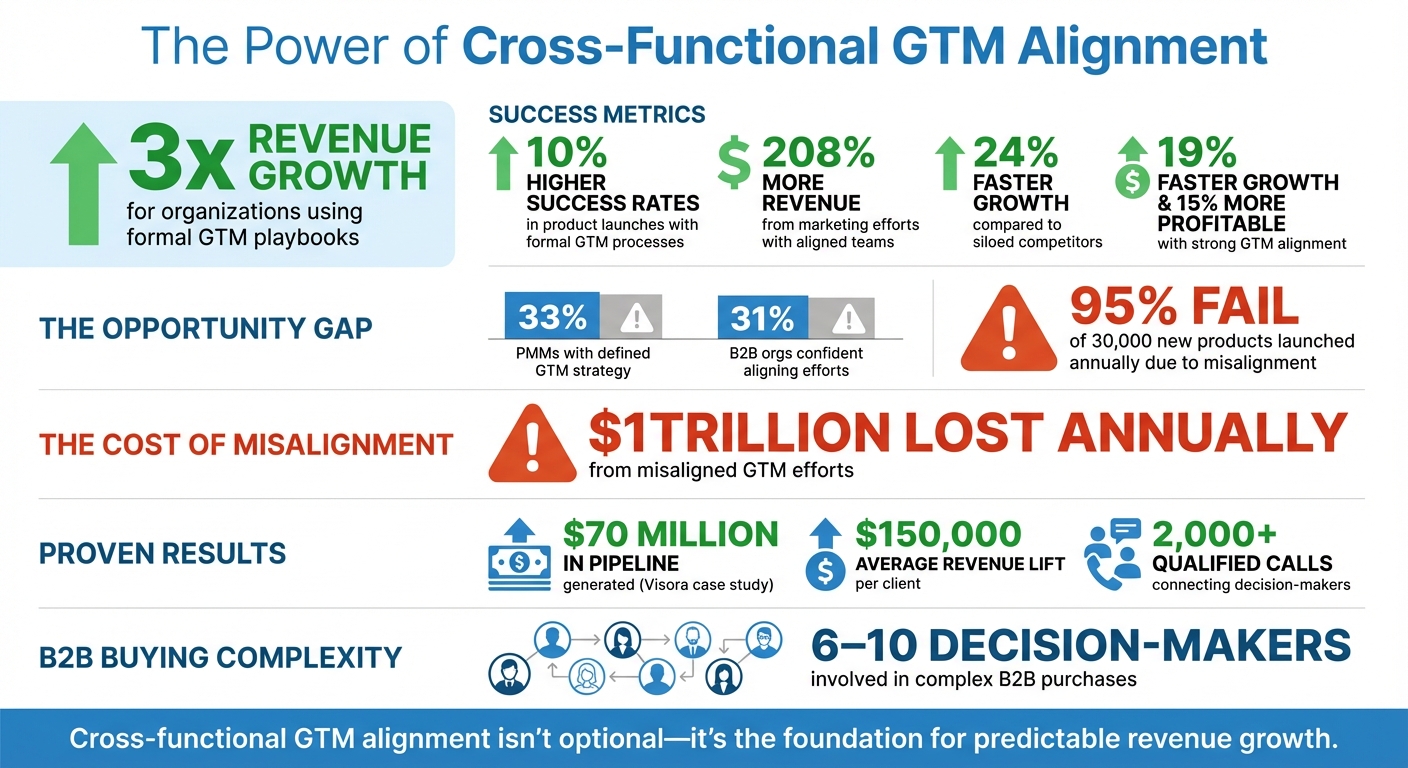
Cross-Functional GTM Team Impact: Key Statistics and ROI Metrics
A cross-functional GTM (Go-to-Market) team isn’t just a group of department leaders meeting occasionally. It’s a well-synchronized unit where every role contributes to the customer journey - from the first interaction to ongoing renewals. Each member focuses on shared revenue goals rather than isolated departmental metrics.
An effective GTM team typically includes six key roles, all working in unison. At the helm is the GTM Owner - often a CEO, GM, or Division Head - who ensures that the executive team aligns around common incentives and KPIs across the organization.
The Product Manager bridges the gap between development and market-facing teams. Their role involves validating the Ideal Customer Profile (ICP) and ensuring the product roadmap addresses pressing customer challenges, rather than just ticking off feature requests. The Product Marketing Manager (PMM) ties everything together, crafting consistent messaging, positioning, and value-driven narratives for all channels.
A Marketing Specialist focuses on demand generation, identifying the best channels to attract prospects and guide them into the funnel. The Sales Leader takes charge of sales strategies and channel enablement, turning that demand into revenue. Meanwhile, RevOps (Revenue Operations) acts as the team’s data hub, providing insights into GTM performance and spotting operational hurdles before they disrupt the pipeline.
Two additional roles round out the team: Sales Enablement, which connects product insights with sales execution by providing tools like scripts and battlecards, and Customer Success, which manages onboarding, retention, and growth through upsells and referrals.
| Role | Primary GTM Responsibility | Contribution to Strategy |
|---|---|---|
| Product Manager | ICP Validation | Ensures the product solves real, pressing problems |
| Marketing | Demand Generation | Builds visibility and engagement through key channels |
| Sales | Channel Enablement | Converts interest into meaningful conversations and deals |
| RevOps | Metrics Alignment | Provides a unified view of performance data |
| Customer Success | Retention & Growth | Converts satisfied customers into referral sources |
Defining these roles is the first step toward seamless collaboration, as discussed in the next section.
When teams operate in silos, chaos can ensue - Sales might promote features that don’t exist, or Marketing could target an entirely wrong audience. These missteps increase Customer Acquisition Costs (CAC) and cause pipeline bottlenecks. GTM Partners succinctly captures this issue:
"You don't have a marketing problem. You don't have a sales problem... You have a GTM problem."
The solution starts with shared KPIs that eliminate conflicting goals. For example, metrics for Sales Enablement should be transparent to Product Marketing, with both tied to revenue velocity rather than activity counts. Clear Service Level Agreements (SLAs) should outline responsibilities for handoffs - whether it’s from Marketing to Sales or Sales to Customer Success - ensuring nothing gets overlooked.
To streamline collaboration, form a "Tiger Team" with one key representative from each department. This avoids unnecessary complexity while ensuring every function has a voice. Weekly "war rooms" can act as focused syncs to maintain transparency and quickly address any misalignments. Additionally, document all processes - handoffs, feedback loops, and reporting structures - so the workflow doesn’t rely on informal communication that might disappear when team members leave.
This isn’t about adding more meetings. As GTM expert Peter Emad puts it:
"Alignment isn't about meetings. It's about workflow integration."
Creating a cross-functional Go-to-Market (GTM) team involves a structured, four-phase process: Research and Alignment, Strategy Development, Planning and Enablement, and Execution and Optimization. Each phase is a building block for the collaborative framework outlined in later sections.
Start by defining your Ideal Customer Profile (ICP) using firmographics, technographics, and behavioral traits. This step isn't just for marketing - every team must agree on the target audience. Map out the entire buying center, identifying roles from initiators to gatekeepers.
Conduct a thorough market analysis to determine your Total Addressable Market (TAM), Serviceable Addressable Market (SAM), and Serviceable Obtainable Market (SOM). Pair this with a SWOT analysis to understand the market challenges your product addresses. Set SMART business goals - specific, measurable, achievable, relevant, and time-bound. For instance, aim to boost market share by 15% within the next year. This ensures everyone is aligned on what success looks like.
Once the research is complete, create a Value Matrix. This tool connects each buyer persona to their pain points and highlights how your product addresses them. It serves as the foundation for consistent messaging across all teams. Decide on the most effective sales motion - Self-Service, Inside Sales, Field Sales, or Channel Sales - based on your product's complexity and pricing structure.
Develop a messaging framework that answers three critical questions: Why does your solution matter? What features and benefits does it offer? How will customers experience it? Slack Co-Founder Stewart Butterfield famously illustrated this concept:
"We Don't Sell Saddles Here"
His point was that Slack isn’t just a messaging tool - it’s about transforming organizational workflows.
Align your pricing and packaging strategy with customer perceptions of value. Whether it's subscription-based, usage-based, or tiered, run cross-functional workshops to break down silos and ensure alignment .
Translate your strategy into action with a repeatable Sales Playbook. This document should outline key messaging, objection-handling techniques, discovery questions, and success stories. Evaluate your tech stack, including your CRM, marketing automation, and account intelligence tools, to ensure you have a unified source of truth across teams.
Create a Content Library tailored to every stage of the buyer's journey - awareness, consideration, and decision. Use a RACI matrix to clearly define roles and responsibilities within the team .
Companies with a documented GTM framework achieve a 10% higher success rate in product launches. Moreover, organizations using a formal GTM playbook see three times the revenue growth compared to those without one. Yet, fewer than 33% of businesses have a formal playbook in place.
Execute your plan iteratively. Use soft launches and A/B testing on digital ad platforms to refine your messaging. Track key performance metrics like Customer Acquisition Cost (CAC), Lifetime Value (LTV), and Net Revenue Retention (NRR). For B2B SaaS companies, a healthy LTV-to-CAC ratio is typically 3:1 or higher.
Establish a Leadership Rhythm by conducting quarterly reviews. This allows you to refine your strategy based on market feedback and competitor activity. Use closed-loop reporting and shared GTM dashboards to ensure all teams work from the same data. Focus on "Time-to-Value" during onboarding, as most customer churn happens within the first 90 days.
"A GTM strategy isn't about having all the answers on day one. It's about creating a structured way to find those answers, test your assumptions, and adapt quickly based on what the market tells you."
– Semir Jahic, Salesmotion
Signal-based outbound strategies can outperform traditional cold outreach by two to ten times. Focus on warm signals like website visits, LinkedIn engagement, or customer alumni moving to new companies. Break down silos so organic content and paid ads work together to target the same accounts. This disciplined approach sets the stage for addressing common challenges, which will be explored in the next section.
Even the best-crafted GTM (Go-To-Market) strategies can falter when teams work in silos. Two major obstacles often derail cross-functional execution: organizational silos and buyer journey friction. The good news? Both challenges can be tackled with structured collaboration and streamlined workflows.
Silos form when departments focus solely on their own metrics instead of shared business goals. Marketing might chase MQLs (Marketing Qualified Leads), sales zeroes in on closing deals, and customer success prioritizes retention - all while barely communicating. This lack of alignment leads to duplicated efforts, slower decisions, and a disjointed customer experience, with each team relying on different sets of customer data.
The impact is clear: companies with strong GTM alignment grow 19% faster and are 15% more profitable than their competitors. Yet, only 31% of B2B organizations feel confident in aligning cross-functional efforts toward a unified GTM goal. This gap between alignment and execution translates directly into lost revenue.
Take Precisely (formerly Syncsort) as an example. Under CMO Kevin Ruane, the company consolidated 16 siloed product areas into three strategic growth initiatives. They introduced formal Service Level Agreements (SLAs) between marketing and Business Development Representatives (BDRs) to streamline lead management. The results? Faster lead follow-ups, improved conversion rates, and shorter sales cycles.
To achieve similar results, try these strategies:
Atlassian addressed silo issues by introducing a "Team Playbook" framework, which included a "Project Poster" initiative - a single-page document aligning goals and stakeholders before launching any project. Their internal research showed that teams using these tools completed projects 20% faster and reported a 33% increase in cross-team satisfaction.
"The structure of a system determines its behavior."
– Donella Meadows, Author of Thinking in Systems
Shifting from a departmental mindset to a systems-thinking approach is what sets top-performing GTM teams apart. In fact, 83% of digitally advanced companies rely on cross-functional teams to maintain their competitive edge. The real question is: how quickly can you break down these silos?
When internal misalignment slows operations, it also creates friction in the buyer's journey.
Internal inefficiencies don't just affect your team - they ripple out to your customers. Buyer journey friction occurs when poor handoffs between teams lead to delays and confusion. Imagine a prospect downloading a whitepaper from marketing, receiving an irrelevant cold call from sales, and then sitting through a product demo that misses their pain points. Each disconnected touchpoint erodes buyer confidence.
Consider this: 95% of the 30,000 new products launched annually fail, often because the sales process doesn't align with the customer's buying journey. In B2B sales, where multiple decision-makers are involved, even minor friction can derail a deal.
Here’s how to eliminate that friction:
Salesloft showcases the power of collaboration. CRO Mark Niemiec emphasizes their "one team" approach:
"Success is about deep partnerships. We're one team, and that's how we analyze the pipeline and make decisions."
– Mark Niemiec, CRO, Salesloft
Salesloft uses a 13-week operating cadence to maintain focus across the business. They track both lagging indicators (e.g., win rates, bookings) and leading indicators (e.g., deal health, predictive churn) to identify friction before it impacts revenue.
Shifting from a traditional sales funnel to a flywheel model (Attract, Engage, Delight) can also reduce buyer journey friction. By focusing on turning customers into advocates, your GTM strategy gains momentum, and future buyer journeys become smoother.
Addressing buyer journey friction isn’t a one-and-done task - it’s an ongoing process of listening, adapting, and refining based on market feedback.

For leaders in financial services looking to streamline their go-to-market (GTM) strategy without overspending on ads or building oversized teams, Visora's Trifecta Program offers a 12-week system designed to drive acquisition. This program brings together three powerful components: the B2B Vortex Funnel, AI-Augmented Appointment Setting, and DD (Data-Driven) Strategy Consulting. Together, these tools tackle common GTM challenges like team misalignment, buyer journey friction, and siloed operations, all while focusing on shared revenue goals.
Visora has already partnered with over 30 organizations across industries like investor relations, real estate development, and financial services. Their efforts have generated more than $70 million in pipeline and delivered an average revenue boost of $150,000 per client. With over 2,000 qualified calls connecting decision-makers - including C-suite executives, founders, and high-net-worth individuals - Visora’s approach is proven to deliver results [Website].
Here’s a closer look at how each element of the Trifecta Program addresses GTM hurdles and accelerates revenue growth.
The B2B Vortex Funnel replaces disjointed marketing and sales efforts with a unified revenue operating system. This system aligns marketing and sales around a single scorecard and funnel stages, ensuring prospects experience a seamless buyer journey rather than fragmented touchpoints.
A key feature of this funnel is intent-based prioritization, which focuses on accounts actively searching for solutions. By analyzing intent data, financial services teams can target prospects who are already "in market" and ready to engage, avoiding wasted effort on cold outreach. The payoff? Better-quality leads, a stronger pipeline, and faster deal closures. In fact, organizations that achieve strong GTM alignment - like the kind this funnel fosters - grow 19% faster and are 15% more profitable than their competitors.
AI-Augmented Appointment Setting takes on repetitive tasks and ensures teams focus on high-value opportunities. By adapting sales playbooks in real time based on deal stage, industry, and persona, this system ensures appointment setters are engaging with the right accounts at the right time. It also uses conversation intelligence to analyze sales calls, highlighting coaching opportunities and creating a continuous learning loop for the entire team.
This approach keeps sales and marketing teams aligned during outreach, reducing the common friction that arises during handoffs. And the benefits go beyond smoother operations - companies that fully integrate AI into their GTM processes are projected to achieve 30% higher revenue growth by 2025. For financial services leaders navigating complex buyer journeys, this ensures no opportunity is overlooked.
To complement the automated tools, DD (Data-Driven) Strategy Consulting ensures strategic alignment across the entire GTM team. By uniting cross-functional teams from the start, this consulting approach establishes a single source of truth for customer intelligence, shared operating rhythms, and unified growth priorities. This is crucial, especially since only 31% of B2B organizations report confidence in aligning their teams toward a unified GTM goal.
With tools like SLAs, RACI matrices, and shared OKRs, DD Strategy Consulting removes confusion and ensures everyone is working toward the same objectives. It also integrates predictive forecasting and centralized data dashboards, giving leadership the insights needed to allocate resources efficiently. When teams across product, marketing, sales, and customer success operate from the same playbook, GTM strategies transition from planning to revenue generation much faster.
Creating an effective cross-functional GTM strategy isn’t just about scheduling more meetings - it’s about building an integrated revenue model. This means aligning product, marketing, sales, and customer success to operate from the same playbook. Companies that achieve this kind of alignment see impressive results: they generate 208% more revenue from their marketing efforts and grow 24% faster than competitors stuck in silos. On the flip side, misaligned GTM efforts come with a massive price tag, costing businesses over $1 trillion annually.
The foundation of this alignment lies in a unified scorecard and shared decision-making. When teams like Sales, Finance, and RevOps align around the same metrics, decision-making speeds up dramatically - shrinking timelines from weeks to days. Mark Niemiec, CRO at Salesloft, captures this perfectly:
"Success is about deep partnerships. We're one team, and that's how we analyze the pipeline and make decisions".
This approach relies on clear ownership frameworks and shared metrics, enabling faster, more collaborative decision-making. It also creates a foundation for agile, ongoing adjustments.
A great GTM strategy isn’t static - it’s dynamic and evolves in real time. Weekly GTM reviews play a crucial role in this process by identifying and addressing revenue leaks, such as high MQL-to-SQL drop-offs, before they become costly. For example, in December 2025, Workflows.io demonstrated the power of this approach by hitting $1M ARR within just three months of launch. Their success stemmed from a signal-based outbound strategy, including their "LinkedIn Connections of Founders" play, which achieved a 25.4% reply rate (94 replies from 370 messages) by leveraging interest built over 1.5 years of organic content. This kind of real-time adaptability shows how a tailored 12-week system can deliver rapid, measurable results.
For financial services leaders, alignment is not just important - it’s critical. Misalignment and operational friction can derail even the best efforts. Visora’s Trifecta Program offers a solution with its 12-week system, which has already generated over $70 million in pipeline across 30+ partner organizations. On average, clients have seen a $150,000 revenue lift by addressing key issues like team misalignment, buyer journey friction, and siloed operations. This integrated system tackles the barriers that often prevent predictable revenue growth.
The takeaway? Cross-functional alignment isn’t optional. With buying groups for complex B2B solutions now involving six to 10 decision-makers, your internal teams need to be just as coordinated as the buyers they’re targeting. Start by setting shared goals, automating where it makes sense, and optimizing based on real data - not guesswork. This disciplined, data-driven approach can make all the difference.
A successful cross-functional GTM team brings together key players from various departments to ensure that strategy, execution, and metrics are aligned throughout every stage of the buyer journey. At the helm of this team is a GTM leader - often a VP of GTM, Chief Revenue Officer, or Head of Product Marketing - who ensures that everyone is working in sync toward common objectives.
Here’s a breakdown of the essential roles:
When these roles collaborate effectively, organizations can eliminate silos, stay aligned, and achieve growth faster.
Shared key performance indicators (KPIs) act as a common thread that ties teams together, aligning everyone toward measurable, unified goals. By connecting departments like product, marketing, sales, customer success, finance, and operations to shared metrics - such as pipeline growth, net revenue retention, or time-to-value - teams gain a clear view of how their individual efforts feed into larger business objectives. This approach helps break down silos, avoids redundant work, and encourages closer collaboration.
When teams share KPIs, they benefit from greater transparency and accountability through unified dashboards. These tools allow everyone to monitor progress in real time, making it easier to spot and address misalignments. For example, if marketing focuses on increasing lead volume while sales targets high-value accounts, shared KPIs can quickly highlight the disconnect, enabling faster adjustments and smoother execution. Visora uses AI-powered analytics to help B2B leaders establish shared KPI frameworks in just 12 weeks, streamlining cross-functional alignment without overburdening resources or creating fragmented reporting systems.
Executing a go-to-market (GTM) strategy often comes with its fair share of hurdles, even for the most carefully planned initiatives. One of the biggest challenges is misalignment between teams. When departments like product, marketing, sales, and customer success operate in silos, it creates inconsistent messaging, duplicated efforts, and ultimately, a subpar experience for customers.
Another common pitfall is starting with an incomplete understanding of the target audience. Without a clear grasp of customer needs, businesses can misjudge priorities, struggle with adoption, and waste valuable resources.
On top of that, unclear roles and responsibilities can throw a wrench in the process. When team members aren’t sure who’s accountable for what, confusion and delays are almost inevitable, leading to missed opportunities. There’s also the issue of rushing to deliver results before the product is fully prepared. This can lead to hasty launches, messaging that doesn’t hit the mark, or even pricing missteps.
Finally, leadership misalignment can derail progress. When leaders have conflicting priorities or make decisions that overlook market research, it creates internal friction and slows everything down.
To tackle these obstacles, companies need to focus on clear communication, define responsibilities with tools like a RACI matrix, and ensure thorough market validation before moving forward. Visora’s AI-powered growth consulting helps B2B leaders bring teams together, simplify processes, and craft GTM strategies that boost revenue while sidestepping these common challenges.
%20(5).png)
