%20Bold.png)

Want better conversions? Start with your CTAs. A well-optimized Call to Action (CTA) can boost email clicks by 371% and sales by 1,617%. Yet, 55% of B2B marketers struggle to get the desired results. This checklist simplifies the process, helping you create CTAs that align with your sales funnel, match buyer intent, and drive measurable outcomes.
Pro Tip: Personalize CTAs - for example, tailored offers can outperform generic ones by 202%. Keep refining to stay ahead.
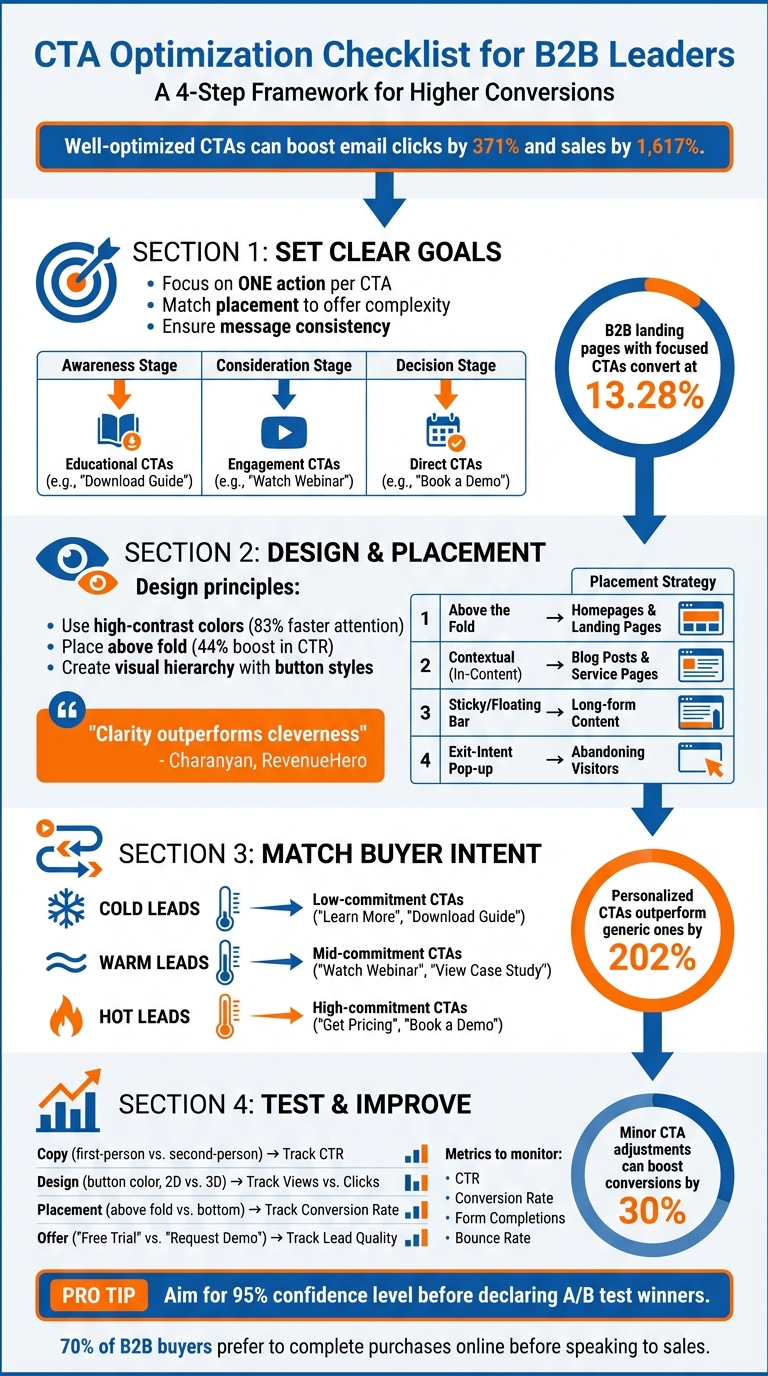
B2B CTA Optimization Checklist: 4-Step Framework for Higher Conversions
Every CTA should aim to drive a single, clear action. Overloading a page or email with multiple CTAs can lead to decision paralysis, where prospects hesitate or fail to act altogether [1]. To avoid this, focus on one main objective per touchpoint - whether it's subscribing to a newsletter, downloading a resource, booking a demo, or completing a purchase [1].
The placement of your CTA should match the complexity of the offer. For straightforward value propositions, position the CTA above the fold so it's immediately visible. However, for more complex products or services that require trust-building through educational content, place the CTA below the fold, where prospects have had time to absorb the value being offered [1].
Message consistency is critical. The text on your CTA button should align seamlessly with the landing page's headline and offer. For example, if someone clicks on "Download Free Template" and lands on a page titled "Get Your Template Now", they'll instantly know they're in the right place. Any mismatch in messaging can confuse prospects and drive them away [2].
"I've found that direct CTA copy tends to perform better than lengthier CTA copy. Succinctly pitching the value... can act as an unambiguous directive on what readers should do." - AJ Beltis, Senior Content Marketing Manager, HubSpot [2]
CTA goals should shift as prospects move through the sales funnel. At the top of the funnel, where audiences are just becoming familiar with your brand, focus on educational CTAs like newsletter signups or guide downloads. These actions establish trust without requiring a big commitment. As prospects move to the middle of the funnel, where they're more engaged, offer resources such as whitepapers, webinars, or introductory calls to deepen the relationship. At the bottom of the funnel, CTAs should be more direct, prompting actions like booking a demo, signing up for a free trial, or scheduling a meeting with a clear time slot [6][3].
Data supports this tailored approach: B2B landing pages with focused offers and strong CTAs convert at an average rate of 13.28%, compared to 9.87% for B2C [3]. Pushing a hard "book a demo" CTA in a first-touch email can feel out of place. Instead, consider a softer approach, like asking, "Would it be helpful to send a short video?" to build engagement gradually [3].
| Funnel Stage | CTA Objective | Recommended Metrics to Track |
|---|---|---|
| Awareness | Educate and identify challenges | Website traffic, social engagement, blog clicks [6] |
| Consideration | Showcase expertise and solve problems | Whitepaper downloads, webinar signups, newsletter subscriptions [6] |
| Decision | Differentiate and drive final choice | Demo bookings, free trial signups, SQLs, ROI, CAC [6] |
By aligning CTAs to each stage, you can set measurable goals and track progress effectively.
Once you’ve established your CTA goals, it’s essential to measure their performance. Start by tracking click-through rates (CTR) to gauge interest and conversion rates to evaluate outcomes. Conversion rate, which measures the percentage of clicks that lead to the desired action, is a key indicator of your CTA's success [4][5]. Set specific benchmarks, such as increasing demo bookings by 25%, boosting form submissions by 15%, or improving meeting conversions by 20%, to measure your progress.
When testing CTA elements like button color, text, or placement, make sure to change only one variable at a time. This approach ensures you can pinpoint what drives improvements [5].
Personalization can make a huge difference. CTAs tailored to a visitor's lifecycle stage can outperform generic ones by up to 202% [3]. For instance, using the same "Contact Us" button for both first-time visitors and returning customers may miss opportunities to connect more effectively. Instead, customize CTAs for different audience segments and compare their performance against baseline metrics to optimize results.
A well-crafted CTA can make all the difference in driving conversions. The way it looks - color, size, contrast, and spacing - plays a huge role in catching the user's eye. CTAs with contrasting colors draw attention 83% faster than those that blend in [7]. This means your primary CTA button should stand out by using a color that doesn't appear elsewhere on the page.
While having clear goals is important, the design and placement of your CTAs are what translate those goals into action. Placement is just as critical as design. For instance, buttons placed in the upper third of the fold are seen 73% more often than those below it. In fact, placing CTAs above the fold can lead to a 44% boost in click-through rates [7]. However, visibility alone isn’t enough. CTAs should be strategically placed where users are most likely to act. As RevenueHero explains, "Timing > location. What worked best was placing CTAs near moments of intent. After a case study, at the end of a compelling product section, or after solving a pain point in copy" [8].
The words on your CTA are just as important as how it looks. The copy should clearly tell users what they’ll gain and why it’s worth their time. Use strong, action-driven verbs like "Discover", "Get", "Start", or "Download" instead of vague prompts like "Submit" or "Click Here." For B2B audiences, straightforward phrases like "Get pricing" or "Book your strategy call" consistently outperform abstract ones like "Unlock the future" [8].
Be specific about the benefits. Instead of writing something generic like "Find new efficiencies", try "Save 16 hours per month on payroll." This kind of concrete promise makes the value crystal clear. Adding reassurances like "No credit card required" or "Cancel anytime" can also help reduce hesitation and improve conversions [2][8].
"Clarity outperforms cleverness. CTAs that clearly stated what would happen next... performed far better than ones that tried to be witty or vague." - Charanyan, Co-founder, RevenueHero [8]
Your CTA button should pop visually to grab attention. Use high-contrast colors that stand out against the page background, and surround the button with white space to keep it uncluttered and easy to spot - even on mobile devices [7][9].
Create a visual hierarchy by using filled buttons for primary actions (like "Request a Demo") and outlined or ghost buttons for secondary actions (like "Watch Video"). This approach subtly guides users toward the most important action. Adding interactive elements like hover effects, shadows, or slight 3D touches can also make buttons look more clickable and engaging [7][10].
Even the best-designed CTA won’t work if it’s not in the right spot. Place your primary CTA in the hero section of your homepage or landing page so it’s immediately visible without scrolling. For longer content, such as blog posts or service pages, embed CTAs within the content itself - ideally right after you’ve provided valuable insights or addressed a key pain point. This ensures you’re capturing attention when the reader is most engaged [7][8].
For long-form pages, consider using sticky or floating bars to keep the CTA visible as users scroll. And for visitors about to leave your site, exit-intent pop-ups can offer one last chance to engage them with a high-value offer, like a free audit or downloadable guide. In short emails, stick to a single bold CTA, while longer emails can include multiple CTAs to cater to different readers [5][7].
| Placement Type | Best Use Case | Key Benefit |
|---|---|---|
| Above the Fold | Homepages & Landing Pages | Ensures immediate visibility for key offers [7] |
| Contextual (In-Content) | Blog Posts & Service Pages | Captures attention when interest peaks [7] |
| Sticky/Floating Bar | Long-form Content | Keeps the CTA accessible while scrolling [7] |
| Exit-Intent Pop-up | Abandoning Visitors | Provides a "last-chance" offer to retain leads [7] |
Once you've set clear goals for your CTAs and optimized their design, the next step is aligning them with buyer intent at every stage of the journey. This alignment ensures your CTAs resonate with prospects, encouraging them to take action.
Not all prospects are in the same place. Some are just beginning their research, others are comparing options, and a few are ready to make a decision. Your CTAs should match these varying levels of readiness. For example, asking a cold lead to book a demo too early might push them away, while offering a generic "Learn More" to someone ready to buy wastes a chance to close the deal.
To gauge intent, use both first-party data - like website activity, clicks, or downloads - and third-party signals such as external searches or review site visits [11][12]. It's also helpful to distinguish between explicit intent (clear actions like requesting a demo) and implicit intent (more subtle actions like reading several related blog posts) [11].
Behavioral scoring can further refine your approach. Look at the frequency, recency, and relevance of a prospect's actions. For instance, someone conducting multiple keyword searches in a week is likely more engaged than someone who casually reads one blog post [11][12]. This scoring helps you decide which CTA to present. With 70% of B2B buyers preferring to complete purchases online before speaking to a salesperson [12], your CTAs must make an impression early.
Tailoring CTAs to match lead temperature ensures you're meeting prospects where they are in their journey.
| Lead Stage | Intent Level | Recommended CTA Examples | Typical Offer |
|---|---|---|---|
| Cold (Awareness) | Low | "Download Guide", "Learn More" | Blog Post, Infographic, Free Guide |
| Warm (Consideration) | Medium | "Watch Webinar", "View Case Study" | Template, Whitepaper, Webinar |
| Hot (Decision) | High | "Get Pricing", "Book a Demo" | Product Demo, Pricing Sheet |
By crafting CTAs that align with these stages, you create a smoother path for prospects to move forward.
Consistency is key when using CTAs across platforms like email, social media, and landing pages. For instance, if your email CTA invites users to join a "Crash Course", the landing page should not refer to it as an "eBook." Such mismatches confuse prospects [2][5]. In fact, even small tweaks to CTAs can boost conversion rates by up to 30% [2].
Ensure the language and tone remain consistent across all channels. If your CTA says "Register Now," don't send users to a general homepage - guide them to a relevant page with a clear next step [5]. Additionally, if your email or social post has a fun or creative tone, make sure the landing page and CTA continue that vibe to provide a seamless experience.
Twilio SendGrid highlighted the power of personalization and consistency in a 2017 A/B test. They compared a generic sender name ("Twilio SendGrid") with a personalized one ("Matt from Twilio SendGrid"). The personalized version saw a 10% higher open rate [5].
"When someone clicks on your CTA, they should see a direct connection between the email message, the CTA, and the destination." - Twilio SendGrid [5]
CTAs naturally lose their punch over time as buyer behavior and market trends shift. Setting clear goals and designing for impact are just the starting points. To keep your CTAs relevant and effective, ongoing testing is key. This approach ensures your CTAs adapt to changing market demands, driving consistent improvements in conversions. Even small tweaks can lead to big results - studies show that minor adjustments to CTAs can boost conversions by as much as 30% [2]. As HubSpot's Carly Stec aptly puts it: "Just because something won once, doesn't mean it can't be beat. Keep going" [15].
A/B testing is a powerful way to refine your CTAs. It works by comparing two variations of a CTA to determine which one performs better. The trick is to test one variable at a time - like the wording, color, or placement - so you know exactly what caused the change.
Start with the copy. Research suggests that using first-person language (e.g., "Start my trial" instead of "Start your trial") can increase conversion rates by up to 90% [14]. You can also experiment with different verbs, such as "Download" versus "Get", and test whether straightforward or playful phrasing resonates more with your audience.
"I've found that direct CTA copy tends to perform better than lengthier CTA copy. Succinctly pitching the value of what you're linking out to... can act as an unambiguous directive on what readers should do." - AJ Beltis, Senior Content Marketing Manager, HubSpot [2]
Next, focus on the design. Test different button colors, shapes (rounded versus square), and effects like 3D shadows or hover animations. Even small adjustments - like increasing contrast between the button and its background - can make a noticeable difference in click rates.
Placement and timing are crucial too. While "above the fold" is a common guideline, strategically placing CTAs near moments of high intent - like after a compelling case study or solution to a pain point - can lead to better results. Try positioning CTAs at the top of the page, within the content, or at the end to see what works best for your audience.
Don’t overlook personalization. Tailor CTAs based on factors like industry, job role, or previous user behavior. For instance, compare the performance of HTML-based buttons versus simple text links to see which feels more natural in your content.
| CTA Element | What to Test | Metric to Track |
|---|---|---|
| Copy | First-person vs. second-person; imperative verbs | Click-through Rate (CTR) |
| Design | Button color; 2D vs. 3D effects; size | Views vs. Clicks |
| Placement | Above the fold vs. bottom of page; anchor text | Conversion Rate |
| Offer | "Free Trial" vs. "Request a Demo" | Lead Quality / Submissions |
To ensure reliable results, aim for a 95% confidence level before declaring a winner [16]. Premature conclusions can lead to misleading insights.
Once you identify winning elements, analyze the data thoroughly to guide your next round of improvements.
Data is your best ally when it comes to refining CTAs. While click-through rate (CTR) is a useful starting point, it’s essential to dig deeper. Look at metrics like form completions, lead quality, time spent on the page, and bounce rates. These help you ensure your CTA isn’t just getting clicks but driving meaningful actions.
Segment your data by factors like device type, user status (new vs. returning), and traffic source. For instance, what works for desktop users might fall flat on mobile. Make sure mobile CTAs are thumb-friendly and load quickly to avoid losing potential leads.
Trust signals can also make a big difference. Adding reassuring micro-copy near your CTA - like "No credit card required" or "Cancel anytime" - can reduce hesitation and encourage action. Additionally, align your CTA’s wording with the landing page headline to create a seamless experience.
Optimization is an ongoing process. Even small, incremental changes can lead to big gains over time [15]. For example, a study of 18 million emails found that three-word subject lines had a 21.2% engagement rate, compared to 15.8% for seven-word subject lines [16][5]. Similarly, Twilio SendGrid discovered that personalizing the "From" address (e.g., "Matt from Twilio SendGrid") increased open rates by 10% [16][5].
Keep testing, analyzing, and refining your CTAs to stay ahead of the curve.

When it comes to driving real pipeline growth, even the most polished CTAs need a robust system behind them. That’s where Visora's AI-powered tools come into play. By integrating AI into your strategy, you can transform CTAs into revenue-generating assets. Visora's AI-driven B2B Vortex Funnel combines outbound campaigns, social engagement, lead targeting, scheduling, and CRM management to not only boost your pipeline but also cut deal cycles by over 50% [17].
This approach doesn’t just optimize individual CTAs - it creates a comprehensive system that connects your efforts directly to measurable revenue outcomes.
For many B2B leaders, bridging the gap between CTA strategies and broader business goals is a challenge. Visora's DD Strategic Advisory was designed to solve this problem. Using insights from over 20,000 market conversations and extensive Fortune 500 advisory experience, this framework refines targeting and messaging to align with your revenue objectives.
The results speak for themselves: Visora's strategies have driven more than $127.15 million in pipeline for clients. One standout example? A corporate finance firm identified a $50 million partnership opportunity - within just 45 days. By connecting CTA strategies to overarching business goals, companies can create a steady flow of new opportunities without relying heavily on referrals or costly ad campaigns [17].
And the benefits don’t stop at strategic alignment - operational efficiency also gets a boost with AI-powered, multi-channel tactics.
Visora takes multi-channel campaigns to the next level by combining AI-driven tools with buyer-intent signals. Their AI-enhanced appointment setters continuously refine messaging through A/B testing, achieving an impressive 95% targeting accuracy [17].
The secret lies in tailoring CTAs to match where the buyer is in their journey. For instance:
Consistency across email, social platforms, and landing pages - backed by private market intelligence - ensures your CTAs deliver results. Clients have reported securing qualified meetings within 7–14 days and saving over 40 hours each month by automating these processes [17].
To make your call-to-action (CTA) as effective as possible, focus on the essentials: clarity over cleverness, design that guides the eye, and messaging that feels like the natural next step for the user. Simple, value-driven copy will always outperform long-winded or overly creative phrasing. Here's a streamlined checklist to help you fine-tune your CTAs for better conversions.
Key takeaways:
Your actionable checklist:
Goal Setting:
Design & Copy:
Strategic Placement:
Journey Matching:
Testing Protocol:
Cross-Channel Consistency:
The click-through rate (CTR) stands out as the key metric for boosting B2B revenue. It reveals how engaging your call-to-action (CTA) is and shows the potential for turning prospects into paying customers. A strong CTR means your audience sees value in your CTA, making it an important factor in pushing leads further down the sales funnel.
Crafting the right call-to-action (CTA) is all about understanding where your audience is in their journey. At the earlier stages, softer CTAs like "Learn More" or "Get Your Guide" work well to generate curiosity and pull users in. These options feel less pushy and encourage exploration.
As users move further down the funnel and become more engaged, it's time to switch to bolder, action-focused CTAs. Phrases like "Buy Now" or "Schedule a Demo" are perfect for warmer leads who are ready to make a decision.
Don’t forget to experiment. Testing different verbs, formats, and designs can help you fine-tune your CTAs for better click-through and conversion rates. The key is to ensure your CTAs resonate with the user's mindset at every stage of their journey.
Start by testing different versions of the messaging or copy in your call-to-action (CTA). Clear, engaging language can make a big difference in how users respond. Try out phrasing that emphasizes specific benefits or uses action-oriented words to encourage clicks. Once you've fine-tuned the wording, move on to testing where the CTA is placed and how it looks. Test variations that ensure the CTA stands out and feels relevant to what your audience is looking for.
%20(5).png)
