%20Bold.png)

Your brand is one of your most valuable assets - especially in the financial B2B space, where trust drives business growth. Neglecting it can cost you more in the long run, as studies show companies spend nearly double to recover lost brand equity. Here’s what you need to know:
This article breaks down actionable strategies to build a strong brand foundation, create impactful content, optimize your digital presence, and measure performance - all backed by data and real-world examples. Whether it’s producing educational content, improving your website’s functionality, or tracking key metrics, these steps ensure your brand stands out in a crowded, competitive market.
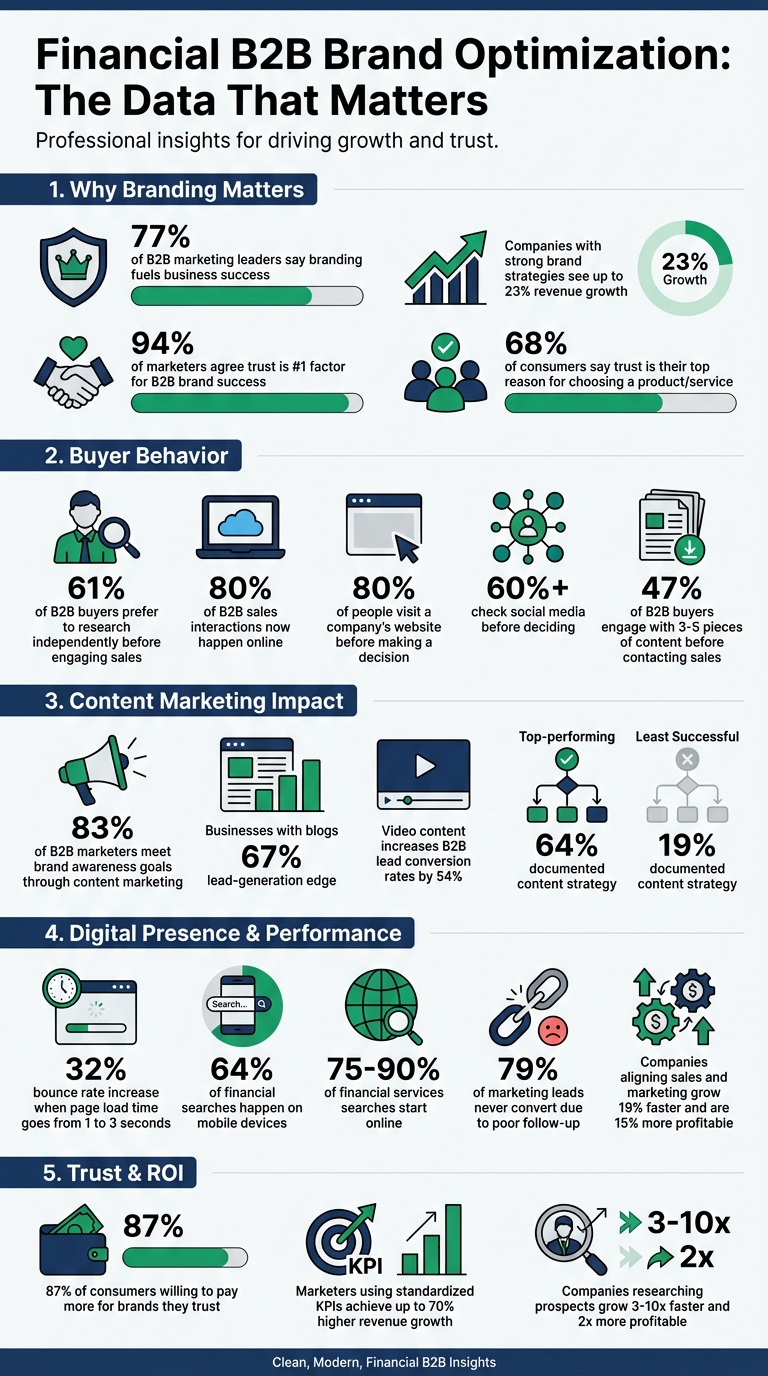
Financial B2B Brand Optimization: Key Statistics and Impact Metrics
Laying a strong brand foundation starts with understanding where your brand currently stands. To do this effectively, you need a clear value proposition and messaging that ties directly to your business goals.
Start with a brand audit to compare how your brand is currently perceived versus where you want it to be [3]. Look at both hard data - like market share, profitability, and repeat purchase rates - and softer metrics, such as trust, preference, and overall brand affinity [4]. Why does this matter? Because companies with strong brand strategies can see revenue growth of up to 23% [3]. But here's the thing: you can’t improve what you don’t measure.
Another key metric is Share of Voice (SOV), which measures your advertising presence relative to your competitors [6]. If your SOV is higher than your Share of Market (SOM), you’re likely on track for faster growth. Additionally, keep an eye on First-Fast Response (FFR) metrics - they’re 2.6 times more responsive and 4 times more predictive of future sales than traditional awareness measures [1].
"Brand is now a financial asset, not a discretionary cost." - Boston Consulting Group [1]
Don’t stop there. Research competitors - both direct and indirect - to see how they position themselves [3][5]. At the same time, define your target audience with detailed personas that include demographics, psychographics, and pain points [3][6]. Companies that take the time to research their prospects and clients grow 3 to 10 times faster and are up to 2 times more profitable [11]. Armed with this knowledge, you’ll be ready to define what makes your brand stand out.
Use the insights from your audit to identify gaps and strengths that will shape your value proposition. This proposition should clearly communicate the benefit you bring to the table. In industries like financial services, trust, expertise, and measurable results are crucial. Keep in mind that 68% of consumers say trust is their top reason for choosing a product or service [1]. For financial services specifically, reputation and prior experience often drive vendor selection [8].
To stand out, focus on market gaps or competitor weaknesses that align with your strengths [9][4]. Specialization is a powerful tool here - it helps you break away from the "sea of sameness" and even command premium pricing [9][11]. Tools like the Value Proposition Canvas can help you tailor your offerings to meet the specific needs of each client segment [4].
For example, in 2025, the B2B fintech company Yapily saw a 2.8x increase in organic inbound leads by zeroing in on bottom-of-the-funnel "money keywords" and optimizing content to rank for 94% of key buying keywords [10]. This laser-focused approach worked because it directly addressed what buyers were actively searching for.
Make your messaging relatable by using a conversational tone [9]. Highlight senior leaders and subject matter experts in your content to build credibility and establish thought leadership.
Once you’ve nailed down your value proposition, it’s time to weave it into every aspect of your brand for a consistent and impactful message.
Your value proposition is just the starting point. To make it actionable, align your brand messaging with your business objectives. Think of your messaging as a framework that informs everything from product development to customer service [4]. When your messaging supports your goals, it helps marketing and sales teams work together seamlessly, ensuring every customer interaction builds momentum toward closing deals [7].
Consistency is key. Make sure your brand voice and visual identity are uniform across all channels [13]. This is especially important in financial services, where decision-making often involves multiple stakeholders and longer sales cycles.
Take the fintech company ComplyAdvantage as an example. They used Account-Based Marketing (ABM) with personalized proposals for high-value prospects. By aligning messaging with sales goals, they achieved a 15% increase in conversion rates [12]. What made the difference? Data-driven insights replaced guesswork, guiding their strategy [4].
"Research is the bedrock of any modern marketing program... firms that conduct systematic research grow three to ten times faster." - Hinge Marketing [11]
To measure success, implement multi-touch attribution models to see how various touchpoints contribute to your goals [13]. Since 80% of people visit a company’s website before making a decision and over 60% check social media [11], it’s crucial to understand which channels are driving results. This approach ensures your messaging isn’t just consistent - it’s effective, too.
Creating top-notch content positions your brand as a trusted expert in your field. It reinforces your core brand values while amplifying your messaging. The stats back this up: 83% of B2B marketers meet their brand awareness goals through content marketing, and businesses with blogs enjoy a 67% lead-generation edge over those without one [15].
Educational content resonates because it tackles real challenges your audience faces. Formats like white papers, case studies, webinars, and expert panels not only address specific problems but also engage prospects without the pressure of a sales pitch.
For instance, in August 2023, North Star Inbound launched a digital PR campaign for Forbes Advisor, surveying over 1,000 millennials and Gen Z adults about their financial habits on social media. The findings were striking - 79% of respondents sought advice from platforms like TikTok and Reddit. This single piece of research earned 291 backlinks from authoritative sites such as ABC News and Fool.com [14].
Matching the content format to your audience's needs is critical. Blogs and how-to guides simplify complex topics and answer common questions, while e-books offer more detailed, visually engaging solutions to professional challenges. Video content, in particular, is a game-changer, increasing B2B lead conversion rates by up to 54% [15]. The focus should always be on delivering value, not pushing products.
Consistency in your messaging and branding across platforms strengthens your authority and builds trust. From your website to social media, email campaigns, and other materials, maintaining a uniform voice and visual identity creates recognition. The numbers tell the story: 64% of top-performing B2B marketers have a documented content strategy, compared to just 19% of the least successful [17].
An editorial playbook is a must-have. It should define your brand voice, tone, and messaging hierarchy. This is especially vital in industries like financial services, where compliance requirements can complicate content creation. Between 2022 and 2023, Self Financial worked with North Star Inbound to implement a multi-step compliance review process. This ensured they met regulatory standards without losing their brand's distinct voice. The result? Over 50,000 organic visits and multiple top rankings for competitive keywords [14].
Repurposing content is another smart strategy. A detailed white paper or research report can be broken down into infographics, social media posts, and email newsletters, ensuring your message reaches a broader audience while staying consistent [17] [18]. For example, LinkedIn pages that post weekly updates see 2x more engagement [17], proving that a steady flow of content matters.
SEO is all about showcasing your expertise and earning trust. Search engines prioritize content that meets E-E-A-T standards: Experience, Expertise, Authoritativeness, and Trustworthiness. Including author profiles with credentials and LinkedIn links, along with citing reliable sources like .gov sites or academic journals, boosts transparency and credibility [14].
Building topical authority is key. A "hub and spoke" model works well - create a central hub page on a core topic, linking it to detailed subtopic pages. This signals to search engines that your site is a comprehensive resource [14] [16]. In 2023, North Star Inbound used this strategy for Self Financial, focusing on interconnected articles about rebuilding credit. They even captured the Google Image Pack for "credit report example" with professionally designed infographics, proving the power of visuals in SEO [14].
"Answer engine optimization (AEO) exposes a gap that's long been hiding in plain sight. Most content is designed to explain - but when marketers stop at answering questions and avoid framing comparisons, trade-offs, and decisions, they hand that responsibility to AI systems and third-party sources." - Lisa Gately, Content Strategy Lead, Forrester [20]
As AI-driven search becomes more prominent, structuring your content to directly answer specific questions is crucial. Cover the entire buyer's journey: awareness content (broad blogs), consideration content (comparison guides), and decision content (testimonials and demos) [14] [15]. These strategies lay the groundwork for a strong digital presence, setting the stage for optimizing user experiences in future steps.
Your website isn't just a placeholder in the digital world - it’s often the first impression prospects have of your business. By 2025, 80% of B2B sales interactions will take place through digital channels [22], and over 70% of B2B buyers will already be well into their decision-making process before they even contact a supplier [22]. That means your online presence has to do the heavy lifting: grabbing attention, building trust, and converting visitors into leads. A strong digital presence, rooted in a clear brand identity, can turn initial interest into actionable opportunities.
Speed matters - big time. Google research reveals that as page load times increase from one second to three seconds, the likelihood of visitors bouncing jumps by 32% [22]. In financial services, where the average session lasts just 82 seconds [2], every second counts. Your website must load quickly, deliver your value proposition upfront, and direct users to key information without delay.
Mobile optimization is no longer optional. With over 64% of financial searches happening on mobile devices [21], and Google prioritizing mobile-friendly sites in its rankings, your site needs to shine on smaller screens. Beyond speed and responsiveness, adding interactive tools - like ROI calculators or financial assessments - can transform your site from a static page into an engaging experience that keeps visitors around longer.
Your website’s navigation should feel natural and logical, helping users quickly find what they need. Clear calls-to-action (CTAs) are essential, whether prompting visitors to download a whitepaper, schedule a consultation, or explore a case study. And here’s a key insight: 68% of consumers cite authenticity as the top driver of their purchase decisions [1]. This means your site design should balance professionalism with a genuine, approachable tone. Real-world endorsements, like testimonials, can further enhance this authenticity.
In an industry where trust is everything, social proof is invaluable. Testimonials and case studies can validate your expertise far better than self-promotion. In fact, 87% of consumers are willing to pay more for products from brands they trust [19], and trust-building can lead to an 8-point boost in First-Fast Response (FFR) scores [1].
Case studies should go beyond listing achievements. Focus on how you solved specific client challenges and delivered measurable results. Organize these stories by audience type or financial service category - such as IRA management or institutional investing - to show your depth of expertise [21]. Sprinkle testimonials throughout your site, not just on a dedicated page. Place them near CTAs, on service pages, or even in email campaigns for maximum impact. To ensure compliance with financial regulations, involve your legal and compliance teams early in the process [21].
"The feeling of trust comes down to distributing our content and thought-leadership through digital marketing platforms to explain the definition of trust." – Heather Collins, Director and Head of U.S. Brand Marketing, RBC Capital Markets [21]
While testimonials build confidence, effective lead capture systems can help turn that confidence into action.
With 75% to 90% of financial services searches starting online [25], it’s clear that digital channels are critical. Yet 79% of marketing leads never convert into sales, often due to poor follow-up and lead management [24]. A strong lead capture system can bridge this gap by offering prospects something valuable in exchange for their contact details.
Think beyond basic forms. Tools like ROI calculators, financial health assessments, or whitepapers on emerging trends can provide real value. For example, in 2025, a mid-market asset manager with $500 million in assets under management launched a whitepaper titled "Navigating Fiduciary Landmark Shifts" as part of a lead capture strategy. By pairing it with LinkedIn targeting and an automated nurture sequence, they achieved a 400% increase in qualified leads and reduced Customer Acquisition Costs (CAC) by 22% in just six months [27].
To maximize efficiency, integrate lead capture forms with your CRM (e.g., HubSpot or Salesforce) for instant follow-up. Automating this process ensures no lead slips through the cracks. Use lead scoring to prioritize prospects based on their engagement - someone attending a webinar signals more interest than someone who subscribes to a newsletter [23] [24]. AI-powered chatbots can also handle real-time questions and let prospects book meetings directly on your calendar [25] [26].
In 2025, George McKenna, Head of Cloud Sales at Ultima, implemented a system that combined intent data with direct dialing. Despite a typical sales cycle of 6–8 months, the firm achieved full ROI in just 8 weeks. Sales managers reduced their call volume from 150 to 30 per day while maintaining the same results, thanks to higher connect rates [26].
"Our sales managers used to make 100-150 calls per day. Now, they can achieve their targets with 30 calls a day because prospects actually pick up the phone." – George McKenna, Head of Cloud Sales, Ultima [26]
Finally, nurture sequences are key to guiding prospects from awareness to decision-making. Multi-stage campaigns keep your brand in the spotlight while respecting the buyer’s journey, ensuring your company stays top of mind as they evaluate their options [24] [27].
After converting visitors through your digital efforts, the next step is to measure and refine your brand's performance. This process transforms your brand assets into actionable insights that drive sustainable growth. In the B2B financial sector, 77% of marketing leaders see branding as essential for business growth [32]. Brand performance focuses on three key areas: internal consistency in using brand assets, how the market perceives your brand, and how those perceptions translate into revenue.
To get started, track metrics across these three pillars:
"In brand management, data is your roadmap to consistency and impact" [28].
Without baseline metrics, you're operating blindly. Track changes monthly or quarterly rather than relying on annual reports [32][33]. These insights set the stage for leveraging integrated CRM tools to make real-time adjustments.
Modern CRM systems and automation tools provide real-time insights into brand performance. AI-powered platforms can analyze vast amounts of data - social media mentions, customer reviews, service logs - using Natural Language Processing (NLP) to detect sentiment shifts before they impact your bottom line [35]. These tools can predict declines in brand awareness or sentiment three to six months ahead of traditional methods [35].
When you integrate brand tracking tools with your CRM and marketing automation systems, you empower sales and customer experience teams to make data-driven decisions [35]. For instance, financial services firms can identify prospects engaging with brand content and adjust their outreach strategies accordingly.
Visora's AI-powered platform is a great example of this approach. It combines intent signals with multi-channel touchpoint analysis, integrating brand performance data into the acquisition process. This allows financial B2B leaders to see how brand perception impacts pipeline quality in real time. By moving beyond last-click attribution to multi-touch models, firms can better understand how brand activities influence the entire buyer journey [28].
For internal consistency, monitor your Digital Asset Management (DAM) analytics. Look for "zero result" searches to identify content gaps that might hinder your sales team from staying on-brand [28]. DAM analytics also reveal which templates are actively used versus those that are overlooked, offering insights into how well your team is adopting brand assets.
Optimizing your brand is not a one-time effort - it’s an ongoing cycle. Follow a continuous loop: collect data, analyze patterns, refine assets and messaging, track results, and repeat [28].
Plan deeper strategic reviews on a quarterly basis [28]. However, if a major market event occurs - like a new competitor entering the space, an unexpected viral moment, or regulatory changes - conduct immediate "pulse checks" [32].
While AI excels at processing large datasets and spotting patterns, human marketers bring the creativity and strategic insight needed to turn technical findings into impactful initiatives [35]. Experienced marketers, for instance, produce 1.7 times more variations of high-performing content, such as videos, to maximize results [1].
Lastly, alignment across internal teams is critical. When Sales, Marketing, and Finance teams understand and adhere to brand guidelines, consistency improves - leading to stronger external recognition [28]. Conduct regular brand audits to assess recall, recognition, and reach, while monitoring social sentiment for opportunities to refine your strategy before problems arise [36]. Companies that treat their brand as a measurable financial asset, rather than a "soft" expense, consistently achieve higher EBIT margins than competitors [32].
Optimizing a financial B2B brand is a continuous effort, and as BCG highlights, treating your brand as a financial asset can lead to compounded returns over time [1]. The strategies we've covered - from establishing a strong brand foundation to using predictive metrics for performance tracking - work together to deliver real, measurable revenue growth.
When built on a strong foundation, measurable performance becomes a key advantage. Marketers who utilize standardized KPI frameworks and advanced measurement techniques can achieve up to 70% higher revenue growth compared to their peers [37]. By tying brand health directly to business outcomes, marketing evolves from being just a cost center to a strategic driver of revenue.
For financial services leaders aiming to accelerate growth, structured acquisition systems can significantly reduce timelines. Visora’s Trifecta Program, for instance, helps U.S. financial B2B leaders implement complete acquisition systems within just 12 weeks. This program focuses on three pillars: conversion optimization, AI-driven appointment setting, and strategic consulting. With partnerships spanning more than 30 financial services firms, Visora has generated over $70 million in pipeline revenue, with an average increase of $150,000 per partner.
Striking the right balance between short-term wins and long-term brand building is critical. Companies that align their sales and marketing efforts grow 19% faster and are 15% more profitable [2]. By aligning your content, digital presence, and performance measurement systems, you can refine your strategy while maintaining the trust of discerning decision-makers. This balance ensures that immediate successes contribute to the enduring strength of your brand.
While trends like AI-driven personalization and answer engine optimization continue to evolve, the core principles remain unchanged: define a clear value proposition, produce educational content that establishes authority, optimize your digital presence for conversions, and measure everything. By sticking to these fundamentals, you can build a competitive edge that delivers growing returns over time.
To gauge how well a brand is performing, financial B2B companies should focus on metrics that tie brand perception to measurable business results. Start by monitoring brand perception metrics like awareness, trust, and relevance through regular surveys. Pair these with performance indicators such as lead-to-opportunity conversion rates, average deal size, and revenue generated from brand-focused campaigns.
Quarterly brand health audits are another valuable tool. These audits can assess employee engagement and investor confidence, offering a clearer picture of the brand’s overall impact. Using modern tools - like AI-powered platforms - can make data collection more efficient, predict trends, and deliver real-time insights into brand ROI. When these insights are aligned with strategic objectives, companies can clearly show how their brand contributes to growth, lowers churn, and boosts shareholder value.
Educational content plays a key role in establishing trust within the financial B2B space. It allows businesses to highlight their expertise and dependability by offering resources like guides, whitepapers, webinars, and case studies. Instead of focusing solely on selling, this strategy shifts the emphasis to educating, positioning companies as trusted advisors. This not only encourages potential clients to engage but also helps ease any concerns they may have.
In the financial B2B world, decision-makers often review multiple pieces of content before committing. Sharing consistent, high-quality materials - such as blog posts, podcasts, or research reports - keeps prospects informed and builds credibility at every stage of their buyer’s journey. Visora enhances this process by leveraging AI-powered tools to help financial B2B firms craft and distribute educational content that inspires trust and supports business growth.
A solid digital presence is crucial for financial B2B brands. Why? It helps establish trust with potential clients by offering professional, easy-to-navigate online platforms. First impressions matter, and a well-designed digital space can set the tone for strong business relationships.
Beyond trust, it boosts visibility by using targeted, data-driven strategies to connect with the right audience. In a crowded market, reaching the people who matter most can make all the difference.
Another key benefit? Access to analytics and insights. These tools allow businesses to fine-tune their strategies, build credibility, and stay competitive in a world that's becoming more digital by the day.
%20(5).png)
