%20Bold.png)
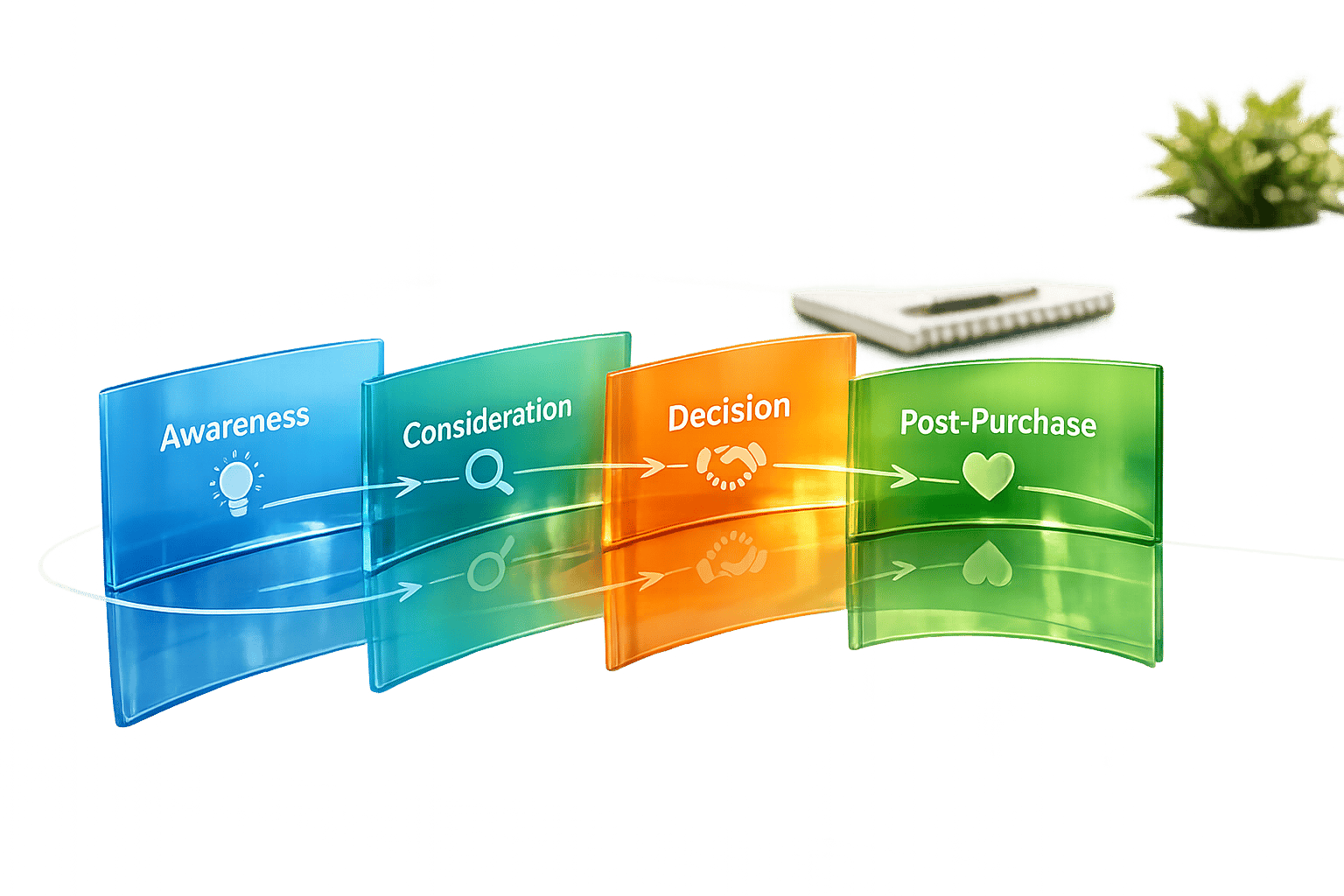
Most B2B companies struggle to align their content with the buyer's journey, leading to missed opportunities and stalled sales cycles. The key to fixing this is mapping content to each stage of the buyer journey - Awareness, Consideration, Decision, and Post-Purchase. By doing so, you can deliver the right information at the right time, shorten sales cycles, and build trust with prospects.
Here’s the gist:
Companies that align content with the buyer journey see 47% higher conversion rates and up to 3x more leads. Start by auditing your content for gaps, create targeted materials for each stage, and use tools like intent data to deliver content when it’s needed most.
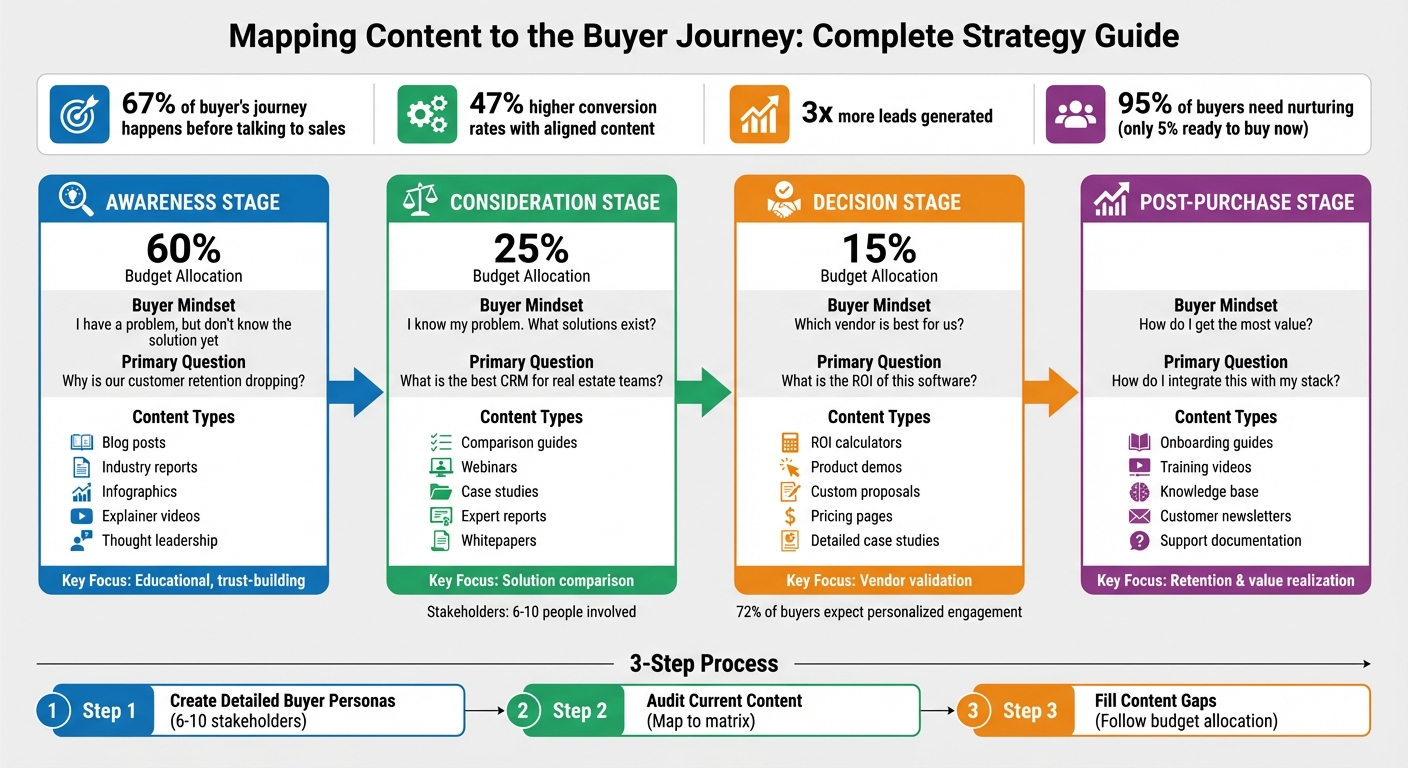
Content Mapping to Buyer Journey: Budget Allocation and Strategy Guide
The B2B buyer journey unfolds in four distinct stages, each with unique behaviors and content needs. Recognizing these stages is crucial because 67% of the buyer's journey happens before a prospect even speaks to a sales representative [3]. In industries like finance and real estate - where sales cycles can span 3 to 12 months and involve buying committees of 6 to 10 stakeholders - delivering the right content at the right time can determine whether deals move forward or stall.
Here’s a key insight: only 5% of your target market is ready to buy right now. The other 95% will enter the market later [3]. This means your content strategy should focus heavily on educating and building trust with that 95%, ensuring your brand is top of mind when they’re ready to make a decision.
| Stage | Buyer Mindset | Primary Question | Key Stakeholder Focus |
|---|---|---|---|
| Awareness | "I have a problem, but I don’t know the solution yet." | "Why is our customer retention dropping?" | All roles - problem identification |
| Consideration | "I know my problem. What types of solutions exist?" | "What is the best CRM for real estate teams?" | Managers and technical evaluators - solution comparison |
| Decision | "I’ve chosen a category. Which vendor is best for us?" | "What is the ROI of this financial software?" | CFOs and executive sponsors - vendor validation |
| Post-Purchase | "How do I get the most value from this purchase?" | "How do I integrate this with my existing stack?" | End users and customer success - value realization |
Let’s explore each stage and how targeted content can guide buyers through their journey.
In the Awareness Stage, focus on building trust through educational content. Buyers here are aware of a challenge but don’t yet know what the solution looks like. For instance, a leader in real estate syndication might notice a drop in investor inquiries after initial contact. They may start searching broadly for answers like, "Why is our customer churn rate increasing?" or "How to improve investor follow-up in real estate" [3].
The key is to provide educational assets such as blog posts, reports, and explainer videos. These formats help prospects clarify their challenges without feeling pressured to buy. Industry reports, infographics, and thought leadership pieces are particularly effective here. Since 95% of your audience is at this stage, allocate about 60% of your content budget to creating resources that foster trust and credibility [3].
In industries like finance and real estate, buyers tend to be cautious and seek reliable sources. Content backed by third-party research, data-driven insights, and expert opinions resonates much more than overtly sales-focused materials. Early engagement ensures your brand stays top of mind when buyers are ready to act [3].
Once buyers have defined their problem, they shift to the Consideration Stage, where they actively research potential solutions. At this point, buyers are comparing different approaches to solve their challenge. For example, a commercial real estate leader might search for "CRM for real estate with mobile app" or "types of sales automation software" [3]. They’re crafting purchase requirements and narrowing down their options.
The most effective content here includes comparison guides, webinars, case studies, and expert reports. These formats help buyers weigh the pros and cons of each solution while subtly positioning your offering as the best choice.
This stage often involves multiple stakeholders with varying priorities. A technical evaluator might focus on specifications and integration capabilities, while a business user prioritizes ease of use and workflow improvements. Your content should address these diverse concerns. Plan to allocate about 25% of your content budget to assets designed for this stage [3].
In the Decision Stage, buyers have narrowed their options to a few vendors and are now evaluating specific solutions. They’re focused on product features, pricing, and implementation details. CFOs, for instance, may require ROI calculators and total cost of ownership analyses, while technical leads want demos and security certifications. Executive sponsors, on the other hand, look for strategic alignment and risk mitigation [3].
Content like ROI calculators, custom proposals, product demonstrations, pricing pages, and detailed case studies is essential here. In industries like B2B finance and real estate, where purchases often involve significant investments, buyers need clear, specific proof that your solution delivers measurable results. Generic marketing won’t cut it at this stage.
Personalization is critical - 72% of B2B buyers expect vendors to tailor their engagement to specific needs [4]. For instance, a real estate investment firm evaluating a CRM system will want examples relevant to their industry, not generic software demonstrations. About 15% of your content budget should be dedicated to Decision-stage materials [3].
The journey doesn’t end with a purchase. In the Post-Purchase Stage, the focus shifts to ensuring clients achieve success with your product. New customers need guidance to onboard effectively, adopt the product fully, and achieve their first measurable win. Content like onboarding guides, knowledge base articles, training videos, and customer newsletters plays a key role here [2].
In industries like finance and real estate, where client relationships can last for years, this stage is crucial for retention and growth. A satisfied financial services leader who sees ROI can become a valuable reference account. Additionally, the feedback you gather during this stage can highlight gaps in your earlier content. For example, if clients repeatedly ask the same implementation questions, you may need to refine your Decision-stage materials. Regularly updating your content map based on client feedback ensures you’re addressing actual challenges, not just assumptions [2].
Mapping content to the buyer journey starts with understanding what buyers need at each stage. Many B2B companies skip this crucial step, then wonder why their content fails to convert. Buyers are drawn to vendors who show they understand their challenges by delivering the right content at the right time. Once you’ve defined your buyer personas, it’s time to match your content to each stage of their journey.
Start by creating personas that represent the key decision-makers in your target accounts. In B2B sales, you’re often dealing with a group of 6–10 stakeholders, each with their own priorities [3]. For example:
To make these personas accurate, interview your sales team. Ask them questions like: What do your best customers have in common? What prompted them to start searching for a solution? Why did they choose your product over competitors? What goals have they achieved since partnering with you? [5]. This approach ensures you’re using real feedback instead of relying on guesswork.
Don’t just stop with job titles or demographics. Dig deeper to identify the specific questions each persona is asking at every stage of the journey. For instance, if sales teams frequently hear prospects say, “We’re struggling to follow up with investors,” that exact phrase should appear in your Awareness-stage content. Addressing these questions directly ensures your content resonates with what buyers are actively searching for.
Once you’ve nailed down your personas, it’s time to audit your existing content. Create a matrix with buyer personas listed vertically and journey stages (Awareness, Consideration, Decision, Post-Purchase) listed horizontally [6]. Then, tag each piece of content - blog posts, case studies, webinars, etc. - with the stage and persona it serves. Any gaps in the matrix highlight where missing content could be holding up deals.
A common issue for many B2B companies is having plenty of Decision-stage content (like pricing pages or product demos) but very little for Awareness or Consideration stages. That’s a problem because 67% of the buyer’s journey happens before they ever talk to sales [3]. Analyze your conversion data to see which pieces are working. For example, if a whitepaper gets lots of downloads but doesn’t lead to further engagement, it might need a refresh.
Look for patterns in the gaps. Maybe you have strong Awareness content for CFOs but nothing for technical leads, leaving part of the buying committee out of the loop. Or perhaps your Consideration-stage content is too generic - like a “Top 10 CRM Features” list - when something more specific, like “Best CRM for Commercial Real Estate Teams,” would perform better. Tools like G2 or Capterra can help you identify the filters buyers use when comparing solutions [3].
Filling those gaps requires strategic planning. Allocate your resources thoughtfully: 60% of your budget should go toward Awareness, 25% toward Consideration, and 15% toward Decision-stage content [3]. This aligns with the 95/5 Rule: only 5% of your audience is ready to buy right now, while the other 95% will need nurturing before they enter the market.
Don’t forget about Post-Purchase content. Resources like onboarding guides, training videos, and knowledge base articles help new customers get quick wins, which boosts retention and referrals. Regularly update your content map based on customer feedback. For instance, if clients keep asking the same implementation questions, it’s a sign your Decision-stage content could use some work [2].
For leaders in financial services and commercial real estate, mapping content to align with the buyer's journey can feel daunting. Even when you know the type of content required, delivering the right message at the perfect time demands precision. Visora's Trifecta Program simplifies this process by combining intent-based funnels, AI-driven outreach, and expert consulting to turn content mapping into a revenue-generating strategy across every stage of the buyer's journey.
The B2B Vortex Funnel pinpoints buyer intent by analyzing behavioral signals such as visits to pricing pages, whitepaper downloads, and spikes in third-party research on specific topics [7]. By assigning weight to actions - like giving more importance to repeated visits to a pricing page than a single blog view - the funnel ensures content is delivered within the critical intent window, before interest fades [7].
Here’s how it works across the buyer journey:
The funnel also integrates Ideal Customer Profile (ICP) scoring with intent data, ensuring efforts are concentrated on high-intent, well-matched accounts [7]. For instance, if a CFO at a financial services firm repeatedly visits a pricing page, the system might deliver a personalized ROI calculator tailored to their industry. This level of precision helps convert interested prospects into qualified leads [1].
Building on this data, the AI Augmented Appointment Setting system takes personalization to the next level.
Timing is everything when a prospect reaches the Decision stage. Visora’s AI Augmented Appointment Setting syncs intent signals directly to your CRM in real time, alerting sales reps when prospects show high intent - like requesting a demo or comparing competitors. By combining ICP fit with intent scores, the system prioritizes outreach to the most promising accounts [7].
Here’s how it works:
Personalization is key. Outreach references specific topics or products the prospect has researched, making it feel timely and relevant rather than intrusive. For example, if a commercial real estate leader has been reading about "Best CRM for Real Estate Teams" and visits a comparison page, the system might trigger an email offering a demo focused on CRM features for real estate.
The program also audits your content library to ensure Decision-stage resources - like case studies or product demos - are always available to address final concerns [2]. By acting within the critical intent window, this system ensures your team connects with prospects before competitors do [7].
"Impressed with how we're able to get this amazing data ...and action it based upon what that person did is just really incredible." - Josh Carter, Director of Demand Generation, Pavilion [7]
Once a prospect becomes a client, the focus shifts to maintaining long-term engagement.
Visora's DD Strategic Advisory helps financial and real estate leaders build systems that foster deeper client relationships. The goal is to integrate relationship-building processes into daily operations, ensuring they don’t rely solely on the founder's involvement [8][9].
Retention efforts include establishing standard operating procedures for onboarding, regular client reviews, and consistent communication. Engaged customers are 50% more likely to try new products and spend 31% more than new customers [9]. The program also helps firms create a structured service calendar, detailing touchpoints like newsletters, check-ins, and reviews throughout the year. This demonstrates ongoing value and keeps clients engaged [10].
"A client who feels heard, understood, and cared for is more likely to remain engaged and loyal to your firm." - Joe Buhrmann, Practice Management Consultant, eMoney Advisor [10]
Retention pays off significantly in financial services. A practice with a 98% annual client retention rate can command a valuation 20-30% higher than one with a 92% retention rate [9]. Visora’s systems have shortened deal cycles by over 50% and saved leaders more than 40 hours per month [8], allowing them to focus on high-impact client relationships. For instance, a real estate syndicate implemented Visora’s engagement strategies and generated over $2.25 million in new project and partnership opportunities within just 45 days.
Aligning your content strategy with the buyer journey isn't just a smart move - it's essential for building a steady, predictable sales pipeline. With 95% of prospects requiring nurturing, awareness-stage content plays a critical role in establishing trust long before they’re ready to evaluate solutions [3]. From there, consideration-stage content positions your offering as the ideal choice, while decision-stage assets provide the proof and reassurance buyers need to confidently move forward. Each stage demands its own format, messaging, and timing to meet buyers where they are in their decision-making process.
As outlined earlier, the key isn't just creating content - it’s about delivering the right message at the right time. This is where Visora’s Trifecta Program steps in to close the gap between strategy and execution. The B2B Vortex Funnel leverages behavioral signals to match content with buyer intent automatically. Meanwhile, AI Augmented Appointment Setting ensures your sales team connects with high-intent prospects before your competitors can. Finally, DD Strategy Consulting establishes retention systems that transform new clients into loyal, long-term partners.
If 45% of marketers struggle to create content that resonates with their audience [11], the answer isn’t producing more content - it’s crafting targeted content for every stage of the buyer journey and delivering it with precision. Start by auditing your existing content library to pinpoint gaps across the stages. Then, align your sales and marketing teams to ensure smooth handoffs and shared definitions. Companies that master this process don’t just generate leads - they see 3x more organic leads compared to those focusing solely on decision-stage content [3].
Take a closer look at your content strategy and identify where improvements can be made. By adopting a systematic approach to content mapping, you’ll boost lead generation and drive more predictable revenue. Ready to accelerate deal cycles and create consistent growth? Schedule a discovery call with Visora to get started.
To figure out which buyer stage a piece of content fits into, think about its goal and the kind of information it delivers. Here's how it breaks down:
By tailoring content to these stages, you ensure it answers the right questions and tackles the challenges buyers face at each step.
To quickly assess your content for gaps in the buyer's journey, start by mapping your existing content to the key stages: Awareness, Consideration, and Decision. Look for areas where buyer needs or questions aren’t addressed. Then, go through your content inventory to spot anything outdated or off-target. This method zeroes in on buyer intent and progression, making your audit both efficient and impactful.
To truly connect with your prospects, you need to understand what they’re searching for and where they are in their buying journey. That’s where intent data comes in. It reveals the research and buying signals of your audience, helping you craft content that speaks directly to their needs - whether they’re in the awareness, consideration, or decision stage.
By digging into these intent signals, you can fine-tune your messaging to align with their interests and challenges. This means your engagement becomes more relevant, their journey through the funnel feels effortless, and your chances of converting them into customers increase significantly.
%20(5).png)
