%20Bold.png)

Revenue attribution helps B2B teams connect marketing and sales efforts directly to revenue, offering clarity on what drives business growth. Many companies struggle with fragmented data, misaligned teams, and unreliable ROI metrics. This checklist provides an 8-step process to set goals, clean data, map customer journeys, choose the right attribution model, and streamline collaboration across teams. By aligning marketing and sales with accurate data, you can identify high-impact touchpoints, allocate budgets effectively, and improve decision-making.
Key takeaways:
This guide simplifies the path to building a unified revenue attribution strategy, helping B2B teams work smarter and achieve measurable results.
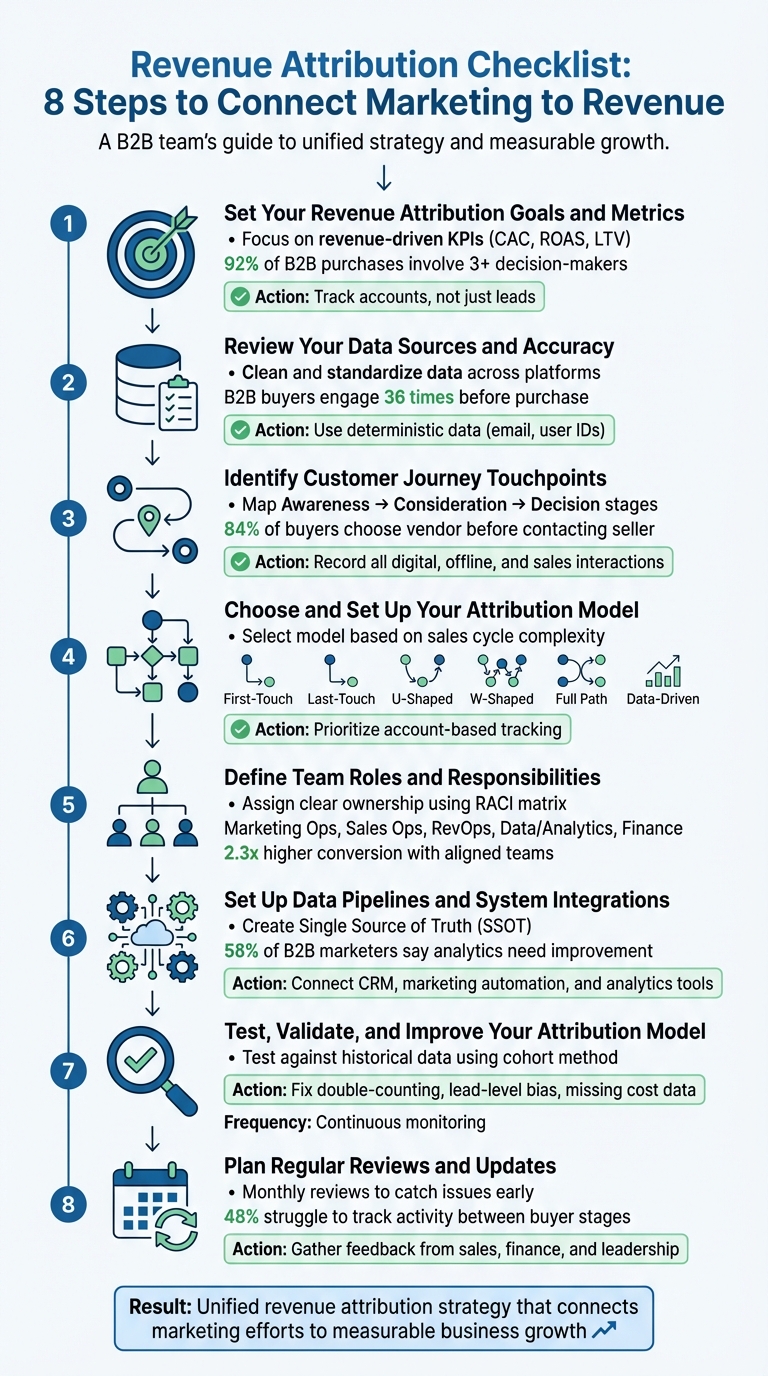
8-Step Revenue Attribution Implementation Process for B2B Teams
Your attribution goals should align with what truly drives your business forward - not just what’s easy to track. Shifting focus from vanity metrics like page views and MQLs to revenue-driven KPIs is a critical step. Many CMOs are already tying their goals directly to revenue targets.
Start by identifying your key business priorities. If profitability is your main focus, prioritize metrics like ROI and budget efficiency. If growth is the goal, keep an eye on early-stage opportunities and account-based marketing (ABM) metrics. For businesses focused on long-term success, metrics such as customer lifetime value and closed-won revenue will be more relevant. In the B2B space, an account-based approach is especially crucial. With 92% of B2B purchases involving three or more decision-makers, tracking accounts and buying groups - not just individual leads - is essential. This shift has led to the rise of Marketing Qualified Accounts (MQAs) and buying group engagement metrics, while reliance on traditional lead-based measures like MQLs has dropped by 10% to 18%.
Before setting new goals, dig into your historical data to establish benchmarks. For instance, if your marketing team currently influences 70% of your pipeline, aim to increase that figure to 75% over the next year. This ensures your goals are realistic and firmly tied to measurable business outcomes.
Once your goals are clear, focus on choosing metrics that will provide meaningful insights into your progress.
With your goals in place, it’s time to pick metrics that genuinely reflect your progress. Metrics like Customer Acquisition Cost (CAC) and Return on Ad Spend (ROAS) are invaluable - provided you integrate cost data from your ad platforms. Without this integration, your ROI calculations may not tell the full story. Be sure to track both marketing-sourced and marketing-influenced revenue to get a complete picture of your team’s impact.
For account-based strategies, prioritize metrics such as MQAs, ABM pipeline, and buying group engagement. These reflect how B2B deals actually unfold - buyers typically engage with vendors an average of 36 times before making a decision. Since many buyers settle on their preferred vendor early in the process, tracking engagement across groups is key to staying competitive.
Efficiency metrics like CAC, ROAS, and LTV are also critical, as they connect your spending directly to profitability. Additionally, consider monitoring "uncontested losses" - deals within your target accounts that were won by competitors without your team even being involved. This can help identify gaps in your marketing reach. Regularly audit these metrics against your CRM data to ensure they align with your internal pipeline reports.
Before relying on attribution insights, take a step back and evaluate how you're gathering data. Start by mapping out all the platforms where your customer data resides - this could include your CRM, marketing automation tools, ad platforms, website analytics, and even offline sources like event registrations or sales calls. The aim here is to pinpoint areas where your data might be incomplete, inconsistent, or just plain wrong.
Keeping your data clean is non-negotiable. Regularly check for duplicates, standardize naming conventions (e.g., "Company Inc." versus "Company, Inc."), and ensure your teams are aligned on data capture processes. This consistency is crucial for building an attribution model that can piece together the entire customer journey.
Whenever possible, prioritize deterministic data - things like email addresses, user IDs, or CRM account IDs - over probabilistic methods. As Ryan Koonce, CEO of Attribution, explains:
"The primary problem that most marketers run into is they've actually never seen attribution that works…anything that uses Google Tag Manager or the Google infrastructure doesn't provide transparency. You can't see cost - ever".
If you can't dig into your raw data, it's hard to trust the insights your attribution model is delivering.
And don't forget offline interactions. Sales calls, trade show visits, and direct mail campaigns should all be logged in your CRM. Missing these touchpoints can leave gaps in your understanding of the customer journey, which is especially problematic when you consider that B2B buyers typically engage with a brand an average of 36 times before making a purchase. Reliable revenue attribution starts with accurate, comprehensive data that reflects every interaction.
Once you've cleaned up your data, the next step is integrating it into a unified system across your teams.
One major challenge for B2B teams is fragmented data. Marketing campaigns might live in one platform, sales interactions in another, and revenue tracking in yet another. This scattered setup often forces teams to manually piece together spreadsheets just to get a basic performance overview.
The solution? Start with unified account-level identifiers, like a company domain or CRM Account ID, to link all interactions. This is especially critical in B2B, where 92% of purchases involve three or more decision-makers. Treat all touchpoints as part of a single account journey rather than isolated events.
Next, integrate your ad platforms - LinkedIn, Google, Facebook - using APIs to automatically pull in cost data. Without these connections, you risk misjudging channel performance. For instance, some channels might look great in terms of conversions but turn out to be unprofitable once costs are factored in. Many standard CRM reports miss this cost data, which makes direct integration even more important.
To tie everything together, centralize your data in a warehouse. This creates a single source of truth where all your tools converge, allowing you to build a unified timeline of each account’s journey. The growing importance of this approach is reflected in the Customer Data Platform market, projected to hit $28.2 billion by 2028. Regular audits against internal records can help you catch issues like double-counting or misattributed conversions before they skew your insights.
The B2B buyer's journey can be divided into three main stages: Awareness (when prospects start researching their challenges), Consideration (when they explore potential solutions), and Decision (when they evaluate vendors and make a purchase). To understand what drives revenue, your attribution model must track the key touchpoints across these stages.
Start by creating a clear timeline that both teams can use to monitor a prospect's journey. Instead of viewing interactions as isolated events, think of them as pieces of a story that illustrate how a prospect moves from their first interaction to becoming a customer.
In B2B, decisions often involve multiple stakeholders. A typical purchase includes several decision-makers, and these teams can have anywhere from 100 to 200 interactions with vendors during the buying process. Because of this complexity, it’s essential to map touchpoints at the account level rather than focusing solely on individual contacts. Aggregating all interactions under a single account provides a clearer picture of how the entire buying team engages with your brand.
| Buyer Journey Stage | Typical Touchpoints to Map | Attribution Goal |
|---|---|---|
| Awareness | Organic search, blog visits, third-party ads, e-book downloads | Identify top-of-funnel lead sources |
| Consideration | Webinars, case studies, email clicks, booth visits at conferences | Measure nurturing effectiveness |
| Decision | Product demos, pricing page views, sales calls, proof of value | Identify the "deal-sealing" interactions |
It’s important to note that not all touchpoints carry the same weight. For example, a demo request or a visit to the pricing page shows much stronger buying intent than a simple social media interaction. Assign strategic importance to touchpoints based on their influence on the deal. This ensures your resources are focused on the interactions that have the greatest impact.
Once you’ve outlined the major stages, document all the interactions within each stage to build a complete view of the customer's journey.
B2B buyers typically engage with a brand multiple times before making a purchase. Missing any of these interactions can create gaps in your attribution model.
To avoid this, make sure to capture all types of interactions - digital (ads, organic search, website visits, content downloads), offline (conferences, trade shows, printed materials), and sales-driven (calls, demos, contract discussions). Tools like UTM parameters, click tracking, and unique identifiers can help automate data collection for digital touchpoints.
Offline channels often have a delayed impact. For example, the value of a trade show might not be clear until weeks or months later when it leads to direct website visits or branded searches. To ensure these events aren’t overlooked, have your sales team log them into your CRM as soon as they occur. Research shows that touchpoints are fairly evenly split between pre-sales (53%) and sales (47%), so neglecting sales interactions means losing half the story. Additionally, since 84% of buyers have already chosen a preferred vendor before contacting a seller, capturing early-stage anonymous website visits and third-party intent signals is critical.
The ultimate goal is to connect all these data points into a single system. Your CRM, website analytics, and email marketing tools should integrate into one unified timeline that tracks the entire account journey. This timeline - from the first interaction to the signed contract - will help you pinpoint the touchpoints that truly drive revenue.
Now that you’ve mapped out all customer touchpoints, it’s time to choose the attribution model that best aligns with your business goals.
Attribution models are generally grouped into three categories: single-touch, rules-based multi-touch, and data-driven.
Here’s a quick comparison of common attribution models:
| Model Type | Best Use Case | Primary Strength | Main Weakness |
|---|---|---|---|
| First-Touch | Brand Awareness | Highlights top-of-funnel drivers | Ignores all nurturing efforts |
| Last-Touch | Short Sales Cycles | Identifies final conversion trigger | Overvalues the last interaction |
| Linear | Long Consideration Cycles | Simple and inclusive | Over-credits minor interactions |
| U-Shaped | Lead Generation Focus | Emphasizes "opener" and "closer" | Undervalues middle interactions |
| W-Shaped | Complex B2B Journeys | Tracks key milestones | Hard to pinpoint middle touchpoints |
| Time Decay | Promotional/Short Cycles | Reflects momentum-building efforts | Undervalues early awareness |
| Data-Driven | High Data Volume Needs | Highly accurate and adaptable | Requires advanced tools and data |
Once you understand the different models, the next step is to select one that fits your sales cycle and customer journey.
For shorter, simpler sales processes, Last-Touch or Time Decay models may suffice. However, most B2B companies face longer, more intricate buying cycles that involve multiple decision-makers - 92% of B2B purchases are made by groups of three or more stakeholders. In these cases, W-Shaped or Full Path models often provide a clearer picture by accounting for key milestones like lead creation and opportunity creation.
Your choice should also reflect your business priorities:
Account-based attribution is another critical factor for B2B. Since 84% of buyers already have a preferred vendor in mind before reaching out to a seller, it’s essential to track the collective engagement of all stakeholders within an account. Aggregating interactions under a single account provides a more accurate view of the buying journey.
Additionally, consider weighting touchpoints by signal strength. Not all interactions carry equal importance. For example, a demo request or a visit to your pricing page signals stronger intent compared to a casual blog visit or a social media like. Assigning higher weight to these "strong signals" ensures your model focuses on the touchpoints that truly impact revenue.
After choosing a model, you’ll need the right tools to bring it to life. At a minimum, you’ll need:
A Customer Data Platform (CDP) or data warehouse can serve as the backbone of your attribution system by unifying first-party data from all channels into a single, reliable source. This eliminates the chaos of managing data in spreadsheets and reduces errors. Look for tools with pre-built connectors and APIs that automatically sync data, minimizing manual effort.
When implementing, prioritize deterministic attribution over probabilistic models. Deterministic methods use unique identifiers, like email addresses or user IDs, to track individual paths to purchase with precision. In contrast, probabilistic models rely on statistical estimates, which can introduce guesswork. Deterministic attribution provides greater accuracy and clarity.
For teams that want to streamline the process, solutions like Visora’s AI-enabled tools can simplify implementation. Their advanced CRM systems and marketing platforms integrate seamlessly with existing tech stacks, while their consulting services help configure the right model for your specific needs. This eliminates the trial-and-error phase, saving time and ensuring a solid foundation for your attribution strategy.
Finally, adopt cohort-based analysis to measure ROI based on campaign start dates rather than conversion dates. This approach allows for fair comparisons of campaign performance over long sales cycles, giving you a clearer understanding of what’s working and where to invest further.
For an attribution model to work effectively, every team member needs a clear understanding of their role. Without defined responsibilities, attribution efforts can falter. Assigning specific tasks ensures everyone knows their part in the process.
Attribution requires clear ownership of tasks like data collection, analysis, and reporting. Without this, you risk duplicate data, tracking gaps, or disputes over credit allocation.
Using a RACI matrix can clarify who is Responsible, Accountable, Consulted, and Informed for each task. Here's an example of how responsibilities can be assigned:
| Team Role | Primary Attribution Responsibility | Key Deliverables |
|---|---|---|
| Marketing Ops | Tracking & Taxonomy | Standardized UTM and campaign tagging |
| Sales Ops | CRM Integrity | Opportunity stage definitions, activity logging |
| Data/Analytics | Model Engineering | Data warehousing, quality control, reporting logic |
| RevOps | Strategy & Alignment | Cross-functional coordination, dashboard creation |
| Finance/FP&A | Financial Validation | ROI/ROAS reconciliation, LTV:CAC calculations |
To ensure accuracy, establish Service Level Agreements (SLAs) for data entry. For example, sales teams should log offline interactions within a specific timeframe to avoid overemphasizing digital channels and undervaluing sales contributions.
Once roles and responsibilities are clearly defined, the focus shifts to fostering collaboration across marketing, sales, and analytics teams.
Assigning roles is just the first step. Effective attribution depends on seamless communication and alignment among marketing, sales, and analytics teams. Companies that align these functions with the buyer's journey see 2.3 times higher sales conversion rates. Yet, 58% of B2B companies admit their marketing performance analysis capabilities need improvement.
The challenge lies in differing priorities. Marketing wants to know which campaigns generate pipeline. Sales needs insights into lead quality and the best-performing channels. Analytics teams focus on ensuring data accuracy. Meanwhile, the C-suite looks for clear connections between marketing investments and revenue growth.
To bridge these gaps, hold quarterly reviews where all teams come together to reassess the model, review lead quality, and adjust budgets based on the latest data. These meetings help prevent silos, promote shared understanding, and support ongoing improvement.
"Attribution isn't about credit. It's about finding directional truth." - Nadia Davis, VP of Marketing, CaliberMind
Gaining executive support early is essential. Attribution insights can sometimes challenge assumptions, such as revealing that a heavily funded channel isn’t performing as expected. When this happens, having leadership on board ensures teams accept the findings rather than questioning the methodology.
Keep in mind that B2B buying decisions often involve 6.8 decision-makers. This means your attribution strategy must focus on tracking accounts, not just individual leads. Marketing Ops should use automated tools to deduplicate accounts and link all touchpoints to a unique Account ID. Shifting to account-based tracking better reflects the reality of B2B purchasing.
Lastly, address the "dark funnel" - those untrackable touchpoints like word-of-mouth, Slack communities, or podcasts. Attribution teams can supplement automated tracking with intent data or simple form fields like "How did you hear about us?" to capture these valuable interactions.
After defining roles, the next step is to connect your CRM, marketing automation, and analytics tools. This ensures your attribution data is centralized and reliable. A unified data infrastructure helps avoid the fragmentation that often disrupts marketing efforts. In fact, 58% of B2B marketers in 2022 admitted their marketing analytics needed improvement or were inadequate. Let’s dive into how to integrate these systems and build a dependable data foundation.
Attribution models rely heavily on a Single Source of Truth (SSOT) - a centralized database that harmonizes data from multiple sources and eliminates inconsistencies. Without it, you’ll find different platforms reporting conflicting numbers, with your CRM saying one thing and ad platforms taking credit for the same deals.
To get started, connect your key systems:
Use ETL tools like Improvado or Funnel.io to automate data consolidation into a centralized warehouse. These tools reduce manual work and help avoid errors caused by human intervention.
Standardized UTM naming conventions are critical. For example, mixing terms like "paid" and "ad" for the same medium can create chaos in your data. Hidden fields in lead forms should capture UTM parameters, referrers, and conversion pages to ensure accurate tracking.
"The primary problem that most marketers run into is they've actually never seen attribution that works… anything that uses Google Tag Manager or the Google infrastructure doesn't provide transparency. You can't see cost - ever." - Ryan Koonce, CEO, Attribution
To protect data integrity, lock down CRM fields to prevent accidental overwrites of critical information like "original source" or "campaign history".
Here’s a breakdown of tools that can help create a seamless data ecosystem:
| Tool Category | Essential Platforms | Primary Function |
|---|---|---|
| CRM | Salesforce, HubSpot | Revenue mapping and lead management |
| Marketing Automation | Marketo, HubSpot | Campaign execution and lead nurturing |
| Analytics | Google Analytics 4 (GA4) | Event tracking and conversion analysis |
| Attribution Engines | Dreamdata, Bizible, HockeyStack | Multi-touch credit allocation and ROI |
| Data Pipeline/ETL | Improvado, Funnel.io | Consolidating siloed data into a warehouse |
| BI/Visualization | Tableau, PowerBI | Visualizing complex data patterns |
To streamline error management, create an "Error View" in your CRM or analytics tools. This can help identify leads with mismatched data, such as "Original Source: Known" but "Custom Channel: Unknown". For platforms like HubSpot, set a 1-minute delay in workflows to ensure all tracking data syncs before categorization logic is applied.
As your business scales, your data pipeline needs to handle increasing complexity. With B2B buyers interacting an average of 36 times before making a purchase, your infrastructure should be robust enough to process this activity without breaking.
Start with a simple attribution model and expand as your data capabilities improve. Opt for tools with native connectors for popular CRMs and ad platforms to reduce maintenance costs and avoid custom integration headaches.
For account-based attribution, incorporate identity resolution using identity graph data structures. This allows you to track interactions across multiple decision-makers within a single organization. Given that B2B buying decisions often involve 6–10 stakeholders over several months, individual-level attribution won’t cut it.
As third-party cookies are phased out, prioritize first-party tracking through Customer Data Platforms (CDPs) or server-side tracking. This ensures data continuity while adhering to privacy regulations. Techniques like fingerprinting, server-side tracking, and consent-based mechanisms will help maintain accuracy in a cookieless world.
To keep your pipeline clean, automate processes like deduplication, normalization, and error correction. Perform quarterly audits of your attribution model and data pipelines to account for changes in marketing channels or sales strategies. Regular reviews can prevent small issues from escalating into major problems that could compromise your entire attribution system.
Now that your data pipelines are ready, it’s time to ensure your attribution model accurately reflects past performance. According to research, 58% of B2B companies admit their ability to analyze marketing performance "needs improvement" or worse. Testing your model is critical to building trust and avoiding the pitfalls of an unreliable dashboard.
Start by applying your model to historical data using a cohort method. This approach tracks ROI from the beginning of a campaign, rather than working backward from the conversion date. It helps link conversions to the original investment, providing a clear view of campaign performance over time. This is particularly important in B2B, where buyers typically engage 36 times before making a purchase.
Next, compare your attribution results with your internal financial and CRM records. For instance, if your model attributes $500,000 in pipeline revenue but your CRM only shows $350,000 in closed-won deals, there’s a mismatch that needs investigation. To refine accuracy, run the same data through multiple models - such as first-touch, multi-touch, and linear attribution - and see which one best aligns with the actual touchpoints that influenced deals.
Be vigilant about double-counting. Without a unified system, platforms like LinkedIn and Google Ads might both claim full credit for the same $50,000 deal. Your total attributed revenue should never exceed the revenue recorded in your CRM.
One common pitfall is lead-level bias, where credit is given to a single person in the buying process, ignoring the contributions of the 6–10 stakeholders typically involved. If you’re seeing a high number of MQLs but little account-level pipeline, this could be the issue.
Another frequent gap is missing cost data. Many models focus on clicks but overlook actual ad spend, leading to skewed ROI calculations. To address this, create an audit trail that tracks individual marketing touchpoints for specific accounts. This can help validate your data and reveal any tracking issues.
Here’s a quick breakdown of common errors and solutions:
| Common Error | Detection Method | Solution |
|---|---|---|
| Double-Counting | Attributed revenue exceeds CRM revenue | Use a unified multi-touch attribution system |
| Lead-Level Bias | High MQL counts but low account pipeline | Shift to account-based attribution |
| Missing Offline Impact | High-spend events show zero ROI | Log offline activities with unique tracking codes |
| Data Silos | Accounts listed differently across platforms | Use consistent identifiers like CRM Account ID |
Don’t forget to account for anonymous and offline interactions. Models that rely solely on form-fills can overlook 70% to 80% of prospect interactions, such as those happening anonymously or through offline channels like events and sales calls.
Once you’ve identified and fixed gaps, it’s crucial to keep your model updated. Attribution isn’t a one-and-done task - it requires regular refinement. Continuously monitor your model’s performance and compare it against other attribution methods to ensure it remains accurate. Think of it like accounting: reconcile revenue credits regularly to prevent over-assigning or duplicating credit across channels.
Revisit your model whenever you adjust your marketing strategy, introduce new channels, or spot discrepancies between attribution data and CRM records. For example, adopting account-based marketing or launching a new ad platform might require recalibration.
Use a test-and-learn approach by making small, incremental changes and validating them with forecasting tools before rolling out major updates. For offline efforts like conferences, remember to consider the "halo effect" - their impact might not show up in your data for weeks or months. Start with a simple model and add complexity gradually as your data capabilities grow.
Attribution isn't a "set it and forget it" task. As your business grows, campaigns evolve, and buyer behavior shifts, your attribution model needs consistent upkeep to remain accurate. Skipping regular reviews risks outdated data, which can lead to misaligned budgets and confused teams. Regular check-ins work hand-in-hand with earlier technical audits, ensuring the model continues to meet your business's changing needs.
Monthly reviews are a smart way to catch potential issues before they snowball. During these sessions, compare your attribution data with CRM records and pipeline reports. If the numbers don’t match, it’s a red flag that something needs attention.
Make sure your review covers these four essential areas:
For example, if your sales cycle has recently gotten longer, you’ll want to expand the attribution window to include all relevant touchpoints.
While technical reviews are critical, they don’t tell the whole story. It’s just as important to involve key stakeholders who can offer insights numbers might miss. During these reviews, gather feedback from sales, finance, and leadership teams.
To fill in gaps where software tracking falls short, consider adding simple feedback fields to capture self-reported data. This is particularly useful for tracking social media mentions, word-of-mouth referrals, and conference interactions - areas that digital tools might not fully capture.
Since 82% of CMOs align their goals with revenue targets, it’s essential to ensure everyone speaks the same language when discussing marketing’s role in driving revenue. This alignment helps create a unified understanding of marketing’s impact on the bottom line.
Revenue attribution reshapes how B2B teams link their efforts to actual revenue. Instead of relying on surface-level metrics like clicks or page views, it provides clarity on which touchpoints truly drive deals forward throughout the sales cycle. On average, B2B buyers interact 36 times before making a purchase. Capturing this level of complexity is no longer optional - it's essential.
The checklist provided addresses the most common challenges teams face in this area. For instance, 48% of B2B companies identify the "inability to track activity between specific buyer stages" as their greatest hurdle. By focusing on clear goals, unifying data sources, mapping customer touchpoints, and conducting regular reviews, you're laying the groundwork for better team alignment and smarter resource allocation. This approach elevates marketing from being just a cost center to a proven revenue generator that leadership can trust. These foundational steps also prepare your strategy for future refinements.
Using a multi-touch attribution model that mirrors your complex buyer journey is key. Refine it with data and ensure it accounts for both online and offline interactions - from LinkedIn ads to in-person trade show conversations. This comprehensive approach, as outlined in the checklist, helps bridge the gaps between marketing and sales teams. Keep your data clean and review your model quarterly to maintain accuracy and relevance.

Specialized support can make a world of difference when it comes to refining your strategy. Visora offers tools and expertise to streamline your revenue attribution system, focusing on unified data infrastructure, AI-driven insights, and account-centric tracking that mirrors real-world B2B deal flows.
With our Trifecta Program - which combines the B2B Vortex Funnel, AI-Augmented Appointment Setting, and DD Strategy Consulting - we’ve helped over 30 partners generate more than $70 million in pipeline revenue, with an average pipeline increase of $150,000. Our method eliminates data silos by integrating your CRM, marketing automation, and ad platforms into a single, cohesive system. Using AI, we identify high-ROI accounts and touchpoints, ensuring no opportunities are missed.
Whether you're in real estate syndication, investor relations, commercial real estate, or financial services, Visora brings Fortune 500-level expertise with the agility of a startup. We can help you implement a fully functional attribution system in just 12 weeks - without unnecessary headcount or excessive spending. Let us help you turn your data into a powerful growth engine.
When it comes to tracking the success of B2B revenue attribution, a few key metrics stand out: marketing-influenced pipeline contribution, revenue-attributed dollars, cost-per-acquisition (CPA), and return on investment (ROI). These metrics bridge the gap between marketing activities and actual business results, making it easier to see what’s working.
Another critical component is the use of multi-touch attribution models. These models assign weighted credit to different touchpoints, such as leads and marketing-qualified leads (MQLs), that play a role in generating closed-won revenue. By leveraging these tools, B2B teams can create a stronger connection between marketing and sales, ensuring their efforts are aligned to deliver measurable outcomes.
To include offline interactions like trade shows, phone calls, direct mail responses, or in-person demos in your revenue attribution model, start by tracking these touchpoints with unique identifiers. These could be QR codes, custom phone numbers, or event registration IDs. Feed this information into your CRM or marketing automation platform, making sure it connects to known contacts or accounts. Include details like the campaign source, channel, and timestamps. Keeping your data clean and free of duplicates is critical to avoid double-counting and to ensure accurate credit allocation.
Afterward, choose an attribution model capable of handling both online and offline data. A weighted multi-touch model or chain-based approach works well to distribute credit fairly across all touchpoints - whether it’s a website visit or a conversation at a conference booth. If offline events play a role in closing a deal, the model should trace the revenue back through the entire sequence of interactions to show their impact.
For a smoother process, tools or partners like Visora can help. Their AI-powered growth solutions integrate offline data into your attribution framework, ensuring every interaction is accounted for and provides a complete view of your revenue drivers.
When building a revenue attribution model, there are several common missteps that can limit its effectiveness. One of the biggest mistakes is leaving out cost data. Without it, you risk over-crediting channels that generate lots of clicks or leads but don’t actually deliver a solid return on investment (ROI). Another frequent issue is messy data - think duplicate records, missing UTM parameters, or inconsistent naming conventions. These errors can throw off your results and make your insights less reliable.
Picking the wrong attribution model is another trap. For example, using a last-click model in a lengthy, multi-touch B2B sales cycle can paint a skewed picture of what’s really driving conversions. And perhaps the most significant error? Treating attribution as a standalone tool instead of integrating it across the company. This approach often leads to isolated use and limited impact.
To sidestep these problems, focus on maintaining clean, standardized data, and choose an attribution model that matches the complexity of your sales cycle. Be sure to include both cost and revenue data to get a clear view of profitability. Most importantly, approach attribution as a collaborative, company-wide effort. Establish clear guidelines, share ownership across teams, and use it strategically to uncover actionable insights and align everyone on revenue goals.
%20(5).png)
