%20Bold.png)
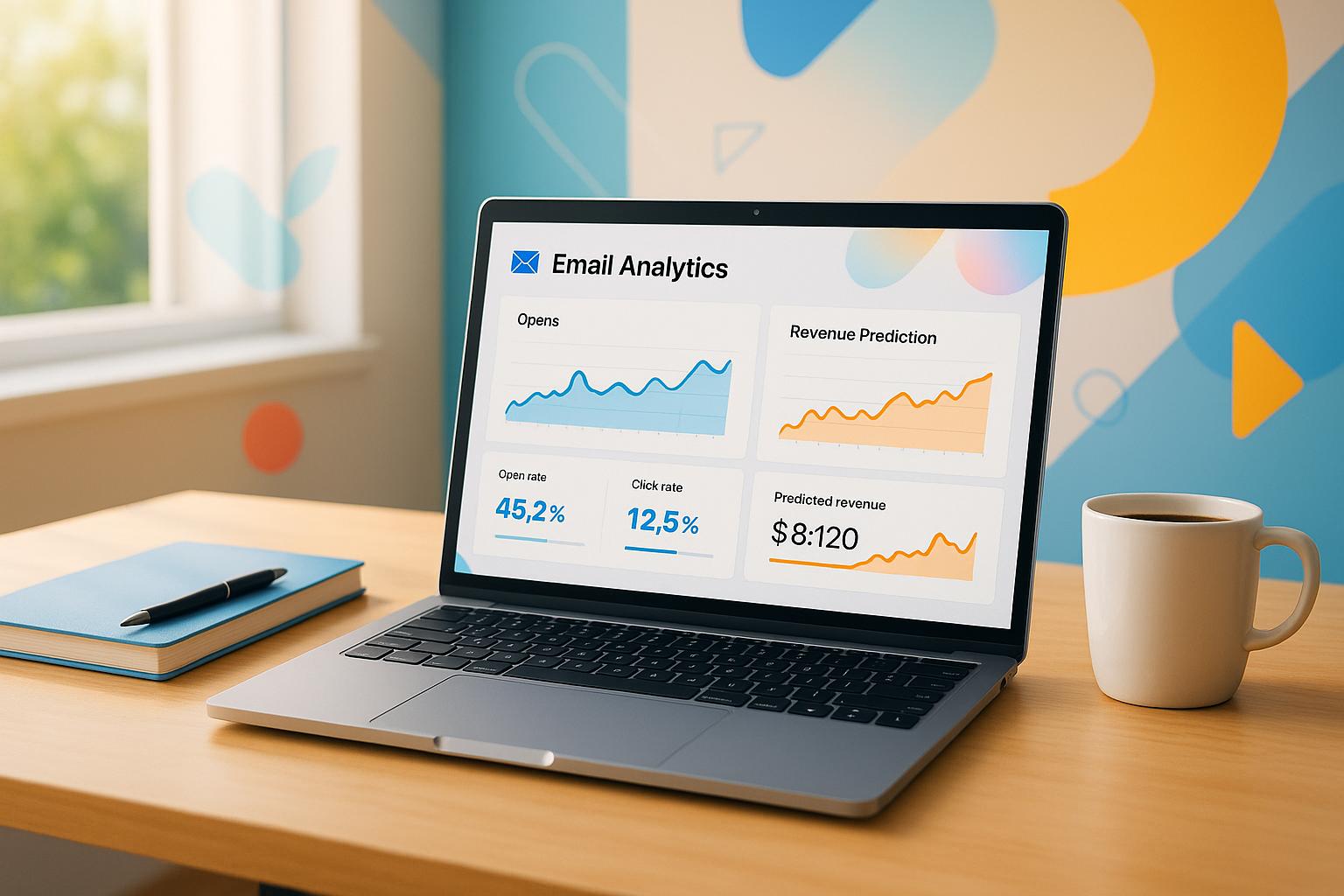
Email campaigns remain a major revenue driver for B2B marketers, with returns of $30–$40 for every $1 spent. But traditional analytics only review past performance, while AI-powered forecasting tools predict future outcomes - from open rates to revenue impact - before you hit send. These tools analyze historical data to optimize email timing, content, and audience targeting, making them essential for industries with long sales cycles like financial services and real estate.
Here’s what you need to know:
Quick Comparison:
| Tool | Key Features | Best For | Pricing |
|---|---|---|---|
| ActiveCampaign | Predictive sending, lead scoring, CRM sync | Long sales cycles, automation | $15+/month |
| Seventh Sense | Send-time optimization, frequency management | Engagement-focused campaigns | $70+/month |
| Mailchimp | Content recommendations, segmentation | SMBs, mid-market teams | $20–$50+/month |
AI forecasting transforms email campaigns into precision tools, helping B2B teams focus on what drives results.
When assessing AI email forecasting tools, the goal is to determine their predictive accuracy. B2B teams need platforms that go beyond basic reporting, using historical engagement and revenue data to deliver reliable predictions about open rates, click-through rates, conversions, and customer lifetime value [5][7]. The difference between a tool that forecasts and one that simply reports can be the deciding factor in whether your team gains a competitive edge or ends up with another underperforming platform.
Start by identifying forecasting use cases relevant to your business. For example, can the tool pinpoint which accounts are most likely to convert from email nurture campaigns? Can it flag investors or decision-makers who may disengage soon? Tools that present these insights through intuitive dashboards and exportable reports are far more practical for daily decision-making [2][4][7].
Testing is non-negotiable. Before signing any long-term contracts, conduct A/B experiments during a pilot phase to confirm measurable improvements in metrics like open rates, click-through rates, or revenue per recipient [3][5].
Once you’ve identified your use cases and tested potential platforms, it’s time to evaluate the features that set predictive tools apart. Core forecasting capabilities should be the focus. One standout feature is send-time optimization, where platforms predict the best times to send emails on an individual level instead of using a one-size-fits-all schedule. This approach can boost open rates by 10–20% [4][5][7].
Another critical feature is engagement and churn scoring, which helps prioritize follow-ups. These scores are especially effective when applied at the account level, enabling B2B teams to coordinate outreach across multiple stakeholders in a buying group [2][7].
For teams focused on ROI, revenue prediction and attribution features are invaluable. The best tools link email engagement patterns to CRM data, such as opportunity values and closed-won deals, to show which campaigns and segments drive business outcomes [5]. In industries like commercial real estate or financial services, where deals involve high stakes and long cycles, this transforms email from a volume-based tactic into a precision tool.
Other valuable features include product or content recommendation engines, next-best-action suggestions, and multi-touch attribution for long sales cycles. While these may not be as critical for e-commerce, they are essential for industries with complex decision-making processes involving multiple stakeholders [2][4][7].
| Evaluation Dimension | Why It Matters for AI Forecasting | What to Look For for U.S. B2B Teams |
|---|---|---|
| Forecasting accuracy & metrics | Ensures predictions about opens, clicks, and revenue impact are reliable [5][7] | Clear dashboards, CRM integration for pipeline and revenue insights, and documented case studies showing measurable improvements [2][4] |
| Core AI features | Directly influences engagement and revenue outcomes [4][5] | Send-time optimization, lead/account scoring, churn prediction, and next-best-action suggestions [2][4] |
| Integrations | Reduces manual work and ensures unified data [2][7] | Native connectors for CRMs like Salesforce or HubSpot, bi-directional sync, and custom field support [4][7] |
| Ease of use | Drives adoption and shortens time-to-value [3][4] | Drag-and-drop builders, clear AI explanations, and role-based access for marketing and sales teams [3][4] |
| Data privacy & compliance | Mitigates regulatory risks in the U.S. market [5][7] | Features like CAN-SPAM compliance, opt-out management, and certifications like SOC 2 Type II and ISO 27001 [5][7] |
| Scalability & performance | Supports growing lists and complex journeys [2][6] | SLA-backed deliverability, performance guarantees, and references from similar-sized organizations [2][6] |
Seamless integration with CRM platforms is critical for maximizing the effectiveness of AI forecasting tools. Accurate forecasts rely on complete data, making integration with systems like Salesforce, HubSpot, or Microsoft Dynamics essential for U.S.-based B2B teams [4][7]. Without these integrations, forecasting models may miss key revenue-related context, limiting their usefulness.
Bi-directional sync is a must-have. This ensures the tool can pull in CRM data like lead scores and opportunity values while pushing back engagement metrics and predicted outcomes. This two-way flow allows sales teams to view email activity within their CRM and enables marketing teams to segment audiences based on pipeline data [4][7]. Additionally, support for custom fields is crucial for tracking industry-specific data, such as investor preferences or deal histories.
Platforms that combine a customer data platform (CDP) with AI orchestration offer a significant advantage. These systems unify data from emails, website activity, and CRM records, creating a single source of truth. This holistic approach significantly improves forecasting accuracy compared to tools that rely solely on email metrics [2][7].
Real-world examples highlight the impact of integration. Companies that automate CRM processes and unify data sources often see a 40% reduction in manual tasks, enabling them to scale operations without adding headcount [8]. Unified systems provide the comprehensive data needed for precise forecasts and better strategic decisions.
When evaluating integration capabilities, involve both marketers and operations teams in building sample journeys and reports during demos. Tools that require heavy IT support or data science expertise for routine tasks can slow down B2B teams [3][4]. The best platforms come with native connectors, detailed API documentation, and playbooks tailored for B2B use cases.
Robust data privacy and compliance practices are non-negotiable for building trust and ensuring long-term reliability. U.S.-based B2B teams should prioritize tools that securely handle customer data while adhering to regulations like CAN-SPAM and CCPA [5][7]. Many platforms now automate compliance tasks, but it’s essential to verify these capabilities during the evaluation process.
Look for enterprise-grade security measures such as end-to-end encryption, secure storage, and regular audits. Certifications like SOC 2 Type II and ISO 27001 demonstrate a vendor’s commitment to protecting data [5][7]. For industries managing sensitive data, such as financial services, data residency options and logging capabilities are critical for maintaining internal governance standards.
Transparency is also key. Review vendor documentation to understand how forecasting models are trained, updated, and influenced by user inputs like goal-setting or feedback loops. Tools that lack clear AI logic can create compliance risks and erode trust.
Usability plays a role here too. Platforms with intuitive interfaces and clear reporting make it easier for teams to monitor data usage, manage consent, and address customer inquiries. Features like drag-and-drop editors, role-based access controls, and responsive customer support simplify compliance management [2][4]. For teams migrating to a new platform, robust onboarding support ensures historical data is transferred securely while meeting regulatory requirements.
AI has reshaped how B2B email campaigns are planned and executed. Instead of relying on guesswork or outdated metrics, AI-powered tools use machine learning to predict which emails will capture attention and drive results. This precision helps businesses allocate their resources wisely and achieve better outcomes.
Below, we’ll explore some of the top tools for email campaign forecasting. Each stands out for its ability to deliver accurate predictions, integrate seamlessly with CRMs, and deliver measurable results for teams managing complex sales processes.
ActiveCampaign stands out with features like predictive sending, AI-driven lead scoring, and deep CRM integration - making it a great choice for businesses with long sales cycles. By analyzing historical campaign data, CRM stages, and engagement signals (like opens, clicks, and replies), it forecasts key metrics such as open rates, click-through rates, and lead-to-opportunity conversions.
One of its standout features, predictive sending, customizes delivery timing based on individual recipient behavior. Case studies show this can increase open rates by up to 25% and conversion rates by up to 15% [4].
In Q2 2024, a financial services firm using ActiveCampaign's predictive tools achieved a 22% boost in open rates and a 14% rise in conversions within three months.
- ActiveCampaign Case Studies, 2024 [4]
ActiveCampaign is particularly useful for B2B scenarios like forecasting attendance for investor webinars, identifying high-potential investors based on past interactions, and estimating the impact of market update campaigns. Its automation and journey mapping tools allow teams to create flexible nurture sequences, such as triggering a personalized LinkedIn message or a direct call when an important investor shows signs of disengagement.
The platform integrates seamlessly with CRMs like Salesforce and HubSpot, offering two-way syncing of contacts, opportunities, and engagement data. Pricing starts at $15 per month for small teams, with advanced AI features available at higher tiers [2][4].
Seventh Sense focuses on optimizing send times and managing email frequency. This makes it a valuable tool for B2B marketers aiming to maximize engagement without overwhelming their audience. It works with platforms like HubSpot and Marketo to analyze individual contact behavior, predicting the best times and days to send emails as well as the ideal frequency to maintain interest [5].
The platform provides dashboards formatted for U.S. users, displaying forecasted metrics like opens, clicks, and conversions. Marketers can also simulate "what-if" scenarios by tweaking variables such as audience size or send cadence to see the projected impact on engagement and revenue.
A real estate syndicate in Q1 2025 used Seventh Sense's send-time optimization and saw a 17% increase in open rates and a 12% rise in appointment bookings.
- Seventh Sense Customer Success, 2025 [5]
Seventh Sense integrates natively with HubSpot and Marketo and offers API access for custom setups. Its dynamic frequency optimization predicts the best intervals between emails, based on each recipient’s engagement patterns. Plans start at approximately $70 per month [5].
Mailchimp caters to U.S. small and mid-sized businesses (SMBs) and mid-market B2B teams with its accessible forecasting tools. It provides templates and ready-to-use models for predicting engagement and conversions, along with automated recommendations for send times and audience segmentation.
Mailchimp’s predictive analytics help teams identify high-impact campaigns, flag underperforming ones, and compare expected results with actual outcomes through exportable reports. Its AI-powered content recommendations suggest subject lines, preview text, and email content based on past data and industry benchmarks - helping businesses achieve up to 30% higher click-through rates [5].
The platform also enables teams to create predictive segments that guide email campaigns, landing pages, and advertising strategies. With strong CRM integrations, including custom field mapping and bi-directional syncing, Mailchimp is a versatile option. It offers a free tier for basic features, while premium AI tools start at $20–$50 per month for small teams, with higher pricing for larger needs [5].
Here’s a side-by-side look at the key features of these tools:
| Tool | Forecasting Use Cases | CRM Integration | Pricing Transparency | Predictive Capabilities |
|---|---|---|---|---|
| ActiveCampaign | Automation, lead scoring, revenue forecasting | Native integration with Salesforce, HubSpot | Transparent tiered pricing | Predictive sending, adaptive journey mapping, conversion forecasting |
| Seventh Sense | Send-time optimization, frequency management | Native integration with HubSpot, Marketo | Transparent pricing | Individual-level timing, engagement prediction, frequency optimization |
| Mailchimp | Content optimization, engagement forecasting | Native integration with Salesforce, HubSpot | Transparent tiered pricing | Predictive analytics, content recommendations, segment forecasting |
These tools highlight how AI-driven forecasting is transforming email campaign strategies, offering tailored solutions for diverse business needs.
Even with advanced forecasting tools, many B2B teams struggle to turn predictions into actual pipeline and revenue. Visora bridges this gap through its Trifecta Program, which helps transform forecast data into booked meetings and closed deals within just 12 weeks. This program combines three core elements: the B2B Vortex Funnel to connect buyer touchpoints, AI-augmented appointment setting to prioritize high-value prospects, and deal-desk strategy consulting to align forecasts with quarterly revenue goals. Drawing on insights from over 20,000 real-time market conversations and Fortune 500-level advisory experience, Visora delivers targeting and messaging strategies that most firms never encounter [8].
"Predictable pipeline systems powered by AI and private market intelligence most firms will never see. Our frameworks are built on 20,000+ real-time market conversations, combined with Fortune 500-level advisory experience to sharpen your targeting, messaging, and positioning."
- Visora [8]
The results speak for themselves: over $127.15 million in pipeline generated across 30+ partners, with most clients seeing their first qualified meetings within 7–14 days [8]. For B2B leaders in industries like commercial real estate, financial services, and investor relations who are tired of relying on referrals or wasting money on ineffective ads, this structured approach offers a faster, more reliable way to acquire new business.
Visora’s framework turns predictive analytics into actionable strategies. The B2B Vortex Funnel uses forecasted probabilities for opens, clicks, and replies to synchronize emails, LinkedIn outreach, and retargeting efforts. The goal? To drive pipeline growth - not just engagement [3][9].
This system combines historical email performance data (like opens, clicks, and meeting rates) with firmographic signals (such as industry, company size, and role) and behavioral cues (like website visits, downloads, and calendar activity) [1][4]. For example, if a contact from a commercial real estate firm visits a financing page twice and clicks on a case study, the system boosts their score and moves them into a higher-priority sequence with more direct offers and senior-sales outreach [1][4].
The funnel continuously adapts in real time, adjusting sequence length, cadence, and messaging to move prospects from awareness to meetings to proposals. For instance, if the AI model identifies that real estate syndicate leaders respond better to case studies than webinar invites, it amplifies the use of case studies while minimizing less effective content [3][5].
In Q2 2024, a U.S.-based commercial real estate firm implemented Visora’s Trifecta Program. Over 12 weeks, they increased their qualified leads by 35% and cut manual outreach time by 40%. The campaign seamlessly integrated with their CRM and revenue dashboards, enabling real-time optimization [10][2].
Visora’s AI-powered appointment setting prioritizes high-probability accounts using data from successful high-ticket deals. Top-scoring accounts are automatically routed to senior sales reps, allowing teams to focus on the most promising opportunities [2][6].
"Outbound that converts. AI appointment setters trained on high-ticket success data, A/B testing that dials in what works, and analytics built to accelerate every deal."
- Visora [8]
The system continuously refines messaging, timing, and offers based on real-world results, improving both forecast accuracy and conversion rates [8]. For example, if an Investor Relations Lead shows strong engagement signals, the system can trigger same-day follow-ups or adjust call scripts to address their specific interests or objections [2][6].
A typical sequence runs for 2–3 weeks, starting with a personalized email tailored to firmographic and intent data. Follow-ups adjust tone and offers based on engagement or lack thereof, while the AI learns which variations perform best for specific segments. For instance, financial services executives exploring acquisition strategies might respond better to a data-driven pitch than a generic offer. The system ensures high-performing messages are prioritized while ineffective ones are phased out, keeping no-show rates and cost per appointment within targets [3][5].
Visora’s approach has built over 3,000 C-Suite relationships and maintains 98% accuracy on qualified opportunities. Clients often see deal cycles shortened by 50%. For example, Visora helped CoherentAI generate over $150,000 in pipeline by aligning demand, targeting, and offers before launching a high-ROI outbound campaign aimed at sales leaders [8].
Visora ensures predictive insights translate into measurable results by integrating forecast data directly into CRM systems. Each contact and account is assigned a "propensity to engage" and "propensity to convert" score, which rolls up into dashboards showing forecasted pipeline and revenue by segment, campaign, and channel [4].
This direct integration allows teams to scale or refine email campaigns in real time. Tracking outcomes like meetings booked, opportunities created, and revenue per opportunity helps improve both initial and ongoing forecasting models [1][9].
Visora’s workflows are designed to comply with U.S. email and privacy regulations. They honor unsubscribe preferences, use permission-based lists, and apply suppression logic to avoid unengaged or high-risk contacts. Deliverability safeguards - like domain warm-up, authentication protocols (SPF, DKIM, DMARC), and monitoring bounce and spam complaint trends - ensure aggressive outreach is reserved for low-risk, high-value segments [9][5].
For teams in sectors like real estate syndication or financial services, the process often begins with a diagnostic engagement. Visora audits email performance, CRM data quality, and acquisition workflows, then defines 1–2 high-value use cases (e.g., "Investor webinar registrations" or "Intro calls with new LPs"). From there, they pilot a Vortex Funnel, connect forecasting outputs to the CRM, and launch an AI-augmented appointment-setting program. This approach allows teams to validate improvements in meeting rates and forecast accuracy before scaling [3].
The result? Clearer visibility into projected pipeline, higher meeting rates with decision-makers, and more efficient use of resources. By focusing on the most promising segments, teams often see measurable gains in booked meetings per 1,000 contacts, reduced acquisition costs, and more reliable revenue projections that align with company goals [2][6].
AI-driven email forecasting offers B2B teams a clear view of their pipeline and revenue potential. The main idea is simple: predictive analytics should guide decisions on when to send emails, which segments to focus on, and the revenue each campaign is expected to bring in.
When choosing a tool, prioritize three factors: accurate predictions with clear reasoning, smooth CRM integration, and strict adherence to data regulations. If the forecast data is buried in a dashboard no one uses, it won’t drive decisions or improve outcomes. For U.S.-based teams dealing with sensitive information or operating in regulated fields like financial services or real estate, compliance isn’t optional - it’s essential.
Data quality is the backbone of reliable forecasts. If your tools rely on incomplete or outdated contact records, even the most advanced algorithms won’t deliver dependable predictions. Start by auditing your email performance metrics - engagement rates, pipeline contributions, and revenue per campaign - before assessing potential vendors.
AI forecasting isn’t a “set it and forget it” solution. It requires continuous refinement. Define success metrics upfront, such as deviation in open rates, reply rates, or pipeline generated per 1,000 emails. Then, track results over a 60–90 day period. If actual outcomes consistently miss the mark, adjust your inputs, refine audience segments, or experiment with new content strategies.
To make the most of AI tools, follow a straightforward implementation plan.
Start by documenting your must-haves: integration with your CRM, support for U.S. time zones, compliance with relevant standards, and any industry-specific requirements. Use this list to narrow your options to three to five tools that clearly meet your needs. When requesting demos, focus on how the tool handles forecasting workflows, not just a general feature overview. Look for B2B case studies that align with your industry or deal size. Once you’ve identified the right tools, move on to a pilot program.
A well-structured pilot typically lasts six to twelve weeks and focuses on specific use cases, like forecasting follow-ups for webinars or nurture campaigns for outbound leads. To measure the impact, set up a control group that operates without AI forecasting. Track both early indicators (like engagement rates and meeting bookings) and long-term results (such as pipeline value and closed deals). Weekly check-ins between marketing, sales, and revenue operations help address any issues quickly and keep everyone on the same page.
For successful adoption, teams need clear communication about what the tool can and can’t do, training on how to interpret forecasts, and playbooks that outline how marketers, SDRs, and account executives should act on predictions. Assign specific roles for setup and performance tracking to ensure the tool is actively used.
Once you’ve demonstrated value in your pilot, standardize forecasting templates, dashboards, and decision-making processes. Expand usage to additional campaigns, such as product launches, event follow-ups, or campaigns tailored to specific industries. Over time, shift from campaign-level forecasting to broader planning, using AI to allocate budgets, prioritize audience segments, and coordinate email efforts across channels.
For leaders in sectors like commercial real estate, financial services, or investor relations looking to accelerate adoption, partnering with specialized firms can help. Companies like Visora design acquisition strategies that integrate forecasting insights - leveraging predicted buyer intent to prioritize email sequences and align multi-channel touchpoints for high-value accounts. This ensures campaigns drive qualified pipeline growth rather than just generating activity metrics.
To get started, audit your current email performance data, identify any gaps, and create a one-page brief outlining your business goals, required integrations, and pilot parameters. Use this brief to evaluate vendors and align internal teams before making a purchase. By following these steps, B2B teams can turn predictive insights into actionable strategies that drive revenue growth.
AI tools take email campaign forecasting to a whole new level by using machine learning and predictive analytics to process massive amounts of data in real time. Traditional methods often depend on static metrics or outdated trends, but AI goes deeper by spotting intricate patterns, adjusting to shifting behaviors, and delivering highly accurate predictions.
What’s more, these tools factor in external elements like market trends and changes in audience behavior to provide insights you can act on. This means businesses can fine-tune their campaigns, boost engagement rates, and see stronger ROI - all while cutting down on the guesswork.
When choosing an AI tool for email campaign forecasting, B2B teams need to prioritize a few essential factors to ensure it meets their specific requirements. First and foremost, accuracy should be at the top of the list. Opt for tools that use advanced algorithms and historical data to provide dependable predictions. Without reliable forecasts, even the best campaigns can fall flat.
Equally important is customization. The tool should let you adjust forecasts to match your audience, industry, and campaign objectives. This flexibility ensures the insights are relevant and actionable for your unique needs.
Another crucial aspect is the ease of integration. Make sure the tool can seamlessly connect with your existing CRM or marketing platforms. This not only saves time but also keeps your workflows smooth and efficient. As your business grows, scalability becomes vital. Choose a solution that can adapt and expand alongside your evolving demands.
Finally, go for tools that offer more than just raw data. Look for those that provide actionable insights - clear recommendations that help you fine-tune your campaigns for better performance. After all, the goal isn’t just to gather data but to turn it into results.
Integrating a CRM system with AI-driven email forecasting tools creates a powerful combination for boosting performance. By centralizing customer data, these tools can analyze detailed insights like past interactions, preferences, and purchase history. The result? More precise predictions and highly tailored campaign strategies that speak directly to customer needs.
This integration also automates data syncing, cutting down on manual errors and ensuring updates happen in real time. The payoff is twofold: businesses save valuable time and gain the ability to make smarter, data-informed decisions that enhance engagement and deliver stronger outcomes from their email campaigns.
%20(5).png)
