%20Bold.png)
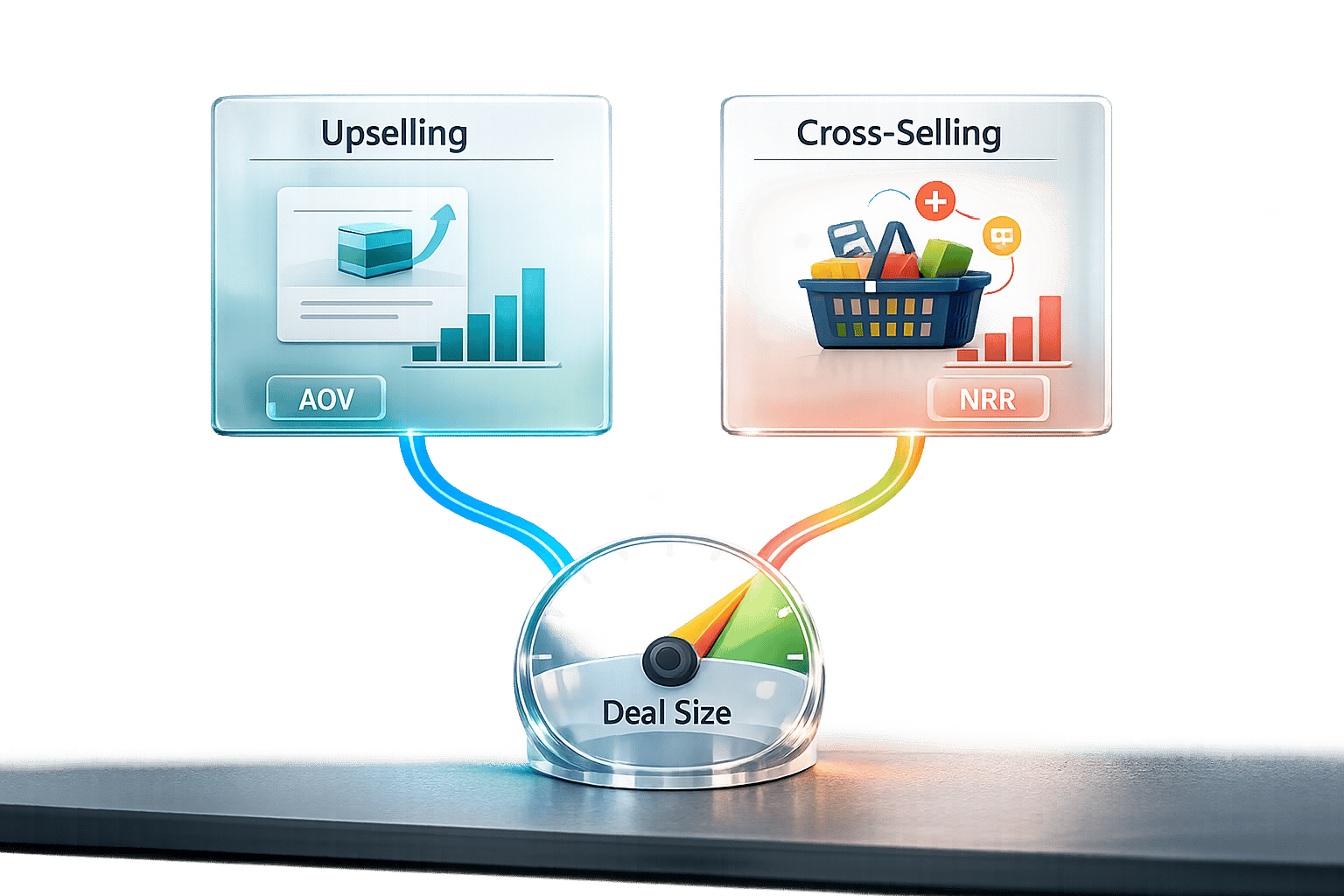
Upselling and cross-selling are two powerful strategies to increase customer spending and grow revenue. Upselling involves encouraging customers to buy a higher-tier or premium version of a product they’re already considering. Cross-selling, on the other hand, focuses on offering complementary products or services to enhance the main purchase. Both approaches can boost deal sizes by 10%–30%, with upselling increasing customer lifetime value by 20%–40% and cross-selling often improving retention due to integrated solutions.
Here’s a quick breakdown:
The right strategy depends on your product structure and customer journey. Both methods, when applied thoughtfully, can drive meaningful revenue growth and strengthen customer relationships.
Upselling encourages customers to opt for a higher-tier version of a product they already use or are considering [3]. Instead of adding more items to a purchase, this approach increases the value of a single transaction. For instance, a customer using a basic SaaS plan might upgrade to a premium version that includes advanced features, higher usage limits, or enhanced customer support. By increasing the transaction's value, upselling directly impacts average deal size, making it a critical metric for driving B2B growth.
This strategy builds on existing trust, as current customers typically spend about 31% more than new ones [7]. It can lead to a 10% to 30% boost in revenue per customer and increase customer lifetime value by 20% to 40% [8, 13].
To make upselling successful, focus on identifying customers nearing their plan limits or facing challenges that can be resolved with a higher-tier product. Present upgrades that highlight clear benefits like saving time, improving security, or automating processes [10]. This approach not only strengthens customer trust but also lays the groundwork for long-term revenue growth.
Upselling offers several key advantages. First, it increases revenue per deal without requiring additional transactions. For example, if a customer upgrades from a $200-per-month plan to a $250 plan, monthly recurring revenue grows by 25%. Second, it strengthens customer relationships, boosting lifetime value. Third, this strategy enhances profitability, making it a powerful tool for maximizing customer lifetime value [9].
Top-performing SaaS companies often achieve net revenue retention rates above 120%, largely due to effective upselling [6]. It’s also an efficient process, as sales teams can focus on customers who already see the product's value. When presented with the right upgrade at the right time, up to 60% of existing customers are likely to make an additional purchase [8, 16]. Altogether, these benefits play a direct role in increasing average deal sizes.
The advantages of upselling come to life in various B2B scenarios.
These examples show how upselling meets evolving business needs with enhanced solutions, justifying higher price points and driving larger deal sizes.
Cross-selling is all about offering complementary products or services to increase the overall transaction value [6][2]. Instead of focusing on upgrading a single product, this approach broadens the deal by adding related items. For instance, a company purchasing a CRM platform might also opt for an integrated email marketing tool or an advanced analytics module during the same transaction. On average, cross-selling can boost revenue per transaction by 10% to 30% [6][11].
The strategy works well because it builds on existing customer trust. When businesses identify operational gaps - like a lack of reporting tools or poor system integration - cross-selling positions additional products as solutions to these issues. This approach is often seen as helpful rather than sales-driven because it addresses broader customer needs. While upselling can sometimes feel like a push for more revenue, cross-selling tends to be perceived as a service enhancement [6].
Bundled offers, a common cross-selling tactic, can increase average order value by 20% to 30% [11]. Additionally, product recommendations - another form of cross-selling - account for up to 35% of total online sales [11].
Timing is everything when it comes to cross-selling effectively. The best moments to introduce additional products include:
On the flip side, cross-selling at the wrong time - like during a support crisis or right after a price hike - can feel intrusive and even harm customer relationships [6].
"The right product at the wrong moment feels like spam, not service." - ECOSIRE Research and Development Team [6]
Cross-selling not only raises the average order value but also enhances customer satisfaction by offering more complete solutions. Instead of selling one product at a time, businesses can bundle related offerings, meeting broader customer needs and increasing profits by about 30% [11][2].
For example, when a customer buys core software and adds implementation services or consulting, they benefit from quicker setup and faster results [2]. This approach reduces friction and helps customers achieve their goals more efficiently.
Cross-selling also strengthens retention. Customers who use multiple interconnected products from the same provider are more likely to stay loyal, as switching to a competitor becomes less appealing [4]. Data shows that existing customers are far more likely to accept relevant cross-sell offers, with conversion rates of 60% to 70%, compared to just 5% to 20% for new prospects [6]. This makes cross-selling an efficient way to drive revenue growth.
Here’s how cross-selling plays out in real B2B scenarios:
These examples illustrate how cross-selling addresses related needs through a single provider, increasing both immediate transaction value and long-term loyalty. Unlike upselling, which focuses on upgrading a product, cross-selling expands the deal by integrating complementary solutions.

Upselling vs Cross-Selling: Key Metrics and Strategy Comparison
Upselling encourages customers to choose a higher-priced or premium version of a product they're already considering [7, 12]. On the other hand, cross-selling introduces complementary products from different categories to enhance the main purchase [7, 12]. Both strategies aim to grow revenue but operate in distinct ways.
Timing plays a crucial role in their effectiveness. Upselling works best while customers are still browsing product pages and weighing their options. Cross-selling, however, is most effective during checkout or even after the initial purchase has been made [7, 8].
When it comes to revenue, the two strategies have different impacts. Upselling can increase the average order value (AOV) by 10% to 30% per transaction. Cross-selling, though, often delivers a slightly higher boost, raising AOV by 20% to 40% [5]. A great example of this in action is Amazon, which credits 35% of its revenue to its recommendation system that blends upselling and cross-selling [7, 8, 13].
"Companies are 60% to 70% more likely to sell to an existing customer, whereas the likelihood of selling to a new customer is 5% to 20%." – Investopedia [3]
Here’s a quick side-by-side comparison to break it down further:
| Metric | Upselling | Cross-Selling |
|---|---|---|
| Primary Goal | Encourage higher-priced versions of the same product [5] | Suggest complementary products to enhance the main purchase [5] |
| Revenue Increase per Transaction | 15–30% [6] | 10–20% [6] |
| Typical AOV Growth | 10–30% [5] | 20–40% [5] |
| Conversion Rate (Warm Leads) | 20–30% [6] | 15–25% [6] |
| Focus | Vertical (upgrading within the same product line) [5] | Horizontal (adding related products) [5] |
| Best Timing | Product page (before the purchase decision) [5] | Checkout or post-purchase (after the main decision) [5] |
| Profitability Impact | Boosts customer lifetime value (CLV) by 20–40% [9] | Increases profits by 20–30% [7, 13] |
Both strategies are powerful tools to maximize revenue, but their success depends on understanding when and how to apply them effectively.
Deciding between upselling and cross-selling isn't about choosing one over the other - it’s about aligning the strategy with your business model and customer needs. The right approach depends on three key elements: your product structure, how customers interact with your solution, and their current stage in the customer journey. These factors directly influence which method can help increase your average deal size.
Product structure is the starting point. Upselling is ideal when your offerings include tiered pricing or modular features that can be unlocked as customers’ needs evolve. For example, SaaS companies often offer higher service tiers with perks like increased storage, additional user seats, or expanded API limits, which naturally lend themselves to upselling. On the other hand, cross-selling shines when you provide complementary products that solve related challenges. Think of a CRM provider introducing a marketing automation tool as a natural add-on [1].
Customer usage patterns help pinpoint the right moment to act. For upselling, opportunities arise when customers are nearing limits - like storage caps or feature restrictions. Cross-selling, however, works best when one department benefits from your product, and another department could use it to address similar needs [4][12].
"The right offer at the wrong time is the wrong offer."
– ECOSIRE Research and Development Team [6]
Pricing models also play a key role. Usage-based or tiered pricing creates clear upsell pathways, while flat pricing can limit opportunities for expansion [12].
Upselling thrives under certain conditions. It’s most effective when customers are approaching a limit - whether it’s a feature cap, a usage threshold, or a capacity constraint. The best opportunities often arise during the initial sales process or when customers hit specific milestones that highlight a need for more [1][4][6].
B2B companies, in particular, see strong results with tiered pricing models. As businesses grow and require additional user seats or advanced features, upgrading becomes a practical solution to an immediate need rather than a theoretical benefit [4][12].
Focus on accounts with high engagement. Pushing upgrades on customers who are struggling can backfire, increasing the risk of churn. For example, healthy SaaS accounts often achieve upsell conversion rates of around 27.6% [11].
Timing also matters. Contract renewals and periods of business growth are excellent opportunities for upselling. During these times, customers are already assessing value and are more open to considering upgrades [1][6].
Cross-selling, on the other hand, is most effective at different points in the customer journey. It works well after customers have had success with your core product and feel satisfied - often about seven days after purchasing physical products. This timing builds on their trust without overwhelming them [4][6].
This strategy also excels when your product has proven its value in one department, and similar needs exist in others. For instance, if your customer success team benefits from your platform, it may be a good time to introduce it to the sales or support teams. This kind of horizontal expansion can boost deal size by 10% to 20% and increase customer satisfaction by about 20%, as long as the recommendations are relevant [1][6].
Point-of-sale moments are another prime opportunity for cross-selling. Suggesting complementary products at checkout can significantly increase revenue. Many retailers report strong results using recommendation-based tactics [6][9].
Finally, post-support interactions are a golden opportunity. After resolving a customer issue, trust is at its highest. This is the perfect time to introduce additional tools that can prevent future problems or offer new capabilities [4][6].
Keeping an eye on the right KPIs can reveal how well upselling and cross-selling are boosting your deal size. These metrics act as a bridge between your strategies and actual revenue growth, helping you spot what’s working and where tweaks are needed.
Average Order Value (AOV) Lift is a key indicator. It tracks how much more customers spend after you introduce expansion offers compared to your baseline transaction value. For instance, upselling often increases AOV by 10–30% per transaction, while cross-selling can push it up by 20–40% [5]. To calculate AOV Lift, subtract your baseline AOV from your current AOV. A healthy target is a 10–25% increase [13].
Attach Rate evaluates how effective your cross-selling efforts are. It’s the percentage of orders that include an add-on product alongside the main purchase. For example, if 25 out of 100 subscriptions include add-on tools, your attach rate is 25%. Successful B2B programs usually aim for a range of 15–30% [6]. For upselling, track the Upgrade Rate - the percentage of eligible customers who move to a higher-tier product. This typically falls between 2–5% [6].
Net Revenue Retention (NRR) is another must-watch metric, especially for B2B companies. It measures whether your existing accounts are growing over time. To calculate NRR, take your monthly recurring revenue (MRR), add expansion revenue, subtract churn and downgrades, and divide by your starting MRR. For example, Salesforce consistently achieves an NRR above 120% thanks to account expansion [6]. In SaaS, an NRR over 110% is considered strong [6].
Expansion Revenue Percentage highlights how much of your total revenue comes from upselling and cross-selling versus acquiring new customers. Aiming for 20–35% of your revenue from expansion efforts is a solid benchmark [6]. For example, Amazon credits up to 35% of its revenue to its product recommendation engine [6].
"Upselling and cross-selling to existing customers is the most capital-efficient revenue growth strategy available."
– ECOSIRE Research and Development Team [6]
Additionally, keep an eye on return and cart abandonment rates. These can quickly reveal any friction points in your expansion strategies.
From the analysis above, it’s evident that choosing between upselling and cross-selling isn’t about declaring one superior - it’s about finding the approach that fits your product model and customer journey. For businesses with tiered subscription models and loyal users, upselling is often the way to go. On the other hand, cross-selling thrives in settings where complementary products can enhance the overall user experience and value [1][6].
Here’s a compelling stat: existing customers convert at a rate of 60–70%, compared to just 5–20% for new prospects [6]. Plus, growing revenue from your current customer base is 5–7 times more cost-effective, potentially increasing profits by 20–30% [14][15].
To make the most of these strategies, start by mapping out clear upgrade paths. Define what a higher-tier version of your core service looks like, and identify products that naturally complement what your customers are already using [6][14]. Automate this process with tools like scripted prompts, integrated digital workflows, and post-purchase follow-ups [14].
Timing is everything. Use A/B testing to experiment with different placements, timing windows, and incentives to see what resonates most with your audience [1][6].
Finally, keep an eye on metrics like Attach Rate, Upgrade Rate, and Net Revenue Retention to measure the effectiveness of your efforts [1][6].
For businesses aiming to scale revenue systematically, Visora’s Revenue Advisory services could be a game-changer. They leverage AI-driven personalization and data-backed targeting to help B2B leaders execute these strategies effectively. With private market intelligence and multi-channel outbound systems, they can help shorten deal cycles and boost deal sizes - all while keeping your headcount in check. It’s a smart way to align revenue growth with broader business goals.
Choosing between upselling and cross-selling comes down to understanding your goals, your customers' needs, and the sales situation.
Upselling focuses on encouraging customers to choose a higher-tier product or service. This approach increases the transaction value by offering enhanced features or benefits. On the other hand, cross-selling involves recommending complementary products that meet additional needs and provide extra value.
When should you use each? Opt for upselling when a customer shows interest in upgrading or improving their current choice. Use cross-selling when related products genuinely enhance their overall experience. The key is to tailor your offers to match what the customer actually needs, which ultimately helps grow the value of each transaction.
The best moment to introduce an upsell or cross-sell offer is when the customer is actively engaged and open to suggestions. This typically happens after they’ve decided to make a purchase or during the checkout process. At this point, they’re more likely to be interested in adding extra value to their purchase.
When measuring the success of upselling and cross-selling strategies, a few key metrics stand out:
These numbers highlight how well-executed strategies can result in larger deal sizes and boost overall revenue.
%20(5).png)
