%20Bold.png)
In 2025, AI-powered lead scoring became essential for B2B financial firms, helping sales teams prioritize prospects, reduce wasted time, and boost conversions. With tools analyzing behavior, firmographics, and intent signals, companies reported a 25% increase in conversion rates and 30% shorter sales cycles. Here’s a breakdown of the top AI lead scoring tools tailored for financial B2B needs:
Each tool offers unique features and integrations, making them suitable for specific financial B2B use cases. Below is a quick comparison for easy reference:
| Tool | Best Use Case | Real-Time Scoring | CRM Integration | Starting Price (USD/year) |
|---|---|---|---|---|
| Salesforce Einstein | Enterprise lead scoring | Yes | Salesforce | $1,980/user |
| HubSpot Predictive | Inbound lead prioritization | Yes | HubSpot, Salesforce | $43,200 |
| 6sense Revenue AI | Account-based marketing (ABM) | Yes | Salesforce, HubSpot | $25,000+ |
| MadKudu Predictive | Product-led growth (PLG) | Yes | Salesforce, HubSpot | $11,988 |
| ZoomInfo Copilot | Trigger-based lead prioritization | Yes | Salesforce, HubSpot | $24,000+ |
| ProPair.ai | Lead-to-rep matching | Yes | Salesforce, Encompass | Custom |
| LeanData | Dynamic lead routing | Yes | Salesforce, HubSpot | Custom |
These tools are transforming lead scoring by automating processes, improving accuracy, and saving time. For financial B2B firms, selecting the right tool can increase efficiency and drive revenue growth.
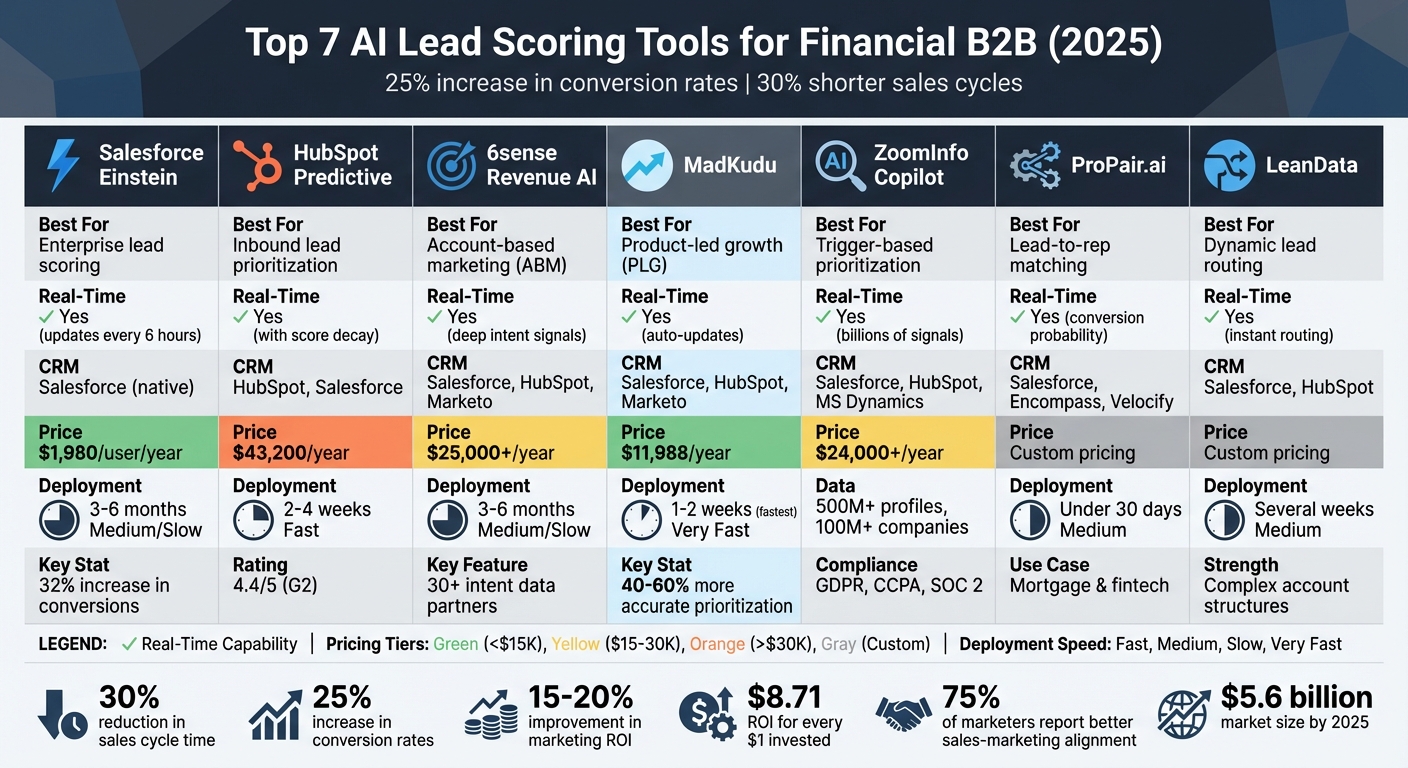
AI Lead Scoring Tools Comparison for Financial B2B: Features, Pricing & Use Cases 2025
Salesforce Einstein uses supervised machine learning to evaluate both explicit data (like job titles, company size, and industry) and implicit behaviors (such as email opens, website visits, and social activity). It predicts lead conversion on a 1–100 scale, providing explanation cards that highlight the factors influencing each score [6][7][8]. This scoring system is a key element for creating focused financial B2B strategies.
"When evaluating our own Einstein AI lead scoring platform, we've found that our customers have experienced a 32% increase in converting prospects to buyers." - Salesforce [9]
For financial services firms, Einstein is particularly effective in identifying cross-sell opportunities. It achieves this by analyzing data such as account activity and income levels [9]. By consolidating information from CRM history, professional demographics, and third-party platforms like LinkedIn, Einstein builds detailed customer profiles [9]. This is especially useful for commercial real estate and investor relations teams, where understanding complex accounts with multiple stakeholders can significantly impact revenue.
Einstein updates lead scores every 6 hours and provides instant updates following key engagements, such as email interactions. The model is retrained every 10 days to ensure accuracy [7][9][4]. To generate reliable predictions, the system requires a minimum of 1,000 leads and 120 conversions collected over six months [7][8].
As a native Salesforce feature, Einstein integrates seamlessly into standard reports, dashboards, and workflows like Salesforce Flow. This enables automated actions, such as routing high-scoring leads directly to specialized financial advisors [6][8]. With a 4.0/5 rating on G2 (based on over 2,900 reviews) and Capterra (with 500+ reviews), users frequently highlight its ease of integration [1].
Einstein Lead Scoring is included in Salesforce's premium editions. The Sales Cloud Enterprise Edition is priced at approximately $1,980 per user annually ($165/month), while the Einstein for Sales add-on starts at $600 per user annually ($50/month) [4][8][10]. For a 10-person sales team, the total yearly cost, including licensing and implementation, typically exceeds $40,000 [7][8].
HubSpot’s Breeze AI uses data like email interactions, website visits, and past deals to assign a lead score from 0 to 100 [4]. It evaluates leads in two ways: "Fit", which measures how well a lead aligns demographically, and "Engagement", which tracks their interactions with key content or assets [4]. This dual-scoring method is especially useful for B2B financial firms dealing with large volumes of inquiries, such as those in fintech, insurance, or lending sectors [4].
To deliver accurate predictions, HubSpot requires a minimum dataset of 100 customers and 1,000 non-customers [4]. Metrics like "Likelihood to close" and "Contact priority" help sales teams zero in on high-value accounts [4]. In August 2025, HubSpot enhanced its scoring system with features like advanced logic, multi-model support, and improved signal transparency [8].
For financial teams with heavy inbound inquiries, HubSpot combines demographic details with behavioral signals to prioritize leads effectively. Its Breeze Intelligence add-on (available from $45/month for 100 enrichment credits) enhances lead profiles with over 200 B2B attributes, boosting the accuracy of "Fit" scoring [8]. This is particularly helpful for identifying prospects that align with an ideal customer profile while also showing active buying interest.
HubSpot updates lead scores in real time, incorporating a "Score Decay" feature that reduces the weight of older interactions. This ensures the focus remains on leads with current intent [3][1].
HubSpot integrates predictive lead scores directly into its CRM, making it easy to incorporate these insights into existing workflows. As a native CRM feature, scores appear as contact properties without requiring extra navigation [3]. These scores can trigger automated workflows, such as assigning high-priority leads to specific sales reps or initiating email sequences when a lead reaches a certain threshold [4]. Additionally, HubSpot syncs seamlessly with external CRMs like Salesforce, enhancing lead management across platforms [4].
Users appreciate the system’s user-friendly interface, earning it a 4.4/5 rating on G2 (from over 12,700 reviews) and a 4.5/5 rating on Capterra (from over 5,800 reviews). The learning curve is manageable, averaging around 5–8 hours [1]. These features enable financial B2B teams to stay agile and focused on data-driven client acquisition.
HubSpot Predictive Lead Scoring is part of the Marketing Hub Enterprise package, priced at $43,200 per year ($3,600/month). This includes 10,000 marketing contacts and 10 core seats [4]. A one-time onboarding fee of $3,500 to $7,000 also applies [8]. For sales-specific scoring, the Sales Hub Enterprise starts at $1,800 per user annually ($150/month), typically requiring a minimum of 10 seats [4]. However, the price jump from the Professional to Enterprise tiers can be a hurdle for smaller teams [8].
6sense Revenue AI is tailored for enterprise ABM, making it a strong choice for financial B2B firms handling intricate, high-value transactions such as investment banking, corporate insurance, and fintech infrastructure [1][3]. The platform monitors anonymous buying activity through over 30 B2B intent data partners [1]. This ability to uncover the "Dark Funnel" provides insights into buyer interest even before formal engagement, empowering teams to make informed decisions early in the sales process [12].
The AI ranks accounts based on fit and engagement, layering predictive scores onto buying-stage models. This allows sales teams to pinpoint exactly where prospects are in their journey [3]. This feature is particularly beneficial for financial services, where long sales cycles and multiple decision-makers are common. For enterprises, it simplifies the management of extended deal cycles, making 6sense a valuable tool for navigating complex sales processes.
For financial services managing long, multi-touch sales cycles, 6sense shines by identifying "in-market" accounts within intricate buying committees [1][3]. The platform’s generative AI enhances sales enablement and orchestrates actions based on buyer-stage data, enabling teams to respond to high-intent signals promptly [3]. With a 4.3/5 rating on G2 from over 1,900 reviews, users commend its extensive intent data coverage and its ability to map the entire buyer journey using multi-channel attribution [1].
6sense’s real-time scoring builds on its predictive analytics to help teams act immediately on new buying signals [3][4]. Scores are updated automatically as leads interact, processing hundreds of data points to identify current buying intent [3][4]. These signals are seamlessly embedded into your CRM, allowing reps to focus on high-intent leads without additional effort [5].
The platform integrates natively with Salesforce, feeding predictive scores directly into the CRM for a streamlined workflow [1]. It also works with HubSpot, Marketo, and Microsoft Dynamics, though implementation typically takes 3–6 months and requires assistance from a Customer Success Manager [1]. To ensure the AI models perform effectively, financial firms should have at least 12 months of clean CRM data before starting [1].
6sense pricing begins at $25,000 annually, with mid-market implementations averaging around $60,000 per year [1]. For enterprise-level deployments, costs range from $100,000 to over $300,000 annually, depending on the number of records and selected features [1][4][5]. A limited free plan is available, offering 50 credits for basic buyer discovery [5]. Given its cost and complexity, 6sense is best suited for organizations with 500+ employees, as smaller teams may find it excessive for their needs [1].
MadKudu takes a distinct approach to predictive analytics, focusing on Product-Led Growth (PLG) conversion, especially for financial B2B SaaS companies that offer free trials or freemium models [3,12]. Unlike platforms like Salesforce Einstein or HubSpot, it emphasizes transparency and actionable insights tailored to PLG strategies.
The platform is designed to identify which free-tier users are most likely to upgrade to paid plans by analyzing product usage data, combined with firmographic and behavioral insights [3,12]. Companies like Figma and Notion rely on MadKudu to pinpoint users within their free tiers who are ready to transition to paid enterprise plans [8].
What sets MadKudu apart is its transparent scoring methodology. Through "lead grade explainers", the platform provides detailed insights into the factors behind each score, ensuring sales teams can trust the data driving their decisions. This level of clarity is especially critical in high-stakes B2B financial sales [1,3].
MadKudu's scoring model is particularly effective for financial services firms offering SaaS products, such as fintech platforms or investment tools. By leveraging product usage data, it helps these firms identify free users who show strong buying intent. For example, one client reported a 25% increase in sales-qualified leads and a 30% reduction in sales cycle time after implementing the platform [2]. This makes it an invaluable tool for converting free-tier users into paying customers.
MadKudu ensures that sales teams act on the latest data by automatically updating scores with each new digital interaction [1,3]. This real-time scoring allows businesses to prioritize leads based on current engagement patterns [8]. Additionally, the platform is quick to implement, with most teams going live within 1–2 weeks - faster than many competitors [1,3]. Teams using MadKudu report 40–60% more accurate lead prioritization compared to traditional rule-based systems [1].
MadKudu integrates seamlessly with popular tools like Salesforce, HubSpot, Marketo, and Segment, embedding its scores directly into existing workflows [1,12]. This integration simplifies deployment, avoiding the lengthy setup times often associated with enterprise tools. The platform also addresses common B2B challenges, such as incomplete CRM records, by prioritizing models that rely on fewer but consistently available data points [13].
MadKudu maintains a 4.6/5 rating on G2 based on over 110 verified reviews, with users frequently praising its transparency and customer support [1,2]. While its entry price is higher than general marketing automation tools, it’s an excellent choice for companies with substantial product usage data [1].
For financial B2B firms aiming to sharpen their lead prioritization, ZoomInfo Copilot combines extensive data intelligence with AI-powered insights. With access to more than 500 million professional profiles and 100 million company records, it offers a comprehensive solution for organizations that need both depth and breadth in their outreach efforts [8][14].
By integrating first-party CRM data with proprietary tools - like intent signals, job change notifications, and news alerts - ZoomInfo Copilot helps pinpoint the right contacts and ideal engagement times. This eliminates much of the guesswork in outbound sales. For financial services teams, this means identifying prospects actively exploring solutions and seizing those opportunities right away. The platform’s mix of detailed data and AI-driven insights ensures a more focused and effective approach to financial sales.
ZoomInfo Copilot is particularly effective for financial B2B teams targeting accounts based on key trigger events or specific installed technologies. Its "Scoops" feature delivers real-time updates on events such as funding rounds, leadership changes, and mergers [14]. For instance, if a fintech company secures Series B funding or a private equity firm announces a new fund closing, your sales team gets an instant alert, enabling timely outreach.
The platform’s technographic data feature is another standout tool for financial services providers. It reveals which technologies target accounts are currently using - like legacy CRM systems, payment processors, or compliance tools - allowing you to tailor your pitch to their specific needs. This level of detail moves your team beyond generic messaging, enabling more relevant and personalized communication. Additionally, real-time scoring capabilities help keep your team ahead of shifting buyer signals.
ZoomInfo Copilot continuously updates lead scores by monitoring billions of intent signals and tracking key changes, such as new hires or role shifts [8][14]. For example, if an account shows increased activity - like employees researching competitor websites or downloading whitepapers on financial automation - the platform flags this behavior and adjusts lead scores accordingly [14].
These real-time alerts empower sales reps to act quickly, a critical advantage in competitive financial markets where timing can make or break a deal.
ZoomInfo Copilot integrates seamlessly with Salesforce, HubSpot, and Microsoft Dynamics through native, bidirectional syncing [14]. This ensures your CRM and marketing automation platforms stay up-to-date without requiring manual data exports or third-party middleware. Built-in data orchestration workflows streamline processes and reduce the need for constant context switching.
For financial organizations handling sensitive client data, the platform meets stringent compliance standards, including GDPR, CCPA, and SOC 2 Type II certifications [14]. This allows teams to use the tool confidently, knowing they’re adhering to regulatory requirements.
To access ZoomInfo Copilot, you’ll need the Advanced Tier, which starts at $24,000 per year [8]. Here’s a breakdown of pricing and features:
| Plan Tier | Starting Price (USD/year) | Key Features |
|---|---|---|
| Professional | $14,995 | Basic B2B data access (excludes Copilot) |
| Advanced | $24,000+ | Copilot AI, intent signals, lead scoring |
| Elite | $39,995 | Full platform access, advanced prioritization |
Mid-market contracts typically range between $25,000 and $60,000 annually [8]. The platform operates on a credit-based pricing model, so keeping track of credit usage is essential for managing costs. While exact Copilot pricing isn’t disclosed publicly, you can explore its features through a free trial before making a commitment [14].
ProPair.ai takes the concept of prescriptive lead distribution to the next level by using historical performance data to connect leads with the most suitable sales representatives. Designed for industries like mortgage lending, fintech, and financial services, it’s built to handle high lead volumes. The platform assigns leads in real time, using conversion probability scores to pair them with the salesperson most likely to close the deal based on past performance data [3].
This system doesn’t just prioritize leads - it ensures they’re directed to the right person. By analyzing historical data, ProPair.ai maximizes conversion rates, making it an invaluable tool for teams managing heavy inbound inquiries. This precision is especially critical in fast-moving financial markets, where matching leads to the right representative can make all the difference.
ProPair.ai shines in environments like mortgage lending and fintech, where teams include multiple loan officers or specialists handling various customer segments. Instead of relying on outdated round-robin methods or manual assignments, the platform uses AI to match leads with representatives who have a proven track record with similar clients. This eliminates guesswork and ensures optimal lead distribution. Their 2025 updates add even more value, incorporating generative CRM insights that coach sales reps based on previous deals and offer detailed post-close attribution modeling [3]. These features provide actionable strategies for managing leads effectively.
Every lead that enters the system is scored in real time, with conversion probabilities updated dynamically [3]. ProPair.ai tracks lead behavior and engagement signals, ensuring sales teams can quickly identify and act on the most promising opportunities. This real-time scoring keeps teams focused on what matters most.
ProPair.ai integrates seamlessly with major CRM platforms like Salesforce, Encompass, and Velocify, among others [3]. Its "CRM Native" functionality ensures that real-time scores are embedded directly into your existing system, so there’s no need to toggle between platforms. Deployment is quick - usually under 30 days - and ongoing model optimization is included without requiring additional developer resources [3].
ProPair.ai offers custom pricing tailored to your lead volume and team size. While specific rates aren’t listed publicly, you can contact their sales team to get a personalized quote for your organization.
LeanData stands out for its ability to orchestrate revenue processes, offering an alternative to traditional lead scoring. It's a key player in financial B2B tech stacks, especially for businesses focused on managing leads dynamically. By streamlining lead routing and aligning sales and marketing efforts within CRMs, LeanData ensures that high-priority leads are directed to the right team members without delay. This approach works hand-in-hand with AI-driven lead scoring, ensuring that top prospects are acted upon quickly and effectively.
LeanData is particularly effective for financial services organizations dealing with intricate account structures and multiple decision-makers. For example, companies that require cross-departmental coordination can use LeanData to route leads based on specific criteria like territory, account ownership, or the deal stage. This ensures that valuable prospects are handled promptly and appropriately, avoiding missed opportunities in complex sales environments.
Although LeanData doesn’t offer its own scoring algorithms, it integrates effortlessly with existing CRM platforms like Salesforce and HubSpot. This integration makes lead scores actionable in real time. Through bi-directional syncing, LeanData triggers automated workflows as soon as a lead hits a sales-ready score. Whether it’s reassigning lead ownership, notifying a sales rep, or escalating the lead internally, the platform ensures no time is wasted. When a lead’s score changes in your CRM, LeanData adjusts routing instantly, bridging the gap between scoring updates and follow-up actions. This eliminates delays and keeps your team responsive to high-value engagement signals.
Choose the right AI lead scoring tool for your financial B2B needs by comparing critical features. The table below highlights how each platform performs in key areas like use case suitability, real-time scoring capabilities, CRM integration, pricing, and deployment timelines.
| Tool | Best Use Case (Financial B2B) | Real-Time Scoring | CRM Integration Options | Starting Price (Yearly) | Deployment Timeline |
|---|---|---|---|---|---|
| Salesforce Einstein | Ideal for enterprise financial institutions requiring automated predictive modeling | Yes, updates automatically | Built directly into Salesforce | License add-on (starting at $300/user) | 3–6 months |
| HubSpot Predictive Lead Scoring | Designed for growing financial firms prioritizing inbound lead nurturing | Yes, dynamically adjusts | Native integration with HubSpot and Salesforce | Around $1,080/user | 2–4 weeks |
| 6sense Revenue AI | Tailored for high-value ABM strategies in corporate banking and insurance | Yes, monitors deep intent signals | Integrates with Salesforce and HubSpot | $25,000+ | 3–6 months |
| MadKudu Predictive Engine | Suited for FinTech SaaS companies with product-led growth strategies | Yes, self-learning models | Connects with Salesforce, HubSpot, and Marketo | $11,988 | 1–2 weeks |
| ZoomInfo Copilot | Focused on real-time intent signals for competitive services | Yes, tracks real-time buying signals | Compatible with Salesforce and HubSpot | Pricing varies (contact vendor) | Days to weeks |
| ProPair.ai | Perfect for high-volume lead-to-agent matching in mortgages and insurance | Yes, enables real-time matching | Works with Salesforce, Encompass, and Velocify | Pricing varies (contact vendor) | Under 30 days |
| LeanData | Best for complex account-to-lead matching for global financial firms | Yes, offers real-time routing | Compatible with Salesforce and HubSpot | Pricing varies (contact vendor) | Several weeks |
Note: Pricing and deployment timelines depend on team size and required features. This table simplifies the decision-making process by showcasing each tool's core strengths, helping you find the most suitable option for your business.
Choosing an AI lead scoring tool can significantly boost revenue. Relying on manual scoring methods is inefficient, with sales reps losing up to 30% of their time - an annual cost of $50,000 to $100,000 per rep [1].
The numbers speak for themselves. Companies using AI-powered lead scoring report a 30% reduction in sales cycle time, a 25% increase in conversion rates, and a 15–20% improvement in marketing ROI [4][15]. Even more compelling, 75% of marketers have noted stronger alignment between sales and marketing teams after adopting these tools [11]. Predictive lead scoring also delivers an impressive ROI of $8.71 for every $1 invested [1].
For industries like mortgage lending, insurance, or corporate banking - where transactions carry high stakes - the right tool does more than just assign scores. It matches leads with the most effective sales reps, analyzes real-time intent signals, and simplifies lead prioritization based on historical data [3]. Nick Osborne, Head of BI & Data at Bruntwood, highlighted the impact of predictive lead scoring:
"Through predictive lead scoring, Infer has helped us to reduce our sales cycle by one week per deal, leading to a saving of over $100k per annum" [4].
To get the most out of AI lead scoring, start with 6–12 months of clean CRM data [1]. Look for tools that integrate seamlessly with your existing systems in real time, avoiding data silos. A 30-day pilot with 3–5 power users can help measure conversion rate improvements before rolling out the tool fully [1]. Combining these steps with advanced AI features ensures a smooth transition and measurable results.
The predictive lead scoring market is forecasted to hit $5.6 billion by 2025 [1][5]. By adopting the right AI-powered tool, financial B2B firms can seize qualified opportunities, close deals faster, and stay ahead in an evolving landscape. Now is the time to take that step toward smarter, more efficient growth.
AI lead scoring thrives when paired with a robust, well-maintained CRM dataset. This dataset should include both historical and current information, such as demographic details, behavioral trends, and engagement metrics. The more complete and organized the data, the more accurate and reliable the predictions will be.
To kick off a 30-day pilot, start by setting clear success metrics - these could include things like conversion rates or cost savings. Choose a small segment, such as a subset of leads or a specific sales team, to test the AI tool. Throughout the pilot, monitor key performance indicators (KPIs) like lead response time, and actively gather feedback from the users involved.
Once the pilot wraps up, take time to analyze the results. Use the insights to make any necessary adjustments and fine-tune the tool’s performance before rolling it out on a larger scale.
To keep your AI lead scores aligned with shifting buyer intent, consider these approaches:
These methods help your scoring system stay responsive to evolving buyer behaviors.
%20(5).png)
