%20Bold.png)
Struggling with top real estate lead generation strategies but short on time? Here's the fix: lead scoring.
Lead scoring helps real estate professionals prioritize high-intent buyers and sellers by assigning numerical values based on behavior, engagement, and readiness to act. Here's what you need to know:
How it works:
The result? Faster response times, better focus on serious leads, and more closed deals. If you're ready to stop wasting time on unqualified prospects, a lead scoring system is your best tool.
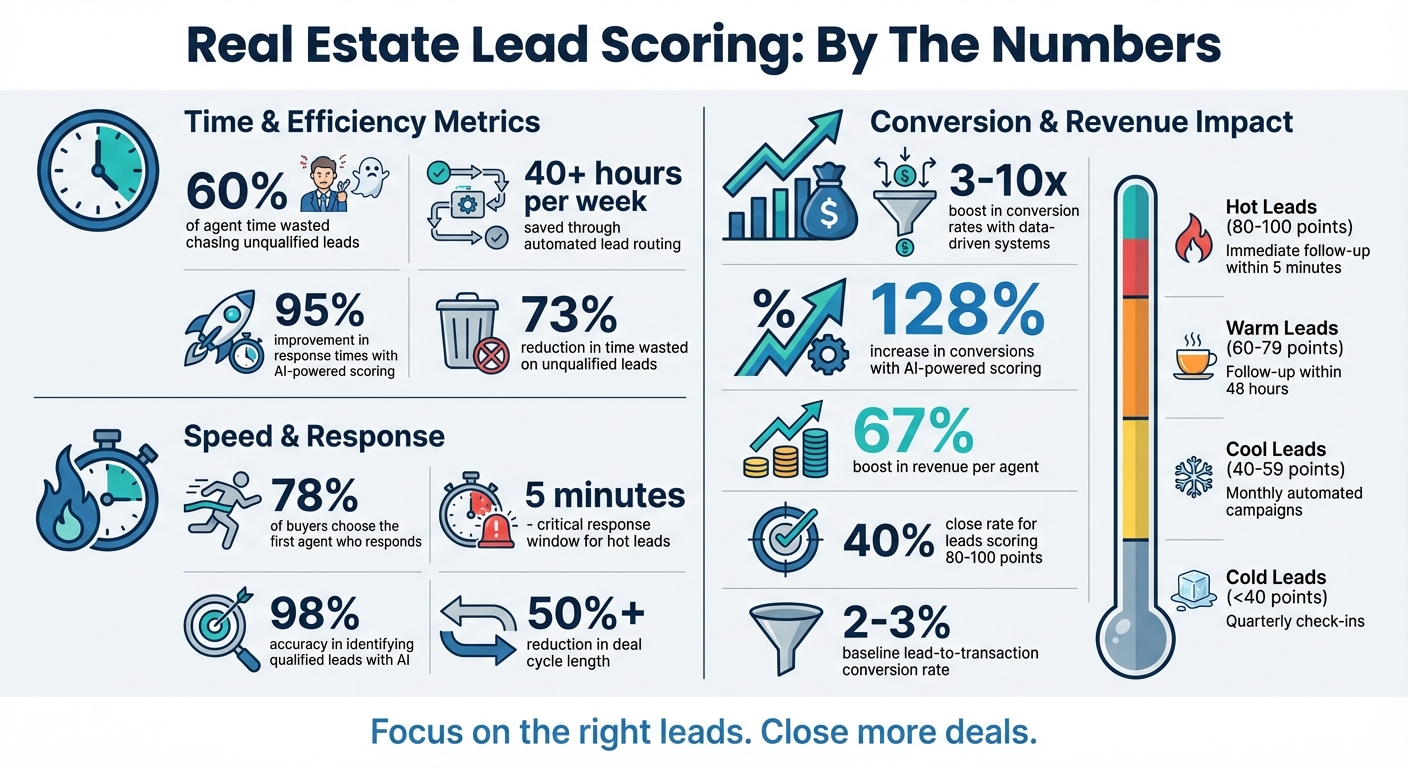
Real Estate Lead Scoring Impact: Key Statistics and ROI Metrics
Lead scoring is the process of assigning numerical values to potential buyers or sellers based on their demographics, behaviors, and engagement levels. The goal? To rank serious prospects higher than casual browsers, helping real estate professionals focus their efforts where it matters most [3][8].
There are two main methods for scoring leads. Rule-based scoring relies on fixed point systems - for example, awarding 10 points when someone requests a property showing [5]. While straightforward, this approach requires frequent manual updates and might overlook subtle patterns in data. On the other hand, AI-driven scoring uses machine learning to analyze thousands of data points, adapting and refining scores in real time [2][7].
Lead scoring typically evaluates two types of data:
Jamie, a Digital Marketer at Carrot, sums it up perfectly:
"Lead scoring is a way to rate how well new leads fit your ideal customer profile based on their activities and details about the opportunity" [5].
By combining these data points, real estate professionals can build a lead scoring system that identifies the most valuable prospects - a critical step in today’s competitive market.
For real estate agents, the challenge isn’t using top real estate lead sites - it’s figuring out which ones are worth pursuing. With only 2–3% of leads converting into transactions, it’s easy to waste time chasing unqualified prospects [7]. That’s where lead scoring comes in.
A solid scoring system helps prioritize leads effectively. For example, leads with scores between 80 and 100 are three to ten times more likely to convert than lower-scoring prospects [2]. This ensures that the most ready-to-act buyers or sellers get immediate attention [3][4]. And in a fast-paced market, timing is everything - 78% of buyers choose the first agent who responds to their inquiry [7].
Automation plays a big role here. With pipelines often exceeding 100 leads, automated systems can route high-scoring prospects to experienced agents for immediate follow-up, while lower-priority leads are placed into nurturing campaigns [3][5]. This triaging ensures no opportunity is missed.
Speed is another game-changer. AI-driven systems that respond to leads within 5 minutes - rather than hours - can boost conversion rates by an impressive 128% [3][7]. As Rework aptly puts it:
"The difference between a 20% conversion rate and a 5% conversion rate often comes down to one thing: speed and focus" [3].
When it comes to refining lead scoring in real estate, focusing on key data points is essential to pinpoint high-intent prospects. The most effective systems rely on three main categories: behavioral signals, demographic factors, and communication patterns. These elements form the backbone of a scoring model that separates serious buyers or sellers from casual browsers.
Behavioral data highlights genuine interest through specific actions. For instance, leads who view more than 10 properties in a week, spend over 10 minutes per session on your website, or revisit multiple times within seven days are showing clear intent [3][7]. Narrowing searches to specific neighborhoods or consistent price ranges strengthens this signal [3][7]. Actions like requesting a Comparative Market Analysis (CMA), using mortgage pre-approval tools, scheduling property showings, or asking for disclosures are even stronger indicators of readiness. These behaviors should carry significant weight - around 40% of the total lead score [7].
Demographic factors reveal whether a lead is financially and situationally prepared to move forward. Mortgage pre-approval status is a major indicator, as it shows the buyer has cleared key financial hurdles. This should add 20-30 points to their score [3][10]. Urgency is another critical factor - a lead aiming to close within 30 days is far more valuable than one planning six months out [3]. On the seller side, having 40% or more home equity often signals strong motivation [3][2]. Additionally, life events like job relocations, downsizing, or career changes often hint at a need to buy or sell, even before the lead explicitly states it [2].
Communication data measures how engaged and responsive a lead is. High email open rates, quick replies (within an hour), and detailed inquiries suggest a lead is more qualified [3][7]. Direct actions like phone calls or scheduling showings carry the most weight because they require a higher level of commitment. On the flip side, certain behaviors should lower a lead’s score. For example, points should be deducted if a lead unsubscribes, goes silent for 30-90 days, or provides fake contact information like "999-999-9999" [3][6][9].
"Savvy competitors have learned to swarm on the best opportunities as soon as they identify them, giving those prospects the highest level of personalized attention." – Mark Osborne, Modern Revenue Strategies [6]
To stay ahead of the competition, your scoring system must be precise, tracking the right data points and assigning appropriate weights to identify top opportunities before others do.
You don’t need to overhaul your entire tech stack to create a lead scoring system. The real key lies in starting with a clear framework, integrating it with your current tools, and fine-tuning it based on actual outcomes. A structured system ensures your focus stays on prospects who are ready to take action. Start by defining the exact criteria that identify your best leads.
Begin by outlining your Ideal Customer Profile. Look at key traits like age, income, neighborhood, and property type - factors that align with clients who’ve closed deals quickly in the past. Then, organize your scoring signals into three main categories:
Use a 100-point scale to assign weights to different actions. High-priority behaviors - like requesting a Comparative Market Analysis (CMA) or scheduling a property showing - should earn significantly more points than lower-intent actions, like opening a general email. For instance, you might assign 30% of the score to financial readiness, 25% to urgency, 25% to engagement, and 20% to fit or source. Set thresholds to guide follow-ups: leads scoring 80–100 points are considered "Hot" and should receive immediate agent attention, while "Warm" leads (60–79 points) can be followed up by an Inside Sales Agent (ISA) within 48 hours. "Cold" leads (below 40 points) can be placed into an automated nurture program.
"The biggest lift in lead scoring is not defining how many points something is worth, it's making sure everyone internally is aligned." – Ryan Durling, Inbound Consultant, HubSpot
Keep it simple when starting out - focus on 5–10 key attributes rather than trying to juggle 50 variables. To assign point values, compare the actions of customers who closed deals to those of all leads, then measure this against your average close rate.
To move from a manual system to an automated one, integrate your scoring model into your CRM. Create custom fields like "Lead Score" (0–100) and "Lead Grade" (A–F) to store and categorize scores. Modern CRMs often allow "When/Then" workflows, which automatically update scores based on lead activity. For example, if a lead saves a property, the system could add 15 points to their score.
Set up automation thresholds to trigger actions. For example, a lead scoring 80+ points might send an instant mobile alert to an agent, prompting a call within 5 minutes - a crucial step, as 78% of buyers go with the first agent who responds [7]. Leads with scores between 60–79 points could be routed to an ISA for follow-up within 48 hours, while those scoring 40–59 points might enter an email nurture sequence with 5–7 touchpoints. To keep your "Hot" list accurate, incorporate score decay by deducting 5 points per week for leads inactive for over 30 days [3]. If your CRM integrates with IDX tools, you can track property search behavior directly, updating scores automatically when a lead narrows their search or revisits a listing multiple times. Once automated scoring is in place, continually test and adjust your model for better results.
Your scoring model isn’t a one-and-done project - it needs regular updates to stay relevant. Before rolling it out fully, test it on historical leads to see if it accurately identifies those who closed deals. For example, a real estate model should ideally show that leads scoring 80–100 points close at a rate of 40% or higher [3].
"Lead scoring is no longer a set-it-and-forget-it deal. We're making real-time adjustments based on the latest data." – Grant, Sales Leader
Plan quarterly reviews to analyze data from closed-won and closed-lost deals. If successful deals consistently have low scores, you may need to adjust your model’s weighting. Similarly, examine high-scoring leads that didn’t convert to identify false positives and improve your negative scoring criteria. A/B testing can also help - run two scoring models side by side for 30 days to see which one better predicts closed deals.
Transparency is vital. A good system should provide a clear breakdown of why a lead received its score, giving agents confidence in the process. Involve both sales and marketing teams early on to ensure everyone agrees on what makes a lead "sales-ready."
Traditional lead scoring methods can pick up on basic signals but often lack the depth needed to fully understand a lead's readiness. AI and predictive analytics take this to the next level by analyzing thousands of data points all at once - like property history, market trends, communication habits, and behavioral patterns. These tools provide a level of precision that manual processes simply can't match [2].
Machine learning models are particularly skilled at identifying patterns that manual methods might overlook. Instead of relying on static scores, AI dives into more nuanced indicators, such as how leads refine their searches, how long they spend on certain pages, how quickly they respond to texts, and how well their budget aligns with the market [7].
AI also updates lead scores in real time. Within seconds of a phone call, email open, or website visit, the system recalculates scores based on the latest activity [11]. Some advanced tools even analyze voice patterns, speech speed, and emotional tone during calls to gauge urgency and buying intent - details that may not come through in words alone [11].
Inactive leads are automatically deprioritized, keeping your focus on the most engaged prospects [3]. But here's the real game-changer: if a lead that’s been dormant suddenly starts browsing properties again, AI picks up on this renewed interest and adjusts their score, ensuring no opportunities slip through the cracks.
The impact of these AI-driven upgrades is clear in real-world results. Take Metro Real Estate Group in Chicago as an example. Managing over 2,000 leads each month with just 15 agents, they struggled to keep up. After integrating AI call analytics into their lead scoring system, their response time plummeted from 4.2 hours to just 8 minutes. This change drove a 217% increase in lead-to-appointment conversion rates (from 12% to 38%) and boosted monthly closings from 28 to 89 transactions. The result? An additional $2.082 million in monthly revenue [11].
AI also helps agents focus on leads with the highest potential. For instance, leads who express timeline urgency - like needing to move by a specific date - convert at a rate of 78%. Similarly, those who mention financial readiness, such as being pre-approved, convert at 72% [11]. AI detects these cues during calls and adjusts scores instantly, prompting agents to act quickly. Since 78% of buyers go with the first agent who responds [7], this speed advantage often seals the deal.
Companies using AI for lead scoring report impressive results: a 67% boost in revenue per agent and a 73% reduction in time wasted on unqualified leads [7].
Once you've identified prospects with high potential, the next step is to act fast and smart. Assign these leads to your best-performing agents without delay. Why? Because about 60% of a real estate agent's time is often wasted chasing unqualified leads [7]. Prioritization isn't just a good idea - it's a revenue-saving strategy.
To make the most of high-value leads, categorize them into actionable groups based on their scores. Here's how you can break it down:
Speed is your ally here. Configure your system to send SMS or push notifications the moment a lead's score hits the "Hot" threshold - typically 80 points or higher. Some teams add extra layers of precision by routing leads based on agent expertise, like assigning luxury property leads to specialists or matching prospects to agents familiar with specific zip codes [12].
Another useful tactic? Implement score decay for inactive leads. This ensures your team isn't wasting time on prospects who have gone cold [3].
| Lead Category | Score Range | Action/Resource Allocation | Follow-up Frequency |
|---|---|---|---|
| Hot | 80–100 | Assign to top agents/ISAs | Within 5 minutes; Daily |
| Warm | 60–79 | Nurture via ISAs or newer agents | Within 48 hours; 5–7 touches in 3 weeks |
| Cool | 40–59 | Automated email campaigns | Monthly |
| Cold | <40 | Long-term drip campaigns | Quarterly check-ins |
This structured approach not only maximizes conversions in the short term but also builds a reliable pipeline for the future.
Quick action on high-priority leads brings immediate results, but a steady sales pipeline ensures long-term success. By prioritizing leads based on data, you can create a predictable flow of deals. For example, if Hot leads (80+ points) have a 40% close rate [3], you can work backward to hit your goals. Want 10 closings in a month? You'll need about 25 Hot leads in your pipeline. This level of clarity helps you plan resources, forecast revenue, and manage workloads effectively.
The real game-changer is automation. By automating the follow-up for 80–90% of your lower-priority leads, your team can focus on the top 10–20% - the ones most likely to convert [7]. Companies using this strategy have reported a 67% boost in revenue per agent and a 73% decrease in time wasted on unqualified leads [7].
Tara Minh, Operation Enthusiast at Rework, sums it up perfectly:
"The difference between a 20% conversion rate and a 5% conversion rate often comes down to one thing: speed and focus" [3].
Let automation handle the low-intent leads so your team can zero in on the prospects that matter most. It's a win-win.
Data-driven lead scoring can transform the way you manage prospects, turning chaotic lead management into a streamlined process that drives predictable revenue growth. By leveraging AI tools alongside behavioral tracking, you can pinpoint the top 10–20% of leads who are genuinely ready to take action, while automating follow-ups for less urgent prospects[2]. Real estate professionals using these strategies have reported impressive results: a 128% rise in conversion rates, a 73% drop in time wasted on unqualified leads, and a 67% boost in revenue per agent[7].
This shift from casting a wide net to precision targeting means your team spends less time manually sorting through CRM data and more time closing deals. AI models, which can identify qualified leads with up to 98% accuracy[1], also help shorten deal cycles by over 50%[1]. Automated alerts ensure you respond to high-priority leads within that critical five-minute window, significantly increasing your chances of conversion[3].
However, lead scoring isn’t a "set it and forget it" strategy. Markets change, customer behavior evolves, and your scoring model must keep up. Conduct monthly audits to confirm that high-scoring leads are closing at rates of 40% or higher[3]. If they’re not, adjust your scoring weights and disqualifiers. Introduce score decay to keep your pipeline free of outdated leads[3], and continuously feed your AI model with data from closed deals so it can refine its understanding of success[3].
Ultimately, success isn’t about the sheer number of leads - it’s about focusing on the right ones first. Combining smart automation with human expertise creates a sales process that’s both efficient and scalable, allowing your team to zero in on high-value opportunities.
To get started, define your scoring bands, integrate lead sources into your CRM, and test your criteria with real data. By transitioning from guesswork to data-driven actions, you’ll not only improve your pipeline but also see noticeable gains in your bottom line.
AI is transforming how real estate professionals score leads by processing massive amounts of data to detect patterns and predict whether someone is likely to buy or sell. By analyzing factors like online activity, engagement history, and market trends, AI helps agents focus on the leads that matter most, saving time and boosting efficiency.
With AI-generated insights, lead prioritization can reach accuracy levels of 85–92%. This means fewer wasted resources and higher conversion rates. It's a smarter, more efficient way to approach lead scoring, giving real estate teams the tools they need to make better, faster decisions.
A strong real estate lead scoring system hinges on identifying the right data points to rank prospects based on their likelihood to convert. Motivation indicators - like the percentage of property equity and how long the property has been owned - can provide clues about a seller's readiness to make a move. Behavioral signals - such as how prospects respond to outreach, interact with emails, or engage during calls - offer a glimpse into their level of interest. The lead source also plays a big role, as leads from inbound inquiries often have more potential than those from cold outreach.
Additional factors, like the number of years a property has been owned, can hint at motivations such as downsizing or dealing with landlord fatigue. Other details, including the property's location, type, and financial specifics like ownership equity, help fine-tune lead scores. By zeroing in on these insights, real estate professionals can focus their energy on the leads most likely to turn into opportunities.
To bring lead scoring into your CRM, the first step is gathering detailed information about your leads. This includes data like demographics, their behavior, and how they engage with your business. With this foundation, you can create scoring criteria based on factors such as recent interactions, property inquiries, or their overall level of interest.
Once you’ve got your criteria, set up the scoring logic in your CRM. Most CRMs allow for customization or even offer integrations with AI tools to streamline this process. Make sure your data sources are directly connected to your CRM so lead scores update automatically. This way, your team can focus on the leads that show the most potential.
Don't stop there - keep revisiting and fine-tuning your scoring system. Regular updates will help ensure the scores remain accurate and effective. By automating and improving this process, your team can save time and zero in on leads that are more likely to convert.
%20(5).png)
