%20Bold.png)
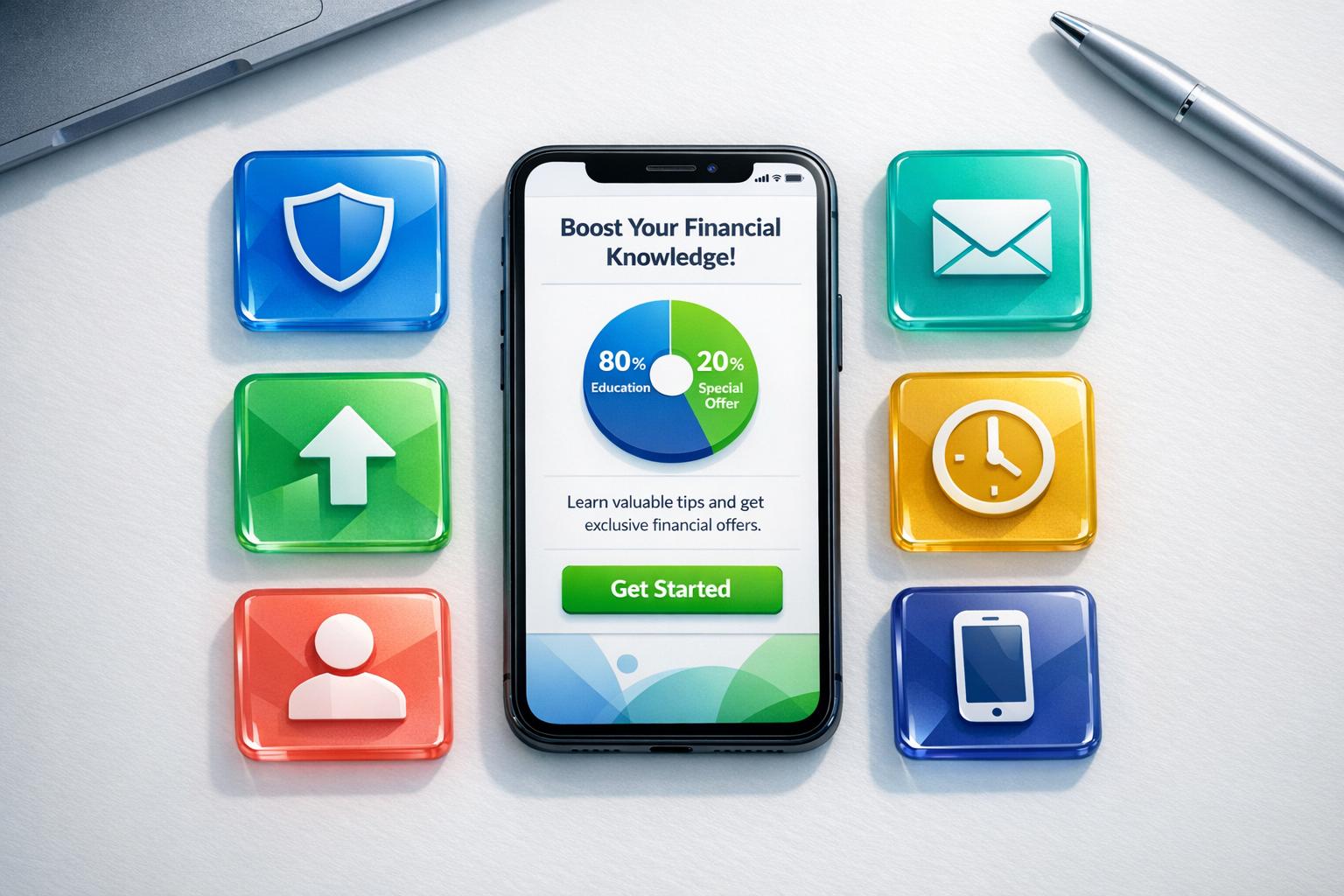
Email marketing is a powerful tool for financial services, but success hinges on strategy and design. Here’s the bottom line: segmented campaigns can boost revenue by 760%, and mobile-friendly emails are essential since 61% of financial emails are opened on phones.
To stand out, focus on these essentials:

Financial Email Marketing Statistics and Best Practices
Not all prospects are the same. A 28-year-old looking to refinance student loans has very different needs from a 62-year-old preparing for retirement. That’s why segmented campaigns are so effective - they allow you to address each group's specific concerns and decision-making stage.
Start by dividing your audience based on two key factors: who they are and where they are in their journey. Begin with fundamental demographics like age, income, and life stage (college students, young professionals, pre-retirees). Then, layer in financial goals such as retirement planning, investment management, tax strategies, or debt consolidation. Behavioral data adds another layer of depth - monitor website activity like HELOC calculator usage, mortgage guide views, content downloads, and email engagement. Each of these insights helps refine your approach.
Equally important is understanding where prospects are in their journey. Those in the Awareness stage benefit most from educational resources like blog posts or interactive tools. In the Consideration stage, case studies, testimonials, and comparison guides resonate better. By the time they reach the Decision stage, time-sensitive offers or free consultations are more likely to seal the deal. As Joyce Colin puts it:
"Personalization isn't just {FirstName}; it's speaking directly to the individual's intent" [9].
To build trust and improve results, combine behavioral insights with demographic data. Use your CRM to track not just basic information but also interaction history - what content they viewed, downloaded, or engaged with. Behavioral triggers can be especially powerful. For example, sending an email within 30 minutes of someone visiting your pricing page or submitting an inquiry can make a big difference. Remember, 96% of website visitors don’t make a purchase on their first visit [9].
Here are some segmentation parameters that can help refine your approach:
| Segmentation Parameter | Typical Impact on Metrics | Recommended Data Source |
|---|---|---|
| App Engagement Frequency | +21% Open Rate | Usage Logs |
| Recent Transaction Volume | +18% CTR | Platform Analytics |
| Demographic Profile | +10% Conversion Rate | KYC Data |
| Support Ticket History | +9% Retention | CRM Records |
Lead scoring can further prioritize your efforts. Assign higher scores to prospects who show strong engagement, like repeatedly visiting pricing pages or downloading multiple resources. For financial firms with transactional data, segmentation can go even deeper - think frequent international travelers or new homeowners [15].
The numbers speak for themselves. Segmentation can lead to up to 14.3% higher open rates and 30% more email opens compared to generic campaigns [4][15]. Additionally, 90% of marketers say segmentation significantly boosts engagement and conversion rates [14]. For example, sending a retirement guide to a 60-year-old instead of a 25-year-old ensures your message is relevant and valuable, while also nurturing leads with targeted educational and promotional content.
Segmentation also helps with email deliverability. Internet Service Providers monitor engagement, and higher engagement rates improve your chances of landing in the inbox instead of the spam folder. Valerie Rivera from eMoney Advisor emphasizes this point:
"By tailoring your communications to each lead's specific interests, pain points, and circumstances, you demonstrate that you understand their unique needs and are committed to providing personalized guidance" [10].
This approach explains why 80% of customers are more likely to buy from a brand that delivers a personalized experience [11]. Segmentation isn’t just about better metrics - it’s about creating connections that lead to lasting trust and loyalty.
The most effective financial email campaigns stick to a simple rule: teach first, sell second. A common approach is the 80/20 ratio - 80% educational content and 20% promotional content [2][17]. Some advisors go even further, using a 90/10 split to build deeper trust [18]. Why does this work? Because financial customers value security and expertise above all else. By showing a solid understanding of the market before asking for anything, you earn the trust needed to make your pitch.
And the results speak for themselves: businesses that use well-planned nurture strategies generate over 40% more sales-ready leads while cutting costs by 33% [2]. It’s a clear reminder that trust drives sales, and trust is built by consistently offering value.
Educational content helps position your business as a knowledgeable partner rather than just another vendor. Focus on topics that address real client concerns: market trends, tax filing tips, retirement planning advice, regulatory changes, and financial strategies [16][18][12]. For instance, sending a tax preparation checklist in early March or a guide on market volatility during uncertain times shows you understand what’s on your clients' minds.
When crafting educational emails, try using the inverted pyramid model. Start with a clear, engaging headline, follow up with visuals or key insights, and guide readers toward a single, well-defined call-to-action at the end [8]. Keep your language straightforward and approachable. As Catherine Cote, Marketing Coordinator at Harvard Business School Online, puts it:
"A successful communicator must take their audience's perspective into account to distill information and determine the most effective method for communicating with them" [17].
Break down complex financial topics with bullet points and concise text. Avoid jargon when possible, but if technical terms are necessary, explain them clearly. The goal is to make your expertise feel approachable, not intimidating. Once trust is established, you can naturally transition to promotional content without losing credibility.
Promotional content works best when it follows value-packed educational material. Place your promotional messages at the end of the email - after readers have been convinced of your expertise, they’ll be more open to a subtle nudge [17]. Think of it as a small "promo strip" that complements the useful information you’ve already shared.
Tailor your call-to-action (CTA) to match where your prospects are in their journey. For early-stage contacts, use soft CTAs like "Download our tax guide" or "View our retirement checklist" [16]. For more engaged prospects - those who’ve opened multiple emails or visited your pricing page - use hard CTAs like "Schedule a consultation" or "Apply now" [16]. Keep CTA buttons short and to the point (e.g., "Secure My Card" or "Download Report") to reduce hesitation [4]. A single, focused CTA can boost click-through rates by 371% and sales by 161% [4].
Avoid spammy language like "cash loans", "lending now", or over-the-top phrases like "perfect" or "amazing" [3][6]. Financial trust is built on professionalism, not hype. If you need to create urgency, make it genuine - "Apply by midnight" tends to perform better than vague pressure tactics, increasing response rates by 22% [4]. Be upfront about what you’re offering, including any risks or terms, to maintain trust over the long term [5].
Finally, ensure your emails are clear and mobile-friendly to keep readers engaged.
Did you know that over 61% of financial emails are opened on smartphones [4]? If your email isn’t optimized for mobile devices, there’s a good chance your message won’t get the attention it deserves. Small fonts, hard-to-tap buttons, or layouts that require excessive scrolling can frustrate readers and hurt engagement. The good news? A few smart design choices can make your emails look great and perform well on any device. Nail the mobile-friendly design first, then focus on refining subject lines and calls-to-action.
Once your design is mobile-friendly, you can shift your attention to crafting subject lines that grab attention.
Your subject line is your first impression - and sometimes your only one. Here’s how to make it count:
Luke Ferris, Contributing Editor at Foundr, emphasizes:
"Engaging hooks, ledes, pitches, and pickup lines all need to quickly help your audience understand why you're relevant and why they should stick with you" [19].
Use A/B testing to experiment with different subject lines and find what resonates most with your audience.
When it comes to CTAs, simplicity wins. A single, focused action often drives the best results.
| Design Element | Impact on Performance |
|---|---|
| High-contrast CTA Buttons | +21% Conversion Rate [4] |
| Single-column Layout | +17% Click Rate [4] |
| Benefit-driven Headlines | +34% Transaction Rate [4] |
| Ample White Space | +13% Increase in Clicks [4] |
Once you've crafted a mobile-friendly email with a compelling subject line and a clear call-to-action, the next step is to evaluate its performance. This phase ensures that your design efforts translate into measurable outcomes. By tracking the right metrics, you can better understand how your audience interacts with your campaigns and pinpoint areas for improvement. Financial email marketing is known for its impressive ROI - averaging $45 for every $1 spent [22]. To achieve such results, it’s crucial to know what to measure and how to test.
Start by monitoring deliverability rates to ensure your emails are reaching inboxes, and open rates to assess how well your subject lines are performing. The click-through rate (CTR) indicates how effectively your content and CTAs resonate with readers, while the conversion rate measures whether recipients are taking the desired action - like completing a loan application or scheduling a consultation or generating real estate leads [2][23]. For financial campaigns, tracking transaction volume, app engagement frequency, and retention rates provides additional insights into long-term success [4][6].
Pay attention to bounce rates and spam complaints, as these can harm your sender reputation and impact inbox placement [23]. Financial firms that optimize deliverability often see up to 40% higher client engagement rates [23]. Be aware that modern privacy settings might artificially inflate engagement metrics by automatically "opening" emails or "clicking" links to verify their safety. For a clearer picture, focus on bottom-funnel conversions like actual applications or purchases [6].
| Metric | Purpose | Financial Context Example |
|---|---|---|
| Deliverability Rate | Ensures the email reaches the inbox. | Confirming account statements are delivered to clients [23]. |
| Open Rate | Evaluates subject line effectiveness. | Comparing "Your account statement is ready" with generic notifications [4]. |
| Click-Through Rate | Measures engagement with content and CTAs. | Tracking clicks on a high-yield savings offer link [4]. |
| Conversion Rate | Tracks the completion of desired actions. | Monitoring loan applications or consultation bookings [2][6]. |
| Bounce Rate | Flags invalid or blocked email addresses. | Cleaning up outdated client lists post-tax season [23]. |
A/B testing is essential for identifying what resonates with your audience. For example, Twilio SendGrid tested two "From" addresses: one simply said "Twilio SendGrid", while the other read "Matt from Twilio SendGrid." The latter saw a 10% higher open rate [24].
Experiment with variables like subject line length (e.g., three-word subject lines had 21.2% open rates compared to 15.8% for seven-word versions [24]), personalization (adding the recipient’s name can increase open rates by 26% [4]), send times, and CTA phrasing. For CTAs, action-oriented language - like "Secure My Card" instead of "Get Started" - can significantly boost engagement [4]. Always test multiple variations at once to achieve statistically reliable results (95% confidence level) [24].
With these tested insights, you’ll be better equipped to refine your campaigns while staying compliant.
Compliance is non-negotiable. Follow regulations such as FINRA, SEC, CAN-SPAM, and GDPR [23]. Each email must include an unsubscribe link, accurate sender details, and the firm’s physical mailing address [23][22]. Additionally, implementing email authentication protocols like SPF (Sender Policy Framework), DKIM (DomainKeys Identified Mail), and DMARC ensures your sender identity is verified, improving inbox placement [23][26].
Regularly clean your email lists by removing unengaged subscribers (after 6–12 months) and hard bounces [23]. Integrating your email platform with a CRM like Salesforce Marketing Cloud or Pardot allows you to automatically archive interaction histories, bounce data, and consent preferences [23][25][26]. This creates a centralized record that supports both compliance and deliverability. Poor email deliverability can cut campaign engagement by up to 50%, so staying on top of these requirements is critical for maintaining both your reputation and your results [23].
Here's a quick rundown of the key practices to keep in mind for your financial email campaigns:
To create effective email campaigns, begin by organizing your audience into segments based on behavior, demographics, or purchase history. These groupings allow you to craft messages that feel more personal and relevant, increasing the chances of engagement and connection with your readers.
To stay compliant without sacrificing conversions, focus on a few key practices. First, always secure explicit consent from your recipients. Make sure your disclosures are clear, and provide easy-to-use opt-out options. Additionally, establish structured approval processes to ensure consistency. Using compliance tools to monitor and archive communications can also help you stay on track. These measures allow you to follow regulations while maintaining effective audience engagement.
When privacy updates make open rates less dependable, shift your attention to click-through rates, conversions, engagement duration, and recipient actions aligned with your campaign objectives. These metrics offer a clearer picture of how your audience interacts with your content and how well your campaigns are performing.
%20(5).png)
