%20Bold.png)

B2B companies waste millions chasing the wrong customers. Nearly 80% of qualified leads fail to convert into revenue, often because Ideal Customer Profiles (ICPs) are based on assumptions rather than data.
Switching to data-driven ICPs changes the game by using historical deal data, retention trends, and real-time buying signals to identify the best-fit customers. The results?
This approach saves resources, aligns teams, and focuses efforts on customers who are most likely to buy, stay, and grow with your business. Companies like APT Global and Trust Insights have already seen faster sales cycles and better-qualified leads by leveraging predictive analytics and intent data.
For businesses that want scalable growth, the takeaway is simple: Stop guessing who your ideal customers are. Use data to find them, engage them, and convert them into long-term revenue drivers.
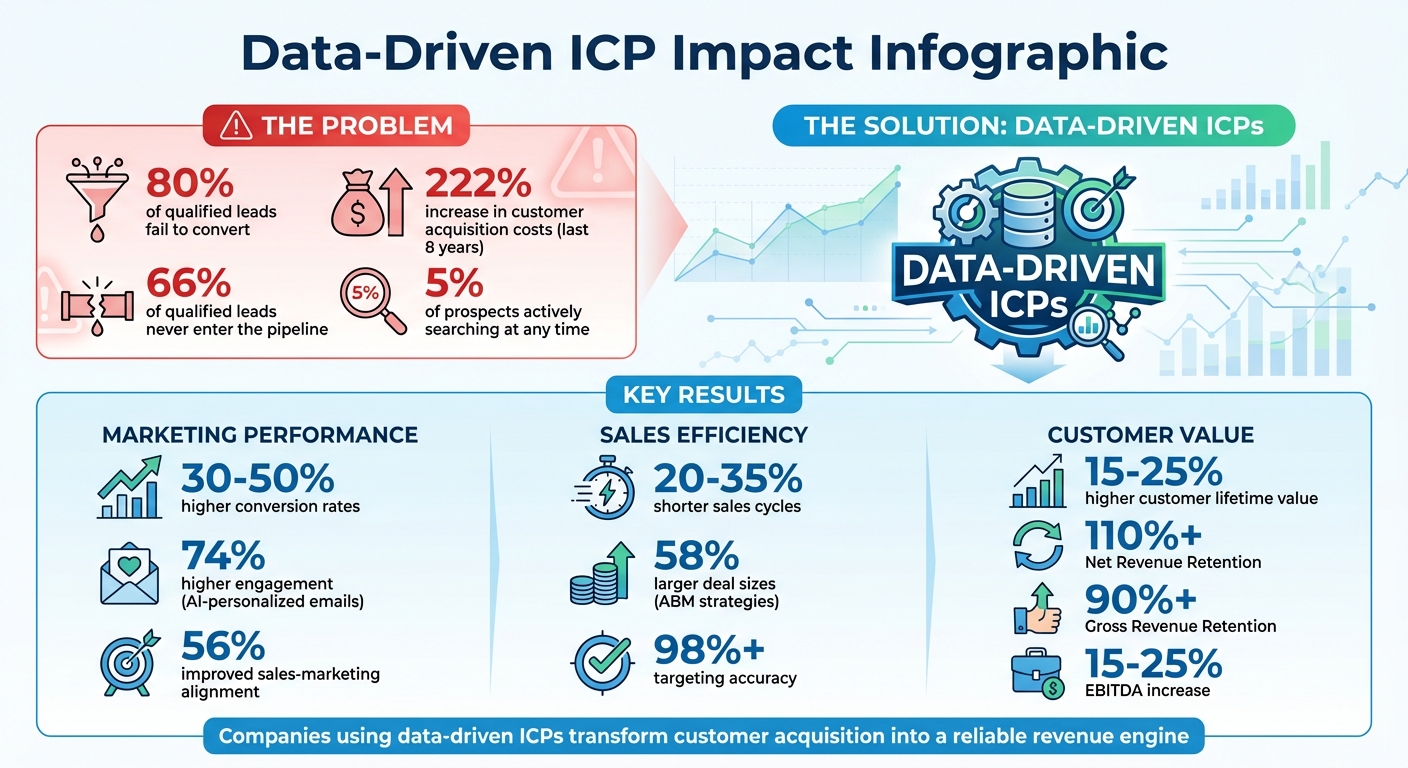
Data-Driven ICP Impact: Key B2B Growth Metrics and Benefits
Defining your ideal customer using data can lead to impressive financial results. Companies that embrace data-driven Ideal Customer Profiles (ICPs) often experience 30–50% higher marketing conversion rates, 20–35% shorter sales cycles, and 15–25% increases in customer lifetime value. These aren’t just minor gains - they can fundamentally shift your business from wasting resources on low-potential leads to creating a reliable revenue engine.
For example, a $50 million ARR B2B SaaS company typically spends $15–20 million annually on sales and marketing. Yet, two-thirds of "qualified" leads never even make it into the pipeline. Data-driven ICPs solve this issue by replacing vague assumptions with actionable insights drawn from past successful deals. These insights - like tech stack preferences, buying behaviors, and retention indicators - help identify high-potential opportunities while filtering out less promising ones.
Traditional B2B customer acquisition is often both costly and inefficient. Over the last eight years, customer acquisition costs have skyrocketed by 222%, with many companies still relying on broad targeting strategies. This approach wastes resources by attempting to engage the entire market, even though only about 5% of prospects are actively searching for a solution at any given time.
Data-driven ICPs flip this model by combining firmographic profiles with intent signals. Instead of casting a wide net, focus shifts to companies showing clear buying intent - like visiting pricing pages or researching competitors. This targeted approach ensures sales teams spend their time on prospects most likely to convert. As Jonathan Bland, Cofounder of Omni Lab, aptly puts it:
"I could have the best creative, the best offer. But if it's targeted at the wrong person, no dice".
The benefits don’t stop there. AI-personalized email campaigns see up to 74% higher engagement rates compared to generic outreach, ensuring your messaging resonates with decision-makers aligned to your success profile. This level of precision makes customer acquisition not just faster, but smarter, paving the way for long-term value.
Data-driven ICPs don’t just help you win customers faster - they help you win the right customers. These are the ones who stick around, grow with your business, and boost profitability. Companies leveraging precise ICPs report Net Revenue Retention (NRR) rates of 110%+ for their high-value segments, meaning these customers are more likely to expand their spending rather than churn.
By analyzing your most successful customers - those with the highest retention and profitability - you can reverse-engineer a blueprint for acquiring more like them. This approach shifts the focus from chasing volume to prioritizing quality. For example, businesses using Account-Based Marketing (ABM) strategies tied to specific ICPs report 58% larger deal sizes. With Gross Revenue Retention (GRR) staying strong at 90%+, you avoid onboarding customers who might later realize your solution doesn’t meet their needs.
Beyond acquisition and retention, data-driven ICPs bring another crucial advantage: alignment between sales and marketing. When both teams operate from a shared, data-backed definition of a high-value customer, collaboration improves, and finger-pointing fades. Marketing stops delivering leads that sales dismiss as unqualified, and sales stops criticizing marketing for misunderstanding the business.
In fact, 56% of organizations report improved alignment between sales and marketing teams when using ABM and ICP strategies. This alignment stems from everyone relying on the same "value cockpit", which highlights high-converting segments, lifetime value leaders, and areas to avoid. As Rohini Katsuri, CEO of HG Insights, explains:
"If all teams - marketing, sales, product - are working off the same data-driven playbook, you are much more precise in your approach. That means fewer wasted resources and a much higher conversion rate".
This unified strategy also empowers sales teams to disqualify poor-fit leads early, allowing them to focus on opportunities that align with the ideal customer profile. Companies achieving this level of alignment report EBITDA increases of 15–25%, as every function - from demand generation to customer success - works toward the same goals with optimized efficiency.
Real-world examples show how data-driven Ideal Customer Profiles (ICPs) can lead to measurable success. By anchoring their strategies in data, these B2B companies achieved impressive growth and efficiency.
APT Global shifted from traditional targeting methods to a predictive system that identified accounts most likely to buy, expand, or renew. By studying historical deal data and customer success trends, they developed profiles that highlighted prospects resembling their top customers. The result? Sales cycles were shortened by 20–35%. This data-driven approach gave their team a clear edge in prioritizing high-potential leads.
Trust Insights faced a familiar challenge: their static ICPs couldn’t determine when prospects were ready to buy. To solve this, they integrated intent data into their CRM, creating dynamic profiles that tracked real-time buying signals. Instead of casting a wide net, they focused on accounts actively researching solutions. By analyzing bookings data - such as contract values, renewals, and churn - they identified prospects likely to become high-value, long-term customers. This targeted approach boosted their ability to connect with the right buyers at the right time.
Digital Scouts took a different route by analyzing their most valuable customers for patterns. They examined firmographic data like company size, revenue, industry type, location, and financial stability. By reviewing closed-won deals and past success metrics, they uncovered traits shared by their most profitable clients. These insights allowed them to create detailed buyer personas that went beyond basic demographics, incorporating behavioral signals that indicated buying intent. As a result, their sales team could quickly disqualify poor-fit leads and focus on prospects that aligned with their proven success profile. This approach highlights how precise data can transform B2B growth strategies by ensuring efforts are directed toward the right opportunities.
Implementing data-driven Ideal Customer Profiles (ICPs) on a large scale requires accuracy and a clear strategy. Visora's Trifecta Program is designed to help B2B leaders transform ICP insights into consistent revenue streams. With a pipeline that has already surpassed $127.15 million, clients often see qualified meetings scheduled within just 7–14 days of launching the program. By combining three interconnected systems, the Trifecta Program delivers fast and measurable outcomes.
The B2B Vortex Funnel brings together outbound campaigns, lead targeting, scheduling, and CRM integration into one streamlined process. It uses insights from over 20,000 real-time conversations to fine-tune targeting, messaging, and positioning before any outreach begins. This upfront alignment of demand, target, and offer achieves a remarkable 98%+ accuracy rate in identifying qualified opportunities while cutting deal cycles by more than half.
For instance, Visora worked with CoherentAI to generate over $150,000 in pipeline revenue. By aligning demand, target, and offer before launching a strategy-driven outbound campaign aimed at sales leaders, they achieved impressive results.
Once precise targeting is in place, Visora's AI-powered appointment-setting system takes over to ensure timely and effective engagement. The system automates the outbound process, leveraging high-ticket success data to train AI tools. These tools employ A/B testing and real-time analytics to refine messaging and identify the best prospects. By combining intent data with ICP insights, the AI identifies in-market accounts ready for engagement. This not only reduces the manual workload for sales teams but also allows them to focus on closing deals.
For example, Visora helped Inflowance secure over 10 high-quality sales opportunities within just 30 days.
"The Visora team is fast, reliable, and high-quality"
Visora also offers consulting services to help businesses build predictable AI acquisition systems. This includes specialized sales training to improve close rates once high-fit relationships are established. A notable example is their work with GPC Real Estate. Visora replaced GPC's manual spreadsheets with a fully automated, custom HubSpot CRM system. This upgrade reduced manual tasks by 40%, enabling the company to scale investor operations without adding more staff. By streamlining operations, this system supports sustainable revenue growth and minimizes inefficiencies.
"Visora is a great agency to partner with... extremely responsive, professional, and knowledgeable throughout the entire process"
When it comes to growing a B2B business, data-driven Ideal Customer Profiles (ICPs) are a game changer. They don’t just help with customer acquisition - they boost retention too. The results? Higher conversion rates, shorter sales cycles, and increased customer lifetime value (CLV). In fact, companies leveraging data-driven growth strategies report EBITDA increases of 15% to 25%.
Moving away from intuition-based targeting to precision backed by data eliminates the inefficiencies that often plague B2B strategies. When marketing, sales, and customer success teams focus on the same high-value accounts, they can channel their efforts toward prospects most likely to buy, expand, and renew.
"ICPs shouldn't just describe who might buy - they should predict who will buy, expand, and renew to maximize customer lifetime value (LTV)." - AlignICP
Visora’s approach highlights how aligning actionable insights with execution can fuel scalable growth. By zeroing in on the right targets, businesses set the stage for smarter, more strategic operations.
But identifying the right ICP is just the beginning. Execution is where the magic happens. It’s about turning data into measurable outcomes. While 64% of B2B companies plan to increase investments in predictive analytics, gathering data alone won’t cut it. To truly make an impact, businesses need to integrate intent signals, firmographic data, and real-time market trends into a cohesive revenue engine. This means evolving from static customer profiles to dynamic, adaptable strategies that can shift with market conditions.
For leaders looking to scale efficiently - without adding headcount or blowing up ad budgets - the roadmap is clear. Start by reverse-engineering success from your top-performing customers, layer in intent data to pinpoint active prospects, and implement systems that turn insights into qualified opportunities. With this framework in place, businesses can transform customer acquisition into a reliable revenue engine, creating growth that compounds over time.
Data-driven Ideal Customer Profiles (ICPs) take the guesswork out of identifying potential customers by turning broad assumptions into precise, actionable insights. By analyzing firmographic (company characteristics), technographic (technology usage), and behavioral data, businesses can pinpoint high-value prospects. This sharpens their focus, cuts down on wasted marketing dollars, and improves the quality of leads - helping teams zero in on accounts most likely to convert.
When paired with advertising or outreach tools, these profiles enable highly targeted campaigns. Businesses can deliver personalized messages that resonate with specific audience segments. Tools powered by AI, like Visora, take it a step further by automating follow-ups and adjusting strategies in real time. The result? Better engagement and higher conversion rates.
Organizations that embrace data-driven ICPs often report a noticeable boost in marketing efficiency and ROI. In fact, many see growth rates soar by 15–25% compared to traditional approaches. By continuously updating these profiles with fresh data, businesses can amplify their marketing efforts, turning more prospects into loyal, long-term customers.
Intent data gives businesses a clear window into which prospects are actively searching for solutions. By analyzing online activities like search queries, content interactions, and website visits, businesses can pinpoint leads that are more likely to convert. This targeted approach not only saves time but also boosts efficiency for marketing teams.
Using intent data, sales and marketing teams can fine-tune their outreach efforts to meet the unique needs of these high-interest prospects. This personalized strategy helps forge stronger connections and opens the door to increased revenue opportunities.
Data-driven Ideal Customer Profiles (ICPs) offer a precise, evidence-backed way to define the accounts that deliver the most value to your business. By analyzing firmographic, technographic, and behavioral data from your best-performing customers, sales and marketing teams can align on which prospects to focus on and when to move leads forward. This eliminates the need for guesswork and prevents decisions from being made in silos.
To make this alignment work, teams can take three key steps:
This process not only reduces duplicate efforts but also improves lead quality and refines strategies through shared insights over time.
Visora takes this a step further with its AI-powered tools, delivering real-time intent signals, enriching customer data, and simplifying collaboration through its Trifecta framework. This enables teams to run synchronized campaigns, shorten sales cycles, and scale revenue effectively - all without the need for massive ad budgets or large teams.
%20(5).png)
