%20Bold.png)

Email marketing delivers an impressive $36 return for every $1 spent, making it one of the most effective channels for financial B2B. With long sales cycles and tight budgets, understanding email ROI is critical for optimizing campaigns and justifying marketing spend. Here's what you need to know:
[(Gross Profit - Campaign Cost) / Campaign Cost] x 100 helps track performance.Tracking the right metrics, maintaining a healthy email list, and leveraging automation are essential for maximizing ROI in financial B2B.
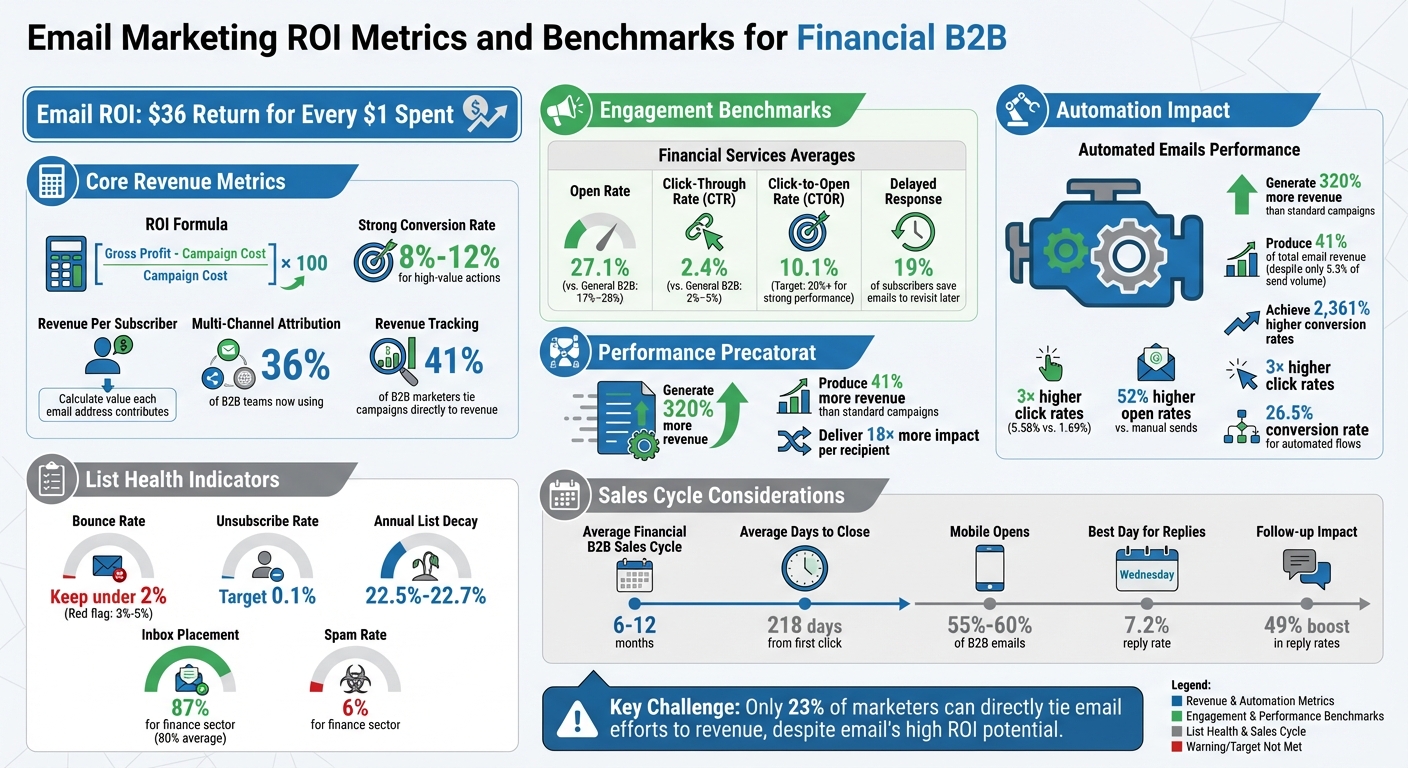
Email Marketing ROI Metrics and Benchmarks for Financial B2B
The right metrics can make or break an email campaign in the financial B2B space. To truly understand your email program's impact, focus on three key areas: revenue metrics that showcase financial outcomes, engagement metrics that measure audience interaction, and list health metrics that ensure your emails continue to land in inboxes. Let’s dive into how these metrics work together to gauge email ROI in financial B2B.
Revenue metrics connect your email efforts directly to financial outcomes. The standard ROI formula is [(Total Revenue - Total Cost) / Total Cost], but for a more nuanced view, you can use Gross Profit ROI: [(Gross Profit - Cost of Email Campaign) / Cost of Email Campaign] x 100 [2][9][10].
A standout metric here is revenue per subscriber, which calculates the monetary value each email address brings to your business. To find this, multiply your annual email revenue by the average lifespan of a subscriber, then divide by your average list size [10][12]. This insight can justify acquisition costs and help identify your most lucrative audience segments.
In B2B financial services, conversion rate carries particular weight. Unlike retail, where conversions often mean purchases, financial campaigns aim for actions like scheduling consultations or downloading investment guides. A strong conversion rate falls between 8% and 12%, with anything over 10% signaling solid performance for high-value actions [8][9].
Advanced B2B teams are also embracing multi-channel attribution models, with 36% now using them to understand email's role alongside other marketing efforts [8]. Additionally, 39% of marketers track email’s contribution to customer retention, a critical factor for long-term profitability in financial services [8]. With 41% of B2B marketers tying campaigns directly to revenue, email is shedding its reputation as an unquantifiable channel.
"Email is quietly becoming one of the most measurable parts of the B2B funnel." - AD150 [8]
While revenue metrics are vital, they only tell part of the story. Engagement metrics reveal whether your content resonates with financial decision-makers.
With the declining reliability of open rates due to privacy updates, click-through rate (CTR) and click-to-open rate (CTOR) have become the go-to metrics for assessing content performance [4][12].
For financial services, here’s how the averages stack up:
A CTOR above 20% is considered strong across industries [4]. This metric is especially useful because it focuses on the quality of your content, rather than just the appeal of your subject lines. If your subject lines generate opens but your CTOR is low, it’s a sign that your content isn’t meeting expectations.
Financial decision-makers often take their time to act on emails. About 19% of subscribers save emails to revisit later [12]. This means a campaign that seems lackluster after 48 hours might perform better after a week or two. This delayed response, often called the "nudge effect", is common in financial services, where decisions typically involve internal reviews and approvals [12].
| Metric | Finance Average | General B2B "Good" Range |
|---|---|---|
| Open Rate | 27.1% [11] | 17% - 28% [11] |
| Click-Through Rate (CTR) | 2.4% [11] | 2% - 5% [11][4] |
| Click-to-Open Rate (CTOR) | 10.1% [11] | 10% - 25% [4] |
Healthy lists are the backbone of successful email campaigns. A bounce rate above 2% can harm your sender reputation and signal poor list maintenance [9][13]. It’s crucial to distinguish between hard bounces (permanent failures, like invalid addresses) and soft bounces (temporary issues, like full inboxes) to know when your list needs immediate attention [4][9].
"A high bounce rate in an email campaign indicates a very low ROI." - Robin Waite [9]
Another key metric is the unsubscribe rate, which should stay around 0.1% for a well-managed program. If it reaches 3% to 5%, it’s a red flag that your content or frequency isn’t aligning with audience expectations [9].
B2B email lists naturally shrink by approximately 22.5% to 22.7% annually due to job changes, company updates, and outdated addresses [9][5]. To counter this, calculate your list growth rate:
{(New subscribers – Unsubscribes & spam complaints) / Total recipients} x 100 [9]. Regular acquisition efforts are essential to maintain a healthy list.
For financial B2B, inbox placement is the ultimate measure of success. While delivery rates might show 98.2%, the actual inbox placement rate averages closer to 80% due to aggressive corporate spam filters [13]. The finance and insurance sector typically achieves an 87% inbox placement rate, with a 6% spam rate and a 7% missing/blocked rate [13]. Authentication protocols like SPF, DKIM, and DMARC are critical to ensuring emails land in inboxes.
"B2B filters aren't mean, they're just skeptical. Think of them like that cautious friend who doesn't trust strangers at parties." - David Morelo [13]
In the world of financial B2B, automation isn't just a convenience - it’s a game-changer for driving revenue. By 2025, 72% of B2B companies are expected to lean on automated workflows to power their email strategies [14]. Why? Because automated emails produce 320% more revenue and achieve conversion rates that are a staggering 2,361% higher than traditional scheduled campaigns [14][17]. For financial services professionals navigating lengthy sales cycles and intricate decision-making processes, automation turns email into a precision tool rather than a one-size-fits-all broadcast.
Let’s break down how to measure the impact of these automated flows.
The numbers don’t lie - automated email flows outperform manual campaigns by a wide margin. Despite accounting for just 5.3% of total send volume, automated sequences generate nearly 41% of total email revenue [19]. Emails triggered by specific actions, like onboarding, re-engagement, or follow-ups after consultations, deliver 18× more impact per recipient than standard newsletters [19].
One metric that highlights this efficiency is Revenue Per Recipient (RPR). Automation boosts RPR by sending timely, behavior-based emails - like when a prospect downloads an investment guide or schedules a consultation. These emails reach prospects exactly when they’re most engaged, rather than sticking to a rigid schedule.
The performance lift doesn’t stop there. Automated flows achieve 3× higher click rates (5.58% vs. 1.69%) and 13× higher order rates compared to broadcast campaigns [19]. In financial B2B, where "orders" often equate to booked consultations or new account openings, these boosts matter. Automation in this space delivers a 26.5% conversion rate, which is almost triple the rate of generic email blasts [21].
"Email flows deliver over 3× higher click rates (5.58% vs. 1.69%) and 13× higher placed order rates than campaigns, showing that relevance and timing outweigh frequency." - Klaviyo [19]
To maximize results, track metrics like open rates, click-through rates (CTR), click-to-open rates (CTOR), and revenue attribution for each email flow. Automated emails see 52% higher open rates compared to manual sends [14]. Each type of automated series - whether it’s onboarding or event follow-ups - should be evaluated based on its specific objectives. This focus on data-driven performance solidifies email automation as a cornerstone of financial B2B strategies.
When it comes to email performance, benchmarking is essential to understand how your campaigns stack up. In the business and finance sector, open rates range between 31.35% and 43.34%, with an average click rate of 4.40% and a CTOR of 7.96% [14][15][16]. These numbers surpass general B2B averages, reflecting the high engagement levels of financial decision-makers actively seeking solutions.
The return on investment (ROI) for email marketing in financial services is equally impressive, delivering an average of $36 to $44 for every $1 spent [3][22][14][17]. This positions email as one of the most effective channels in the marketing mix.
Here’s a snapshot of key benchmarks:
| Metric | Financial/Business B2B Benchmark | General B2B Benchmark |
|---|---|---|
| Average Open Rate | 31.35% – 43.34% [14][16] | 39.26% [15] |
| Average Click Rate | 4.40% [15] | 2.4% [14] |
| Average CTOR | 7.96% [16] | 10% – 25% [4] |
| Average ROI | $36:$1 [14] | $36-$42:$1 [17] |
| Lead Conversion Rate | 2% – 5% [14] | 2.53% [14] |
Timing plays a critical role in financial B2B email success. Wednesday consistently emerges as the best day for reply rates, with a peak of 7.2% for B2B emails [14]. A well-timed follow-up email can boost reply rates by 49% [14]. Considering that the average financial sales cycle spans 218 days from the first click to a closed deal [18], automation must focus on nurturing leads over the long haul.
Lastly, mobile optimization is key. Between 55% and 60% of B2B emails are opened on mobile devices [14][17], as decision-makers often check emails during commutes or in between meetings. Responsive design is non-negotiable, and maintaining a top-tier deliverability rate - above 95% with a bounce rate below 0.21% - is essential for meeting these benchmarks [14][15].
Boosting email ROI in financial B2B requires a deliberate approach. With long sales cycles and complex purchase decisions, every email sent needs to have a clear purpose. By refining strategies, you can cut costs, better attribute revenue, and make email a major contributor to your bottom line. Start by analyzing all cost factors to uncover opportunities for greater efficiency.
Many financial firms focus solely on platform fees, but the Total Cost of Ownership (TCO) includes much more - like content creation, design, management, and analytics tools [6]. To get a true picture of ROI, divide total attributed revenue by all these costs. This reveals your actual performance and highlights areas where waste can be trimmed.
List hygiene is another critical factor. Cleaning up your email list by removing invalid or inactive contacts not only lowers operational costs but also protects your sender reputation. In the Business + Finance sector, keeping unsubscribe rates around 0.15% and minimizing bounce rates ensures solid deliverability [6][20].
Revenue attribution in B2B isn’t always straightforward since deals often require multiple touchpoints before closing. Instead of relying on last-click models, adopt multi-touch attribution, which captures email’s role throughout the buyer journey [6][24]. Integrating your email platform with CRM and business intelligence tools allows you to track metrics like pipeline contribution, sales velocity, and lead quality (e.g., MQL-to-SAL conversion).
A key metric to monitor is Revenue Per Email (RPE). Calculate this by dividing total attributed revenue - both direct sales and influenced deals - by the number of emails sent [6]. This helps identify which campaigns are pulling their weight. Segmentation, in particular, can amplify revenue, with targeted campaigns increasing revenue by up to 760% [23].
While reducing costs and improving revenue attribution deliver immediate benefits, it’s equally important to adjust your approach for the long sales cycles common in financial B2B.
Extended sales cycles require a different mindset. Instead of focusing solely on immediate conversions, pay attention to how email engagement affects sales velocity - the time it takes for prospects to move through the funnel [24].
Tracking behavioral progression is key. For example, if a prospect downloads an investment guide and later attends a webinar on portfolio strategies, these interactions signal growing interest. Automated, behavior-triggered emails can nurture these leads through the lengthy consideration phase [24].
When calculating ROI, shift your focus from one-off transactions to Customer Lifetime Value (CLV) [25]. For instance, a customer might start with a $60 engagement but generate $500 in revenue over two years. This perspective justifies higher upfront acquisition costs and enables effective segmentation. By categorizing subscribers into groups like active readers, occasional openers, and inactive users, you can fine-tune email frequency and content to better engage each group.
| Funnel Stage | Key ROI Metrics for Financial B2B | Goal |
|---|---|---|
| Awareness | Impressions, Reach, CPC, Website Traffic | Visibility & Brand Recognition |
| Consideration | Lead Magnet Downloads, Email CTR, Webinar Attendance | Education & Engagement |
| Decision | Opportunity-to-Close Rate, Sales Velocity, CAC | Conversion & Revenue |
| Post-Sale | Churn Rate, CLV, Renewal Rate, NPS | Retention & Expansion |
Using stage-specific KPIs makes it easier to measure ROI across the funnel. For example, at the awareness stage, focus on impressions and cost-per-click. During consideration, track lead magnet downloads and webinar attendance. By the decision stage, metrics like opportunity-to-close rate and customer acquisition cost (CAC) become critical. This approach gives you a complete picture of email’s impact on revenue [24].
Lastly, A/B testing is essential for optimizing conversions. Experiment with key elements like subject lines, calls-to-action, and audience targeting. These tests can help refine your strategy and improve the metrics that drive high-value conversions [6].
Email marketing can deliver an impressive $36 return for every $1 spent [1][23]. Yet, only 23% of marketers can directly tie their email efforts to revenue [6]. This disconnect highlights a need for a smarter, data-driven approach.
Visora bridges this gap by integrating real-time intent signals with multi-touch attribution models, tracking email's role throughout the intricate financial sales process. Their method focuses on strategic goals like customer acquisition cost (CAC), revenue per email (RPE), and customer lifetime value (CLV). With AI acquisition systems, they refine qualification accuracy, while predictive modeling uncovers performance trends [7][26].
Visora has crafted a three-part program to help B2B leaders optimize email ROI in just 12 weeks:
By automating lead qualification and nurturing, Visora helps clients achieve results without increasing advertising budgets or expanding their teams.
Visora’s strategies have delivered measurable success for financial B2B clients:
These results stem from focusing on meaningful financial metrics, like conversion rates and ROI calculations, instead of vanity metrics. By zeroing in on what drives real growth, Visora equips clients to create email campaigns that deliver maximum impact [2][10].
Email marketing continues to be a powerhouse for financial B2B, delivering an impressive $36 for every $1 spent. Yet, 85% of B2B marketers struggle to directly connect email efforts to measurable business outcomes [1][24]. The key to success lies in tracking the right metrics and taking action based on the insights they provide.
Focus on conversion rates. Privacy changes have made open rates less reliable, so conversion rates - ideally between 8% and 12% - are now the gold standard for measuring whether your emails are driving results [9]. A Click-to-Open Rate (CTOR) above 20% indicates that your content is resonating with financial decision-makers [4]. By prioritizing these metrics, you can shift from vanity numbers to data that directly ties to revenue.
List health matters. With B2B email lists decaying at a rate of 22.5% annually [5], maintaining a clean and updated list is essential for protecting your sender reputation and ensuring your emails land in inboxes.
Given the lengthy sales cycles in the financial sector - often stretching over months - it’s critical to track ROI across the entire funnel, from initial engagement to post-sale retention [24]. Monitoring sales velocity can highlight where prospects are getting stuck, while automated email flows can keep them engaged during these long decision-making processes [27]. For instance, well-timed welcome emails can generate 320% more revenue than standard campaigns [27].
Companies like Visora emphasize aligning email metrics with broader revenue goals, such as customer acquisition cost (CAC) and customer lifetime value (CLV). By focusing on these outcomes and adapting to the complex nature of B2B buying journeys, financial leaders can transform email marketing into a measurable driver of growth rather than just a cost.
To evaluate email marketing ROI effectively, financial B2B leaders should focus on metrics that highlight both campaign performance and profitability. Begin with the fundamental ROI formula: (Total Revenue - Total Cost) ÷ Total Cost. This calculation offers a straightforward way to understand your return on investment. For instance, if your campaign generates $10,000 in revenue and costs $2,000, your ROI would be 400%.
In addition to revenue, it’s essential to monitor metrics like conversion rate, click-through rate, bounce rate, and unsubscribe rate. These indicators provide insight into how engaged your audience is and the overall quality of your email list. For example, a high click-through rate suggests your content is resonating with readers, while a low bounce rate reflects strong deliverability and good list management.
On average, email marketing delivers a return of $36 for every $1 spent, according to industry benchmarks. By pairing these metrics with real-time analytics and consistently fine-tuning campaigns, financial B2B leaders can improve their strategies and achieve better ROI over time.
Automation transforms email marketing by simplifying how businesses send messages that are tailored, relevant, and perfectly timed. With tools powered by triggers and AI, companies can connect with their audience in a way that feels personal and engaging. The result? Higher open rates, improved click-through rates, and more conversions. Research even shows that automated email sequences can drive a noticeable increase in revenue, making them a smart investment for boosting ROI.
On top of that, automation makes it easy to track key performance metrics like open rates, bounce rates, and conversions. These insights help marketers fine-tune their strategies to create content that truly connects with their audience. By cutting down on manual tasks and enabling campaigns to scale effortlessly, automation not only saves time but also ensures email efforts deliver maximum impact. It’s a must-have for any marketer aiming to succeed.
Maintaining a healthy email list is key to ensuring your campaigns hit the mark and achieve results. A well-maintained list boosts email deliverability, lowers bounce rates, and drives higher open and engagement rates. All of this contributes directly to better ROI by ensuring your messages reach people who are genuinely interested and engaged.
Regularly cleaning your list - removing inactive or invalid contacts - not only keeps your targeting sharp but also helps protect your sender reputation and reduces the risk of being flagged as spam. In short, a clean email list lays the groundwork for smarter decisions and more effective campaigns.
%20(5).png)
