%20Bold.png)

In 2026, choosing between HubSpot and Marketo comes down to your business needs, team size, and budget. Here's a quick breakdown:
| Feature | HubSpot | Marketo |
|---|---|---|
| Ease of Use | Simple, intuitive | Complex, requires expertise |
| Implementation | 2–4 weeks | 2–6 months |
| Pricing | Transparent, starts at $15/mo | Custom quotes, high upfront costs |
| CRM | Built-in | Requires external CRM |
| Best For | Small to mid-sized teams | Large enterprises |
Bottom Line: HubSpot is great for smaller teams prioritizing ease of use and quick deployment. Marketo is better for enterprises with complex workflows and larger budgets. Your choice depends on your team’s resources and growth goals.

HubSpot vs Marketo 2026 Platform Comparison for B2B Marketing
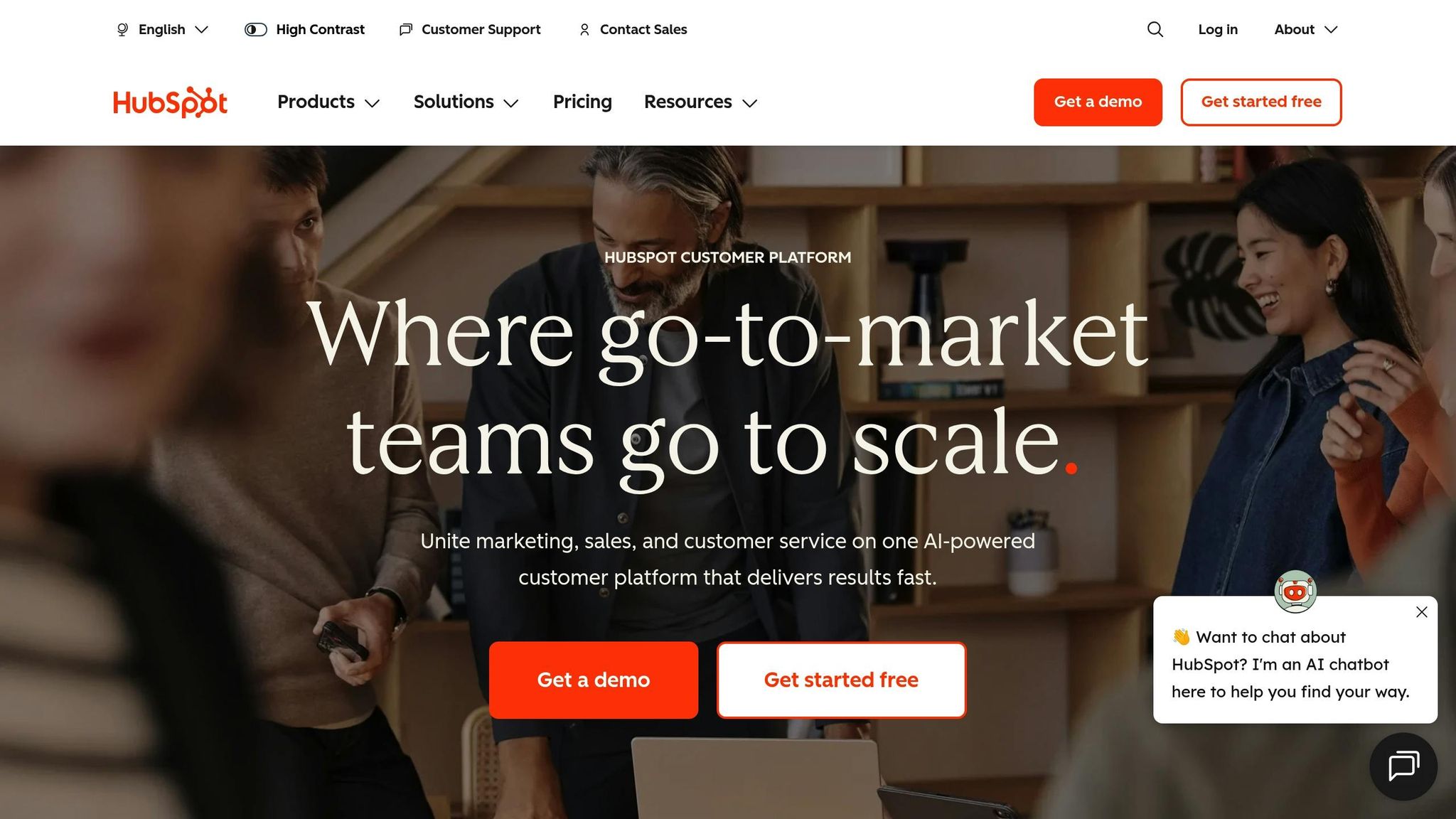
HubSpot has carved out a niche as an all-in-one growth platform, seamlessly combining CRM, marketing, sales, service, CMS, and commerce tools into a single database. By doing so, it eliminates the integration headaches often faced by B2B financial teams [5][8]. Unlike competitors that rely on external CRM syncing, HubSpot’s marketing tools are natively built on its free CRM. This creates a "single source of truth" for managing the entire customer journey [5][9]. For CFOs, this approach supports clear ROI tracking and enhances operational efficiency.
One standout feature is the visual automation builder, designed for lean teams. It empowers non-technical users to create complex, multi-branch campaigns without needing any coding skills [5][7]. This feature is especially valuable for firms with 20–200 employees that lack dedicated marketing operations staff. As of 2026, HubSpot supports over 1,500 native integrations, including popular tools like Slack, Gmail, and Salesforce. Of these, 804 are specific third-party apps [2][7][1]. The platform’s emphasis on simplicity and speed means teams can become productive in days rather than the months often required by enterprise solutions [2].
"HubSpot pioneered the 'growth platform' approach, bundling marketing, sales, and service tools into one ecosystem. This isn't just marketing automation - it's a complete GTM stack." - Usereviews.io [7]
HubSpot’s pricing structure in 2026 revolves around a seat-based model. It includes "Core Seats" for general access and specialized "Sales" or "Service" seats for advanced capabilities [13][15]. With over 238,000 businesses using HubSpot globally, the platform offers options ranging from free plans to enterprise solutions [15].
| Tier | Starting Cost | Key Features | Onboarding Fee |
|---|---|---|---|
| Free | $0 | Basic CRM, contact management (up to 15 million contacts), limited email marketing | None |
| Starter | $15–$20/mo per seat | Basic automation, higher contact limits, no HubSpot branding | None |
| Professional | $890/mo (Marketing Hub) | 10,000 contacts, visual workflows, A/B testing, custom reporting | $3,000 (mandatory) |
| Enterprise | $3,600/mo (Marketing Hub) | Custom objects, advanced permissions, predictive lead scoring, multi-touch attribution | $7,000 (mandatory) |
Pricing for the Marketing Hub depends on "Marketing Contacts", meaning only contacts actively engaged via email or ads are counted. Non-marketing contacts can be stored for free within certain limits [12][15]. Professional and Enterprise plans require annual commitments, with Enterprise often paid upfront [10][12][13]. Discounts ranging from 20% to 40% are commonly negotiated, particularly when deals are finalized at the end of fiscal quarters (March, June, September, December) [15].
"The Professional plan is highly sought after for its powerful automation. This tier allows you to route tickets, send follow-ups, and manage repetitive tasks more efficiently." - Stevia Putri, Marketing Generalist, eesel AI [13]
These pricing tiers support HubSpot’s ongoing innovation and adaptability to modern business needs.
In 2026, HubSpot has introduced several game-changing updates. Leading the pack is Breeze AI, a comprehensive AI suite that includes Breeze Agents for lead qualification and customer service, Breeze Intelligence for data enrichment, and Breeze Studio for content creation [5][8]. These tools operate using "HubSpot Credits" or "Breeze Intelligence credits", starting at roughly $30 per month [11][14][15]. With AI-driven content generation, users can quickly create landing pages, blog drafts, and email subject lines directly within campaign workflows [5][8].
Other updates include enhanced lead scoring models and tools that directly link marketing activities to revenue - a feature designed to meet the priorities of CFOs in financial services [7][9]. HubSpot’s shift to usage-based pricing for AI features, offering flexible credit packs, reflects a growing industry trend toward consumption-based billing [11].
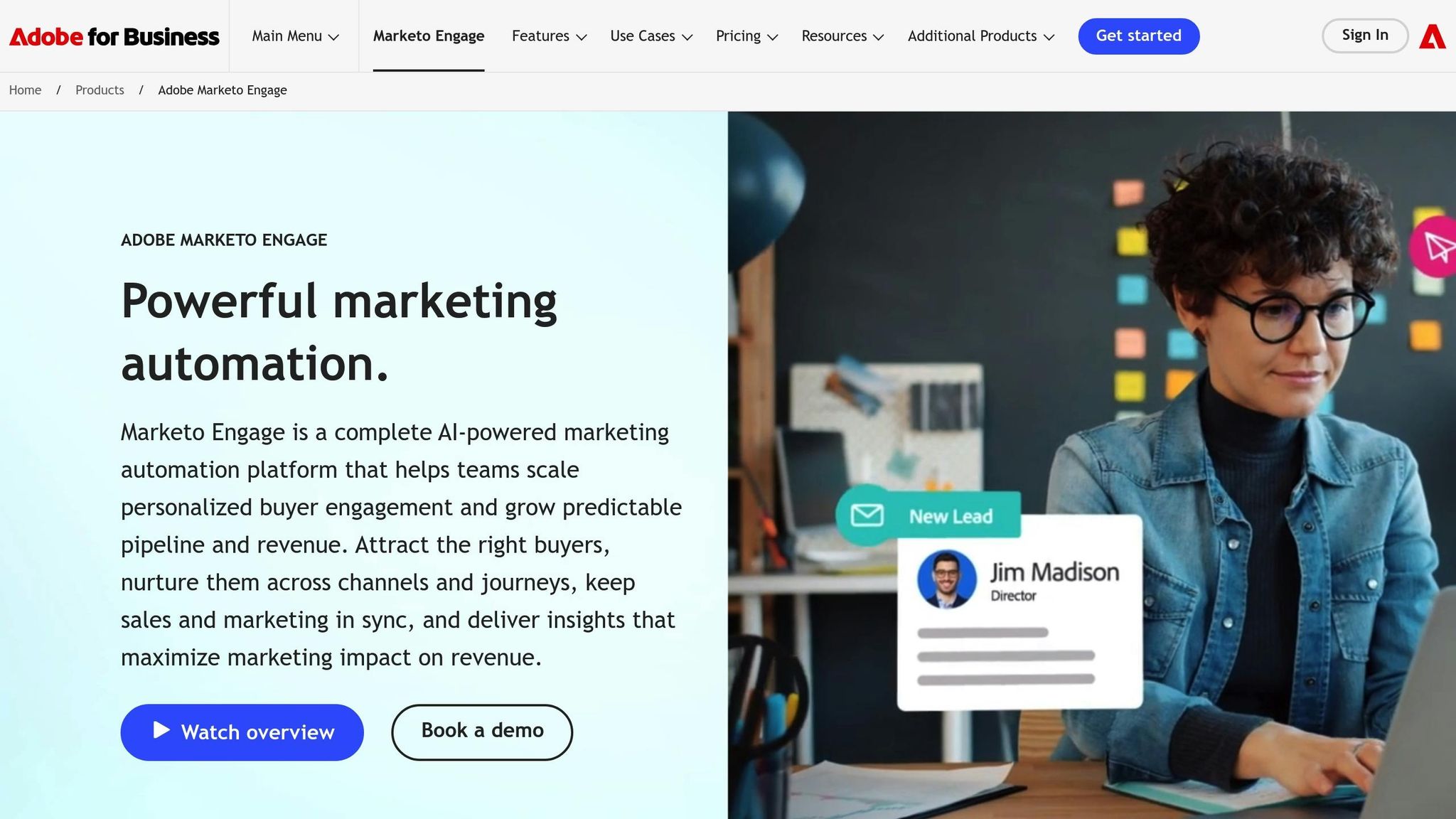
Adobe Marketo Engage is designed for enterprise-level B2B organizations that deal with extended decision-making cycles, often requiring over 20 touchpoints before a lead converts [7]. It integrates seamlessly with top CRMs like Salesforce and Microsoft Dynamics, ensuring a unified customer record [16][17]. This makes it a go-to solution for businesses that depend on a single, reliable source of truth [16].
Marketo’s lead scoring system is highly advanced, leveraging hundreds of behavioral and demographic signals [7]. This is particularly useful for industries like B2B financial services, where tracking prospects through long decision cycles is critical. Its Account-Based Marketing (ABM) suite takes account tracking to the next level, offering tools tailored for buying committees and account-level analytics [2][16]. Additionally, its team segmentation capabilities allow large, decentralized organizations to operate independently while maintaining centralized oversight [18].
"Marketo is the most technically sophisticated platform... built for complex, multi-touch B2B journeys where a single lead might interact with your brand 20+ times before converting." - Usereviews.io [7]
One key difference between Marketo and HubSpot lies in their automation models. Instead of using visual workflow builders, Marketo employs "engagement programs" with content streams and transition rules. This approach is better suited for managing large-scale nurture sequences [16][18]. The platform has earned a 4.4-star rating on Gartner Peer Insights, with users frequently highlighting its advanced lead scoring and multi-touch attribution capabilities [18]. However, this sophistication comes with a learning curve - implementation can take 3 to 6 months, and most organizations will need a dedicated Marketing Operations specialist to manage it effectively [7]. Marketo’s pricing reflects its complexity, relying on a flexible, custom-quote model.
Marketo continues to use a custom-quote pricing structure, primarily determined by database size and selected features [2][16]. Unlike HubSpot’s straightforward seat-based pricing, Marketo requires direct negotiation with Adobe’s sales team. In 2026, the platform offers four main tiers:
| Tier | Database Size | Key Features | Estimated Starting Cost |
|---|---|---|---|
| Growth | Up to 50,000 contacts | Basic automation, onboarding support | Custom quote |
| Select | Variable | AI tools, 10 custom data objects, attribution dashboards | ~$895/mo |
| Prime | Variable | Predictive audiences, journey analytics, workspace partitioning | Custom quote |
| Ultimate | Variable | Advanced attribution (Marketo Measure), behavioral and ad data tracking | Custom quote |
For enterprise clients, the total cost of ownership can exceed $50,000 in the first year, factoring in implementation fees (ranging from $10,000 to over $100,000), Salesforce licensing, and ongoing consulting [2]. While this makes Marketo a significant investment, its deep integration with Salesforce and Microsoft Dynamics often justifies the expense. Contracts are annual, and costs scale as your database grows.
Marketo has made significant strides in AI-driven personalization, leveraging Adobe Sensei to enhance predictive content recommendations and audience segmentation [16]. This is particularly beneficial for industries like financial services, where firms manage thousands of prospects across multiple product lines. With these updates, manual marketing workloads have been reduced by up to 60% [18].
The platform has also improved its Salesforce integration, eliminating data sync issues that previously hindered account-based strategies [19]. New features include enhanced multi-touch revenue attribution models, which are ideal for tracking engagement across 6–12 month sales cycles - a common scenario in B2B financial services [2][18]. Additionally, integration with Adobe Real-Time CDP and Adobe Experience Cloud provides a more comprehensive view of the customer journey, extending beyond CRM data [16].
"Marketo's strength lies in its campaign system that supports detailed behavioral and demographic scoring through separate automated programs." - Performance Marketing Advisors [18]
These enhancements have helped Marketo deliver an ROI of 267%, though achieving this level of return typically requires a team of five full-time employees to manage the system effectively [18].
In 2026, HubSpot and Marketo have developed distinct approaches to automation, AI, and integration. HubSpot offers a visual drag-and-drop workflow builder with if/then branching and goal-based triggers, catering to marketing generalists seeking quick results [4][20]. Marketo, in contrast, employs "Smart Campaigns" that rely on program logic, making it a better fit for intricate, multi-step workflows requiring nested logic and scalability through tokens and cloning patterns [4][20][21].
On the AI front, HubSpot's Breeze AI suite (featuring Assistant and Agents) focuses on tasks like automated content creation, repurposing, and predictive lead scoring [3][6]. Marketo counters with Adobe Sensei and Firefly, which excel in predictive audience targeting, real-time content suggestions, and generative AI for chat and email communications [3][21]. Notably, HubSpot users reported a 19% improvement in campaign launch times and a 25% boost in time savings through automation [6].
| Feature | HubSpot | Marketo | Winner (Depends on Use Case) |
|---|---|---|---|
| Automation Style | Visual Drag-and-Drop Workflows | Logic-based "Smart Campaigns" | Tie (User-dependent) |
| AI Tools | Breeze AI (Assistant & Agents) | Adobe Sensei & Predictive Content | HubSpot (Ease of Use) |
| CRM Integration | Native / Built-in | Third-party (Salesforce/Microsoft Dynamics) | HubSpot |
| Integrations Available | 1,500+ options | 500+ options | HubSpot |
| Reporting | Built-in, user-friendly dashboards | Advanced revenue attribution | Marketo (Depth) |
| Implementation | 2–4 weeks | 2–6 months | HubSpot |
| Learning Curve | Low (Days to learn) | High (Requires certification) | HubSpot |
HubSpot’s fully integrated CRM stands in contrast to Marketo’s reliance on third-party CRM tools. However, for B2B financial services firms already utilizing Adobe tools like Analytics or Experience Manager, Marketo offers a seamless connection to these platforms [2]. This distinction is pivotal for firms needing both technical sophistication and rapid deployment.
The differences in usability and implementation time are further illustrated by user experiences. HubSpot is known for its quick onboarding process, with most users becoming proficient in just weeks. For example, Loon Jian Yew, Regional Marketing Communications Manager at Konica Minolta, shared how new team members could launch campaigns within two to three weeks using HubSpot - something they couldn't achieve with Marketo [6].
"HubSpot is incredibly intuitive and easy to use. It's built for marketers and not just developers. With a bit of training, someone that has just onboarded can roll out a campaign in only two or three weeks. We couldn't do that with Marketo."
– Loon Jian Yew, Regional Marketing Communications and Corporate Branding Manager, Konica Minolta [6]
Marketo, on the other hand, requires a significantly longer implementation time of 2–6 months, often involving consultants, which can cost upwards of $10,000 [2][20]. Peggy Winton, VP & CMO at AIIM, described Marketo’s interface as "cumbersome" and less intuitive for inbound marketing, which led to an 87% customer growth after switching to HubSpot [6]. For smaller teams without dedicated Marketing Ops specialists, this complexity can be a major hurdle. However, for large enterprises with complex B2B sales cycles spanning 6–12 months and ample technical resources, Marketo’s depth and capabilities may justify the investment [2][20].
B2B financial services firms face a unique set of challenges when it comes to choosing the right marketing automation platform. Whether you're an investment firm, a real estate syndicate, or a financial advisor, the decision often hinges on factors like long sales cycles, strict compliance requirements, and the need for seamless coordination between marketing and sales. Key considerations include team structure, existing CRM systems, and overall operational maturity. This analysis builds on earlier discussions about ROI and implementation hurdles in today's B2B landscape.
HubSpot is ideal for firms that need a unified platform to align sales and marketing without dealing with heavy technical complexities. Its built-in CRM acts as a single source of truth, eliminating data silos that often slow down financial services teams. This makes HubSpot especially appealing to small- and mid-sized investment firms or real estate syndicates that might not have a dedicated marketing operations expert.
For example, HubSpot's "Flywheel" model allows teams to create service level agreements (SLAs) by sharing insights into lead activity. This transparency fosters better collaboration between departments. If your firm values simplicity and fast setup, HubSpot offers a practical solution that aligns with these priorities.
Marketo, on the other hand, caters to large financial enterprises that typically integrate it with robust CRMs like Salesforce or Microsoft Dynamics 365. It shines in scenarios requiring advanced features like multi-touch revenue attribution, predictive lead scoring, and complex account-based marketing (ABM) campaigns. However, these capabilities come with a hefty price tag. Implementing Marketo often requires a significant investment - ranging from $10,000 to over $100,000 for consulting services - along with a dedicated marketing operations team to manage the platform.
"Marketo justifies its cost with multi-touch attribution, predictive lead scoring, and advanced ABM." – Sequenzy Analysis
The table below highlights key criteria to help financial services firms decide between HubSpot and Marketo:
| Criteria | Choose HubSpot If… | Choose Marketo If… |
|---|---|---|
| Budget | You need predictable pricing ($15–$890/month) with clear costs. | You have enterprise-level budgets starting at $895+/month, plus implementation fees. |
| Team Size | Your team is small (under 10) or includes generalist marketers. | You have a large team with dedicated Marketing Ops/RevOps specialists. |
| CRM Needs | You prefer a built-in CRM or use niche financial CRMs (HubSpot integrates with 107+ CRMs). | You rely on Salesforce or Microsoft Dynamics with established compliance systems. |
| Automation Needs | You want simple, visual workflows for lead nurturing. | You need complex workflows with nested logic and advanced scoring. |
| Scalability | You’re growing from small to mid-market and need fast results. | You operate at a global enterprise scale. |
| Implementation Timeline | You need campaigns running in days or weeks. | You can dedicate 2–6 months to setup and training. |
While the matrix offers a clear comparison, firms must evaluate their internal readiness before committing. As Mark Grainger from FRG Technology Consulting explains, "Marketo is a tool for experienced specialists, and trying to test a marketing automation strategy for a small business is likely to do both your business and Marketo a disservice."
For smaller firms or those new to marketing automation, starting with HubSpot can be a smarter move. It allows you to document processes, build foundational workflows, and focus on ROI tracking and compliance without overwhelming your team. For enterprises with the resources and technical expertise, Marketo’s advanced capabilities can unlock powerful marketing strategies tailored for large-scale operations.
When it comes to B2B financial services, both platforms cater to distinct organizational needs. Here's a breakdown of the key advantages and limitations of each:
| Platform | Pros | Cons |
|---|---|---|
| HubSpot | • Built-in Smart CRM that integrates marketing, sales, and service • 91% of users master it within one month [6] • Transparent pricing starting at $20/month [6] • Over 1,500 native integrations [2] • 19% faster campaign launch times [6] |
• Costs increase as contact lists grow [22] • Limited multi-touch attribution without add-ons • Governance tools fall short for complex, multi-unit organizations |
| Marketo | • Advanced behavioral lead scoring with over 50 data points [7] • Strong Salesforce integration for intricate workflows • Superior ABM (Account-Based Marketing) capabilities for high-value accounts [2] • Detailed permission controls for regulated industries [23] |
• Steep learning curve, requiring 3–6 months of training [7] • Implementation costs range from $10,000 to over $100,000 [2] • Needs an external CRM and dedicated Marketing Ops team • No free tier available [5] |
This comparison sets the foundation for our final recommendations.
Based on this analysis, HubSpot emerges as the go-to platform for most B2B financial services firms in 2026, especially for those with smaller teams or a need for quick implementation. Its unified CRM, user-friendly interface, and predictable pricing structure make it a solid choice for investment advisors, real estate syndicates, and mid-market financial services companies aiming to launch campaigns in a matter of weeks.
On the other hand, Marketo is better suited for larger enterprises with robust Marketing Operations teams, heavy Salesforce dependencies, and long-term strategies. Its advanced lead scoring, comprehensive account-based marketing features, and strong governance tools justify its higher upfront investment, which often exceeds $50,000 in the first year [2].
The ultimate decision boils down to operational readiness and budget. Firms new to marketing automation may find HubSpot ideal for building foundational workflows, while those with well-established Marketing Ops teams and intricate Salesforce needs will likely benefit more from Marketo's advanced capabilities. For companies aiming to scale efficiently without inflating headcount or ad spend, working with experts like Visora can simplify implementation and accelerate revenue growth.
When calculating overall costs, it's important to think about things like scalability, setup, and long-term expenses. HubSpot offers more predictable pricing upfront because many features are bundled together. However, as your contact list expands, costs can climb quickly. On the other hand, Marketo uses quote-based pricing, which depends on the complexity of your automation needs. Be prepared for potential increases in subscription fees, along with additional costs for implementation, training, and ongoing maintenance.
To use HubSpot efficiently, a small team can suffice with roles such as a Marketing Manager or Campaign Specialist, backed by a CRM Administrator. These team members handle tasks like setting up workflows, managing email campaigns, and tracking analytics, all without needing extensive technical skills.
Marketo, on the other hand, is more intricate and often demands a larger team. Key roles include a Marketing Operations Manager or Automation Specialist, a CRM Administrator, and data analysts. This setup is essential for managing advanced tasks like detailed segmentation, complex integrations, and lifecycle management.
Financial firms need advanced compliance tools integrated into their marketing platforms to ensure they meet regulatory standards. For example, Marketo is equipped with enterprise-level compliance features, making it a strong choice for larger organizations. On the other hand, HubSpot offers simpler tools, which are often sufficient for smaller firms.
To further strengthen compliance, implement role-based permissions to control data access. This ensures that only authorized personnel can view or manage sensitive information. It’s also crucial to audit and update these permissions regularly. Doing so not only helps maintain compliance but also protects sensitive data and keeps up with evolving regulations and organizational changes.
%20(5).png)
