%20Bold.png)
Intent data helps financial firms refine client segmentation by identifying online behaviors that signal purchase intent. These signals - like website visits, keyword searches, and content downloads - allow firms to spot prospects early in their buying journey, long before direct engagement. Here's why it matters:
Unlike demographic-based methods, intent-based segmentation focuses on real-time behaviors, helping firms prioritize high-potential leads, shorten sales cycles, and improve ad efficiency. By integrating intent data into CRM systems and leveraging AI, financial teams can target in-market prospects more effectively while personalizing outreach for decision-makers. This approach not only boosts conversions but also strengthens retention by identifying clients at risk of churn.
Key Takeaways:
Intent data is transforming how financial firms identify and engage with clients, offering a more precise and effective way to drive growth in a competitive market.
Financial firms rely on three main types of intent data to understand where prospects are in their decision-making process and to refine audience segmentation.
This type of data comes directly from your own sources, such as your CRM, website analytics, email campaigns, or app interactions. For example, if a prospect downloads a whitepaper on retirement planning, fills out a contact form, or clicks on an email about ESG investing, they’re signaling first-party intent. Since this data is based on direct interactions with your brand, it’s highly reliable. However, it has a limitation - it only covers individuals who are already aware of your company, leaving out a larger pool of potential prospects who are still exploring other options.
Third-party intent data is collected from external platforms, such as industry news sites, research hubs, or publisher networks. It provides insights into prospects’ research activities before they even visit your website. For instance, 86% of websites in Bombora's Data Co-op are exclusive to their platform, offering unique visibility into B2B buying behavior [2]. This data can help financial firms identify prospects actively researching wealth management or fintech solutions - those who haven’t yet entered your sales funnel.
It’s also particularly useful for uncovering "dark social" signals - situations where prospects share content through private channels like messaging apps, which traditional tracking methods can’t monitor [3].
"Cognism identifies the leads and allows us to target them based on the prospect's intent. Using intent data has massively reduced our time to engagement." – George McKenna, Head of Cloud Sales, Ultima [3]
Beyond external research, analyzing how prospects engage with specific content helps refine segmentation even further.
This type of data focuses on how prospects interact with specific content, such as reading blog posts, sharing articles on social media, commenting on LinkedIn, or exploring review platforms like G2. In finance, engagement with topics like "investment research" or "digital banking solutions" can highlight specific interests. Additionally, when clients browse competitors on review sites, it may signal potential churn.
Financial firms that leverage this kind of behavioral data can gain a competitive edge - boosting client engagement and retention by up to 30% [8].
The real value comes from combining all these data types. By integrating intent data with your CRM, purchase history, and demographic insights, you can create more detailed audience segments. This approach allows you to focus on prospects who show multiple high-value interactions, rather than those with isolated touchpoints [5].
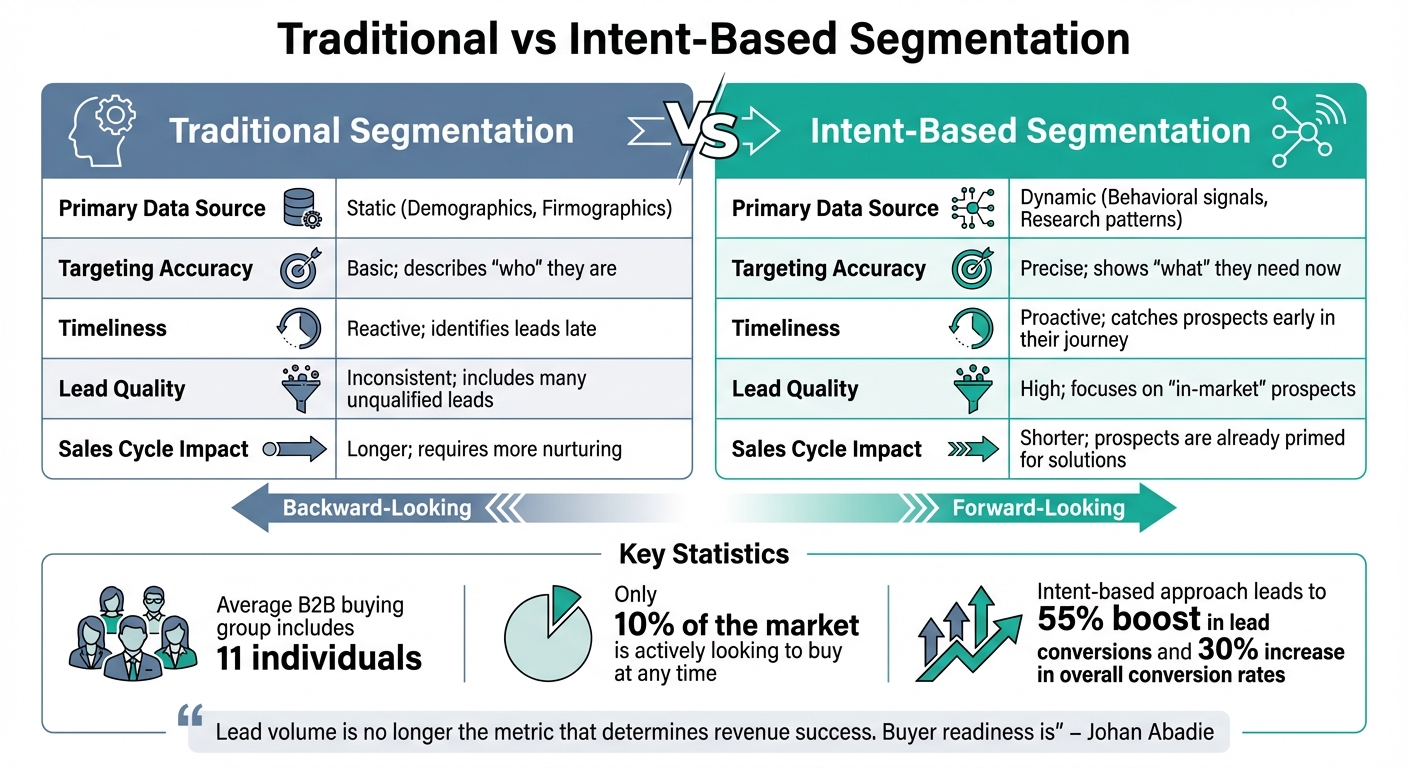
Traditional vs Intent-Based Client Segmentation in Financial Services
Traditional segmentation methods, long relied upon by financial firms, fall short when compared to intent-based approaches. These older methods group prospects by demographics (like age, income, or location), firmographics (such as company size or industry), or psychographics (values or risk tolerance). While these approaches help describe who a prospect is, they fail to capture what that prospect is actively doing. For instance, even if a high-net-worth individual fits your target profile, they won’t be in-market unless they’re currently researching wealth management solutions. Traditional segmentation often reacts only after a prospect has already engaged - by which time competitors may have their attention [6].
Intent-based segmentation changes the game. Instead of waiting for prospects to signal interest, it identifies accounts actively researching financial solutions across the web - even before they visit your site. This approach provides a proactive advantage, revealing buying readiness in real time. As Johan Abadie puts it, "Lead volume is no longer the metric that determines revenue success. Buyer readiness is" [6]. This is particularly critical in financial services, where decisions are often made by groups - the average B2B buying group includes 11 individuals [7]. Intent data doesn’t just focus on individual leads; it offers insights into entire buying committees.
The timing of intent-based segmentation is a game-changer. Traditional lead scoring often flags prospects too late - by the time a lead scores high, they’re likely already evaluating vendors [6]. Intent data, on the other hand, identifies prospects during their early research phase, when they’re still forming opinions. It distinguishes between predictive signals (indicating future interest) and demand-capture signals (like pricing page visits or competitor comparisons, which suggest immediate purchase intent) [6]. This dual focus allows teams to close deals for this quarter while nurturing opportunities for the next, setting intent-based segmentation apart from traditional methods.
Here’s a breakdown of how traditional and intent-based segmentation differ:
| Feature | Traditional Segmentation | Intent-Based Segmentation |
|---|---|---|
| Primary Data Source | Static (Demographics, Firmographics) | Dynamic (Behavioral signals, Research patterns) |
| Targeting Accuracy | Basic; describes "who" they are | Precise; shows "what" they need now |
| Timeliness | Reactive; identifies leads late | Proactive; catches prospects early in their journey |
| Lead Quality | Inconsistent; includes many unqualified leads | High; focuses on "in-market" prospects |
| Sales Cycle Impact | Longer; requires more nurturing | Shorter; prospects are already primed for solutions |
The shift from traditional activity-based qualification to signal-driven strategies marks a major change in how financial firms prioritize accounts. Instead of treating all leads equally, intent data pushes high-intent accounts to the front of the line, cutting down on wasted effort and boosting meeting conversion rates [6]. John Phillips, Head of Demand Generation at Nerdery, shared his experience implementing intent-activated lead generation in early 2024: "Identifying which target accounts are in an active buy-cycle was an important piece, but we still required an effective way to get decision-makers at those accounts to engage with our brand" [5]. By pairing intent signals with targeted branded content, the firm was able to convert these accounts into quality top-of-funnel leads far more effectively than through traditional methods. This approach helps financial teams allocate resources more efficiently, focusing their efforts where they’ll see the best results.
Financial firms are leveraging intent data to fine-tune client segmentation, focusing on purchase readiness. By analyzing intent signals, they classify prospects into two main groups: predictive signals (indicating potential future purchases, such as leadership changes or funding rounds) and demand-capture signals (showing active buying behaviors, like comparing prices). This allows firms to distinguish between early-stage researchers and prospects who are closer to making a purchase decision [6].
This strategy helps teams allocate resources more effectively. For example, sales teams can nurture early-stage prospects while prioritizing efforts on those actively engaging with pricing pages or requesting product demos. The results? Sales leaders have reported a 55% boost in lead conversions, with overall conversion rates increasing by 30% [9].
Intent data also plays a crucial role in identifying specific buying groups within an organization. It enables firms to tailor their outreach to different stakeholders, whether it's a CRO, CIO, or another decision-maker. Additionally, it helps flag existing clients who might be exploring competitor solutions. Beyond improving lead quality, this data-driven approach enhances advertising efficiency and strengthens client engagement [7].
Intent data has transformed advertising strategies, making campaigns significantly more cost-effective. Campaigns driven by intent data are 2.5 times more efficient than traditional ones, with click-through rates soaring by up to 220% [9]. Instead of spreading ad spend broadly, firms now target accounts that display clear buy-cycle signals, cutting down on wasted impressions.
John Phillips from Nerdery highlighted the success of combining content syndication with targeted display ads aimed at accounts identified through intent data. This approach notably improved the quality of top-of-funnel leads [5].
The impact of intent data is undeniable - 99% of companies report better ROI and sales growth after adopting this strategy [9]. Hooman Radfar, Co-founder and CEO of Collective, emphasized its importance:
"The Sona Revenue Growth Platform has been instrumental in the growth of Collective. The dashboard is our source of truth for CAC and is a key tool in helping us plan our marketing strategy" [9].
Start by defining your Ideal Customer Profile (ICP) to filter intent signals and focus on high-value financial clients [6]. This helps your team avoid being overwhelmed by unnecessary data and zero in on accounts that truly matter.
Gather intent signals from three main sources:
Next, organize these signals by their timeline. Predictive signals highlight accounts likely to develop future needs, like those undergoing leadership changes, securing funding, or adopting new technology [6]. Meanwhile, demand-capture signals point to accounts already in evaluation mode - think pricing page visits, competitor comparisons, or repeated case study views [6]. Assign numerical values to signals based on their recency, frequency, and intensity. This ensures that high-intent "in-market" accounts are prioritized in your outreach [10][11].
Remember, intent data doesn't last forever. Focus on signals from the past 30–90 days, as older data quickly loses relevance [5][10]. With your data categorized and ready, you can move on to segmenting clients by their intent levels.
Once intent data is collected, use it to segment clients based on their position in the buying journey. For example, activities like blog reading or whitepaper downloads align with early awareness stages. On the other hand, high-intent actions like visiting a pricing page or requesting a demo indicate a client is closer to making a decision [5][6].
Track engagement across multiple stakeholders within the same organization to understand the entire buying committee. This approach provides insight into decision-makers like CROs, CIOs, or other executives, allowing you to tailor your outreach more effectively.
"Identifying which target accounts are in an active buy-cycle was an important piece, but we still required an effective way to get decision-makers at those accounts to engage with our brand." - John Phillips, Head of Demand Generation, Nerdery [5]
Start with broad segments and refine them over time [5]. Intent data isn't just useful for acquiring new clients - it can also help with retention. For instance, keep an eye on existing clients researching competitors. This can trigger proactive outreach to maintain their business [7][6]. Keep in mind that only 10% of your total addressable market is typically "in-market" at any given time [1], so precision is far more important than volume.
Once your segments are defined, integrate these insights into your CRM for real-time engagement.
Combine intent signals with your existing CRM data - like demographics, purchase history, and website behavior - to create detailed audience segments [5]. Configure your CRM to assign specific values to intent behaviors. For example, a demo request might add +10 points, a whitepaper download +5, and multiple site visits +3 [11]. On the flip side, disengagement signals like unsubscribing from emails or visiting career pages can subtract points to ensure the segments stay accurate [11].
Set up dynamic alerts to notify your team when accounts begin researching competitors or alternatives [7]. This proactive approach helps prevent churn and keeps your sales team focused on accounts showing genuine buying interest. Automating workflows is another critical step. For instance, when a high-intent signal is detected, it can immediately trigger sales alerts or personalized email sequences - no manual intervention needed [10][6].
Companies leveraging intent-based targeting through advanced platforms have reported impressive results, including a 454% ROI and a 4x increase in win rates [1]. The secret lies in ensuring intent signals seamlessly integrate into your CRM, allowing sales teams to act on high-priority accounts without disrupting their workflow [6]. Treat segmentation as an ongoing process - regularly review performance and fine-tune your targeting criteria based on conversion data [5][12].
Financial firms are increasingly turning to the "In-Market Ideal Customer Profile" (IICP) to better understand buyer behavior. By leveraging AI and machine learning, companies can analyze billions of data points to identify accounts that mirror past buyers. This allows firms to predict client needs even before they actively start searching. For example, Natural Language Processing (NLP) scans B2B pages for specific topics and keywords, matching accounts with interests like ESG investing or fintech adoption.
The results speak volumes: firms that pair predictive capabilities with intent data have reported a 39% increase in opportunities and a 38% reduction in deal cycles. Additionally, users of predictive models experience 13% more wins and 45% larger deal sizes [1]. By 2026, these AI-driven insights will become a cornerstone of financial services marketing [4].
"In 2026, campaigns built on behavioral intent and AI-driven insights will separate the leaders from the laggards in financial-services marketing."
The move from manual lead scoring to AI-driven models is transforming outreach strategies. These tools prioritize engagement based on real-time patterns, giving visibility into the buyer’s journey even before they make contact. This is crucial because 78% of buyers define their needs before reaching out to a seller, and 84% of the time, they buy from the first seller they engage with [1]. Such insights empower firms to create more precise and effective engagement strategies.
Generic messages are no longer effective. AI now allows financial firms to tailor their communication across emails, ads, and social platforms to match a prospect’s stage in the buyer journey - whether they’re in the Awareness, Consideration, or Decision phase [4]. This approach, often called "personalization at scale", ensures consistent messaging across channels, fostering trust in high-stakes financial decisions.
Here’s how firms can align content with intent levels:
AI-powered tools simplify the process of engaging with low-intent segments, cutting down on manual effort [1]. To stay relevant, financial firms should refresh their intent signals at least every quarter, especially in response to regulatory changes or shifts in digital banking trends [4].
With advanced segmentation comes the responsibility to navigate complex compliance landscapes. Collecting intent data requires strict adherence to privacy laws like GDPR and CCPA. Firms must secure prior and explicit consent from users before gathering first-party data, particularly when operating globally, where regulations can vary significantly.
"Ethical considerations and privacy compliance are essential in intent data collection, particularly for first-party data. You must obtain prior and explicit consent from the user, aligning with GDPR and CCPA statutory requirements."
AI models rely on high-quality data, making data integrity critical. Poor data not only weakens segmentation but also risks compliance violations. While intent data can help firms uncover buyer activity, ethical practices must guide its use. Missteps can be costly - go-to-market teams waste $2 trillion annually targeting accounts that aren’t ready to buy [1]. By centralizing data in a Customer Data Platform (CDP) and integrating AI, firms can better navigate compliance while fostering stronger customer relationships.
Companies like Visora are already using these AI-driven tools to refine segmentation strategies, ensuring financial firms remain agile and compliant in an ever-changing digital world.
Intent data has reshaped how financial firms approach client segmentation. Instead of relying solely on static, demographic-based methods, companies now use dynamic, behavior-driven strategies. This shift helps them reach prospects during active research phases and uncover entire buying groups. As a result, firms can craft multi-stakeholder campaigns that align with the complexity of modern B2B financial decisions [7].
The advantages of intent-driven segmentation go far beyond just generating leads. Financial firms can now zero in on high-intent accounts by analyzing precise buying signals [6].
"Intent data allows your teams to transcend basic demographics, and engage buyers where they're at right now based on their behavior." - Allie Kelly, Intentsify [7]
This quote highlights the importance of real-time behavioral insights in shaping effective financial services marketing strategies.
Intent signals also prove useful throughout the entire customer journey. They can alert firms to potential client churn and uncover cross-sell opportunities. This makes segmentation an ongoing, adaptive process, continuously informed by real-time market behavior [5][7].
For financial firms looking to stay ahead, outdated "guess and spray" methods are being replaced by "focus and convert" strategies powered by intent data [7]. Companies like Visora are helping financial services leaders implement AI-powered systems that not only identify high-value opportunities but also ensure data compliance. Adopting these advanced approaches positions firms to deliver tailored client experiences while making smarter use of their marketing budgets in today’s data-driven landscape.
Intent data gives financial professionals a powerful tool for understanding who's actively searching for specific financial solutions right now. Instead of relying on outdated demographics or static data, intent data tracks real-time buyer behavior - like online searches, content interactions, and purchasing signals.
This means you can focus your efforts on high-priority prospects who are already showing interest in your services. By zeroing in on decision-makers most likely to convert, you can target more effectively and make better use of your time and resources. With these insights, businesses can fine-tune their marketing and sales strategies, driving growth while boosting ROI.
When using intent data in financial services, staying compliant with data privacy laws is crucial for maintaining client trust and meeting legal obligations. Financial institutions need to follow regulations like the California Consumer Privacy Act (CCPA) in the U.S. and the General Data Protection Regulation (GDPR) in Europe. These laws require obtaining proper consent before collecting or using any data, especially when it involves personally identifiable information (PII).
Equally important is being transparent - clients should know how their data is collected, stored, and used. To protect this information, firms should adopt strong security measures like encryption and restricted access. Regularly reviewing and updating data-handling practices not only ensures compliance with changing regulations but also helps build and maintain trust with clients.
Financial firms can take client engagement to the next level by integrating intent data into their CRM systems. This approach moves beyond static client information by incorporating real-time insights like website visits, content interactions, and behavioral patterns. These intent signals help create a more dynamic and personalized client experience.
By combining this enriched data with AI-powered tools in their CRM, firms can prioritize leads and clients based on who’s most likely to engage. This means sales teams can focus their energy on high-potential opportunities, saving time and boosting efficiency. Beyond that, outreach efforts become much more tailored - messaging and offers can align with each client’s current interests and actions, making interactions feel more relevant and timely.
Another major benefit? Firms can continuously monitor intent signals to spot upsell and cross-sell opportunities at just the right time. This not only strengthens client relationships but also improves conversion rates. By seamlessly weaving intent data into their CRM, financial firms can adopt a more responsive and client-centered engagement strategy.
%20(5).png)
