%20Bold.png)
Should you spend big on LinkedIn Ads or invest time in organic outreach for finance leads? Here's the short answer:
Key Takeaways:
| Factor | LinkedIn Ads | Organic Outreach |
|---|---|---|
| Cost Per Lead | $90–$120 (Finance) | ~$555 |
| Speed of Results | 24–48 hours | 3–6 months |
| Lead Quality | Mixed | High (trust-based) |
| Primary Investment | Money | Time |
| Engagement Rate | 0.4%–0.6% | 2%–6% |
| Scalability | High (budget-dependent) | Limited (time-dependent) |
If you need quick results, go for ads. If trust and cost-efficiency matter, focus on organic outreach. For the best results, blend both approaches.
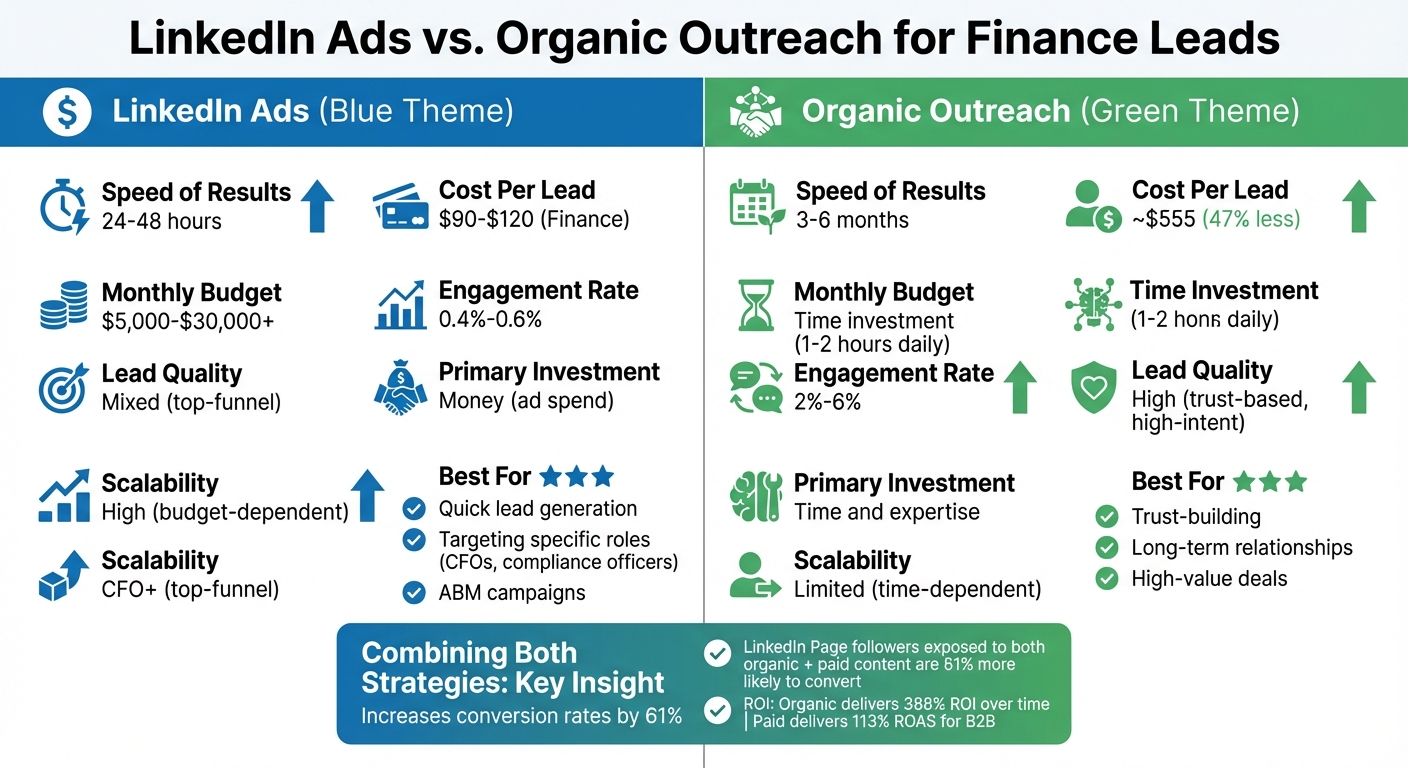
LinkedIn Ads vs Organic Outreach: Complete Comparison for Finance Leads
LinkedIn Ads offer a paid advertising platform tailored to help financial services firms connect directly with key decision-makers. Unlike organic posts, these ads ensure your message reaches your intended audience - whether it's CFOs at mid-sized companies or compliance officers at large banks. LinkedIn provides various ad formats to support different goals, from boosting brand awareness to generating leads with pre-filled forms.
One of the standout aspects of LinkedIn Ads is their precision targeting. Using LinkedIn's detailed professional data, advertisers can filter audiences by job title, company, industry, seniority, and even specific skills [7]. This means you can zero in on niche finance roles, such as fintech treasurers or risk managers. Such granular targeting is rare on platforms like Facebook or Instagram, which cater more to general consumer audiences.
LinkedIn Ads are built for targeted reach, and here are some of their standout features:
Understanding LinkedIn Ads' pricing is essential for planning your ad spend effectively.
LinkedIn uses an auction-based model, offering options like Cost-Per-Click (CPC), Cost-Per-Impression (CPM), and Cost-Per-Send (CPS) for message ads. The global median CPC typically falls between $5 and $7 [8], though finance-specific targeting often increases costs. For example, broad finance targeting might cost $2.50 to $3.00 per click, but narrowing the focus to roles like CFOs can push CPCs to $5 to $20 or more [8].
| Ad Format | Typical CTR | Typical CPC (Finance) | Primary Use Case |
|---|---|---|---|
| Sponsored Content | 0.4% - 0.6% | $5 - $20+ | Native feed engagement, ABM |
| Message/Conversation Ads | ~3% (Headline) | $0.50 - $1.00 (Per Send) | Personalized outreach, direct response |
| Video Ads | ~0.40% | $7 - $9 | Brand awareness, storytelling |
| Text & Spotlight Ads | ~0.02% | $2 - $3 | Low-cost frequency and brand presence |
| Lead Gen Forms | ~0.50% (Submit) | Varies | High-conversion lead capture |
The cost-per-lead varies depending on how specific your targeting is and how well your campaign is optimized. Generally, finance campaigns see costs ranging from $60 to $150 per lead, though enterprise-focused campaigns can exceed $200 per lead [8]. While LinkedIn's minimum daily spend is $10, campaigns typically require $25 to $100 per day to deliver meaningful results [9].
LinkedIn's auction system rewards relevance, meaning well-targeted ads often enjoy lower CPCs compared to broader campaigns [8]. However, ad fatigue can occur quickly - most ads need refreshing every two to three weeks to maintain their performance [9]. Managing these factors requires both a strong budget and ongoing expertise. Up next, we’ll dive into how organic outreach metrics compare.
Organic outreach on LinkedIn is all about building genuine relationships and generating leads without relying on paid ads. Instead of spending money for visibility, you invest time in meaningful engagement - sharing relevant content, optimizing your profile, sending personalized connection requests, and interacting with others' posts through likes and comments [2][4]. This approach prioritizes trust over quick wins, making it especially effective for financial services professionals. For instance, a CFO exploring a new treasury management solution is more likely to respond to someone who consistently shares insightful market analysis than to a cold, sponsored message.
One major benefit of organic outreach is the quality of leads it generates. These leads often have higher intent because they’ve engaged with your content or accepted your connection request out of genuine interest, not because of targeted ads [4][2]. LinkedIn’s algorithm also favors personal posts, which make up 39% of feed content, compared to just 1% to 2% for company page posts [1]. This shift toward individual voices creates a unique opportunity for finance professionals ready to invest the effort.
The data backs this up. Organic posts on LinkedIn achieve engagement rates of 2% to 6%, far outperforming the 0.4% to 0.6% rates of sponsored ads [1]. Direct messages sent through LinkedIn see a 10.3% response rate, double the 5.1% average for cold emails [11]. These numbers explain why many financial firms are shifting their focus to organic strategies, especially when targeting decision-makers who value trust and relationships.
A successful organic outreach strategy involves warming up prospects through multiple touchpoints before making any direct requests. Start by viewing a prospect’s profile, then engage with their content by liking or leaving thoughtful comments. After 24 to 48 hours, send a personalized connection request that references something specific, like a recent post or a shared interest [12]. This gradual approach ensures that when your request arrives, you’re no longer a complete stranger.
Personalization plays a huge role in success. Connection requests under 250 characters that mention a specific achievement or post see acceptance rates rise by 30% to 40% [12]. Avoid using generic templates. For example, instead of saying, “I’d like to connect,” try something like, “I saw your post on ESG reporting challenges - dealing with the same issues at mid-sized funds. Would love to hear your perspective.” Personalized requests can boost reply rates by up to 72% compared to blank ones [12].
Once connected, lead with value. Instead of immediately asking for a meeting, offer something helpful - a short case study, a framework for solving a common issue, or an industry report [12]. Voice messages can also be effective, generating 15% to 20% more replies than text because they show extra effort [12].
Content sharing is another critical element. Posting insights two to three times a week for two to four weeks before starting outreach helps establish credibility [12]. Your posts don’t need to be overly complex - a quick take on regulatory changes, a market trend, or a lesson from client work can showcase your expertise. Interestingly, employee-shared content tends to get eight times more engagement than brand posts [1].
Follow-ups are where many opportunities are won or lost. Research shows that 60% to 70% of results come from the second and third follow-up messages, yet many people stop after the first [12]. Space follow-ups five to seven days apart, and always add value - don’t just send “checking in” messages. For example, if your first message shared a case study, the second could include an ROI calculator or a link to a relevant webinar.
Organic outreach takes time and consistency. To see results, you’ll need to dedicate one to two hours daily [2], and it typically takes three to six months to build momentum and generate a steady flow of leads [4][2][11]. Initial setup - like optimizing your profile and developing a strategy - can take four to six hours [12].
Daily tasks include visiting profiles, engaging with content, sending personalized connection requests (usually capped at 25 to 30 per day to avoid account restrictions), and crafting tailored messages [12][11]. Posting at least once a week keeps you visible in your network’s feed [6], while regular engagement ensures you stay top of mind. Though the first 90 days require the most effort, things get easier over time as your network and content library grow.
The long-term payoff is worth it. On average, organic outreach delivers a 388% ROI as relationships deepen and trust builds [1]. For financial services professionals targeting high-value clients - whether wealth management accounts, institutional investors, or corporate CFOs - the trust earned through organic efforts often outweighs the quick reach of paid ads.
LinkedIn Ads offer quick results through paid targeting, while organic outreach focuses on building trust over time. With paid ads, you can see results in as little as 24 to 48 hours by targeting a specific audience [2]. Organic outreach, on the other hand, requires consistent effort over three to six months before gaining traction [2][4]. These differences significantly affect the type of leads you generate and how they convert.
When it comes to lead quality, organic outreach has the upper hand. In financial services, for example, the cost per lead averages $761 for paid campaigns, compared to $555 for organic strategies [13]. Organic leads tend to convert 30% to 50% better than paid leads because they’re built on trust rather than interruption [13]. When someone interacts with your content or accepts a connection request, it signals genuine interest, unlike responding to a targeted ad.
Scalability and reach, however, lean heavily toward paid ads. LinkedIn Ads can scale directly with your budget - spend $10,000 one month, $30,000 the next, and you’ll see a corresponding rise in lead volume [2]. Organic outreach, by contrast, is limited by the time and effort an individual can invest. LinkedIn’s algorithm also plays a role here, prioritizing personal posts (39% of feed content) over company page posts (1%–2%), giving employees’ organic efforts a boost [1]. In fact, content shared by employees generates eight times more engagement than brand posts [1].
Here’s a breakdown of the key differences:
| Factor | LinkedIn Ads | Organic Outreach |
|---|---|---|
| Primary Investment | Money (ad spend) | Time and expertise |
| Speed of Results | Immediate (24–48 hours) [2] | Slow (3–6 months) [2][4] |
| Lead Quality | Mixed; often top-funnel [2] | High; trust-based and high-intent [1][2] |
| Cost Per Lead (Finance) | ~$761 [13] | ~$555 [13] |
| Engagement Rate | 0.4%–0.6% [1] | 2%–6% [1] |
| Scalability | High (scales with budget) [2] | Limited by personal capacity [2] |
| Trust/Credibility | Lower (perceived as promotional) [4] | Higher (perceived as authentic) [4] |
For financial services professionals, these differences can shape the choice of strategy. CPC rates for LinkedIn Ads continue to climb, with costs increasing 15% to 20% year-over-year across most B2B industries [2]. Current CPCs range from $5 to $15+ depending on competition [2][5], and a booked sales call through paid ads can cost between $500 and $750 [2]. Meanwhile, organic outreach delivers a 388% ROI over time as relationships deepen [1].
"The companies winning on LinkedIn in 2026 won't be the ones with the biggest ad budgets. They'll be the ones who empowered their people to share authentic, valuable content consistently" [1].
LinkedIn Ads provide precise targeting options tailored for financial services, though the costs are notably higher compared to other platforms. For context, the average cost per lead (CPL) in financial services across all channels is $461. On LinkedIn, native Lead Gen Forms typically generate leads at a CPL between $90 and $120 [8][14]. However, highly targeted account-based marketing (ABM) campaigns can push CPL beyond $200 [8].
Click costs follow a similar trend. For example, clicks targeting the Finance job function average $6.90 [15]. When targeting enterprise-level audiences, cost-per-click (CPC) can range from $5.00 to over $20.00 [8]. These higher costs might seem steep, but they set the stage for LinkedIn Ads' strong return on investment (ROI). Despite the higher upfront expenses, LinkedIn Ads deliver a 113% return on ad spend (ROAS) for B2B campaigns - outperforming Google Search at 78% and Meta Ads at 29% [16].
Peter Palarchio, CEO & Co-Founder of NAV43, puts it this way: "In enterprise FinTech, a $200 lead that closes a $500K deal beats a $50 lead that goes nowhere" [8].
LinkedIn Ads stand out for their lead quality and influence. The platform drives 36% of sales-qualified leads and contributes to 35% of new business deals in B2B [16]. Additionally, LinkedIn Ads improve SDR (sales development representative) meeting-to-deal conversions by 43% [17]. Native Lead Gen Forms, which auto-fill professional data, achieve completion rates between 6% and 10%, consistently outperforming external landing pages by double [8][15]. This contrasts with organic outreach, which may offer lower CPL but often lacks the same level of trust and precision.
LinkedIn Ads also play a key role in shaping the sales cycle for financial services. In enterprise FinTech, the buying journey typically spans 211–320 days from the first interaction to closing revenue [8][16]. On average, buying committees now include 8.5 stakeholders [8], requiring campaigns to engage decision-makers across finance, operations, and technical teams. This extended timeline highlights why LinkedIn's share of B2B ad budgets increased from 31% to 39% by the end of 2024 - marketers are leveraging the platform to nurture complex, high-value deals [16].
Organic LinkedIn outreach offers a cost-effective way for financial services professionals to generate high-quality leads. Compared to paid ads, the costs are significantly lower, making it an attractive option for building connections and trust [1]. Even more impressive, organic LinkedIn marketing in the financial services space delivers an average ROI of 390% over three years [3]. This reflects the long-term benefits of cultivating trust-based relationships, which tend to grow over time.
The real magic lies in the quality of leads. Organic content allows financial professionals to showcase their expertise, drawing in prospects who are genuinely interested in their insights. These leads often come into the sales funnel "warmer" because they’ve already engaged with meaningful content rather than being targeted by ads [2]. As a result, these leads tend to convert at higher rates and often lead to larger deals compared to those from paid campaigns.
"Organic outreach builds trust before the pitch, creating higher-intent prospects who are more likely to book calls and convert to customers." - Cleverly [2]
Engagement metrics further highlight the strength of organic efforts. Organic LinkedIn posts typically achieve engagement rates between 2% and 6%, far surpassing the 0.4% to 0.6% seen with paid sponsored posts [1]. This difference is partly due to LinkedIn’s algorithm, which prioritizes genuine, people-focused content. For financial professionals, whose success often depends on personal credibility, this is a key advantage.
That said, organic outreach isn’t an overnight solution. It requires consistent effort - regularly creating valuable content, engaging thoughtfully with prospects’ posts, and optimizing profiles. Most financial leaders can expect to see meaningful, predictable lead flow after 3 to 6 months of committed effort [2]. However, once momentum builds, the benefits tend to grow exponentially over time [1].
If you're looking for quick results or need to connect directly with key decision-makers, LinkedIn Ads can be a powerful tool. Unlike organic outreach, which often takes 3 to 6 months to show results, paid ads can start driving traffic and generating leads in as little as 24 to 48 hours - perfect for hitting quarterly targets or navigating seasonal business cycles [2].
One of the standout features of LinkedIn Ads is their precision targeting. You can zero in on professionals based on job title, seniority, or even specific company attributes like technographics. While this level of targeting comes with a higher cost (CPCs typically range from $5 to $20 or more for enterprise finance audiences), it’s often worth the investment. This precision makes LinkedIn Ads a natural fit for Account-Based Marketing (ABM).
ABM campaigns thrive on LinkedIn. When you're targeting high-value financial institutions or accounts, ads can deliver personalized messaging to multiple decision-makers simultaneously. This is particularly valuable in the enterprise finance sector, where buying journeys can stretch from 211 to 320 days [8]. Additionally, LinkedIn Ads can complement your organic efforts by retargeting website visitors or those who’ve engaged with your content. In fact, LinkedIn Page followers are 61% more likely to convert when exposed to both organic and paid content [6].
Another smart use of LinkedIn Ads is for market testing and validation. Whether you’re fine-tuning messaging, exploring new positioning, or gauging product-market fit across various audience segments, ads provide rapid feedback. This approach saves time compared to waiting for organic strategies to yield insights. To make a meaningful impact in the B2B space, most businesses allocate $5,000 to $30,000 per month on LinkedIn Ads, with the average cost-per-lead for enterprise finance leads falling between $90 and $120 [2][8].
Organic outreach shines when you're dealing with high-value, long-cycle finance deals. Whether it's commercial lending, B2B fintech, or wealth management, these services often require complex sales cycles that can stretch over 6 to 12 months - or even longer. Decisions this significant aren't made on a whim, and key players like CFOs, controllers, and finance directors prefer meaningful, peer-to-peer interactions over cold, impersonal outreach [19]. This is where organic strategies excel, offering cost efficiency and stronger engagement.
For example, organic LinkedIn leads are far more affordable and engaging compared to paid ads. With constrained budgets, organic outreach delivers 20% to 35% reply rates, a striking contrast to the mere 4% to 5% typically seen with cold emails [12]. This kind of performance can revolutionize your approach to lead generation.
As LeanLabs puts it:
"Organic leads are generally more cost-effective. You don't need to pay to get their attention; they found you." - LeanLabs [20]
Organic outreach is especially effective in trust-sensitive industries like insurance, legal services, and financial services, where credibility is paramount. Unlike the transactional feel of ads, organic strategies provide a human touch. Seeing your face, professional title, mutual connections, and recent activity creates what GTM expert Peter Emad calls a "built-in context layer" that ads simply can't match [18]. This personal approach not only builds trust but also drives higher engagement, as personal content outperforms company pages.
However, organic outreach isn't about instant gratification. While LinkedIn Ads can generate leads in as little as 24 to 48 hours, organic strategies take time - typically 3 to 6 months of consistent effort. This means posting weekly, engaging with prospects' content, and building relationships before sending direct messages [2][4]. Dedicating 1–2 hours daily to these activities can establish a strong, lasting reputation. Each comment, post, and connection adds to your credibility, creating a foundation that delivers ongoing results without the recurring expense of paid campaigns.
Using LinkedIn ads alongside organic outreach creates a dynamic combination that can significantly enhance lead conversion. Many leading finance firms have adopted this dual approach. As Kylee Lessard, Product Marketing at LinkedIn, explains: "Organic is a flywheel for paid. Alone, they are powerful. But together, they are unstoppable" [21]. The data backs this up - LinkedIn Page Followers exposed to both organic and paid content are 61% more likely to convert compared to those who only see paid ads [6].
Start by building trust and credibility through organic posts. Share valuable market insights, comment on industry trends, and engage directly with your prospects' content. Organic posts typically achieve engagement rates between 2% and 6%, making them a great tool for identifying topics that resonate. Once you spot high-performing posts, amplify their reach with paid ads to target a broader, more specific audience [6].
Retargeting is another way to strengthen this strategy. By using LinkedIn's Matched Audiences, you can target prospects who have already interacted with your organic content. For instance, share thought-provoking insights or comment on relevant trends to engage your audience, then follow up with paid retargeting ads. A great example of this in action is ADP’s strategy in 2024–2025. By combining thought leadership posts with targeted paid campaigns aimed at non-followers, ADP managed to double their follower count in just one year, making LinkedIn their top source of traffic for conversions [22].
From a cost perspective, organic outreach is a more budget-friendly way to build credibility, while paid ads deliver faster reach. Use organic methods to foster relationships and establish thought leadership, and reserve paid ads for time-sensitive campaigns like webinar promotions or gated financial reports. This balanced approach not only broadens your reach but also reinforces trust - an essential element in financial lead generation [2].
Another key tactic is leveraging employee advocacy. Encourage your advisors and executives to share insights from their personal profiles. Amplify their top-performing posts with Thought Leader Ads to combine personal credibility with increased visibility. This integrated approach lays the groundwork for advanced strategies, such as Visora's Trifecta Program, which further aligns organic and paid efforts for maximum impact.
Visora's Trifecta Program offers a solution for finance professionals who need both quick wins and lasting credibility. Designed specifically for U.S.-based financial services professionals - such as real estate syndicate leaders, investor relations teams, and commercial real estate firms - the program helps build proprietary deal flow without relying on referrals or heavy ad budgets.
The program integrates three essential components: the B2B Vortex Funnel for capturing and nurturing leads, AI-augmented appointment setting to scale outreach efficiently, and strategic advisory services to align acquisition systems with business goals. This combination addresses a key challenge in finance lead generation: achieving immediate results while also cultivating the trust needed to close high-value deals. It merges the speed of paid lead generation with the trust-building power of organic outreach, creating a dual strategy that delivers results.
Visora's approach has already shown measurable success. For instance, the program helped uncover a $50 million partnership opportunity for a corporate finance firm in just 45 days. Another private equity firm secured over $20 million in new partnerships within 180 days, while a real estate syndicate generated $2.25 million in new project and partnership opportunities in only 45 days.
The B2B Vortex Funnel focuses on intent-based signals to identify prospects actively engaging with relevant LinkedIn content - an indicator of their buying readiness. Unlike traditional broad targeting, this method zeroes in on high-intent leads who are already interested in financial services. By combining organic thought leadership with targeted ad amplification, the funnel ensures that ad spend is only directed toward messaging that has already proven effective. This creates a compounding effect, maximizing return on investment by leveraging content that resonates with the audience.
Manually managing LinkedIn outreach can take up 1–2 hours daily, which limits scalability [2]. Visora's AI-augmented system automates key actions like likes, comments, and connection requests while mimicking human behavior to ensure account safety. The system also uses predictive lead scoring to prioritize prospects based on behavioral signals such as profile visits, content engagement, and job changes. Considering that financial services is the most prospected industry - accounting for 13.7% of all outreach emails [14] - this precision is crucial for standing out. The automated engagement is further supported by strategic advisory to ensure the outreach aligns with market trends.
Visora's strategic advisory service helps finance professionals create acquisition systems tailored to their specific market needs. This includes optimizing LinkedIn profiles - critical given that up to 50% of ad traffic lands on a brand's social profile instead of the landing page - and coordinating multi-channel campaigns to align sales and marketing efforts [23]. The program also emphasizes employee advocacy, encouraging advisors and executives to share insights from their personal profiles. By blending personal credibility with targeted paid amplification, finance leaders can scale relationship-building while maintaining the trust necessary for closing complex deals.
Deciding between LinkedIn ads and organic outreach isn’t about choosing one over the other - it’s about aligning your strategy with your goals. Paid ads offer instant visibility but come at a premium cost, averaging $310 per lead with monthly budgets ranging from $5,000 to $30,000+ [1][2]. On the other hand, organic outreach costs 47% less per lead at $164 but requires daily effort and a build-up period of three to six months. While organic outreach takes time, it fosters the trust necessary for closing complex financial deals. This trade-off between speed and trust forms the basis for a hybrid approach.
The challenge for finance leaders lies in balancing immediate reach with long-term relationship building. A combined strategy - leveraging both organic and paid methods - can increase conversion rates by 61% compared to relying solely on paid ads [6]. This hybrid approach allows you to test messaging organically and amplify successful efforts with targeted ads, optimizing ROI while building trust.
For U.S.-based financial services professionals - whether you're managing investor relations, leading a real estate syndicate, or forming partnerships in commercial real estate - Visora's Trifecta Program provides a dual solution. By combining AI-powered appointment setting, strategic advisory, and intent-based funnels, this program has delivered tangible results, such as uncovering a $50 million partnership opportunity in just 45 days for a corporate finance firm.
Start where your resources can be most effective. If your budget is tight but you can commit one to two hours daily, focus on organic outreach through personal profiles. If you have the capital but lack time, invest in paid ads while laying the groundwork for an organic presence. Ultimately, successful finance leaders on LinkedIn understand that trust and speed are not opposites - they’re complementary tools in a well-crafted acquisition strategy.
LinkedIn Ads and organic outreach complement each other beautifully, offering a blend of instant visibility and relationship building over time - a winning combination for generating finance leads. Ads allow you to quickly target specific audiences, ensuring your message gets in front of the right decision-makers at the perfect moment. On the other hand, organic outreach focuses on building trust and credibility by nurturing authentic connections and consistently sharing meaningful, engaging content.
When used together, these strategies enhance each other's impact. Organic outreach lays the groundwork by establishing trust, making your paid campaigns more impactful. Meanwhile, ads can boost the visibility of your organic content, speeding up engagement. This synergy creates a reliable and effective way to attract and convert top-tier leads in the financial services industry.
Deciding between LinkedIn Ads and organic outreach comes down to your specific goals, budget, and how quickly you need results.
LinkedIn Ads are perfect if you're working on a tight timeline or running a time-sensitive campaign. They provide instant visibility, allowing you to reach a large, targeted audience quickly - ideal if you have the budget to support paid advertising.
On the flip side, organic outreach is a budget-friendly option focused on building trust and long-term relationships. It’s especially effective for generating high-quality leads and supports sustainable growth. Plus, it works well with LinkedIn’s algorithm, which favors authentic, engaging content.
The smartest move? Combine both strategies. Use ads for immediate impact and visibility, while organic outreach helps you nurture relationships and build a loyal audience over time.
Finance professionals can improve their ROI on LinkedIn by blending organic outreach with targeted paid ads, aligning these efforts with their specific goals and growth stage. Organic methods - like personalized messaging, engaging with prospects, and sharing content that prioritizes value and connection - help build trust and attract higher-quality leads. These strategies are not only budget-friendly but also offer lasting benefits, especially since LinkedIn’s algorithm favors posts from individuals and employees over company pages.
For those seeking faster outcomes, paid ads can deliver strong results but often require a significant financial commitment - around $30,000 or more per month - to see meaningful returns. Combining organic efforts with well-targeted ad campaigns creates a powerful synergy, boosting conversions and optimizing ROI. Tools like LinkedIn Sales Navigator, paired with consistent and strategic outreach, can further refine lead quality and drive measurable success.
%20(5).png)
