%20Bold.png)

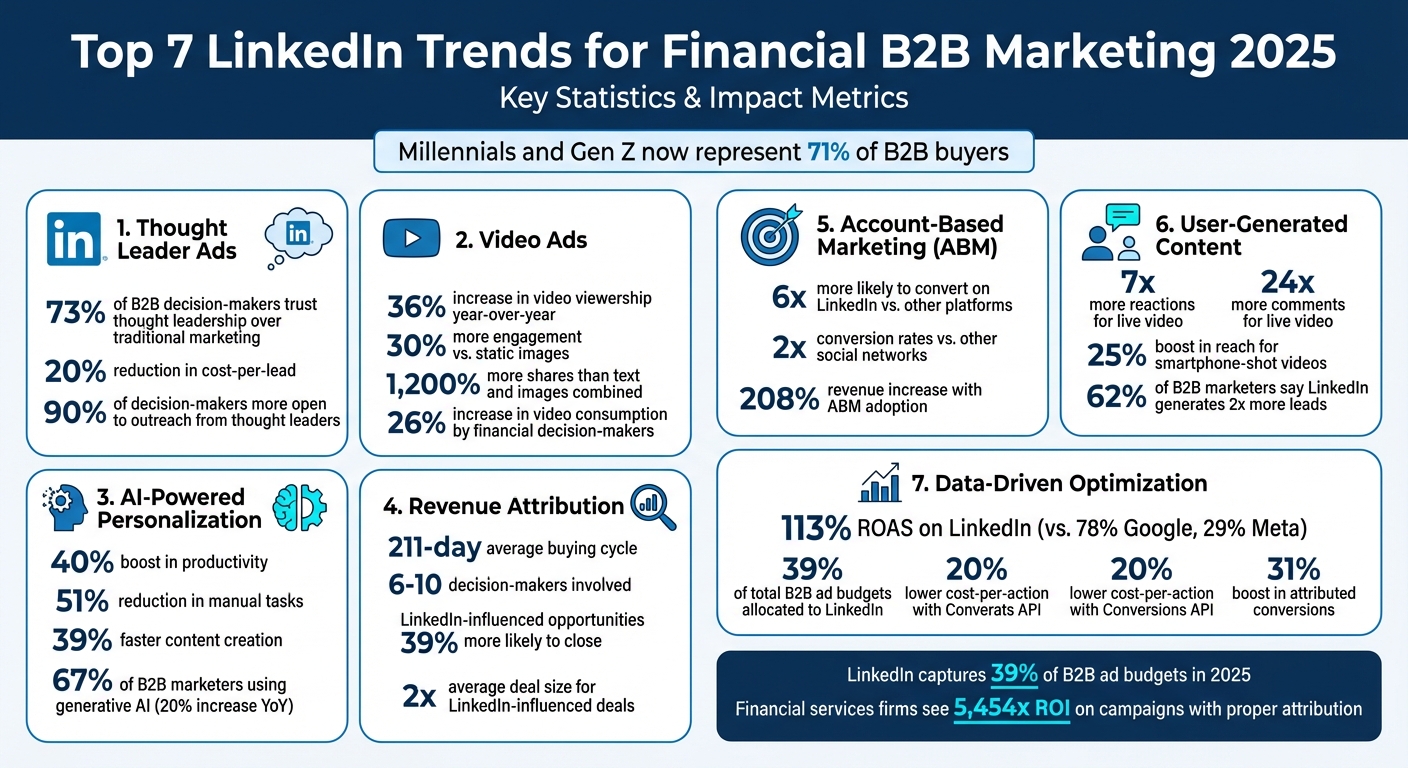
LinkedIn has become the top platform for financial B2B marketing, offering tools that directly connect ad spend to revenue. By 2025, marketers are leveraging features like Thought Leader Ads, video content, and AI-powered personalization to engage Millennial and Gen Z buyers who now dominate 71% of the B2B market. Key trends include:
These trends align with LinkedIn’s 2025 updates, which prioritize deeper connections, dwell time, and AI-powered tools for better results. Financial marketers who stay ahead with these strategies can drive measurable growth and long-term success.
7 LinkedIn B2B Marketing Trends for Financial Services 2025
Thought Leader Ads (TLAs) take a fresh approach to B2B advertising by focusing on posts from executives and industry experts rather than corporate accounts. For financial services firms, where building trust is essential, this personal strategy allows senior leaders - like CFOs or wealth management directors - to share their insights in a way that feels genuine and relatable, avoiding the sterile tone of corporate messaging.
The data speaks volumes: 73% of B2B decision-makers trust thought leadership content more than traditional marketing materials or product brochures. In the financial world, where credibility is non-negotiable, TLAs let senior leaders demonstrate their expertise directly, fostering trust through their professional authority. A great example comes from Lombard Odier, which used short LinkedIn videos in 2025 to discuss sustainability topics. The campaign saw impressive results, including a 28% video completion rate and a 12% increase in brand favorability among senior professionals.
Beyond building trust, TLAs deliver tangible marketing results. By creating authentic conversations long before a sales pitch, these ads pave the way for stronger engagement. In fact, 90% of B2B decision-makers are more open to outreach from companies that consistently produce high-quality thought leadership. For instance, upGrad combined TLAs with Document Ads featuring both students and experts, achieving a 20% reduction in cost-per-lead and a 56% boost in lead-to-enrollment conversion rates. Financial marketers can further optimize TLAs by incorporating "micro-asks" like, "DM me for a copy of our latest market analysis," making it easy for prospects to engage without the hassle of lengthy forms.
LinkedIn’s 2025 algorithm now prioritizes "Connection Depth" and content from meaningful professional relationships over standard brand posts. This makes TLAs even more effective, as content from individual voices tends to drive better engagement. Posts that encourage longer "dwell time" - the amount of time users spend reading - also gain greater visibility. Plus, with LinkedIn’s Conversions API tracking offline actions like sales calls and CRM updates, financial marketers can directly link TLA engagement to revenue outcomes, even in the long and complex B2B sales cycles common in their industry.
Video content is thriving on LinkedIn, with viewership climbing 36% year-over-year. In fact, 95% of video marketers say video is a must-have tool in their strategy. For financial B2B firms aiming to grab attention and spark initial interest, short-form video ads are the perfect solution to stand out in a crowded feed and kickstart conversations early in the buyer's journey.
LinkedIn's video consumption among financial decision-makers has jumped 26% year-over-year. With Millennials and Gen Z now making up 71% of the B2B market, video has become the go-to content format for these audiences. LinkedIn also ranks as the top media source for financial advisors, who are 1.7x more likely to engage with brand messages on the platform. A great example of video’s power is the Institute of Management Accountants (IMA®), which used targeted video campaigns to engage specific professional groups, leading to a staggering 513% increase in sign-ups year-over-year. For professionals like wealth managers and asset managers, video has gone from being a "nice-to-have" to a must-have for capturing the attention of busy executives who might otherwise scroll past static content.
When it comes to driving engagement, video outperforms other formats by a wide margin. Video content generates 1,200% more shares than text and images combined, and video ads see 30% more comments per impression compared to static images. The results can be transformative. For instance, one asset manager working with Acxiom found that their campaign delivered new deposits worth 5,454 times the cost of the ad spend. Salesforce also demonstrated the power of video by using a hybrid approach - blending Connected TV (CTV) ads with in-feed video ads - which reached over 70% new viewers and achieved 11x better cost efficiency than traditional TV ads.
To maximize impact, keep videos short - between 15 and 30 seconds - and grab attention within the first 3–6 seconds. Use captions since many professionals watch videos with the sound off, and opt for high-contrast visuals to boost completion rates by as much as 68%.
LinkedIn’s upcoming 2025 features are set to make video ads even more effective. Programs like Wire, Accelerate, and enhanced live video tools will amplify engagement by encouraging more reactions and comments. For example, the Wire Program now enables brands to run in-stream video ads alongside trusted financial publishers such as Bloomberg, Barron’s, Reuters, and The Wall Street Journal. Live video content, in particular, generates 7x more reactions and 24x more comments than standard video posts.
Additionally, with 98% of LinkedIn members tuning into Connected TV weekly, financial B2B marketers can extend their campaigns into premium streaming environments, broadening their reach.
"The easy sharing and commenting functionality on LinkedIn generated deeper engagement than one would see when distributing video on traditional media channels."
- Kateryna Ranieri, Media & Communications Manager, Lombard Odier
AI is changing the game for LinkedIn campaigns, especially in the financial B2B space. By offering a new layer of personalization, artificial intelligence is transforming how marketers create and share content. With AI's ability to analyze user behavior, it powers hyper-targeted campaigns, suggesting the best messaging, content formats, and posting times. For financial services firms vying for the attention of CFOs, wealth managers, and institutional investors, this precision turns casual browsing into actionable leads.
The use of generative AI is on the rise, with two-thirds of B2B marketers already incorporating it by 2025 - a 20% increase from the previous year. For financial marketers, AI addresses critical challenges in the sales cycle. Predictive analytics tools, for example, help identify high-value prospects and improve lead scoring, enabling sales teams to concentrate on the leads most likely to convert.
"We can leverage AI models to predict which leads our sales team has the best chance of converting, and identify the leads they should be contacting"
- Guillermo Novillo, Director of Integrated Marketing at Microsoft LATAM
This capability is especially vital in financial services, where trust-building is essential - 94% of B2B marketers agree on its importance.
AI is delivering tangible results for marketers, including a 40% boost in productivity, 39% faster content creation, and a 51% drop in manual tasks. Beyond these efficiencies, AI enables dynamic ads that adapt in real time. For instance, financial firms can use AI to serve personalized case studies or send webinar invitations based on subtle signals like page visits. This approach shortens sales cycles without increasing team size.
LinkedIn's Accelerate program takes AI-driven campaigns to the next level by automating tasks like campaign setup, audience targeting, creative recommendations, and bidding optimization. The platform's Conversions API (CAPI) further enhances this by connecting LinkedIn ad clicks to offline actions such as sales calls. This ensures that campaigns optimize for revenue generation rather than just engagement metrics.
"AI isn't just for the tech-savvy - it's for every marketer looking to improve their efficiency and results"
- Alexandra Rynne, Content Strategy Lead at LinkedIn Ads
For financial B2B firms, these advancements mean less time spent on repetitive tasks and more time for strategic decision-making. By leaning into AI, LinkedIn is evolving into an even more powerful tool for financial marketers, helping them achieve greater efficiency and impact.
Once you've delved into content and personalization trends, the next step is understanding how revenue attribution connects engagement to actual revenue. For financial B2B marketers, the focus has shifted from basic metrics to priorities like pipeline generation, win rates, and revenue. Considering that the average buying cycle lasts 211 days and typically involves 6 to 10 decision-makers, traditional last-touch attribution just doesn't cut it anymore. This shift spotlights tools that can directly tie every marketing dollar to measurable revenue outcomes. Revenue attribution tools, for instance, integrate LinkedIn ad data with CRM systems, helping marketers demonstrate ROI to senior leadership.
Here's the challenge: 64% of B2B marketing leaders admit their organizations don’t trust current measurement methods for making decisions. For financial services firms targeting roles like CFOs, wealth managers, and institutional investors, this lack of trust can create a disconnect between marketing and finance teams. Revenue attribution bridges this gap by translating campaign performance into metrics that resonate with finance professionals - think pipeline value, return on ad spend (ROAS), and deal velocity.
"What eventually matters to the business are the revenue metrics. It's all about how many customers we're winning, how many opportunities we're creating, and the ROI we're generating on marketing investments." - Vivek Khandelwal, Director Digital Acquisition, Strategy and Operations, ServiceNow
One financial services firm provided a great example by using closed-loop analysis to assess their LinkedIn campaigns. The result? They attributed new deposits worth 5,454 times the original campaign cost. That’s the kind of evidence that transforms marketing from a perceived cost center into a proven revenue generator.
Revenue attribution doesn’t just validate marketing efforts - it helps optimize them. By pinpointing which campaigns, audiences, and regions yield the highest deal sizes and win rates, financial marketers can reallocate budgets to what’s actually working. For instance, LinkedIn-influenced opportunities are 39% more likely to close compared to non-influenced deals. In another case, an enterprise tech company found that LinkedIn-influenced deals had double the average deal size compared to those without LinkedIn’s impact.
Marketers now track metrics like real-time cost-per-qualified lead, mid-term pipeline ROAS (spanning 3–12 weeks), and long-term LTV-adjusted ROI. This approach shifts the focus from sheer lead volume to lead quality, balancing short-term wins with long-term growth. It’s a clear move away from vanity metrics toward actionable insights that drive financial outcomes.
As LinkedIn continues to evolve with advanced content strategies and AI-driven tools, revenue attribution becomes the linchpin for refining overall marketing strategies. LinkedIn’s Revenue Attribution Report, for example, integrates CRM data with Campaign Manager, linking ad spend to revenue won, opportunity win rates, and average days to close. The Conversions API takes it further by connecting online interactions - like clicks and form submissions - with offline outcomes, such as sales calls and in-person meetings.
This integration addresses one of the biggest challenges for marketers: siloed data. In fact, 73% of marketers cite this as their top measurement hurdle. For financial B2B firms, these tools provide a clear view of how LinkedIn campaigns contribute to closed deals. Instead of guessing which campaigns are effective, marketers can analyze performance down to the campaign level and see exactly what drives revenue.
Account-Based Marketing (ABM) takes revenue attribution to the next level by honing in on high-value financial accounts. On LinkedIn, financial B2B marketers can pinpoint specific targets - like institutional investors, wealth management firms, and financial advisory practices - crafting messages tailored to the unique priorities of individual decision-makers. Instead of spreading resources thin across a broad audience, ABM focuses on the key players who hold the power to make decisions. This approach works hand-in-hand with revenue attribution strategies, creating a framework for highly focused engagement.
LinkedIn is where financial professionals, including CFOs, wealth managers, and institutional investors, actively seek insights. In fact, LinkedIn users are twice as likely to look for financial advice on the platform compared to other social networks. A great example of this in action comes from State Street Global Advisors. They used LinkedIn's Matched Audiences feature to upload specific account lists, delivering custom content to their target audience. This strategy helped them cut through the noise of a crowded industry and build a dedicated following.
ABM doesn’t just refine targeting - it significantly improves conversion rates and deal quality. Audiences on LinkedIn are six times more likely to convert than on other platforms, with conversion rates double those of other social networks. In industries with long sales cycles - such as financial services, where the average B2B buyer journey now spans 211 days - precision targeting ensures every dollar spent on ads reaches the right audience. For example, BNY Mellon Wealth Management used LinkedIn’s precision tools and insights from LinkedIn Marketing Partners to deliver impactful content to high-net-worth individuals, boosting both brand awareness and engagement.
LinkedIn’s upcoming 2025 updates are set to supercharge ABM strategies. The LinkedIn Accelerate tool, powered by AI, streamlines campaign setup and identifies high-intent audiences in real time. Meanwhile, the Conversions API (CAPI) bridges the gap between online and offline actions, tracking everything from LinkedIn clicks to in-person meetings and signed contracts.
"LinkedIn really is the best platform for B2B audience targeting, due to its professional nature and robust user data. It allows advertisers to reach a highly engaged and relevant audience based on job titles, industries, company sizes and a lot more."
- Crystal King, Social Media Professor, HubSpot
The Revenue Attribution Report now syncs CRM data directly with LinkedIn Campaign Manager, offering a clear connection between ABM efforts and revenue outcomes. For financial firms navigating long sales cycles, this feature is a game-changer, with reporting now covering up to 12 months of CRM activity. Plus, integrations with tools like HubSpot, 6sense, and Demandbase allow you to layer intent data on top of LinkedIn’s targeting. This ensures your efforts are directed toward accounts actively researching specific financial products. These advancements make ABM campaigns more precise and seamlessly align with broader revenue strategies, setting the stage for even more effective financial B2B marketing.
In the financial services world, trust isn’t just important - it’s everything. When it comes to LinkedIn, user-generated content (UGC) has proven to be a powerful way to establish that trust. Why? Because content shared directly by employees, executives, and even clients feels more genuine and relatable than polished corporate messaging. For financial B2B buyers, who value expertise and authenticity over flashy marketing, this kind of content makes all the difference.
Financial B2B buyers are looking for real insights and expertise - not just another corporate pitch. When your team members or clients share their personal experiences or professional knowledge, it gives your brand a human face. This is especially important on LinkedIn, where users are twice as likely to seek advice and 1.7 times more open to brand messages compared to other social platforms. For financial advisors, LinkedIn has even earned the title of the #1 media source.
LinkedIn’s 2025 algorithm updates have only amplified the value of authentic content. Smartphone-shot videos, for instance, now perform exceptionally well, with a 25% boost in reach. Live videos are even more impactful, generating 7 times more reactions and 24 times more comments than standard posts. These trends highlight a shift: raw, unpolished content is what truly resonates.
UGC doesn’t just build trust - it delivers measurable results. LinkedIn is a lead-generation powerhouse, with 62% of B2B marketers reporting that it outperforms other platforms by generating leads at twice the rate of the next-best channel.
One way to maximize this potential is through employee advocacy programs. When employees share industry insights or company updates from their personal profiles, they tap into networks that corporate pages simply can’t reach. This approach transforms team members into trust-building ambassadors.
Take IMA®, for example. By leveraging LinkedIn’s targeting tools and crafting engaging content, they achieved a staggering 513% year-over-year increase in sign-ups. Similarly, Invesco used LinkedIn Live to host a Women’s History Month event in 2025. By combining live video with precise audience targeting, they successfully created a thriving community for women in finance.
"People don't buy companies, people buy from people. Audiences want to buy from brands that teach, inspire, and lead."
- Alexandra Rynne, Content Strategy Lead, LinkedIn Ads
LinkedIn’s 2025 platform updates have made UGC even more effective. Features like Collaborative Articles - where AI suggests topics and invites user contributions - help brands position themselves as thought leaders while sparking meaningful industry discussions.
The platform’s updated algorithm now prioritizes quality interactions and dwell time over basic engagement metrics. This means that fostering genuine conversations in the comment section is more important than ever. Responding to comments within the first two hours of posting is key, as it turns your posts into community-building hubs.
Additionally, younger professionals are changing how B2B decisions are made. Forty-six percent of Gen Z professionals now start their B2B research on social media instead of Google, and they typically review up to 13 pieces of content before engaging with sales. Peer-led UGC is essential in capturing the attention of this next generation of decision-makers.
When it comes to financial B2B marketing on LinkedIn, the days of simply tracking clicks and impressions are long gone. By 2025, the most successful firms are using integrated tools that directly link ad spend to revenue, making every marketing dollar count.
The financial services buying cycle isn’t a sprint - it’s a marathon. On average, it takes 211 days to complete, and for larger companies, that timeline can stretch nearly 50% longer. This extended cycle means multi-stage performance tracking is no longer optional; it’s a must. Financial marketers now focus on three key funnel stages:
But the game-changer here is going beyond these traditional metrics to measure actual revenue impact. A great example? In 2024, a global asset manager used closed-loop analysis with Acxiom to attribute new deposits worth 5,454 times the campaign’s original cost. That’s the kind of ROI that makes a difference.
This shift from tracking marketing signals to focusing on tangible revenue ensures that every marketing decision is backed by hard data. It’s not just about clicks or impressions anymore - it’s about proving the value of every dollar spent.
LinkedIn has become the go-to platform for financial B2B marketers, and the numbers back it up. Compared to other major B2B networks, LinkedIn boasts a 113% ROAS, leaving Google Search (78%) and Meta (29%) far behind. By the end of 2024, LinkedIn had captured 39% of total B2B ad budgets, making it the top channel for many firms.
What’s driving this performance? LinkedIn’s advanced tools, like the Conversions API (CAPI), which connects online ad clicks to offline results - think in-person meetings or signed contracts. Companies using CAPI report a 20% drop in cost-per-action and a 31% boost in attributed conversions compared to those who don’t.
Then there’s the Revenue Attribution Report (RAR). By syncing CRM data with LinkedIn Campaign Manager, it shifts the focus from basic lead counts to actual revenue generation. Instead of asking, “How many leads did we get?” marketers can now ask, “How much revenue did we generate?”.
"We can leverage AI models to predict which leads our sales team has the best chance of converting, and identify the leads they should be contacting."
- Guillermo Novillo, Director of Integrated Marketing, LATAM, Microsoft
LinkedIn’s 2025 updates have taken data-driven marketing to the next level. Tools like Accelerate use AI to fine-tune targeting, creative assets, and bidding strategies in real time, ensuring campaigns hit their marks without constant manual tweaking.
The platform’s algorithm has also evolved, prioritizing dwell time and interaction quality over basic engagement metrics. This means marketers need to create content that holds attention, whether it’s through long-form posts, carousels, or content that encourages users to click "Read More."
Financial marketers should also shift their focus to tracking cost per company influenced rather than just cost per click. LinkedIn proves to be 25% more cost-efficient than Google Search and 70% more efficient than Meta when it comes to influencing target accounts. These benchmarks not only justify budget allocation but also position marketing as a strategic investment rather than a cost center. It’s about showing the real value marketing brings to the table.
Visora puts LinkedIn's latest trends into action through its integrated Trifecta Program, designed to help financial B2B leaders - like real estate syndicate heads and investor relations teams - achieve tangible results without inflating budgets or teams. This program combines three powerful elements: the B2B Vortex Funnel, AI-Augmented Appointment Setting, and DD Strategy Consulting. Together, these components align seamlessly with LinkedIn's capabilities projected for 2025.
The B2B Vortex Funnel focuses on hyper-personalized, data-driven content that adjusts in real time based on user behavior, industry specifics, and engagement patterns. For financial services leaders, this means tailored landing pages and email campaigns that directly address their unique challenges. By leveraging tools like LinkedIn’s Matched Audiences, we target decision-makers at high-value accounts with precision. Considering that companies using AI in sales and marketing generate 50% more leads and cut costs by up to 60%, our clients enjoy similar performance boosts through this system.
Our AI-Augmented Appointment Setting takes LinkedIn’s advanced attribution tools and account-based marketing capabilities to the next level. Instead of focusing on metrics like clicks, we prioritize cost per targeted company, ensuring every dollar spent translates into meaningful conversations with C-suite executives, founders, and high-net-worth individuals. So far, this method has created $70 million in pipeline value and facilitated over 2,000 qualified calls, delivering an average pipeline gain of $150,000 per client.
The DD Strategy Consulting element brings Fortune 500-level expertise to financial firms, implemented over a streamlined 12-week period. This hands-on approach mirrors LinkedIn's Accelerate tool by continuously analyzing performance metrics and refining campaigns in real time. Whether it’s video ads or thought leadership posts, every campaign element is fine-tuned to build trust and drive revenue. With 66% of B2B buyers expecting personalized engagement, our system ensures financial firms deliver exactly that - without needing to expand their teams or rely solely on referrals.
In short, Visora provides financial B2B leaders with a complete acquisition system that lowers ad spend, boosts qualified interactions, and ties every effort to measurable revenue outcomes. By strategically aligning with LinkedIn's evolving platform, we help clients stay ahead in an ever-changing landscape.
The world of financial B2B marketing on LinkedIn has undergone a major transformation. The days of relying on static posts and impersonal corporate messaging are fading fast. Today’s digital-savvy buyers, especially younger professionals, demand video content, personalized experiences, and genuine voices. They’re no longer interested in faceless brand pages - they want real connections.
The data backs this up. Companies that adopt Account-Based Marketing see a 208% increase in revenue compared to those that don’t. Meanwhile, 94% of B2B marketers agree that trust is now the most important factor in building a successful brand. These numbers highlight the importance of adapting to longer, more intricate purchase journeys.
With extended sales cycles requiring multiple touchpoints, financial marketers need to stay visible across platforms like LinkedIn, through formats like video, thought leadership pieces, and even Connected TV. Leveraging AI-powered tools and precise attribution methods allows businesses to deliver human-focused content while improving efficiency. For example, companies using AI in sales and marketing report 50% more leads and up to 60% cost savings.
Success lies in weaving these trends into a unified strategy. The most forward-thinking companies are connecting every LinkedIn interaction directly to revenue, embracing video, AI, and advanced attribution to stay ahead. LinkedIn’s shift toward video-first content and AI-driven optimization presents a massive opportunity for financial B2B firms ready to break away from outdated methods. Programs like Visora’s Trifecta Program offer a roadmap for aligning with these changes seamlessly.
The time to act is now - before your competitors take the lead.
Thought Leader Ads build trust by presenting genuine, expert-driven content that connects with decision-makers. By incorporating engaging stories and insights from founders or industry leaders, these ads impact nearly 75% of buyers during the shortlisting phase. This strategy helps financial B2B prospects feel assured and more open to further interaction.
For the often skeptical financial audience, credibility is everything. Thought Leader Ads establish your brand as a reliable authority while creating meaningful connections with potential clients. This makes them a powerful way to drive engagement and nurture lasting relationships.
AI is transforming how financial B2B companies approach LinkedIn marketing, making campaigns sharper and more effective. By analyzing massive amounts of engagement data, AI pinpoints buyer intent signals, allowing marketers to zero in on specific audiences like investors, corporate treasurers, and leaders in real estate syndication. This level of precision ensures campaigns resonate with the right people.
When it comes to content creation, AI takes efficiency to a new level. It can produce compliance-friendly posts, articles, and ad copy in just seconds, giving marketing teams more time to focus on strategy and creativity. AI doesn’t stop there - it also fine-tunes campaign delivery by identifying the best times to post, suggesting impactful topics, and dynamically adjusting ad bids to get the most out of every dollar spent.
AI-powered tools also supercharge outreach efforts. They enable financial firms to send personalized connection requests and follow-ups at scale, maintaining an authentic tone while saving time. This turns LinkedIn into a real-time acquisition platform, delivering faster, smarter, and more compliant marketing results.
Video content is a powerful way to connect with decision-makers on LinkedIn. It’s the most engaging format on the platform, with videos being shared up to 20 times more than other types of content. In just a year, video consumption on LinkedIn has increased by 36%, and a whopping 87% of viewers say videos influenced their purchasing decisions.
Using video allows you to grab the attention of professionals who are actively seeking solutions and share your message in a way that resonates. For B2B marketers, it’s a strategy that can’t be overlooked.
%20(5).png)
