%20Bold.png)
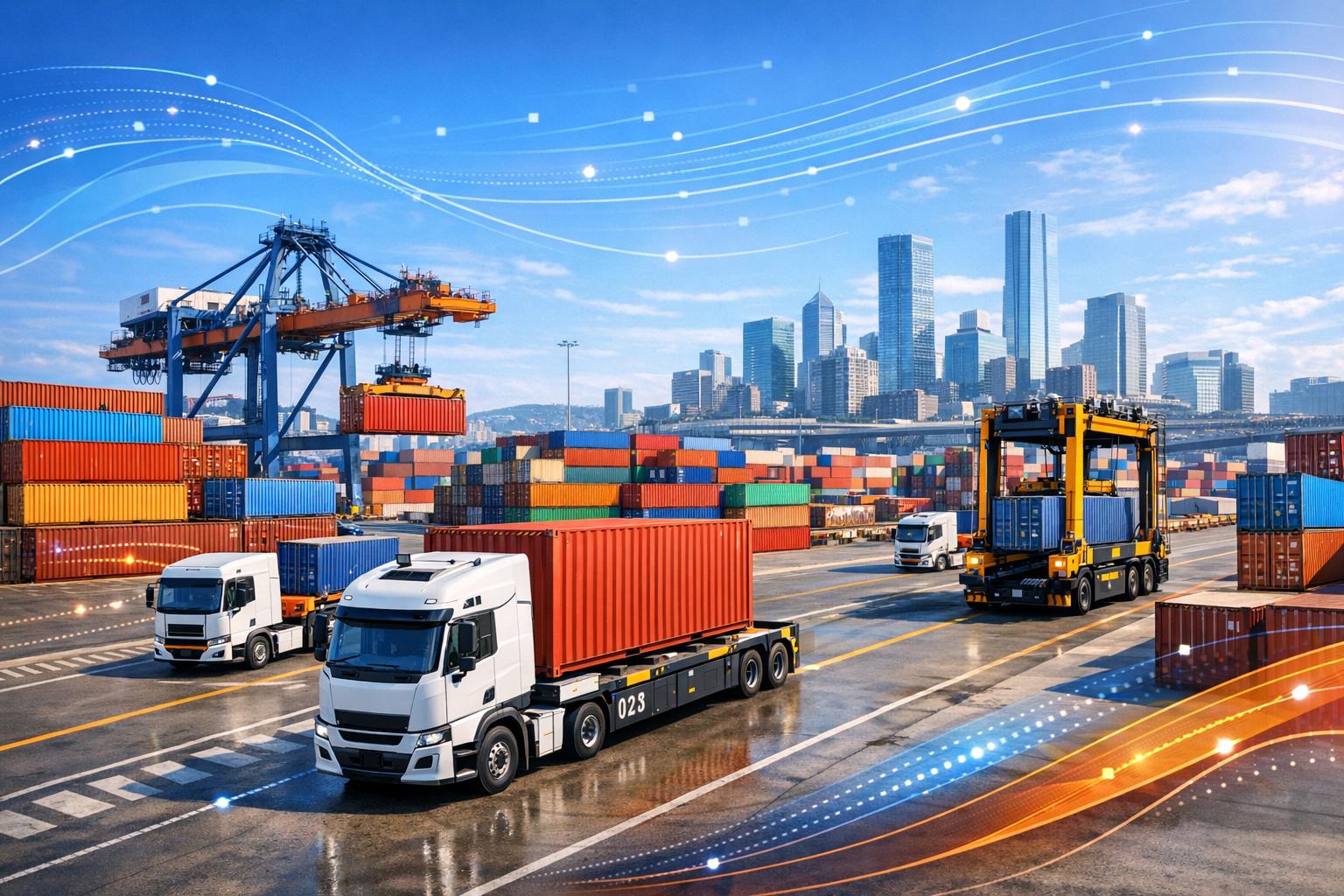
AI is transforming freight pricing by replacing slow, error-prone manual processes with fast, data-driven systems. Companies using AI tools report reduced costs, higher accuracy, and improved efficiency. For example, freight quotes that once took hours can now be generated in seconds, saving $50–$100 per load and cutting empty miles by up to 15%.
AI-powered systems also improve forecasting, streamline operations, and integrate seamlessly with existing logistics tools like TMS and ERP systems. Companies like Uber Freight, C.H. Robinson, and Sphere demonstrate how AI is reshaping freight management, from pricing and routing to auditing and compliance.
AI isn't just about saving money - it’s helping businesses make smarter, faster decisions in a rapidly changing market. If you're not using AI in freight pricing yet, it’s time to start.
Uber Freight has revolutionized the freight industry by using a Markov Decision Process (MDP) to set upfront prices for thousands of loads daily, removing the need for traditional manual negotiations [6]. Their platform relies on machine learning models like XGBoost to match carriers to loads, factoring in variables such as lead time, repeat bookings, and distance.
Since its launch in 2017, Uber Freight has facilitated the movement of over $20 billion in freight and now serves one in three Fortune 500 companies [12]. Their AI-powered route optimization has cut empty miles for carriers by 10% to 15%, while their recommendation system has boosted active user bookings by 12% [10][11].
In 2024, Colgate-Palmolive tapped into Uber Freight's Insights AI tool to manage a complex logistics operation. Under the guidance of Chief Supply Chain Officer Luciano Sieber and VP Tatiana Martinez, the AI-powered dashboard pinpointed carriers falling short of contractual obligations, improving compliance and reducing logistics expenses [13].
Freddie Jimenez, owner of F&J Logistics Inc., also benefited from Uber Freight's AI-driven routing. By strategically planning daily schedules - such as aligning trips from Chicago to New Orleans to Houston - he minimized waiting times and cut down on empty miles [12].
Additionally, a global manufacturer's experience highlights how AI can streamline even the most intricate freight networks.
One global manufacturer implemented AI-powered software to optimize its supply chain across more than 300 freight lanes at once. By leveraging operations research techniques, the system accounted for freight volume changes, product priorities, truck capacity limits, and network incentives [15].
The results were impressive: profit margins rose by around 10%, predictive analytics slashed operational costs by nearly 15%, and automated shipment bundling reduced empty miles by up to 45% [16]. Furthermore, machine learning models significantly improved freight cost predictions, achieving a 24.6% reduction in mean squared error and a 29.5% reduction in mean absolute error compared to traditional forecasting methods [14].
AI isn't just transforming routing and pricing - it’s also reshaping freight auditing. Sphere has implemented AI-driven auditing systems to uncover pricing errors and inconsistencies that manual checks often miss. Using Optical Character Recognition (OCR), the platform automates document processing, speeding up invoicing and compliance checks while reducing human error [14][16].
Sphere's tools also extract and structure critical load and pricing data from unstructured sources like emails, text messages, and spreadsheets [8]. By centralizing this information, the system simplifies the identification of discrepancies across thousands of invoices. While specific recovery figures remain undisclosed, Sphere’s technology shows how AI can turn freight auditing into a proactive process, continuously monitoring for errors and recovering lost revenue.
These case studies highlight the transformative role AI plays in freight pricing, from optimizing routes and reducing costs to improving accuracy and efficiency across operations.
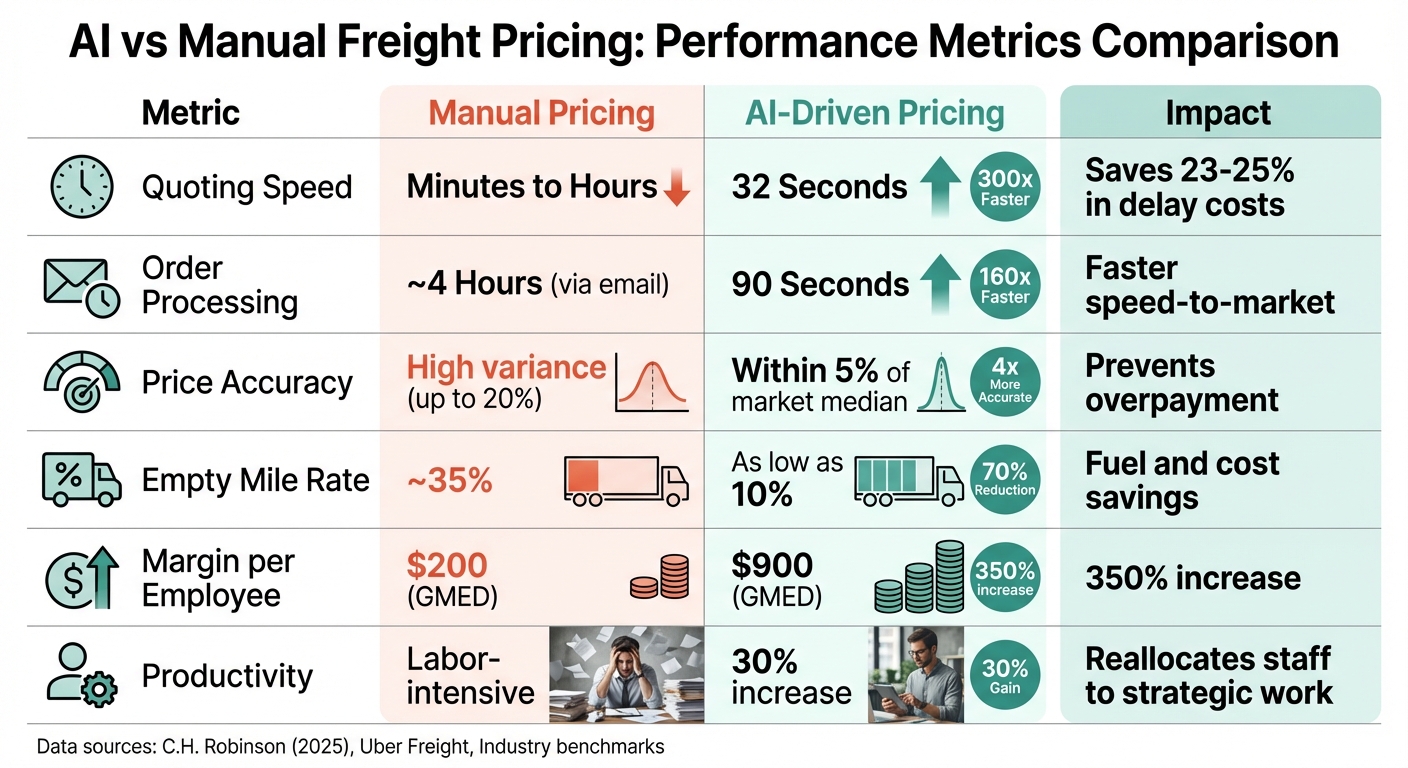
AI vs Manual Freight Pricing: Speed, Cost and Efficiency Comparison
AI-driven freight pricing offers a clear path to cutting costs and improving profit margins. For example, Uber Freight's machine learning algorithms have reduced empty miles for carriers by 10% to 15%, with some carriers achieving rates as low as 10% [7]. Real-time rate benchmarking ensures spot quotes stay within 5% of the market median, helping businesses avoid overpaying in markets where prices can fluctuate by as much as 20% in a single month [1]. Additionally, AI agents can save $50–$100 per load by aligning rates with current market conditions. These savings not only help businesses combat inflation but also allow them to maintain competitive margins.
This cost efficiency lays the foundation for greater accuracy in forecasting, as explored in the following section.
AI doesn't just save money - it also makes forecasting much more precise, which directly impacts profitability. Machine learning models can process billions of data points, ranging from historical shipment data to real-time capacity, fuel price changes, and seasonal demand patterns. These advanced models outperform manual forecasting methods, enabling companies to make smarter, faster decisions. For instance, businesses that rely on data-driven insights have reported a 12 percentage point increase in their bid-win rates [18]. This level of accuracy helps logistics providers secure more contracts while keeping their margins intact.
The advantages of AI-driven pricing become even more apparent when directly compared to manual methods. Take C.H. Robinson, for example: in June 2025, they deployed over 30 AI agents to streamline their operations. Their Quoting Agent alone generated over 1 million customer-specific quotes in just 32 seconds - a task that previously required hours of back-and-forth communication via email [17]. Similarly, their Orders Agent processes 5,500 truckload orders daily, saving 600 hours of manual labor every single day [17].
Here’s a closer look at how AI stacks up against manual pricing:
| Metric | Manual Pricing | AI-Driven Pricing | Impact |
|---|---|---|---|
| Quoting Speed | Minutes to Hours | 32 Seconds [17] | Saves 23–25% in delay costs [17] |
| Order Processing | ~4 Hours (via email) [19] | 90 Seconds [19] | Faster speed-to-market |
| Price Accuracy | High variance (up to 20%) [1] | Within 5% of market median [1] | Prevents overpayment |
| Empty Mile Rate | ~35% [7] | As low as 10% [7] | Fuel and cost savings |
| Margin per Employee | $200 (GMED) [2] | $900 (GMED) [2] | 350% increase |
| Productivity | Labor-intensive | 30% increase [17] | Reallocates staff to strategic work |
Mark Albrecht, VP for Artificial Intelligence at C.H. Robinson, highlighted the company’s edge in leveraging AI:
"Our tech can connect details in different parts of the email, discern what's missing, go fill in the blanks and take action... We can do that like no one else, because we have the competitive advantage of the largest dataset in the industry" [19].
Artificial intelligence is reshaping freight pricing by predicting market changes, incorporating environmental considerations, and seamlessly integrating with operational systems. Together, these advancements are setting the stage for a more dynamic and efficient freight pricing landscape.
Machine learning is revolutionizing freight pricing by making it predictive rather than reactive. Algorithms now analyze a wide range of factors - past lane rates, current benchmarks, weather patterns, traffic conditions, and road closures - to forecast spot-market prices before they change [2][7]. Using frameworks like MDP (Markov Decision Processes) and Bellman equations, these systems create optimal pricing strategies that eliminate the need for manual negotiation [9]. Tools such as XGBoost ensure that as prices adjust, the likelihood of bookings aligns logically [9].
These predictive models have achieved over 90% accuracy in forecasting carrier costs, saving businesses millions annually through automated data pipelines that connect legacy systems to cloud-based models [2]. AI negotiation agents, powered by reinforcement learning techniques like Deep Q-Learning, have drastically reduced the time spent on price negotiations - from hours of email exchanges to mere seconds [1].
Chris Caplice, Executive Director at MIT’s Center for Transportation and Logistics, highlighted the self-improving nature of these systems:
"By being trained continuously, the models will learn better routing policies automatically; if a policy shifts, for example, the model will pick up on it, eliminating the need for specialty algorithms" [7].
Looking ahead, AI’s predictive capabilities are expected to generate between $1.3 trillion and $2 trillion annually in economic value across the logistics sector over the next 20 years [20]. This technology is also paving the way for more sustainable pricing practices.
Sustainability is no longer just a buzzword - it’s becoming an integral part of freight pricing. AI-driven route optimization is helping to cut down on "empty miles" (trucks traveling without cargo), which directly reduces fuel consumption and emissions. At any given time, about 35% of trucks on U.S. highways are empty, but AI can lower this figure to as little as 10% [7].
In April 2025, Uber Freight used machine learning to optimize routes for thousands of shippers, including 200 Fortune 500 companies. Under the leadership of CEO Lior Ron, the initiative reduced empty miles by 10% to 15%, contributing to the company’s movement of over $20 billion in freight since its inception [7]. Lior Ron emphasized:
"The ultimate goal is to make every mile of a trip a paid mile and make it worth everybody's while that these guys are out there making deliveries" [7].
FreightWaves, a key player in this space, raised $16 million in May 2021 to expand its FreightWaves Carbon Intelligence (FCI) platform. This tool enables supply chain managers to benchmark and forecast Scope 3 emissions, helping over 500 companies work toward carbon neutrality [21]. CEO Craig Fuller explained:
"There is a major need in the market for carbon emission transparency and solutions that can help companies actively mitigate their carbon footprint. With FCI, supply chain managers are able to benchmark, analyze, monitor and forecast their Scope 3 emissions" [21].
AI is also transforming how freight pricing integrates with Transportation Management Systems (TMS) and Enterprise Resource Planning (ERP) systems. These platforms are evolving from basic record-keeping tools into real-time logistics hubs powered by AI [5][22]. Through agentic automation, AI agents embedded within TMS handle tasks like procurement, execution, and payments autonomously [22][17].
In June 2025, C.H. Robinson deployed over 30 AI agents across its global operations. Their Quoting Agent generates price quotes in just 32 seconds, while the Orders Agent processes 5,500 truckload orders daily, saving 600 hours of manual work each day. This shift has boosted the company’s productivity by 30% since 2023 [17].
Similarly, in May 2025, Colgate-Palmolive partnered with Uber Freight to integrate its "Insights AI" into their logistics operations. This AI-powered TMS, trained on $20 billion in freight data, provided real-time network analysis to improve decision-making. Tatiana Martinez, VP of North America Customer Service & Logistics, shared:
"With the scale and complexity of our operations, the collaboration with Uber Freight on Insights AI has helped empower our team to access timely information, analyze our network, and make strategic decisions" [22].
These AI-first TMS platforms streamline workflows by automatically extracting data from legacy systems, performing advanced analysis, and reintegrating the insights back into operational tools [2]. This enables shippers to make instant, data-driven decisions without leaving their primary systems [3]. The future of freight pricing points toward "real-time market sensing", where external factors like geopolitical events or weather disruptions trigger immediate rate adjustments [1].
AI has revolutionized freight pricing, shifting from outdated, manual methods to efficient, automated systems. The results speak volumes: faster quoting, significant cost savings, and optimized operations. For instance, Uber Freight managed to cut empty miles by 10% to 15% using AI-powered route optimization, improving efficiency across $20 billion in freight [7].
This transformation boosts both profitability and environmental responsibility. Companies leveraging AI have reported productivity gains of 30% since 2023, while drastically reducing response times - from hours to mere seconds [17]. AI also keeps spot rates within 5% of market medians, saving businesses $50 to $100 per load, all while eliminating the time-consuming back-and-forth of traditional bidding processes [1]. By reducing empty trailer rates and emissions, AI further aligns logistics with sustainability goals [7].
The evidence is clear: AI offers a strategic edge in freight operations.
Leading companies are already ahead of the curve, deploying generative AI at twice the rate of slower-growing competitors [18]. By 2028, 33% of enterprise software is expected to include agentic AI, a sharp rise from less than 1% today [6]. The real question isn't whether to implement AI but how quickly you can integrate it into your operations without falling behind.
Start with your most critical pricing decisions. You don’t need perfect data to begin - launch a pilot program that compares AI-driven recommendations with your historical pricing to build confidence in the system [4][18]. From there, scale up strategically. Integrating AI into existing TMS and ERP systems can unlock efficiencies and growth opportunities. Companies like Visora specialize in guiding B2B leaders through this process, helping them install acquisition systems that drive revenue without relying on referrals or inflated budgets. Their expertise ensures AI implementation happens at a pace that matches the urgency of today’s market.
The future of the freight industry belongs to those who act now. AI isn’t just reshaping pricing - it’s redefining what’s achievable in logistics, cost management, and sustainability.
AI brings a new level of precision to freight pricing by processing massive amounts of historical and real-time data. It takes into account factors like market trends, load details, routes, and potential risks. With machine learning models, AI can benchmark rates and adjust quotes in real-time to match shifting market conditions.
This method delivers prediction accuracy exceeding 90%, helping businesses stay competitive with pricing that reflects median market rates. By fine-tuning pricing strategies, companies can boost profits while ensuring fair and transparent rates for their customers.
AI is making a big impact in freight management by cutting down emissions through smarter route planning and reducing the number of empty trailers on the road. Right now, about 35% of trucks on U.S. highways travel without cargo, wasting fuel and adding to greenhouse gas emissions. AI helps tackle this problem by optimizing routes and ensuring trucks are used more efficiently.
On top of that, AI-powered tools for pricing and capacity planning help shippers and carriers fill trucks to their maximum capacity. By squeezing more goods into fewer trips, these tools not only boost efficiency but also shrink the carbon footprint of logistics operations.
New AI technologies are also helping companies keep a close eye on freight-related emissions. These tools provide detailed data, making it easier to set meaningful reduction goals and track progress toward greener operations. With these advancements, the freight industry is taking steps toward a cleaner, more sustainable future.
Integrating AI into logistics systems starts with linking your Transportation Management System (TMS) to AI-powered analytics tools. This connection enables AI to analyze real-time data on shipments, routes, and carriers, paving the way for more efficient pricing, smarter route planning, and better capacity matching. Many businesses achieve this by using APIs or middleware to bridge older systems with AI models, ensuring smooth data flow and quicker decision-making.
Typically, successful integration follows three main steps:
For U.S. companies looking to adopt AI, Visora provides specialized consulting and implementation services. Their 12-week "Trifecta" program focuses on integrating AI-driven pricing models into current systems, helping businesses create smarter workflows and achieve measurable growth - all without requiring additional resources.
%20(5).png)
