%20Bold.png)

AI-driven pricing is reshaping the telecom industry by delivering measurable revenue growth and cost savings. By 2025, telecom companies moved beyond static pricing models to real-time, AI-powered strategies that adjust prices based on customer behavior, market conditions, and network performance. Key highlights include:
AI isn't just improving pricing - it's transforming customer retention, operational workflows, and revenue management. With the market projected to reach $19.42 billion by 2029, scaling AI strategies is now a priority for telecom providers.
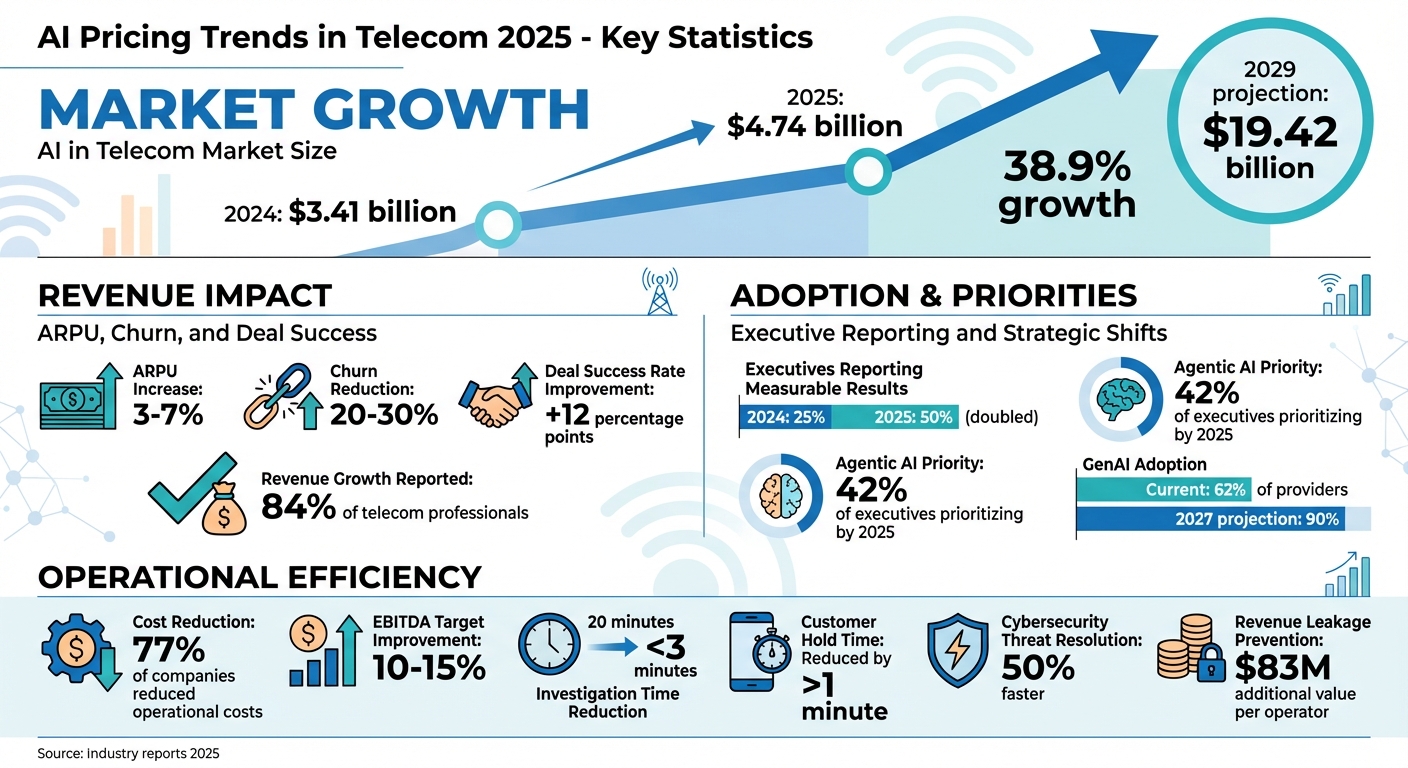
AI Pricing Impact in Telecom 2025: Market Growth, Revenue & Efficiency Statistics
AI is reshaping how telecom companies approach pricing, allowing them to move beyond rigid, fixed models. With real-time pricing adjustments, telecom providers can adapt their prices dynamically to reflect market conditions. By leveraging AI algorithms, companies monitor customer usage patterns, competitor pricing, and network performance to fine-tune prices instantly. This isn't just about offering discounts - it’s about aligning prices with each customer's willingness to pay while maximizing revenue across millions of users.
The results speak for themselves: 84% of telecom professionals report increased annual revenue from AI-driven pricing, while 77% note reduced operational costs [11]. This combination of higher revenue and lower costs highlights why real-time pricing is one of the most impactful AI applications in telecom.
AI doesn't just crunch numbers - it dives deep into customer behavior. For example, Singtel’s October 2024 deployment showcased how effective this can be, reducing response times to just 15 seconds and slashing costs by 30% [9]. AI models analyze detailed usage data, customer interactions, and satisfaction scores to predict behaviors like readiness for an upgrade or the risk of churn. Machine learning tracks everything from data consumption habits to service preferences, enabling pricing adjustments that reflect each customer’s unique needs and habits.
The emergence of "agentic AI" is revolutionizing pricing decisions. These autonomous agents operate independently, crafting personalized offers, validating them with financial systems, and even negotiating deals - all without human input [3]. According to research, 42% of telecom executives prioritize scaling agentic AI use cases by 2025 [3].
These agents work around the clock, analyzing market trends and competitor pricing while managing end-to-end workflows. For instance, if a customer’s data usage suggests they need a larger plan, goal-based agents can automatically propose an upsell offer tailored to that need - all while keeping revenue goals in mind [3]. This shift transforms pricing from a periodic task into a continuously adaptive system.
"Agentic AI is transforming operations and value creation through autonomous, goal-driven software agents." – Ericsson [10]
With real-time, autonomous pricing, telecom companies are paving the way for even more personalized strategies focused on customer retention and satisfaction.
AI is transforming how telecom companies approach pricing, moving away from one-size-fits-all models to highly personalized, behavior-driven strategies. By leveraging AI’s ability to analyze customer data, telecom providers can create pricing plans tailored to individual behaviors, preferences, and usage patterns. This level of personalization doesn’t just enhance customer satisfaction - it also delivers measurable results. For instance, it can reduce annual churn rates by 20% to 30% while boosting Average Revenue Per User (ARPU) by 3% to 7% [4]. Building on the foundation of dynamic, real-time pricing adjustments, these tailored models deepen customer engagement by offering plans that feel uniquely designed for each user.
AI takes personalization to the next level by creating detailed customer profiles from vast amounts of data. This includes analyzing spending habits, location, network performance, and even customer feedback. Predictive models then identify key factors influencing a customer’s willingness to pay, as well as their likelihood of renewing a contract at various price points. AI also taps into unstructured data, like sales call transcripts, to assess price sensitivity and recommend plans that align with individual usage patterns and revenue goals.
The adoption of AI in telecom is accelerating. As of now, 62% of telecom providers use generative AI to enhance customer experiences, and this figure is projected to hit 90% by 2027 [4]. These advanced systems do more than just segment customers - they anticipate needs before customers are even aware of them. For example, if a remote worker’s data usage spikes during work hours, AI can preemptively suggest a business-tier plan with enhanced daytime performance, priced to reflect its added value.
Personalized pricing isn’t just about keeping customers happy - it’s a powerful tool for driving revenue. By aligning prices with what customers value most, telecom providers can avoid losing subscribers to cheaper competitors or underpricing their services. This precision pays off: data-driven pricing strategies have been shown to increase deal success rates by 12 percentage points [1].
The benefits don’t stop at the point of sale. In 2024, Vodafone Group used Microsoft Azure AI to upgrade its virtual assistant, "TOBi", which now handles over 45 million monthly customer interactions. Under the leadership of Ahmed Elsayed, CIO of UK and Europe Digital Engineering, TOBi’s personalized support has reduced average customer hold times by more than a minute [4]. When customers feel their needs are understood - whether through customized pricing or responsive service - they’re more likely to stay loyal and spend more, turning retention into a significant revenue driver rather than just a cost-saving initiative.
The AI market in telecommunications hit $4.74 billion in 2025, reflecting a 38.9% jump from $3.41 billion in 2024 [6]. By that same year, 50% of telecom executives reported measurable results from AI and Generative AI - a significant leap from just 25% in 2024 [3]. Looking ahead, this market is expected to surge to $19.42 billion by 2029 [6].
AI with a focus on revenue growth is driving this expansion. Dynamic pricing and customer analytics have emerged as standout areas in 2025 [2][6]. Telecom providers are aiming for EBITDA gains of 10% to 15% by scaling AI across their operations [3]. AI simulations are also being used to precisely forecast returns on network investments, allowing operators to optimize capital allocation by similar margins [12].
Telecom and pay TV services worldwide generated $1.532 trillion in revenue in 2025, marking a modest 1.7% year-over-year growth. With traditional voice and messaging revenues continuing to decline, providers are leaning heavily on AI to deliver personalized services that can boost ARPU (average revenue per user) and offset these losses. These shifts in revenue dynamics are paving the way for increased adoption of dynamic, real-time pricing solutions.
As the market grows, telecom operators are reallocating resources to scale proven AI-driven pricing strategies. In 2025, companies moved away from experimental AI projects, focusing instead on scaling successful use cases. Spending on AI and Generative AI accounted for about 0.2% of total telecom revenues [2]. This shift also saw capital moving from traditional network investments toward cloud-based AI and software-as-a-service solutions [2].
Investments in AI have led to significant advancements in personalized pricing. For instance, one North American telecom provider used AI to gain detailed insights into customer network experiences, optimizing its capital allocation by roughly 10% [3]. Full-scale AI deployments are showing rapid returns, with another North American operator creating a Generative AI platform featuring 50 reusable services. This innovation reduced the time required to deploy new AI use cases from several months to just two weeks [3].
The rise of "agentic AI" was another major focus in 2025, with 42% of telecom executives naming it a top priority [3]. These autonomous systems can generate tailored product recommendations, validate deals with finance teams, and even negotiate smaller contracts without human involvement [3].
"Telcos shouldn't treat AI as an add-on, but as a core driver of efficiency and growth, and plan their investment volume and priorities accordingly."
– Boston Consulting Group [2]
Beyond software investments, telecom providers are also investing in infrastructure. In 2025, more than 15 global telecom companies announced plans to build their own Generative AI data centers, creating new revenue streams by offering training and inference services [5]. Additionally, AI Radio Access Networks (AI-RAN) are enabling providers to monetize unused processing power at cell towers, effectively turning infrastructure into a service [5]. These advancements signify more than just better pricing - they represent a fundamental rethinking of the services telecom companies can offer.
AI has moved beyond just reshaping pricing strategies - it’s now a game-changer for internal operations and cost management.
In the telecom sector, AI is revolutionizing back-office processes. For example, it automates the entire B2B "order-to-cash" workflow, seamlessly linking sales, operations, and finance teams. This eliminates manual rework, speeds up service delivery, and reduces errors [13]. Tools like Agentic AI handle tasks such as reconciling orders, deliveries, and billing, removing the need for manual verification [13]. These advancements not only enhance operational efficiency but also contribute to profitability and better customer experiences.
Take Orange France, for instance. In 2025, the company deployed generative AI tools that slashed investigation times from 20 minutes to under 3 minutes [4]. Additionally, a survey revealed that 77% of telecom professionals believe AI has significantly reduced their company’s annual operating costs in operational areas [11].
"AI provides opportunities within functions... In addition, AI helps dissect and address inefficiencies across the value chain, from marketing to procurement to service." – Marcus Wittig, Managing Director & Partner, BCG [13]
AI’s impact extends beyond customer service. In 2024, Nokia integrated a generative AI assistant into its NetGuard Cybersecurity Dome, aiming to reduce the time required to identify and resolve cyber threats by as much as 50% [4]. Telecom operators are also leveraging generative AI and Optical Character Recognition (OCR) to digitize contracts, enabling them to flag unfavorable terms and identify negotiation opportunities before signing new agreements [1].
AI’s role isn’t just about streamlining operations - it’s also critical in tackling revenue leakage.
Revenue leakage - a common issue in telecom - happens when services provided are not accurately billed. With the explosion of 5G and IoT services, managing complex billing data in real-time has become essential. AI-powered billing systems address this by analyzing data on the fly, preventing revenue leakage and delivering an estimated $83 million in additional value per operator [16]. Neural network-based price models also help close pricing gaps in B2B environments, adapting to market changes to protect margins [15].
Automated auditing further boosts accuracy by comparing transactions against contract terms, catching opportunities to enforce agreements and prevent losses [1]. As telecom operators upgrade their Business Support Systems (BSS) and Operations Support Systems (OSS) with AI integration, they gain greater data visibility, ensuring every service provided is captured and billed accurately [5].
| AI Application Area | Operational Impact | Efficiency Metric |
|---|---|---|
| Customer Service | Automated inquiry handling | Hold time reduced by >1 min [4] |
| Cybersecurity | Automated threat detection | 50% faster resolution [4] |
| Root Cause Analysis | Automated data synthesis | 20 min reduced to <3 min [4] |
| Revenue Management | Billing accuracy improvement | $83M additional value [16] |
AI-driven pricing strategies in the telecom industry are no longer just experimental concepts - they’re delivering measurable results. This marks a major shift, as these strategies have evolved into reliable tools for driving revenue and efficiency. Let’s break down the key areas where AI is making a tangible impact.
AI pricing has become a game-changer for financial performance. For example, in February 2025, a European telecom company reported a 5–15% increase in ARPU (average revenue per user) thanks to generative AI. Similarly, a North American telecom provider cut capital expenditures by 10% without sacrificing customer satisfaction [3]. These results highlight the scalability and effectiveness of AI across different facets of telecom operations.
Many telecom companies are now setting their sights on achieving a 10% to 15% improvement in EBITDA by scaling AI and generative AI solutions [3]. What’s even more impressive is the speed of returns: AI-powered network and capital allocation simulations are delivering ROI in as little as 12 months [12]. On the sales front, data-driven approaches are yielding a 12 percentage point higher win rate, further amplifying the financial impact [1].
While the financial benefits are clear, there’s more to the story. AI pricing doesn’t just boost revenue and cut costs - it also strengthens customer loyalty, which is critical for long-term success.
AI pricing models are proving their worth by reducing churn rates by 20–30% and increasing ARPU by 3–7% [4]. These numbers show how AI creates pricing structures that customers find valuable and reliable over time. By enabling dynamic and personalized pricing strategies, AI not only drives revenue growth but also fosters stronger, more enduring customer relationships.
The telecom industry is stepping into a new chapter where AI-driven pricing is becoming a cornerstone for staying competitive. By 2027, it's anticipated that 90% of telecommunications providers will rely on generative AI to improve customer experience scenarios, signaling a significant shift in how the industry operates [4]. What began as experimental AI deployments is now evolving into strategies that directly drive revenue, with providers moving past cost-saving measures to embrace innovative service models [7].
One of the most exciting developments is the rise of autonomous agents capable of handling entire workflows without human involvement. In B2B sales, for instance, these agents will identify potential leads, create tailored product recommendations, and even negotiate pricing with built-in finance validation [3]. Looking further ahead to 2030, telecom companies are gearing up for 6G-integrated pricing models, which will enable premium features that enterprises are expected to pay a premium for [5]. Another area being explored is AI-RAN monetization, where operators equip cell towers with generative AI chips and sell unused processing power for AI inference or training as a service [5].
The rapid integration of AI into telecom operations isn't just a trend - it's a necessity. To keep up, providers need to modernize their data infrastructures, establish cross-functional governance teams, and ensure human oversight in algorithms. This is crucial for navigating the "Dynamic Game", where AI adjusts pricing and value in real-time [8]. This shift emphasizes how deeply AI is becoming embedded in every aspect of telecom, from pricing strategies to service delivery.
The numbers tell a compelling story: the telco AI market is forecasted to grow from $235 billion in 2023 to $632 billion by 2028 [14]. For telecom operators, the real question isn't whether to adopt AI-driven pricing - it’s how fast they can scale these strategies to remain competitive. After all, in an industry where 84% of professionals already report that AI is boosting annual revenue, the clock is ticking [11].
AI is transforming how telecom companies approach pricing by moving away from rigid, one-size-fits-all plans to dynamic, data-driven models customized for each customer. By examining vast amounts of information - like network usage patterns, device behavior, and shifting market trends - AI makes it possible to create flexible, usage-based pricing that adjusts in real time. This not only boosts customer satisfaction by offering tailored solutions but also helps operators maximize their revenue.
The financial benefits are hard to ignore. With AI-driven pricing, telecom providers can align their rates more closely with real-time costs and customer demand, leading to higher average revenue per user and lower customer churn. Looking ahead, advancements in AI are paving the way for even more tailored offerings, such as personalized promotions, smarter bundles, and predictive discounts. By 2025, these innovations are set to make pricing a key driver of growth across the industry.
AI-powered pricing brings a host of advantages to telecom companies, from boosting revenue growth to improving EBITDA margins. By using AI, businesses can fine-tune their pricing strategies to better match market trends and customer needs, resulting in smoother operations and reduced costs.
On top of that, AI makes it possible to create personalized, value-driven offers that enhance customer satisfaction and build loyalty. This not only sharpens a company's competitive edge but also positions telecom providers to succeed in an industry that's constantly changing. Leveraging AI-driven pricing is a forward-thinking choice for telecom companies looking to excel in 2025 and beyond.
Autonomous pricing agents are AI-driven tools designed to handle pricing decisions in telecom systems without human intervention. They analyze vast amounts of data, including usage patterns, network performance, and market trends, to adjust prices dynamically. By leveraging machine learning, these agents predict demand and set optimal prices for various services. This ensures pricing adapts to real-world factors like network congestion, seasonal fluctuations, or shifts in customer behavior.
With access to real-time data and advanced predictive algorithms, these agents empower telecom providers to implement flexible, usage-based pricing models. They fine-tune revenue strategies by experimenting with price variations, learning from customer reactions, and aligning pricing strategies across departments such as sales, finance, and operations. This dynamic approach helps providers stay competitive while maximizing profitability in the ever-evolving U.S. telecom market.
%20(5).png)
