%20Bold.png)

Competitive intelligence (CI) is critical for financial services firms to stay ahead in a fast-changing market. It involves gathering and analyzing competitor strategies, market trends, and customer insights to drive informed decisions. This approach helps companies reduce market response times, anticipate threats, and identify growth opportunities. Key elements include:
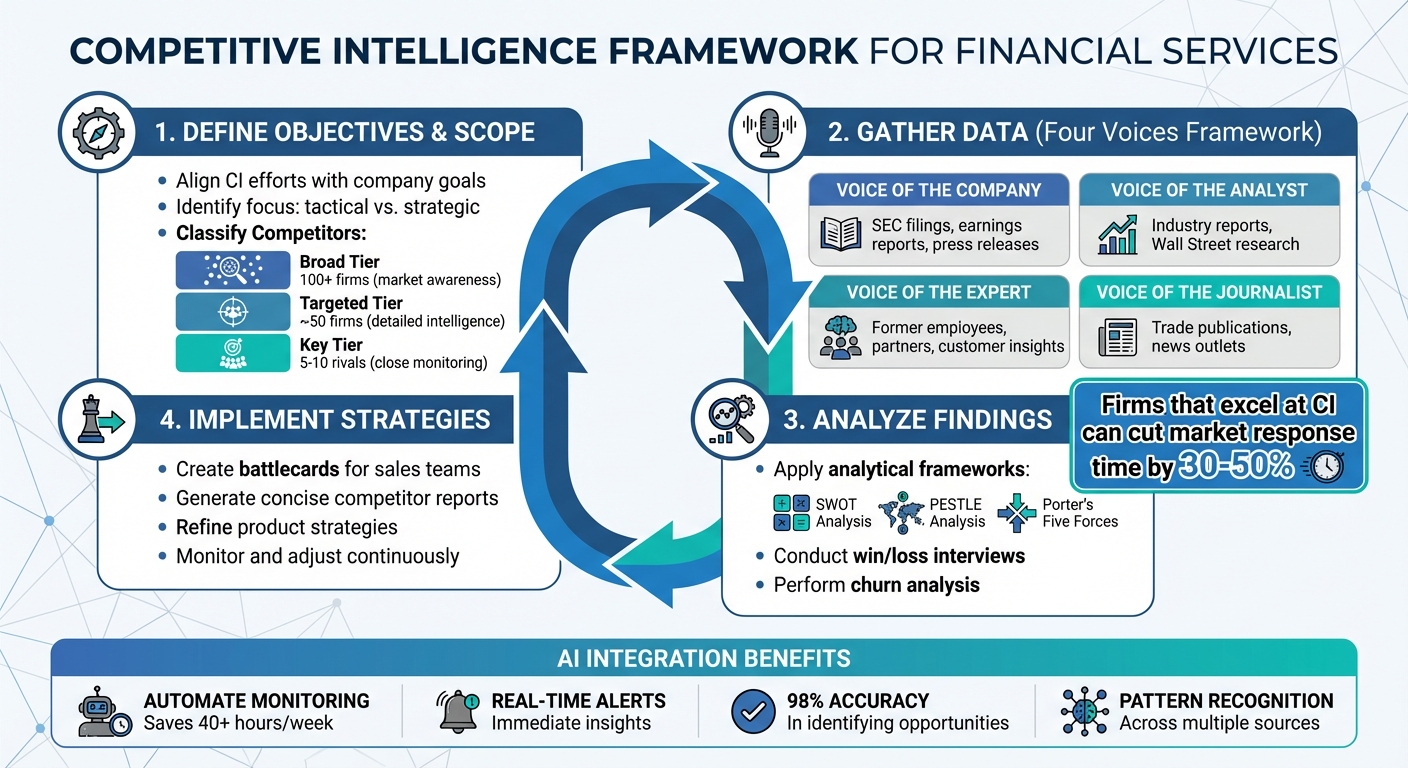
Competitive Intelligence Framework: 4-Step Process for Financial Services
Creating a competitive intelligence framework hinges on three main pillars that transform raw market data into actionable strategies. Each component plays a crucial role in helping financial services firms anticipate market changes and outmaneuver competitors.
Start by identifying both direct and indirect competitors. In financial services, direct competitors offer similar products to the same target audience, while indirect competitors, such as fintech apps, tackle comparable customer pain points in different ways [6]. For example, traditional banks contend not just with other banks but also with digital challengers disrupting the space [5].
A practical way to approach this is by organizing competitors into three tiers [3]:
This tiered method ensures teams aren’t bogged down by excessive data while prioritizing attention on the most impactful competitors.
"The big purpose behind doing one of these [landscape analyses] is supporting our SLT's decision-making. This isn't just about understanding strengths and weaknesses – it's about charting our course..." – Hunter Sones, Competitive Enablement Manager, Klue [6]
Once the competitive landscape is mapped, distinguish between short-term tactical moves and broader, long-term trends. Use systematic data collection to quantify these insights effectively.
Gathering intelligence requires a structured approach. The "Four Voices" framework provides a comprehensive way to collect data from different perspectives [3][7]:
To make sense of this data, apply analytical frameworks like SWOT, PESTLE, or Porter's Five Forces. These tools help uncover competitors' strengths, vulnerabilities, and market dynamics [3][6][7][10].
The true value of competitive intelligence lies in turning insights into actionable strategies. Use the gathered intelligence to create tools like battlecards, concise reports, and customer interview summaries that can sharpen sales and product strategies [8][9]. For example, product teams can simulate potential competitor responses to planned initiatives, refining their approach before launch.
"Competitive intelligence done right is a powerful growth lever for any organization." – Competitive Intelligence Alliance [9]
Win/loss interviews with customers are particularly revealing. These conversations can uncover why prospects choose competitors, highlighting product gaps or service shortcomings. They also help identify indirect competitors that traditional CRM systems might miss [9].
To stay ahead, adopt an ongoing cycle: define objectives, gather data, analyze findings, and implement strategies [9]. Firms that excel at this process can cut their market response time by 30–50% [4], transforming competitive intelligence from a reactive necessity into a proactive tool for growth.
A well-structured competitive intelligence (CI) framework transforms scattered data into actionable strategies. For financial services, this means staying ahead of competitors who rely on inconsistent or ad hoc methods.
Begin by clarifying the purpose of your CI efforts. Are you aiming to refine product strategies, explore new markets, or analyze emerging fintech innovations? Tie these objectives directly to your company’s broader goals from the start. Amelia Wilson from the Competitive Intelligence Alliance highlights this approach:
"By aligning your CI efforts with company objectives from the get-go, you can transform competitive insights from a nice-to-have into the lifeblood of your organization" [9].
Start with an internal review of your ideal customer profile (ICP), value propositions, and product limitations [6]. This step helps eliminate internal bias. Next, classify competitors into tiers, prioritizing immediate threats and avoiding data overload - especially critical as global data volumes are expected to reach 181 zettabytes by 2025 [3].
Decide whether your focus will be tactical (e.g., pricing and marketing) or strategic (e.g., macroeconomic trends and regulatory shifts) [3]. For financial services, regulatory intelligence is essential. Track compliance strategies and legislative changes that could impact your organization’s financial standing [11]. Establish a weekly update schedule to ensure consistent and reliable insights [10].
Once objectives are defined, the next step is identifying key competitors and the data sources that will power your intelligence framework.
Competitors can be grouped into three categories:
To manage the data flow effectively, organize competitors into three tiers:
This tiered approach keeps your team focused on critical threats without getting bogged down by excessive data.
Use the "Four Voices" framework to collect well-rounded intelligence:
Additionally, CRM data and call recordings can help identify emerging fintech threats [6]. Hunter Sones, Competitive Enablement Manager at Klue, emphasizes the importance of churn analysis:
"Churn analysis is unbelievably helpful when it comes understanding your adjacent competitors because people who leave your product know it intimately –– they understand your value prop and limitations, so their next choice tells you a lot" [6].
Monitor competitors’ hiring trends on LinkedIn and job boards to spot potential expansion plans. Track their digital presence - app updates, social media activity, and online advertising - to gauge their market strategies. For retail financial services, review platforms like G2 or Capterra can reveal customer pain points related to competitors’ products or services [6].
With competitors and data sources mapped out, the focus shifts to monitoring and benchmarking their strategies for actionable insights.
Divide monitoring efforts between tactical aspects (e.g., pricing, marketing campaigns) and strategic insights (e.g., industry trends, regulatory developments) [3]. Instead of organizing competitors solely by name, group them by product capabilities (e.g., wealth management, retail banking, or digital payments) to uncover niche threats [6].
Automate alerts for SEC filings, marketing updates, and earnings calls. This can reduce monitoring time to just one hour per week [2][3].
To benchmark performance, use tried-and-true frameworks:
Create battlecards - concise summaries of competitor strengths, weaknesses, and key objection-handling points - for your sales team to reference during prospect calls [2][9].
Finally, conduct win-loss and churn interviews to gain direct feedback from buyers. These conversations provide valuable insights into why customers chose competitors or discontinued your service, shedding light on competitor strengths and areas for improvement [6].
AI has transformed the traditionally slow and tedious process of competitive intelligence (CI) into a real-time, dynamic strategy. Instead of relying on outdated reports that take weeks to compile, AI processes vast amounts of data in minutes, uncovering patterns that might otherwise go unnoticed. For financial services firms, this means the ability to monitor dozens of competitors across multiple product lines with unprecedented efficiency [12].
These tools automate tasks like tracking competitor website updates, pricing changes, and job postings, which can reveal expansion plans. Machine learning further enhances CI by analyzing win-loss interviews and sales call recordings, identifying recurring themes and sentiment patterns. This allows businesses to act quickly on critical insights [6][12]. With AI, the groundwork is laid for a more integrated and responsive approach to competitive intelligence.
Visora's Trifecta Program is a prime example of how AI can be harnessed to drive competitive advantage. Designed for U.S. financial and real estate B2B leaders, the program integrates three key components into a single, streamlined conversion engine:
Visora’s framework boasts a 98% accuracy rate in identifying qualified opportunities and has generated over $127.15 million in pipeline for its clients. Firms using the Trifecta Program report deal cycles that are over 50% shorter and save more than 40 hours per week by eliminating manual research and administrative tasks [13]. These results highlight how AI integration can revolutionize competitive positioning in the financial sector.
AI significantly enhances CI by replacing outdated, manual methods with dynamic, real-time systems. Traditional approaches often rely on static reports and lengthy data collection processes, while AI-enabled tools pull from a variety of sources - such as intent signals, CRM systems, and real-time digital monitoring - to deliver actionable insights [12].
| Method | Data Sources | Speed | Outcomes |
|---|---|---|---|
| Manual | Manual research, market reports | Slow | Limited and static |
| AI-Augmented (e.g., Visora) | Multi-channel data | Fast | Dynamic and high-impact |
AI-powered SWOT analysis takes the guesswork out of strategy by using objective data from customer feedback and market trends. Automated sentiment analysis reveals competitor weaknesses, helping refine objection-handling strategies. Real-time alerts keep you informed about competitor pricing changes, product launches, or shifts in messaging - allowing you to respond immediately instead of waiting for quarterly updates [12].
"In 2025, competitive analysis is not just an option - it's a necessity. Banks that embrace AI-driven insights will be the ones leading the financial industry" [5].
The real strength of AI lies in combining its data-processing capabilities with human expertise. While AI excels at gathering and analyzing data, your team’s judgment is crucial for making strategic decisions. To get the most out of AI, focus on answering specific questions like, "Where are the pricing gaps?" or "How do competitors position themselves against us?" This ensures your data collection remains targeted and actionable [12].
Competitive intelligence should deliver measurable returns, such as increased revenue and expanded market share. Let’s explore the key performance indicators (KPIs) that validate these efforts.
One of the clearest indicators of competitive intelligence effectiveness is your win rate. This metric, calculated by dividing won deals by lost deals, provides a direct measure of how well your strategies are working against competitors[14]. In industries like financial services, tracking the competitive revenue gap - which highlights revenue lost to specific rivals - can offer even deeper insights[6].
Revenue attribution is another vital metric. By linking new customer acquisitions and upgrades directly to intelligence-driven strategies, you can assess the financial impact of your efforts[14]. Early-stage indicators, such as trials, demos, and product page views, also provide clues about whether your positioning is resonating with potential customers[14].
Customer retention is equally important. You can calculate retention using this formula:
(Customers at end of period – New customers acquired) / Customers at start of period[14]. Pair this with churn analysis to identify why customers might be leaving and how competitive intelligence could address those issues[6].
For a broader perspective, tracking market share is essential. Regularly reporting both current and projected market share helps you evaluate growth relative to competitors and the total addressable market[14]. Internally, it’s also important to measure how often teams - like sales, product, or leadership - are using competitive intelligence tools and reports. This reflects how well the insights are being integrated into decision-making processes[14].
"The goal for strategic intelligence is not to collect market information, but to use that information to generate insights that in turn support ever-changing perspectives." – Harvard Business Review[14]
While short-term metrics are crucial, maintaining a focus on the long game is equally important. Building a lasting competitive edge means using intelligence to anticipate market shifts before they happen. Strategic competitive intelligence delves into broader industry trends, economic factors, and competitor motivations to identify potential changes in the landscape[3]. This proactive approach goes beyond simply reacting to competitors - it equips you to adapt to structural shifts in the market.
Continuous competitive benchmarking is key to understanding where your organization is gaining or losing ground over time. By consistently comparing performance against rivals, you can identify areas for improvement or celebrate sustained growth[3].
Tools like the BCG Growth-Share Matrix can help you visualize the long-term health of your product portfolio. By plotting products based on market growth rates and relative market share, this framework simplifies resource allocation decisions and ensures your strategies align with market realities[6].
Lastly, win/loss and churn analysis provide insights that raw market share data might miss. These analyses help you understand shifts in customer preferences and competitor positioning, ensuring your strategies remain relevant and effective[6]. Together, these measures create a feedback loop that continuously refines your competitive intelligence efforts.
Competitive intelligence has shifted from being a "nice-to-have" to an essential strategy for financial services firms navigating today’s unpredictable markets. With fintech disruptors and tech giants like Apple and Google reshaping the industry, traditional institutions can no longer rely on reactive approaches[3][5]. The firms that succeed are those that move beyond analyzing past trends - what some call "competitive archaeology" - and embrace forward-looking strategies that anticipate market changes before they happen[3][12].
To build an effective competitive intelligence framework, start by identifying 3-5 key questions to guide your efforts. For example, ask, "What pricing gaps exist in our lending products?" or "Which competitors are expanding into our target markets?"[12]. From there, establish a repeatable process: Define your objectives, Gather data from a variety of sources, Analyze it using tools like SWOT or Porter's Five Forces, and Implement actionable insights like sales team battlecards[9]. The goal is to transform static reports into dynamic, real-time intelligence that supports proactive strategies.
With data volumes projected to hit 181 zettabytes globally by 2025, AI-powered tools have become indispensable[3]. These platforms streamline data collection and analysis, saving time and reducing errors[1][7]. Companies like Visora, mentioned earlier, exemplify how AI-augmented solutions can deliver results. In just 45 days, Visora helped clients uncover $50 million in partnership opportunities and generate project pipelines worth over $2.25 million.
To summarize, the following steps are critical for leveraging competitive intelligence effectively: monitor competitors strategically, automate data collection, and turn insights into actionable reports that drive decision-making[3][9].
"Competitive intelligence done right is a powerful growth lever for any organization." – Competitive Intelligence Alliance[9]
AI is transforming competitive intelligence in the financial services sector by enabling firms to process and analyze massive amounts of data in real time. This capability helps organizations spot market trends, understand competitor strategies, and adapt quickly to changes, keeping them ahead in an ever-shifting industry.
Through AI, financial firms can uncover patterns and insights that traditional methods might overlook. Advanced tools provide a clearer view of customer behavior, highlight new market opportunities, and identify potential risks. This empowers businesses to make smarter, data-driven decisions with confidence.
A tiered approach to competitor analysis gives financial services firms a structured way to prioritize competitive insights. By organizing competitors into tiers - based on factors like market influence or perceived threat - firms can allocate their resources more effectively, focusing on the most impactful players while still keeping an eye on the broader industry.
This approach also offers a clearer picture of the competitive landscape. Breaking competitors into categories such as direct rivals, up-and-coming challengers, or established market leaders helps uncover their strategies, strengths, and weaknesses. With this knowledge, firms can develop more focused strategies that adapt to shifts in the industry.
On top of that, the tiered method promotes ongoing, scalable monitoring. It enables firms to track significant changes across different competitor groups without becoming overwhelmed, which is crucial in the fast-moving financial market. This way, businesses can maintain their edge and respond quickly to emerging trends or threats.
Financial services firms can measure the return on investment (ROI) of their competitive intelligence (CI) efforts by focusing on clear, measurable outcomes that impact both revenue and operational efficiency. Metrics like Customer Acquisition Cost (CAC), Customer Lifetime Value (CLV), and Net Revenue Retention (NRR) are particularly useful for determining how well CI supports acquiring and retaining clients. Additionally, tracking improvements in areas like sales cycle length, conversion rates, and monthly recurring revenue (MRR) can provide insight into efficiency gains achieved through CI.
It’s also important to evaluate how CI influences strategic decisions, such as entering new markets, refining product positioning, or shaping marketing campaigns. For example, CI insights might uncover new opportunities or help reduce risks, leading to faster deal closures, higher sales, or stronger client relationships. By regularly reviewing these metrics, firms can clearly quantify the impact of their CI efforts and make smarter decisions about where to allocate resources in the future.
%20(5).png)
