%20Bold.png)

Cross-channel messaging is critical for B2B success in today’s digital-first world. Buyers engage with over 10 channels before contacting sales, and campaigns using 3+ channels perform 494% better than single-channel efforts. Consistency across platforms - email, LinkedIn, ads, and more - builds trust, shortens sales cycles, and drives higher conversion rates.
Key insights:
This guide breaks down how to align messaging, connect data, and leverage tools like AI and intent signals to create a unified buyer experience.
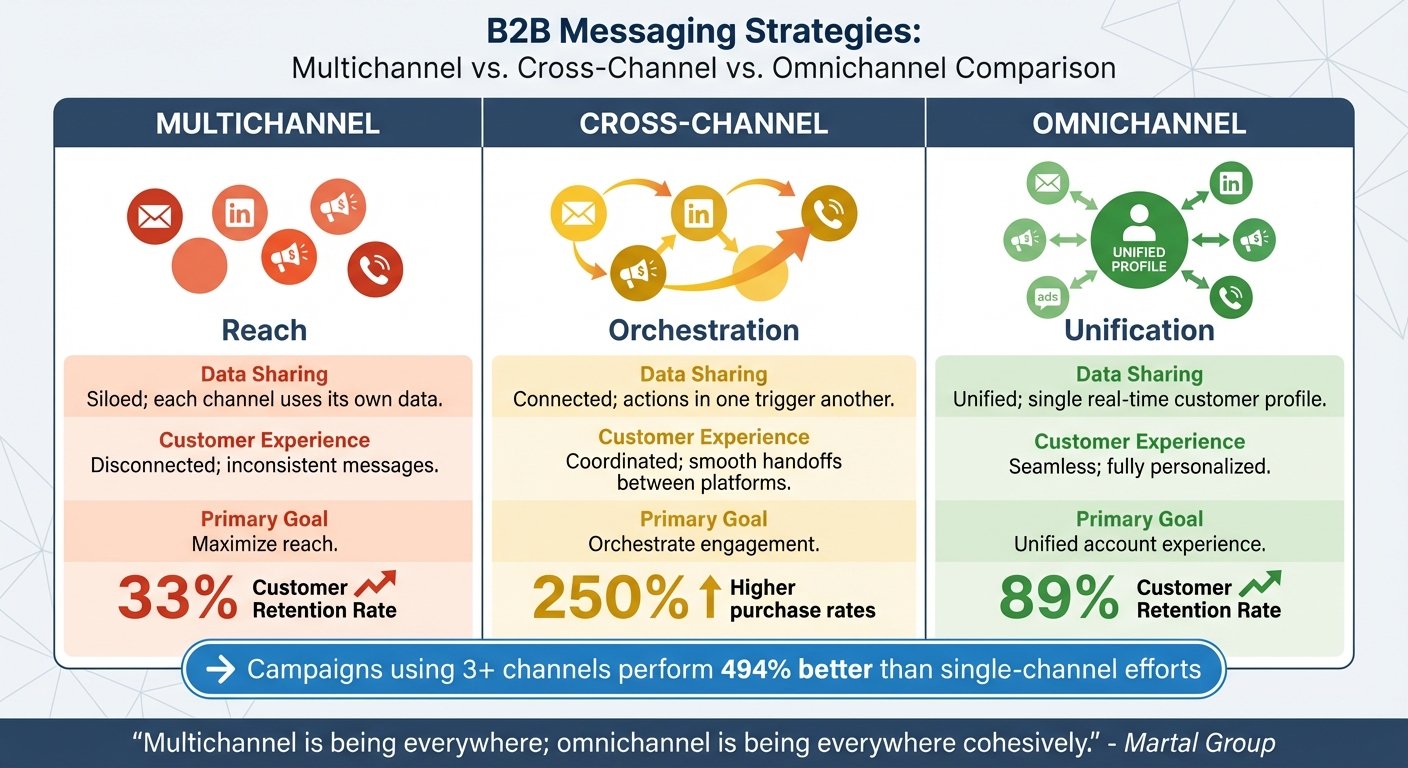
Multichannel vs Cross-Channel vs Omnichannel Messaging Strategies Comparison
Multichannel messaging involves running separate campaigns across different platforms, where each channel works independently with its own data and objectives [5][7].
Cross-channel messaging, on the other hand, creates a more connected approach. For example, if a prospect downloads your eBook, it might trigger a LinkedIn ad tailored to them, or a visit to your pricing page could notify your sales team. In this model, channels share data, allowing each interaction to build on the last [5][1].
Omnichannel messaging takes this a step further by maintaining a single, real-time customer profile that updates across all touchpoints [5][1]. This means the entire buyer journey - from their first website visit to closing a deal - is stored in one unified system, accessible to everyone on your team.
B2B purchases are rarely made by a single individual. Instead, they involve committees of 14–23 stakeholders, each with their own priorities and preferred platforms [5]. For instance, your CFO might be active on LinkedIn, your CTO might prefer technical blogs, and your VP of Operations might engage through webinars. Without consistent messaging across these channels, you risk delivering fragmented communication to these decision-makers.
"Multichannel is being everywhere; omnichannel is being everywhere cohesively." - Martal Group [4]
These distinctions are key to understanding the complex and non-linear journey of B2B buyers.
B2B buyers don’t follow a straight, predictable path. They move across platforms, often completing much of their research before ever contacting your sales team [10][4]. One day they might read your LinkedIn post; the next, they’re downloading a whitepaper, exploring product reviews, attending a webinar, and checking your pricing page - all before scheduling their first call.
67% of the B2B buyer’s journey happens digitally before they reach out to vendors [10]. Buyers are busy researching, comparing options, and building internal consensus. Each stakeholder approaches this differently: the CFO might focus on financial case studies, the IT director might dive into technical forums, and end-users might watch product demos or read customer reviews.
In 2025, Schneider Electric implemented a multi-channel account-based marketing (ABM) strategy. By coordinating their messaging across platforms and tailoring content to specific roles - whether through email, LinkedIn, or live events - they influenced revenue for 21% of their target accounts and sped up their sales pipeline [5].
Another trend is the rise of self-service. Buyers now divide into three groups: one-third prefer in-person meetings, another third favor remote interactions like video calls, and the last third prefer a fully digital, self-service experience, avoiding human contact until they’re ready [10]. Your messaging strategy needs to align with all these preferences.
Consistent messaging doesn’t just improve the buyer’s experience - it also drives growth. Campaigns using three or more channels see 250% higher purchase rates than single-channel efforts [5]. Companies with strong cross-channel integration retain 89% of their customers, compared to only 33% for those with weak integration [10][4].
Consistency builds trust, especially during long buying cycles. When your messaging is aligned across email, LinkedIn, sales calls, and demos, your brand appears professional and well-organized [9][7]. On the flip side, inconsistency frustrates buyers - 87% report being annoyed when they have to repeat information across channels [1].
| Strategy | Data Sharing | Customer Experience | Primary Goal |
|---|---|---|---|
| Multichannel | Siloed; each channel uses its own data [5] | Disconnected; inconsistent messages [1][4] | Maximize reach [5] |
| Cross-Channel | Connected; actions in one trigger another [5] | Coordinated; smooth handoffs between platforms [1][4] | Orchestrate engagement [5] |
| Omnichannel | Unified; single real-time customer profile [1] | Seamless; fully personalized [1][5] | Unified account experience [5] |
These insights highlight why integrating messaging across touchpoints is essential.
In 2025, Black Hills AI revamped their HubSpot CRM to eliminate data silos and connect cross-channel interactions. This reduced manual CRM tasks from 5 hours a day to just 2, saving 15–20 hours weekly. The extra time was redirected toward active sales conversations [7].
"Success isn't about using more channels. It's about integrating the channels you're already using into an omnichannel lead generation system." - Michael Maximoff, Co-founder, Belkins [7]
The numbers speak for themselves: buyers who engage across multiple channels spend 30% more on average [6]. Coordinated campaigns also shorten sales cycles by 23% [5]. And with 80% of B2B sales interactions projected to occur digitally by 2025 [4], mastering cross-channel messaging is key to staying competitive.
A strong messaging framework begins with a brand messaging audit. Take a close look at how your team communicates across marketing, sales, and customer service. Are there inconsistencies? For instance, does your website say one thing while your sales deck or LinkedIn posts say something entirely different? Identifying these gaps is the first step to creating a unified approach [2].
Next, define 3-5 core messaging pillars that highlight your unique benefits. These aren't catchy slogans or taglines - they're the foundational themes that shape all your content, from blog posts to sales calls [2]. These pillars should tie directly to your value proposition and address the specific challenges your buyers face.
In B2B sales, decisions often involve multiple stakeholders, each with their own priorities. For example:
Instead of using generic messaging, align your communication with the unique concerns of each role. Once your message pillars are in place, adapt them for specific channels to ensure they resonate with your audience.
With your unified messaging framework as a foundation, customize your communication for each channel based on its strengths and audience expectations. For example:
Consistency across channels is key. To achieve this, you’ll need reliable tools and processes to keep everyone aligned.
A brand style guide is a must-have. Beyond logos and fonts, include a detailed section on your brand’s "voice" - specific terms to use (or avoid). This is especially important in industries like financial services, where certain language might have legal implications [2].
Set up a shared content library where your team can access approved assets, such as case studies, email templates, slide decks, and social posts. Platforms like HubSpot or Marketo can simplify this by storing templates in one place and automating sequences [1][2].
A cross-functional calendar can help synchronize messaging initiatives. For instance, if your blog post, email campaign, LinkedIn ads, and sales outreach are all aligned around the same theme, your brand will come across as polished and professional [2]. Regular strategy meetings between sales, marketing, and customer service teams ensure everyone stays on the same page. This is crucial because 87% of consumers get frustrated when they have to repeat information across channels [1].
"A seamless, unified brand experience is needed to build brand recognition, establish trust, and enhance marketing efficiency." - Melissa Proulx, Content Strategist, Conveyor Marketing Group [2]
Some companies are even experimenting with custom GPTs trained on their brand voice and messaging pillars. This allows them to scale content production while maintaining consistency [2]. Whether you use AI or stick to traditional methods, the goal remains the same: ensure every team member delivers a clear and consistent message.
B2B buyers move through the Awareness, Consideration, and Decision stages using different channels. Your task? Pinpoint the most relevant channels for each stage and create workflows that align with buyer behavior[13].
In the Awareness stage, prospects are exploring their challenges. This is where educational content shines - think blog posts, LinkedIn thought leadership, and retargeting ads. During the Consideration stage, they’re weighing their options. Case studies sent via email can help tip the scales in your favor. By the time they hit the Decision stage, it’s all about direct engagement. Personalized calls, demos, and tailored outreach are key.
Here’s a twist: B2B purchases often involve around 22 stakeholders[13]. Your workflows must cater to everyone in the buying committee. For instance, while the CFO might need ROI-focused data, the IT director will want technical specs.
"Any key decision-maker that you ignore becomes your biggest objection inside the company." - Jeffrey Lupo, Belkins[7]
Take Terrascope, for example. In 2025, they identified four key personas and created tailored messages for each. The Chief Strategy Officer (CSO) received content focused on strategic visibility, while the CFO got materials addressing financial risk. This approach doubled their sales-ready meetings in Q3[7].
Once you’ve mapped customer stages, it’s time to assign roles to your channels. Each one has a job to do:
The magic happens when these channels work together. For example, a LinkedIn connection could trigger a follow-up email, or a visit to your pricing page might notify your sales team to act. Businesses using this integrated approach see 50% more sales-ready leads at 33% lower costs[12][13] and enjoy 63% higher response rates compared to single-channel strategies[12].
Forget old-fashioned "handoffs" between teams. Instead, create real-time feedback loops where sales and marketing share a single CRM, ensuring every touchpoint is visible and actionable.
Start small. Focus on 3–5 core channels where your audience is most active. A good starting trio? LinkedIn, Email, and Retargeting. Master these before branching out.
With your channels connected, AI and intent data take your workflows to the next level. AI analyzes cross-channel behavior in real time, constantly fine-tuning your lead nurturing efforts. Predictive lead scoring uses machine learning to update priorities every 6 to 24 hours based on engagement patterns[12]. When paired with AI-driven personalization, this can triple conversion rates by responding to behavioral triggers[12].
Intent data helps you spot when prospects are actively researching solutions. First-party intent (from your website or CRM) shows direct interest in your brand. Meanwhile, third-party intent (from publisher networks) highlights broader research activity[14]. For instance, multiple visits to your pricing page in a single week or simultaneous engagement from several team members at the same account are strong buying signals.
These insights can trigger immediate, relevant responses. A whitepaper download might lead to a LinkedIn connection request, followed by a personalized email series. Similarly, webinar attendance could prompt your sales team to schedule a call within 48 hours. This replaces cold outreach with timely, meaningful interactions.
One challenge? 87% of B2B teams struggle with unreliable intent signals, and only 26% of those signals turn into real opportunities[14]. The solution: Combine AI’s pattern recognition with human judgment. Let AI highlight promising leads, then have your team validate them before diving deeper. Companies with strong omnichannel strategies retain 89% of their customers, compared to just 33% for those without[13][4].
To make the most of AI and intent insights, your systems need to integrate data seamlessly and track performance effectively. Without a centralized data source, cross-channel strategies often fall apart. While 88% of businesses understand the importance of having a consistent view of customers across all channels, only 15% have managed to achieve this goal so far[15]. The main challenge? Data is scattered across disconnected systems.
The answer lies in identity resolution. This technology connects data points from tools like your ESP, SMS platform, and ad systems into one unified customer profile. It works through deterministic matching (using exact identifiers like email addresses or customer IDs) and probabilistic matching (analyzing behavioral patterns and device data)[15].
A great example of this in action is Jersey Mike's. By integrating the Segment CDP with digital analytics and Iterable for campaign execution, they synced messaging across email, SMS, and push notifications, all based on real-time customer behavior. This approach led to a doubling of online orders[15]. With unified data, businesses not only simplify operations but also improve real-time decision-making[1][3].
"I fundamentally think that if you're going to be sending emails and SMS, they have to know what each other are doing." – Jonathan Guez, CTO, Sunrise Brands[19]
For a robust cross-channel strategy, your tech stack should include three core components: a CRM (like Salesforce or HubSpot), a Customer Data Platform (CDP) such as Segment or Simon Data, and multi-touch attribution software like Dreamdata[15][17][20]. Each plays a specific role: the CDP unifies customer profiles through identity resolution, the CRM manages customer relationships, and attribution software pinpoints which touchpoints drive revenue.
ASOS provides a compelling example of this setup. By transitioning from siloed email service providers to Simon Data's unified CDP and orchestration engine, they generated $77.5 million in additional revenue. This shift enabled them to create coordinated customer journeys across multiple channels[17].
Orchestration engines are particularly powerful when they use shared triggers. For instance, an email open might trigger a follow-up call task, creating a seamless customer experience across platforms. Yet, 62% of brands still struggle with delayed campaign launches due to siloed data and rigid systems[16]. A strong data foundation is critical for eliminating these delays and maximizing the effectiveness of your tech stack.
Relying on last-click attribution alone won't cut it - especially in B2B settings where the average deal spans 211 days, involves 76 touchpoints, and crosses 3.7 channels[8]. Multi-touch attribution (MTA) offers a more accurate picture, with models like the "U-Shaped" approach assigning 40% credit to the first touch, 40% to the last touch, and 20% to the interactions in between[18].
Companies that adopt advanced cross-channel attribution often see a 15% to 20% boost in marketing budget efficiency[17]. But for attribution to work, tracking every touchpoint is essential. Consistently applying UTM parameters on all external links - whether in ads, emails, or social media posts - ensures accurate data collection[18].
Snyk, a security platform, offers a standout example. In 2025, they implemented a multi-channel strategy for 50 Account Executives, using Prospeo for data validation. By maintaining 98% email accuracy and refreshing their data every seven days, they slashed bounce rates from 35% to under 5% and increased their AE-sourced pipeline by 180%[8]. This highlights the importance of clean, reliable data - it’s the difference between guessing and knowing what’s driving results.
Key performance metrics to monitor include Lead-to-Opportunity Conversion Rate, Opportunity Win Rate, and Pipeline Created (measured in revenue value)[20]. These metrics reveal whether your cross-channel efforts are making a measurable impact.
Cross-channel messaging brings all your conversations together, no matter the platform. Campaigns that use three or more coordinated channels see 250% higher conversion rates compared to single-channel efforts[4]. Plus, customers who engage across multiple channels tend to have a 30% higher lifetime value[4]. These stats highlight how crucial it is to have deliberate, well-coordinated messaging.
The backbone of this success lies in having a single source of truth to guide every interaction. Unified data is what turns scattered channels into a smooth, cohesive strategy. For example, Terrascope doubled their sales-ready meetings by identifying four key personas and delivering tailored content across more than 60 touchpoints[7]. Similarly, Snyk achieved 98% email accuracy through weekly data updates, leading to a 180% increase in their AE-sourced pipeline[8].
AI and intent signals are also changing the game by refining engagement in real time. Predictive lead scoring now refreshes every 6 to 24 hours[14], and intent-based triggers help teams connect with high-value leads within just five minutes of engagement[21]. But here's the key: AI is a tool to enhance human efforts, not replace them[22]. Use it to draft email sequences or uncover patterns, but always layer in the human touch that builds genuine relationships.
Moving from multichannel chaos to cross-channel harmony requires careful planning. Start by mapping your customer journey across at least 12 touchpoints, tailoring content to each role in the buying committee. Automate processes like pause rules - so, for instance, a LinkedIn reply automatically halts email sequences[21]. As McKinsey puts it, "the shift to omnichannel in B2B is now 'the predominant path' for winning sales"[4].
To get started, focus on one improvement: unify your data, map a single buyer journey, or set up intent-based triggers. Coordinated touchpoints are the foundation for creating a seamless, measurable pipeline that drives growth.
To get started with cross-channel messaging using three platforms, here’s a straightforward plan:
This method keeps things simple while helping you reach a broader audience effectively.
To communicate effectively with stakeholders in a buying committee, it's crucial to maintain a consistent message across all channels while addressing their individual priorities. Start by leveraging shared insights from the customer journey and aligning on reliable data to ensure clarity and avoid mixed signals.
Tailor your communication to each stakeholder's role and goals - whether they're focused on budget, technical details, or long-term value. By coordinating messaging that connects with their specific needs, you can create a sense of trust and unity. This approach helps guide the entire committee toward making a collective, confident decision.
To keep your channels working in harmony and avoid creating silos, centralize your customer data with a Customer Data Platform (CDP). A CDP pulls together customer profiles into a single, unified view, making it easier to deliver consistent messaging across platforms. Pair this with tools that allow real-time data sharing and marketing automation to keep your campaigns aligned. The result? Smoother communication, fewer silos, and a better experience for your customers as all your channels work together seamlessly.
%20(5).png)
