%20Bold.png)
B2B buyers use over 10 channels during their purchasing journey, and 94% prefer omnichannel approaches. Businesses that integrate multiple touchpoints see 287% higher purchase rates compared to single-channel efforts. To stay competitive, you need a plan that connects data, personalizes outreach, and aligns marketing with sales.
Here’s a quick breakdown of the five key strategies to improve B2B lead generation:
These strategies ensure you're engaging buyers at the right moments with the right message, helping shorten sales cycles and drive better results.
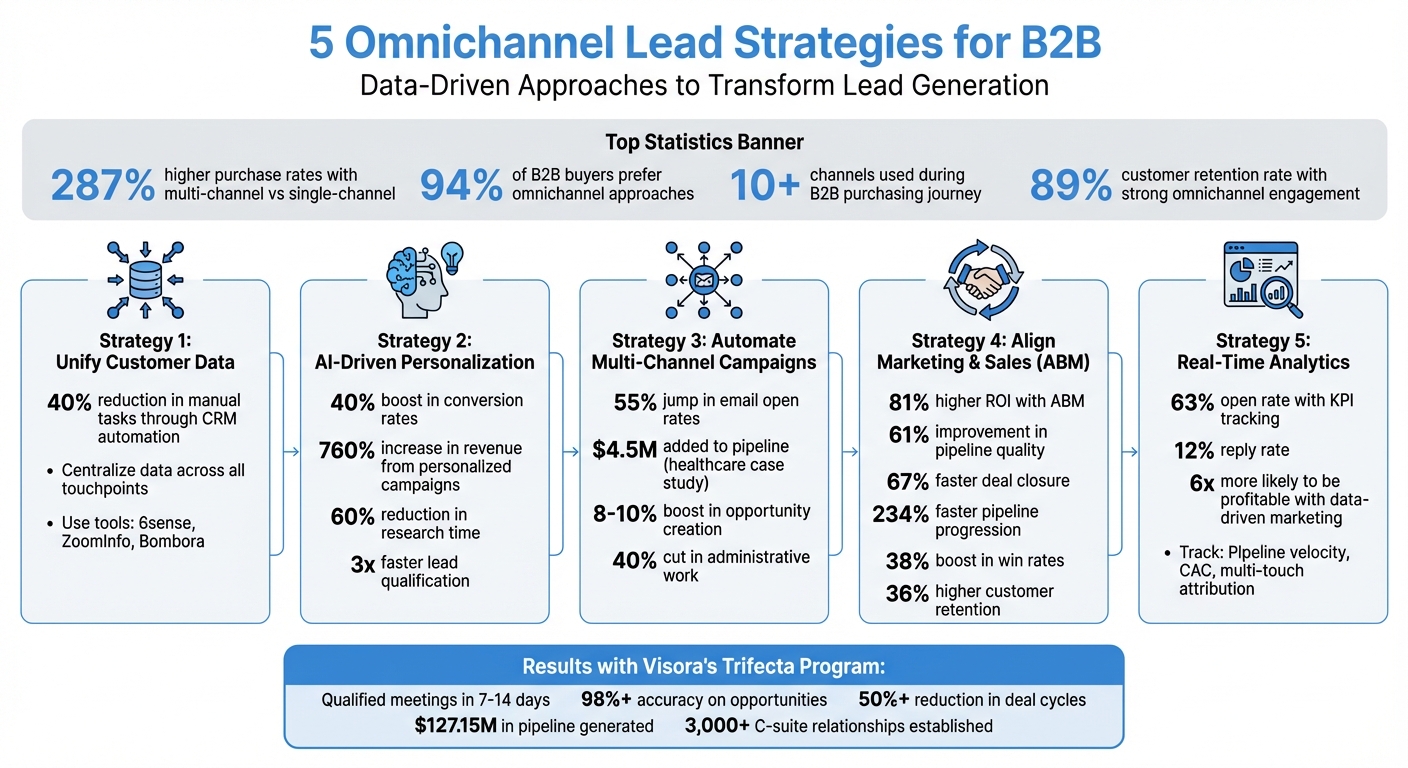
5 Omnichannel Lead Strategies for B2B Success - Key Statistics and ROI
Bringing customer data together is the backbone of a seamless omnichannel experience. Your CRM should act as the single source of truth for every interaction you have with prospects. If your lead data is scattered across different platforms, it’s almost impossible to keep track of customer touchpoints. By centralizing all lead data in a powerful CRM and linking it to tools like Salesloft, Outreach.io, or Marketo, you ensure real-time synchronization. This way, marketing won’t waste time targeting leads that have already closed [8][4]. Centralizing your data lays the groundwork for actionable insights and consistent communication.
"If it's not logged in CRM, it didn't happen." – SalesAR [4]
Once your data is centralized, the next step is to standardize how you collect it across all touchpoints. Enrich these records with third-party intent data from platforms like 6sense, Bombora, or ZoomInfo. These tools reveal which accounts are actively researching solutions, helping your team focus on high-intent prospects rather than wasting time on cold leads [4].
The benefits are clear. Automating your CRM processes can reduce manual tasks by 40%, giving your team more time to focus on selling instead of tedious data entry [1]. Tools like Dreamdata provide a comprehensive view of the buyer’s journey, tracking user behavior across the funnel [2][3]. When a prospect interacts with key touchpoints, your system can flag them as high-priority, enabling your team to act quickly.
Don’t overlook data hygiene. Regular audits of your domain health and email deliverability are critical. Tools like Folderly or MailReach can help ensure your email campaigns reach the right inboxes [4]. Outdated or duplicate data doesn’t just waste resources - it can harm your reputation if you send conflicting messages or reach out to the wrong person.
With a unified data system in place, you’re better equipped to fine-tune your strategies for each channel and drive meaningful engagement with your leads.
AI is changing the game when it comes to connecting with prospects. By analyzing individual data points, it helps you craft messages that really resonate. Forget those one-size-fits-all pitches - AI allows you to tailor your approach based on each prospect's behavior and preferred communication channel. For instance, if you're targeting a CFO on LinkedIn, you might highlight cost-saving strategies. Meanwhile, that same CFO could receive ROI-focused content in their email inbox [10]. And here’s the kicker: personalized, AI-driven outreach can boost conversion rates by 40% [10].
AI doesn’t stop there. It tracks engagement in real time and automatically adjusts the next steps. Let’s say a prospect ignores three emails - AI might then prompt a customized LinkedIn connection request [10]. It even uses sentiment analysis to interpret tone and intent, like detecting interest in pricing, and adjusts follow-ups accordingly [10].
"AI is a co-pilot, not a replacement. Prospects can tell when every word is machine-written." - SalesAR [4]
This approach blends personalization with automation, creating a scalable system that still feels human.
While personalized messaging drives engagement, automation ensures you can scale those efforts without breaking a sweat. AI can qualify leads three times faster than traditional methods, slashing research time by 60% [10]. Tools like AI-powered chatbots work around the clock, handling initial interactions and qualifying prospects with smart questions about budgets and timelines [10]. This frees up your team to focus on closing deals instead of sifting through unqualified leads.
AI also uses machine learning to spot patterns in customer behavior, helping predict which prospects are ready to convert. For example, if someone visits your pricing page multiple times, AI might immediately suggest offering them a personalized demo [4]. And the results speak for themselves: companies using segmented, personalized email campaigns have reported a 760% increase in revenue [4].
The trick is knowing where to draw the line. Use AI for the heavy lifting - like research and basic qualification - but hand off complex, high-value accounts to your sales team when nuanced objections or detailed discussions come into play [10].
Automating campaigns across various channels takes personalized outreach to the next level by making it scalable. Instead of juggling tasks like manually sending emails, scheduling LinkedIn posts, or tracking responses across platforms, automation handles these repetitive activities. This frees up your team to concentrate on strategy and closing deals.
AI and machine learning play a key role here, enabling tailored content delivery on a large scale. For instance, in 2022, a nationwide healthcare provider used 6sense's AI Email Assistant to automate personalized email campaigns. The results? A 55% jump in email open rates and an additional $4.5 million added to their net-new pipeline in just two months [8].
Automated lead scoring further enhances efficiency by analyzing engagement data to pinpoint high-value prospects. Companies employing high-intent automation strategies report an 8% to 10% boost in opportunity creation from marketing-qualified leads [8]. Zendesk achieved similar success with 6sense by targeting enterprise-level accounts in the "Decision" or "Purchase" stages. They personalized outreach based on search keywords and website activity, driving impressive results [8].
But for automation to truly shine, it’s crucial to align data across all channels for consistent and non-redundant messaging.
Without centralized data, prospects may end up receiving duplicate messages, and sales teams might lack the insights they need to engage effectively. Real-time syncing between platforms like Salesloft or Outreach (for sales engagement) and tools like HubSpot or Marketo (for marketing automation) solves this problem. For example, GPC Real Estate transitioned from manual spreadsheets to an automated HubSpot CRM system. As a result, they scaled investor operations without adding staff and cut administrative work by 40% [1].
This level of integration not only streamlines workflows but also lays the groundwork for refining campaign performance through ongoing testing and adjustments.
Automation tools make it easy to set up A/B tests for subject lines, calls-to-action, and content variations, optimizing campaigns without requiring constant manual oversight [11]. These tools automatically identify the best-performing versions and allocate traffic accordingly, driving continuous improvement.
It’s essential to track metrics that matter. Instead of focusing on vanity stats like opens or clicks, prioritize metrics such as pipeline velocity, closed-won opportunities, and revenue growth [12][3]. Multi-touch attribution offers a deeper look at how various channels contribute to conversions. In fact, businesses using three or more channels achieve purchase rates that are 287% higher compared to single-channel campaigns [4].
When marketing and sales operate in silos, it often leads to mixed messages and stalled deals. Account-based marketing (ABM) bridges this gap by bringing both teams together to oversee the entire conversion funnel as a unified force. Companies that successfully align ABM with outbound sales experience a 61% improvement in pipeline quality and higher win rates [12]. The results speak for themselves: ABM-focused campaigns deliver an 81% higher ROI, and engaged accounts close 67% faster compared to those targeted with traditional methods [12].
"This kind of ROI is only possible when your marketing and sales teams are aligned and built on the same data set. If not, you are not truly doing ABM" – Vikas Bhatt, Co-Founder of ONLY B2B [12]
To achieve this alignment, create shared playbooks that clearly define responsibilities for touchpoints, timing for handoffs, and strategies to avoid redundant outreach [12]. These playbooks establish a unified approach to data, enabling targeted personalization and measurable results.
A single, integrated data source is critical for ABM success. Combine CRM data, intent signals, analytics, and technographics into one centralized view so sales teams can access real-time insights [12][4][13].
Segment accounts using three key factors:
This segmentation ensures both teams focus on high-value accounts. Use smart triggers to sync marketing and sales efforts - for instance, an automated nurture email sequence followed by an immediate sales alert when a prospect shows high intent, like visiting a pricing page [12].
Equip your sales team with tailored content to guide prospects through the decision-making process. Even something as specific as a case study targeted to their industry can make a difference [2]. Personalization should also address the unique needs of different stakeholders within the same account - such as focusing on ROI for CMOs and technical feasibility for CTOs [12].
Leverage intent-based calling lists with prospects who’ve already interacted with LinkedIn or email campaigns. These "warm" leads are 3x more likely to answer a call [7][4]. Additionally, account-based retargeting helps build familiarity with decision-makers before direct outreach [4]. This precise targeting works alongside broader omnichannel strategies, ensuring every account receives consistent, data-backed attention.
To maximize the impact of your tailored outreach, track progress using shared performance metrics. Focus on KPIs like pipeline velocity and closed deals [12][4]. Companies that implement orchestrated, omnichannel ABM see pipeline progression that’s 234% faster than single-channel efforts [12]. Strong alignment between teams also leads to a 38% boost in win rates and 36% higher customer retention [5].
Ensure all communication history is visible in one centralized view to provide complete context for every interaction [13]. Regular check-ins between marketing and sales teams are essential for monitoring trends, setting goals, and refining your Ideal Customer Profile (ICP) [14]. This feedback loop allows marketing to improve lead generation quality using real-world conversion data from sales [14].
Real-time analytics work best when all your channels funnel into a single, centralized platform. This ensures that both marketing and sales teams operate with the same accurate, up-to-date information. To achieve this, connect your CRM - whether it's HubSpot, Salesforce, or Pipedrive - with tools like sales engagement platforms, intent data providers such as 6sense or Bombora, and marketing automation systems. This creates a unified source of data that everyone can rely on in real time.
However, the quality of your data is just as important as its integration. Tools like Demandbase Data Integrity can help clean up duplicates and fill in missing information[9]. Without clean and complete data, even the most advanced analytics dashboard will fall short. Regular data maintenance is non-negotiable. Once your data is clean and consistent, you can focus on the metrics that directly impact lead generation and acquisition.
Zero in on the metrics that matter most for driving B2B leads. For example, your lead conversion rate measures how many leads turn into qualified opportunities, while Customer Acquisition Cost (CAC) tells you how much you're spending to win each new customer[3]. Another critical metric is pipeline velocity, which tracks how quickly deals move through your sales funnel. A well-executed omnichannel strategy should naturally speed up this process[4].
Multi-touch attribution is a game-changer when it comes to understanding your marketing performance. Instead of attributing success to just the last interaction before a conversion, this approach examines how all touchpoints - like email, LinkedIn, paid ads, and phone calls - work together to close deals[3]. Multi-touch attribution highlights how integrated strategies can significantly improve conversion rates. Armed with these insights, you can adjust your tactics in real time to respond to high-intent actions.
Here’s an example: In December 2024, Belkins used real-time KPI tracking and ongoing A/B testing to refine their campaigns. By addressing bottlenecks as they appeared, they achieved a 63% open rate and a 12% reply rate[2].
"Companies that adopt data-driven marketing are six times more likely to be profitable."
– John Lincoln, CEO, Ignite Visibility[6]
Set up real-time alerts for high-intent actions. For instance, if a prospect repeatedly visits your pricing page or downloads a case study, your sales team should be notified immediately[2][4]. These alerts allow you to engage prospects while their interest is at its peak. Additionally, align specific KPIs with each stage of the customer journey - from initial awareness to closing the deal. This helps you identify where prospects drop off and fine-tune your approach at those critical points[9].
These five omnichannel strategies have the potential to revolutionize B2B lead generation and conversion. By unifying data, leveraging AI for personalization, automating multi-channel campaigns, aligning marketing with sales, and tracking performance in real time, businesses can connect with buyers wherever they are. The numbers speak for themselves: companies using three or more channels experience 287% higher purchase rates compared to single-channel campaigns [4]. Additionally, organizations with strong omnichannel engagement retain an impressive 89% of their customers on average [5].
However, for many B2B leaders, the real hurdle isn’t knowing what to do - it’s finding the time and resources to execute these strategies effectively without overextending their teams or budgets. That’s where Visora’s Trifecta Program comes in. This 12-week framework sets up a complete acquisition system built around three key pillars:
This approach delivers results fast. Visora’s clients often see qualified meetings within 7–14 days, achieve 98%+ accuracy on opportunities, and reduce deal cycles by more than 50% [1].
"The Visora team is fast, reliable, and high-quality."
– Partner, Pinnacle Realty [1]
For U.S.-based B2B leaders in industries like top real estate lead sites or financial services, Visora provides a solution that eliminates the need to rely on referrals, costly advertising, or traditional lead generation for real estate agents. By offering Fortune 500-level strategies at startup speed, Visora has generated over $127.15 million in pipeline for its clients and established more than 3,000 C-suite relationships [1]. Visit Visora to see how the Trifecta Program can help you implement these omnichannel strategies and close deals faster.
Consolidating your CRM data into one unified system transforms how you manage your lead generation process. By bringing together contact details, interaction histories, intent signals, and firmographic data, you create a single, reliable source of truth. This makes it easier to pinpoint high-priority prospects, apply consistent lead-scoring methods, and roll out personalized outreach campaigns - whether through email, LinkedIn, phone calls, or ads. With seamless access to buyer information, your team can deliver the right message at the perfect moment, boosting conversion rates and speeding up sales cycles.
A centralized CRM also opens the door to smarter automation and more precise targeting. When your data is clean and complete, AI tools can step in to identify intent-based leads, craft customized messaging, and fine-tune campaigns on the fly. The result? Higher-quality leads and a unified omnichannel experience that aligns with what today’s B2B buyers expect. By organizing your CRM, you transform scattered data into actionable insights, enabling your business to scale efficiently while driving measurable growth.
AI takes prospect data and turns it into personalized outreach by analyzing factors like behavior, company details, and intent signals. It groups prospects into segments and pinpoints the best talking points for each individual. This allows sales teams to send customized emails, craft LinkedIn messages, or prepare call scripts at scale - without the hassle of manual research.
On top of that, AI delivers real-time analytics, tracking metrics such as open rates and response trends. These insights help marketers fine-tune both the content and timing of their outreach for maximum effectiveness. By syncing efforts across email, LinkedIn, and phone, AI ensures every interaction feels connected, creating a smooth and tailored experience for the buyer.
In B2B omnichannel strategies, AI-driven personalization plays a crucial role in spotting high-value leads, reaching out at the right moments, and automating follow-ups. The result? Better engagement and quicker deal closures.
Aligning marketing and sales is key to making ABM work effectively. When these teams are on the same page, they can craft a consistent and data-informed strategy that delivers personalized messaging across all channels. This creates a smooth and engaging experience for the accounts you’re targeting.
Collaboration between marketing and sales means they can jointly nurture top-priority accounts, speed up the sales pipeline, and boost conversion rates. With a shared focus on common goals, both teams can work more efficiently and achieve better outcomes.
%20(5).png)
