%20Bold.png)

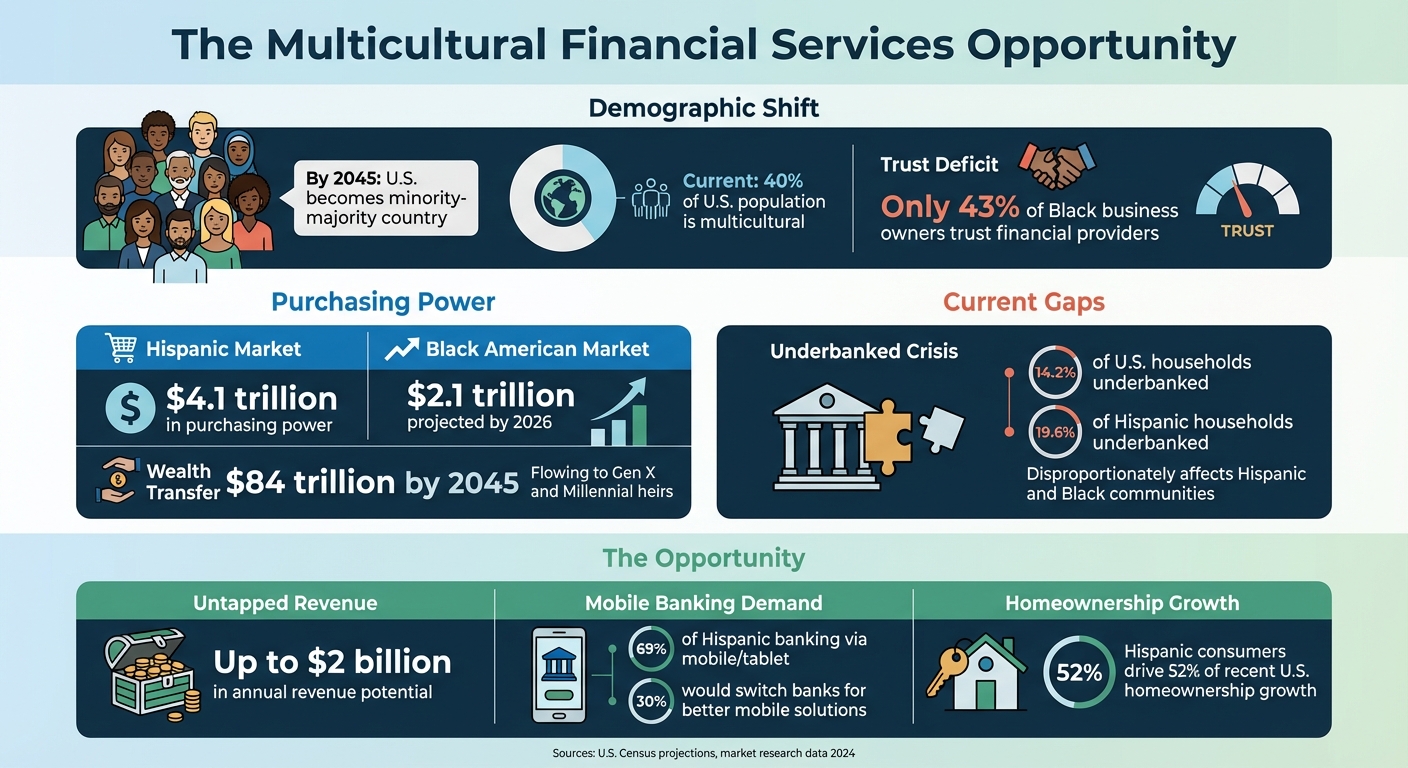
The U.S. financial services industry is facing a demographic shift that cannot be ignored. By 2045, the U.S. will become a minority-majority country, and already, multicultural groups make up 40% of the population. These communities are driving massive growth in consumer spending and wealth transfer:
Yet, financial institutions often fail to connect with these groups due to outdated strategies. Disparities in wealth, underbanking, and trust highlight the need for better engagement. For example, only 43% of Black business owners trust financial providers, and 14.2% of U.S. households are underbanked, with Hispanic and Black communities disproportionately affected.
Financial institutions that adapt to these changes now stand to benefit from the growing purchasing power and wealth of multicultural audiences.
Multicultural Market Opportunities in US Financial Services 2024-2045
Visora understands that engaging with multicultural audiences requires more than just translating content. They take it a step further by tailoring messages to reflect the unique experiences of specific communities. For example, the firm emphasizes the importance of crafting distinct messages for first-generation immigrants compared to later generations, who often juggle their cultural roots with mainstream societal norms [6].
To ensure culturally relevant communication, Visora employs AI-powered content governance tools. These tools help financial services leaders create messaging that feels authentic, avoiding the pitfalls of generic corporate outreach. This approach not only helps institutions sidestep costly mistakes but also fosters trust and builds meaningful connections with diverse audiences.
By combining this culturally sensitive messaging with precise audience segmentation, Visora helps institutions connect with communities in a more impactful way.
Visora employs a needs-based segmentation model that integrates geographic trade area analysis with internal membership data to pinpoint high-value opportunities [3][4]. Instead of grouping all Hispanic or Asian American households together, they dive deeper into the unique characteristics of these communities.
For instance, they differentiate between vulnerable households - those who are underbanked or lack savings - and affluent, high-growth segments like Asian American households, one of the fastest-growing wealth demographics in the U.S. This nuanced understanding allows financial institutions to align their strategies with their strengths, whether it’s supporting underbanked communities or appealing to affluent multicultural investors.
In today’s fast-moving markets, speed matters. Visora’s 12-week Trifecta Program is designed to help banks engage diverse communities quickly and effectively. This program enables institutions to launch acquisition systems 12 weeks faster than traditional methods. The results speak for themselves: a $50 million opportunity identified in just 45 days and $20 million uncovered within 180 days [3].
While some institutions are exploring AI-driven tools to connect with multicultural markets, many still rely on tried-and-true methods that have proven effective over time.
One key strategy is transcreation, which goes beyond basic translation to create messaging that resonates deeply with specific cultural audiences [5].
For instance, BB&T (now Truist) launched the "BiBi" tapes in 2011 - a 12-CD Spanish-language novella designed to teach financial literacy. This was part of their Vecino ("Neighbor") branch concept, which featured native-speaking staff and mini-branches located in ethnic shopping centers [9]. This approach acknowledged that Hispanic audiences often connect more with storytelling than with traditional brochures.
"Simplifying the language and avoiding jargon is important. If you use jargon, your client can get lost and will have a harder time trying to understand what you're saying. Instead of trying to sell products, try educating your clients first."
- Javier Pena, Multicultural Markets Manager, Global Atlantic [8]
Another common approach is using alternative credit scoring to reach unbanked populations. Instead of relying solely on FICO scores, institutions evaluate creditworthiness through utility bills, cell phone payments, and remittance receipts [4]. This is particularly relevant, as 19.6% of Hispanic households are underbanked, compared to the overall U.S. average of 14.2% [1][5].
These culturally tailored strategies set the stage for more focused segmentation efforts.
Financial institutions often refine their market segmentation to better serve multicultural communities. For example, FirstBank in Denver created specialized Asian and Spanish banking centers in the 1990s. They staffed these branches with employees fluent in Spanish, Chinese, Vietnamese, and Korean. This initiative started when a loan officer successfully educated the local Chinese community about the U.S. banking system through ads in Chinese newspapers [3].
M&T Bank took this concept further in 2020 with a pilot program of 19 multicultural branches, which expanded to 124 by the end of the year. They prioritized hiring from local neighborhoods and offered a 10% pay premium to certified bilingual bankers. Additionally, they launched a Multicultural Small Business Innovation Lab, awarding $10,000 to top pitch competition winners [3].
"We want to make sure our employees match our communities and that way people come to the bank feeling comfortable and they see people that look like them and speak their language."
- Tony Oum, EVP, FirstBank [3]
This focus on segmentation aligns with the fact that Hispanic consumers are 1.5 times more likely to start a new business than other demographics [5]. Programs tailored to entrepreneurship, alongside personal banking services, are critical for meeting their needs.
Institutions often roll out multicultural initiatives gradually, using data to guide their efforts. A phased approach allows banks to test marketing, staffing, and product strategies in one location or a small group before expanding. For example, Truist Bank designates branches as multicultural banking centers based on Census data showing high concentrations of African-American, Asian, or Latino populations. They prioritize hiring locally to ensure staff understand community-specific dialects and cultural nuances, which helps build trust [3].
These strategies aren't just about inclusivity - they're also good for business. With over 62 million people, the U.S. Hispanic population wields a purchasing power of $4.1 trillion [1]. Hispanic consumers have driven 52% of recent growth in U.S. homeownership [5], making them a vital audience for mortgage and wealth management services.
Additionally, 69% of Hispanic banking is conducted via mobile or tablet devices [5]. About 30% of surveyed consumers said they would switch banks for better mobile solutions [5], highlighting the importance of bilingual, mobile-friendly platforms.
With $84 trillion in generational wealth expected to transfer by 2045, much of it shifting to more diverse Gen X and Millennial heirs [2], financial institutions that invest in multicultural engagement today are positioning themselves to capture a substantial share of future markets.
When crafting financial services for multicultural audiences, the approach you choose can make or break your ability to scale and capture revenue effectively. The table below contrasts AI-driven methods with more traditional approaches, highlighting key differences.
| Criteria | Visora | Standard Approaches |
|---|---|---|
| Cultural Adaptation | Tailored, AI-driven, specific to sub-groups | Generic, one-size-fits-all strategies [10] |
| Segmentation Strategies | Advanced, data-driven, and generational | Broad demographic categories |
| Implementation Speed | 12 weeks via the Trifecta Program | Slower, phased rollouts [7] |
| Revenue Impact | Proven results (e.g., $50MM partnerships) | Less measurable; $2B in potential left untapped [10] |
These distinctions highlight how AI-driven strategies outperform traditional methods in several critical areas.
Traditional approaches often rely on generic messaging, which can feel inauthentic and fail to connect with diverse audiences. AI-driven methods, on the other hand, use behavioral data and intent signals to deliver messages that resonate with specific sub-groups, enhancing engagement and trust.
Segmentation is another area where traditional methods fall short. While they typically use broad Census data for targeting, this often overlooks important nuances. AI-driven models, like alternative credit scoring systems that incorporate utility and mobile payment data, can identify and serve underserved segments. For example, only 43% of Black business owners trust financial service providers to support them [10]. Precision targeting can help bridge this trust gap.
Speed of implementation is another critical factor. With the U.S. Latino market growing 2.5 times faster than non-Latino segments [7], rapid deployment is essential. Traditional methods often require lengthy management approvals and phased rollouts, which can take months or even years [7]. In contrast, AI-driven solutions like Assurance Financial's AI Sales Assistant have demonstrated how quickly technology can convert leads into qualified appointments. By using intent signals, this tool eliminated the need for manual outbound calls, delivering results faster [11].
Finally, revenue impact is the ultimate measure of success. If financial products were more equitably accessible across racial groups, institutions could unlock $2 billion in incremental annual revenue [10]. While traditional methods often lack clear measurement frameworks, AI-driven strategies focus on measurable outcomes, moving beyond surface-level demographic checkboxes to achieve genuine engagement and growth.
Together, precise segmentation, speed, and measurable results make AI-driven approaches a game-changer in the financial services sector.
Reaching multicultural audiences in financial services goes far beyond simple translations or surface-level diversity efforts. It demands a deep understanding of generational nuances, authentic trust-building, and scalable messaging tailored to cultural contexts. With the U.S. expected to become majority multicultural by 2042 [13] and minority groups like African American, Asian American, and Native American consumers collectively wielding nearly $3 trillion in buying power [12], the financial services sector cannot afford to rely on outdated, one-size-fits-all approaches. These demographic shifts call for a strategic reset grounded in genuine trust.
The numbers highlight a pressing issue: trust remains a significant barrier. Only 43% of Black business owners feel confident in financial providers’ ability to support them, and nearly half of Black households are either unbanked or underbanked [10]. Sticking to traditional, slow-moving strategies risks leaving up to $2 billion in potential annual revenue untapped [10]. This is where AI-driven solutions shine, offering the ability to align messaging with cultural nuances, ensure compliance, and deliver targeted outreach more effectively.
For leaders in B2B financial services - whether they focus on commercial real estate, investor relations, or syndicate management - speed and precision are no longer optional. With Hispanic purchasing power now exceeding $4.1 trillion, engaging these markets quickly and effectively has become a business imperative [1].
AI-powered tools are stepping up to meet these challenges. Take Visora's Trifecta Program, for example: it enables financial services leaders to implement acquisition systems in just 12 weeks, uncover $50 million in partnership opportunities in as little as 45 days, and generate $2.25 million in new project pipelines - all without relying on referrals or expanding headcount. By leveraging AI for content creation, intent-based targeting, and multi-channel outreach, financial institutions can connect with diverse audiences faster while staying compliant and culturally aligned.
Ready to reshape your financial services strategy for multicultural audiences? Visit Visora or schedule a discovery call at https://calendly.com/visora/discovery to start identifying high-value opportunities today.
Building trust with customers from diverse backgrounds starts with showing genuine respect for their unique experiences and perspectives. Recognize how their cultural contexts influence financial decisions and priorities. Clear, honest communication is key - be transparent and address concerns with empathy. Offering bilingual resources or tailoring messages to reflect their cultural values demonstrates awareness and care. Above all, focus on delivering personalized and respectful service that aligns with their needs, helping to establish credibility and nurture lasting relationships.
To connect with multicultural audiences on a deeper level, it's essential to look beyond just language differences. Dive into cultural, social, and behavioral traits to truly understand your audience. For instance, analyzing factors like ethnicity, socioeconomic background, and education can reveal insights into financial habits and preferences.
It's also important to consider cultural values, traditions, and community priorities when crafting strategies. These elements shape how people interact with brands and make decisions. By leveraging data-driven tools to uncover behavioral patterns, you can fine-tune personalization efforts. This approach not only builds stronger connections but also fosters trust - an invaluable asset in competitive markets.
To measure the ROI of multicultural marketing, focus on key metrics like market share growth, customer acquisition, and retention rates within the specific communities you're targeting. Analytics tools and segmentation data can also play a big role in evaluating how well your culturally tailored campaigns resonate. Keeping an eye on these indicators will give you a clear picture of how effective your outreach efforts really are.
%20(5).png)
