%20Bold.png)

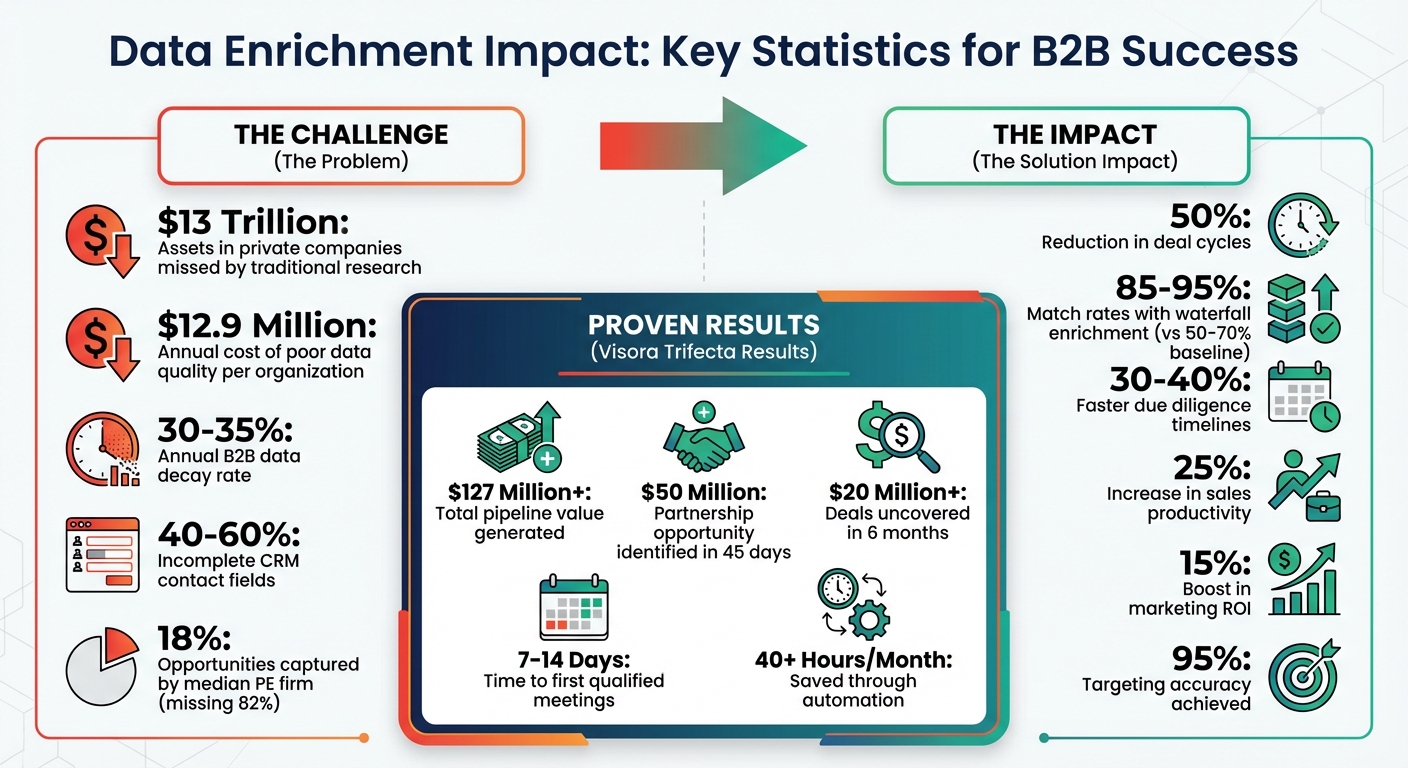
Private market intelligence helps B2B leaders find untapped opportunities by analyzing non-public data on private companies. Traditional research focuses on public firms, missing founder-owned businesses that represent $13 trillion in assets. Data enrichment enhances this process by adding details like job titles, tech stacks, and funding history to basic records, creating actionable profiles. This approach reduces deal cycles by up to 50%, improves targeting, and speeds up decision-making with AI-driven tools.
Key benefits:
Visora's Trifecta Program combines AI, enriched CRM data, and expert advisory to help firms generate qualified leads and shorten deal cycles, delivering over $127 million in pipeline value. By integrating enriched data and AI into your workflow, you can stay ahead in competitive private markets.
Data Enrichment Impact on B2B Sales Performance and ROI
Data enrichment involves adding third-party information - such as verified contact details, job titles, firmographics, technographics, and funding history - to basic records, turning them into well-rounded profiles [5] [6].
The impact of poor data quality is staggering, costing organizations up to $12.9 million annually [5] [7]. Compounding this issue, B2B data decays at an annual rate of 30% to 35%, leaving 40% to 60% of CRM contact fields incomplete. This forces sales teams to make decisions without the full picture [5] [6] [9].
Modern data enrichment goes beyond the basics by layering firmographic data (like industry, revenue, and headcount), technographic data (such as software usage and IT infrastructure), ownership details (e.g., private equity backing or founder ownership), and behavioral signals (like hiring trends or M&A activity). These enriched profiles allow businesses to proactively identify opportunities, such as leadership changes or early M&A signals, before companies officially enter sale processes [1] [2] [5] [6].
The most advanced method, known as waterfall enrichment, uses a sequential approach that queries multiple data providers. This boosts match rates from 50–70% to an impressive 85–95% [6] [7]. By tapping into 15 or more sources, this method fills gaps that any single vendor might miss.
This enriched data doesn’t just improve the clarity of prospect profiles - it directly supports faster, more informed decision-making.
Incorporating enriched data into private market intelligence enables B2B teams to identify high-value opportunities with precision.
For example, an AI-powered account review tool analyzed 340 call transcripts in a single month, uncovering 2,100 new data points. This increased budget intelligence capture from 18% to 64% and shortened negotiation cycles by 11 days [8].
Precision is another key benefit. By enriching data with tech stack insights, one team discovered a prospect was using Snowflake and dbt. This allowed them to deliver a tailored demo, boosting their demo-to-proposal conversion rate from 41% to 58% [8].
"Traditional enrichment gives you a snapshot of a company. Call extraction gives you a movie. You see how things change over time - budgets shift, priorities change, people move around."
– Kenji, Sales Professional [8]
Operational efficiency also gets a major lift. Verified email enrichment can reduce bounce rates to under 1%, safeguarding sender reputation [5]. Automated enrichment saves SDRs an average of 6 hours per week, time that would otherwise be spent on manual research [5]. For investment firms and consultants, this efficiency means deal teams can focus on building relationships and conducting strategic analysis instead of gathering data.
Timing is critical. Enriching data as soon as a lead enters the system ensures accurate lead scoring and routing right from the start [5]. Since data deteriorates at about 3% per month, refreshing active records every three to six months is essential to maintaining accuracy [7] [9].
Firmographic data helps answer a key question: "Does this account align with our Ideal Customer Profile (ICP)?" By analyzing factors like company size, revenue, industry classification, and employee count, you can filter out low-value prospects and focus on accounts with the best potential [10][11].
But don't stop at surface-level attributes. Instead of targeting broad industries like "healthcare", narrow your focus to specific niches, such as digital health startups or ambulatory surgery centers. These smaller segments often have unique procurement processes and challenges that broader categories overlook [10]. Growth trajectory data can also signal opportunities - companies rapidly expanding their engineering or sales teams may need new tools to handle their growing pains [10]. Additionally, tracking funding rounds, leadership changes, and organizational shifts can reveal accounts poised for transformation, creating natural opportunities for engagement.
For example, in April 2026, Analytic Partners combined firmographic insights with real-time account signals, tracking over 1,000 sources for updates like leadership changes and hiring trends. This initiative, led by Andrew Giordano, VP of Global Commercial Operations, boosted their qualified pipeline by 40% year-over-year and cut manual research time by 85% [10].
"Firmographic data identifies fit. Technographic data confirms compatibility. Intent data reveals timing." – Salesmotion [10]
Once you've defined account fit, the next step is to focus on buyer behavior to refine your targeting even further.
While firmographics establish whether an account is a good match, buyer intent data identifies the right time to engage. Intent signals, such as keyword searches, content downloads, and other digital activities, provide clues that a prospect is actively looking for solutions. This shifts your strategy from guessing when to reach out to knowing when a company is ready to buy [11][12].
Layering intent data with firmographic insights takes targeting to the next level. For instance, instead of broadly targeting "manufacturing companies", you can zero in on "VPs of Operations at manufacturing firms currently researching digital transformation." This ensures your outreach aligns with their active evaluation phase, avoiding wasted efforts months before or after their decision-making window [11].
Real-time tracking of engagement patterns, competitive research, and job changes can also open doors for timely outreach. For example, when key contacts move to new companies, they often bring along vendor preferences, creating opportunities for re-engagement [10][11][14][6].
In 2025, Amanda Newman, SDR Manager at UserEvidence, switched to phone-verified enrichment data, replacing their previous provider. This change improved their match rate from 72% to 98% and increased call connect rates from 14% to 22%, ultimately driving a 33% jump in sales pipeline over just three months [13].
| Data Category | Primary Purpose | Refresh Rate |
|---|---|---|
| Firmographic | Defines "Fit" (Who they are) | Quarterly to Annually |
| Technographic | Confirms "Compatibility" (What they use) | Monthly to Quarterly |
| Intent | Reveals "Timing" (What they're doing now) | Daily to Weekly |
Beyond identifying the right accounts and timing, understanding decision-maker networks is key to closing deals.
After confirming account fit and timing, the next step is mapping the decision-makers within target accounts. Relationship mapping goes beyond company-level data to identify key stakeholders, influencers, and budget holders [11]. By enriching demographic data, such as job titles, seniority, and departmental structures, you can turn general account profiles into actionable contact lists.
Understanding organizational structures is also crucial. For instance, knowing whether a company uses centralized or decentralized procurement can help you tailor your approach, as decentralized setups often require alignment across multiple stakeholders [10]. This insight allows teams to build multi-threaded strategies instead of relying on single points of contact.
Tracking professional movements can also create high-conversion opportunities. When executives change roles or companies, they often bring established vendor relationships and may have immediate purchasing authority. Automated job change monitoring can transform past relationships into fresh leads without requiring cold outreach [14][6].
In 2025, Druva's EMEA SDR Manager Antony Arcan used enriched marketing data from events and webinars to drive 22% quarterly pipeline growth. This led to the company's highest marketing closed-won results for that financial year [13].
"The reps who crushed quota were not the ones with the most phone numbers. They were the ones who walked into every call knowing something the prospect did not expect them to know." – Semir Jahic, CEO, Salesmotion [12]
Keeping up with the fast-paced world of private markets is no small feat, especially when relying on manual research. AI steps in by monitoring millions of company websites and analyzing navigation patterns to uncover business models and classifications [15] [2]. By synthesizing data from multiple sources, these tools fill in gaps left by traditional databases, estimating details like revenue, ownership structures, and operational models [15] [2].
AI also plays a crucial role in proactive sourcing. It scans for non-financial triggers - such as spikes in hiring, leadership changes, or regulatory updates - that signal a company might be gearing up for a transaction [4] [2]. Nearly half (49%) of dealmakers now rely on AI tools daily to break down complex data and streamline due diligence [2]. Agentic AI acts almost like a virtual analyst, interpreting user intent and connecting market insights from scattered sources. These systems can flag emerging competitors, detect shifts in market momentum, and identify opportunities ahead of the broader market [2] [1]. Firms using integrated AI platforms report that their sourcing cycles are now 40% to 50% faster [1].
"The firms winning in today's deal environment aren't just sourcing faster - they're using investment-grade financial data, network relationships, and agentic AI workflows to make decisions that used to take weeks in a matter of hours." – Grata [1]
This constant stream of insights sets the stage for automating deal flow, as detailed below.
AI doesn't just analyze signals - it transforms how deal flow is managed. Traditional methods often miss the mark, with the average private equity firm capturing only about 18% of relevant deal opportunities in its target markets [4]. AI changes the game by consolidating fragmented data from CRMs, PDFs, emails, and web activity into a single intelligence hub [3] [1].
Among data-focused venture capital firms, 35% report that automated tools now generate half or more of their deals [16]. These systems sync seamlessly with CRM platforms, enabling deal teams to update and share enriched data without the hassle of manual input [2]. By combining proprietary deal histories with external intelligence, firms gain a competitive edge [3].
Visora is a prime example of how AI can supercharge deal flow. Their systems help U.S.-based B2B leaders in sectors like investment, finance, real estate, SaaS, and consulting integrate private market intelligence with AI-powered business development. This approach sharpens targeting accuracy through data enrichment and speeds up deal cycles to as little as 12 weeks - no referrals or extra staff required. For instance, Visora's AI identified a $50M partnership opportunity in just 45 days and uncovered over $20M in deals within six months.
The trend is unmistakable: 97% of dealmakers now actively pursue outbound sourcing instead of waiting for leads to come to them [16]. AI has evolved from a niche tool to the backbone of the investment lifecycle, with firms reporting that AI workflows cut due diligence timelines by 30% to 40% [1].
In private market intelligence, using enriched data in your CRM can make a big difference in targeting and decision-making. To make this happen, follow a structured three-phase process. Start with the Foundation phase: figure out which signals are most important for your business (like funding rounds, executive hires, or changes in tech stack). Then, integrate enrichment vendors using APIs or native connectors and create custom CRM fields such as "Tech Stack", "Last Funding Date", or "Buying Intent Score" [17][18]. This setup ensures your CRM becomes a reliable source of truth, eliminating the need for scattered spreadsheets.
The next step is Workflow: set up real-time alerts via Slack or email for trigger events, and create tailored sales playbooks for scenarios like a "New Executive Hire." Use LinkedIn and email templates to streamline outreach. Additionally, build reports to measure how enrichment efforts are impacting outcomes [17]. Finally, focus on Adoption - train your team with role-playing exercises and highlight early successes to encourage buy-in [17].
There are two main approaches to data enrichment. Batch enrichment is ideal for cleaning up your database and conducting periodic audits, while continuous enrichment keeps your records updated in real time based on trigger events [17]. For a more comprehensive solution, try waterfall enrichment - a method that uses multiple data providers in sequence. This approach can improve your data coverage from 50–70% to an impressive 80–90% [5][18].
"The Business Development team gets 80 to 90 percent of what they need in 15 minutes. That is a complete shift in how our reps work." – Andrew Giordano, VP of Global Commercial Operations, Analytic Partners [17]
With this solid CRM foundation, you can execute precise, multi-channel outreach strategies.
Once your CRM is enriched with relevant signals, it’s time to take your outreach to the next level. Enriched data allows you to move away from generic messaging and focus on precision targeting. By combining firmographic data (company size, industry), demographic insights (job title, seniority), technographic details (software stack), and intent signals (like keyword searches or content downloads), you can craft personalized messaging that resonates with prospects [11][5].
Timing is just as critical as the message itself. Launch campaigns tied to trigger events, such as new funding rounds, executive hires, or geographic expansions, to create a sense of urgency and relevance [17][2]. Enrich leads as soon as they’re captured (e.g., through form submissions) to ensure your outreach happens during the crucial first hour of interest [5]. Before launching campaigns, validate email addresses and phone numbers to protect your sender reputation and improve connection rates [5].
The impact of enriched data is clear: companies report a 25% boost in sales productivity and a 15% increase in marketing ROI [11]. Campaign response rates can improve by 20%, and sales close rates often rise by 15% within six months of implementation [17]. Businesses with clean, enriched data have even seen revenue grow by as much as 66% [17].
Measuring results is essential to understanding how data enrichment drives success in sales and marketing. Organizations with enriched data enjoy 30% higher sales revenue compared to those relying on incomplete records [18]. Additionally, AI-powered enrichment tools can cut manual data tasks by 41% [18].
Tracking the completeness of your data is a good way to gauge success. For example, accounts with over ten structured data fields have a 29% win rate, compared to just 13% for accounts with fewer than five fields. Poor data quality can be costly, with organizations losing an average of $12.9 million to $13 million annually [5][17]. Plus, B2B contact data can decay at a rate of nearly 30% per year [5][17].
| Metric | Unenriched Baseline | Enriched Improvement |
|---|---|---|
| Sales Productivity | Baseline | +25% [11] |
| Marketing ROI | Baseline | +15% [11] |
| Campaign Response Rate | Baseline | +20% [17] |
| Sales Close Rate (6 months) | Baseline | +15% [17] |
| Revenue Growth | Baseline | +66% [17] |
| Manual Data Work | 100% | –41% [18] |
| Sales Revenue | Baseline | +30% [18] |
To maintain accuracy and combat data decay, set a regular refresh schedule. Re-enrich core segments every quarter and focus on high-value accounts monthly [5]. Define clear goals for enrichment, such as reducing your sales cycle or increasing lead-to-opportunity conversions by 15%, to showcase the return on investment [11].
Visora's Trifecta Program leverages data enrichment and AI-driven targeting to turn private market intelligence into measurable growth opportunities. It’s designed as a "zero-lift" revenue engine, streamlining processes and automating deal flow with three key components.
The B2B Vortex Funnel acts as a centralized system that integrates various tools - outbound campaigns, social media presence, lead targeting, scheduling, and CRM - into one cohesive conversion engine. This ensures your pipeline moves seamlessly from initial contact to qualified meetings [19][22].
With AI-Augmented Appointment Setters, the program automates outbound prospecting. This AI system, trained on over 20,000 hours of success data and real-time market insights, eliminates the need for manual research while maintaining high-quality outreach [19][21].
The DD Strategic Advisory provides fractional executive support, delivering high-level strategies typically associated with Fortune 500 companies. This includes sales training and operational systems designed to help U.S.-based B2B firms in real estate and finance - those with annual revenues over $3 million - scale their operations effectively [21][22].
"We help U.S.-based B2B leaders generate qualified conversations, shorten deal cycles, and build high-value relationships through AI systems and private market intelligence." – Visora [19]
By combining these elements, the Trifecta Program seamlessly integrates with private market intelligence systems, enhancing efficiency and precision.
Visora's structured approach has consistently delivered impressive outcomes for its clients, particularly in the investment and finance sectors.
For example, the Trifecta Program identified a $50 million partnership opportunity in just 45 days. Another private equity firm unlocked over $20 million in partnership opportunities within six months, while a real estate syndicate secured $2.25 million in new projects in just 45 days.
The program has generated over $127 million in pipeline value, achieving a 95% accuracy rate in targeting [19][21]. It also reduces deal cycle lengths by more than 50% and saves B2B leaders over 40 hours each month through automation [19]. Most clients begin seeing results - like their first qualified meetings - within 7 to 14 days of implementation [19][22].
Visora’s client list includes executives from Citi Group, Morgan Stanley, Boston Consulting Group, NYC Housing Authority, Christie's, Kushner, and Sotheby's. The company was founded by Danny Kim, a former Deloitte growth leader who has advised major firms like Meta, Disney, Amazon, and Cisco on multi-million-dollar engagements [20].
Using data-enriched private market intelligence has become a game-changer for driving B2B growth. Here’s why it matters: the median private equity firm captures only 18% of potential opportunities, leading to an average loss of $12.9 million annually [4][5].
The solution? A combination of enriched firmographic data, buyer intent signals, and AI-powered automation. Together, these tools help sales teams identify high-fit prospects before they enter formal sales processes. This approach can save sales representatives around 312 hours per year [5]. Deals backed by enrichment data with 10 or more structured fields see win rates soar to 29%, compared to just 13% for deals with minimal data [8].
AI is now stepping into the role of an autonomous analyst, tracking ownership changes, leadership shifts, and growth signals. By replacing manual research with automated workflows, firms can shorten sourcing windows from weeks to mere days [1]. This technology doesn’t replace human judgment - it enhances it, ensuring the right opportunities are surfaced exactly when they’re needed.
For U.S.-based B2B leaders in industries like investment, finance, real estate, and consulting, the path forward is clear. To stay ahead, integrate data enrichment into your CRM and engagement platforms, refresh core segments every three to six months to counteract the 30-40% annual data decay [5][9], and rely on AI for ongoing market monitoring. Firms that embrace these strategies now will gain access to proprietary deal flow, while others lag behind, waiting for opportunities to come to them.
A real-world example of this approach in action is Visora’s Trifecta Program. It has delivered impressive results: over $127 million in pipeline value, deal cycles cut by more than 50%, and qualified meetings scheduled within just 7 to 14 days of implementation [19][21]. By aligning data enrichment, AI automation, and expert advisory, businesses can secure the edge they need to thrive in competitive private markets.
To get started, enhance your company-specific data by incorporating details like firmographics - think company size, industry, location, and financials - and key decision-makers along with their roles. This creates a sharper picture of your potential targets. From there, layer in intent signals and behavioral data to fine-tune your targeting. These insights can spotlight prospects' interests and engagement levels, making your outreach smarter and more effective. Prioritize contact data first, as it directly boosts the quality of your outreach and helps transition from reactive to proactive deal sourcing.
To keep your CRM data accurate and dependable, make it a habit to update it at least every quarter. Why? CRM data tends to degrade fast - at a rate of 2–3% per month. Over the course of a year, that adds up to about 25% of your data becoming outdated. Regular updates ensure your CRM stays a trustworthy tool for informed decision-making.
Using behavioral data to identify prospects who are showing interest or are ready to engage can transform the way you approach outreach. By linking these intent signals to tools like CRMs or marketing automation platforms, you can create a system that triggers personalized outreach whenever specific behaviors or signals are detected.
This approach allows you to align your engagement strategies with the actual behavior of your prospects. The result? A more efficient process that can shorten deal cycles and help you establish a stronger, more exclusive deal flow.
%20(5).png)
