%20Bold.png)

AI intent signals are transforming how B2B sales teams manage pipelines. Instead of waiting for prospects to engage late in their buying journey, these signals identify buying intent early, enabling timely, data-driven outreach. Here's what you need to know:
AI-driven tools like Visora's Trifecta Program integrate signals into CRM systems, automate outreach, and refine targeting to deliver measurable pipeline growth. For B2B teams, this approach is no longer optional - it's essential for staying competitive.
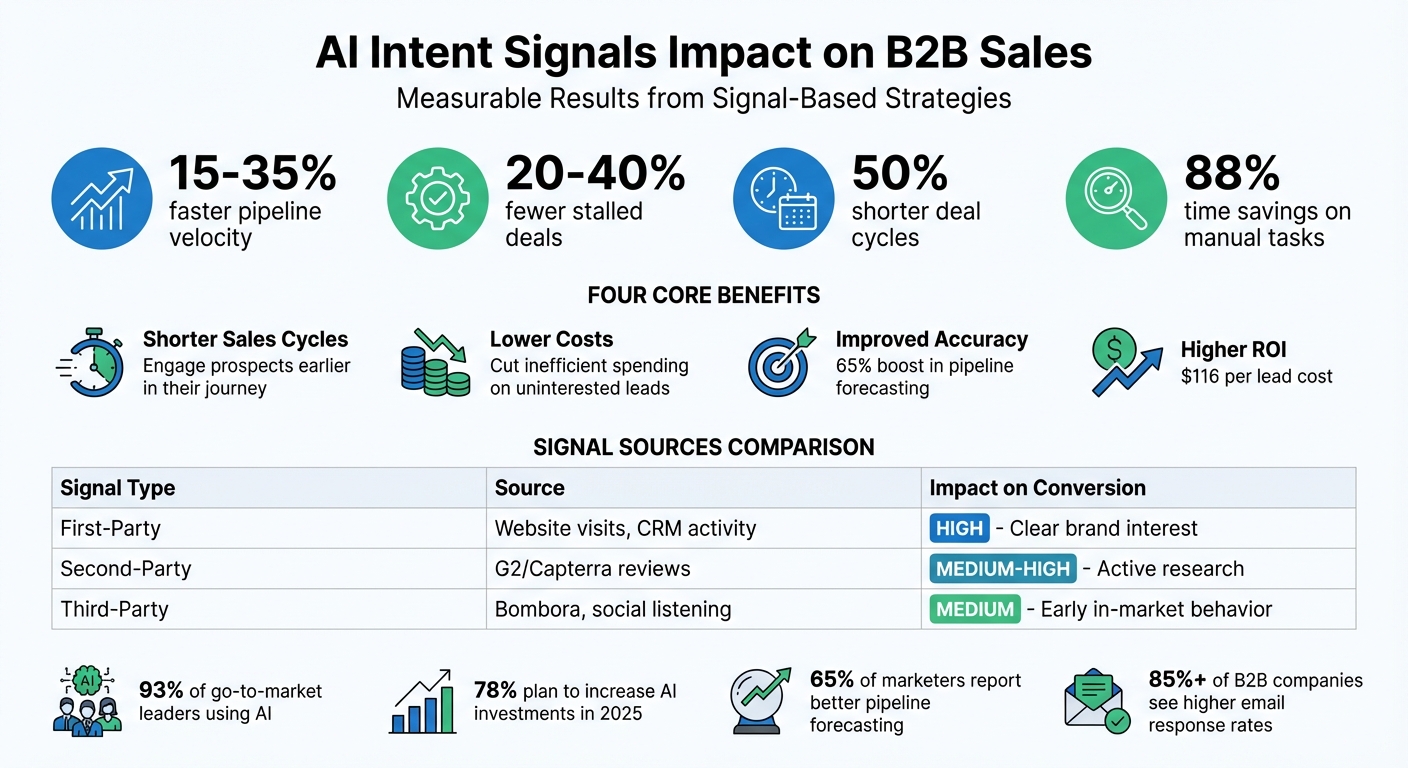
AI Intent Signals Impact on B2B Sales Pipeline Performance
AI intent signals are insights derived from analyzing online behaviors and market trends to identify where a prospect is in their buying journey. Instead of waiting for traditional indicators like form submissions, these signals catch interest much earlier - during the research phase.
Think of intent signals as digital breadcrumbs. They come in various forms: implicit signals, like page visits or time spent on a site; explicit signals, such as demo requests; and inferred signals, where machine learning connects behaviors to predict the likelihood of a purchase. These are further divided into two types: predictive signals (e.g., funding rounds or new hires) that help forecast future needs, and demand-capture signals (e.g., visits to pricing pages or competitor comparisons) that point to immediate interest. Together, they support both long-term planning and real-time engagement strategies.
Shifting from traditional lead scoring to a signal-based approach has shown measurable success. For instance, 65% of marketers report better pipeline forecasting accuracy when they use intent signals. By identifying buyers who are actively in-market, businesses can engage proactively and more effectively.
With this foundation in place, the next step is understanding where these signals originate and how they can be used to enhance your pipeline.
Intent signals are drawn from three primary data sources, each offering unique insights into buyer behavior:
Combining these sources creates a well-rounded view of buyer interest. For example, Jason Widup, VP of Marketing at a company leveraging Qualified Signals, shared that merging first-party website engagement with third-party research data generated $7.2 million in influenced pipeline and delivered a 927% ROI in 2023.
Since B2B purchasing decisions often involve 6–10 stakeholders, the most effective teams focus on account-level aggregation rather than individual leads. This approach provides a more complete picture of interest across an organization. High-performing teams also use “data recipes,” which blend firmographic details, first-party website data, and spikes in third-party intent to trigger timely, targeted outreach.
AI intent signals help sales teams zero in on prospects who are actively researching, cutting down on wasted time chasing cold leads. This focus on "in-market" accounts allows sales teams to connect with buyers at the perfect moment, speeding up the sales process and improving conversion rates.
For example, companies using AI-driven systems have reported deal cycles being cut by more than half. Industry leaders like Salesforce and Workday leverage real-time sales triggers to create personalized outreach campaigns that not only shorten sales cycles but also increase close rates. AI-driven strategies have been shown to boost stage-to-stage conversion rates by 8–18%, thanks to tailored messaging that addresses the concerns of the 6–10 stakeholders typically involved in B2B decisions. This efficiency naturally leads to lower costs for acquiring new customers.
By using intent signals to focus efforts on accounts that are ready to buy, companies can significantly reduce wasted spending on uninterested prospects. One NYC real estate firm, working with Visora, demonstrated notable cost savings by adopting this signal-based approach.
AI tools also slash the time needed for tasks like timeline analysis and content creation, reducing a process that once took 8–16 hours to just 1–2 hours - a massive 88% time savings.
"Winning new accounts can cost five times more than expanding within existing accounts." – Chloe Swierzbinski, Senior Director of Product Marketing at Bombora
As an example of this efficiency, GPC Real Estate implemented an automated CRM system through Visora in 2025. This upgrade reduced manual operational tasks by 40% while allowing the company to scale its investor management processes.
When shorter sales cycles and reduced costs come together, pipeline velocity - the speed at which deals move through the sales process - gets a significant boost. With AI intent signals, pipeline velocity can improve by 15–35%. By identifying which accounts are gaining momentum, sales teams can prioritize outreach effectively, keeping deals on track. Predictive tools further enhance this by reducing stalled deals by 20–40%, thanks to real-time recommendations for the next best actions.
Additionally, 65% of marketers say intent signals have improved their ability to forecast pipelines more accurately. Companies like Palo Alto Networks use predictive scoring and continuous signal monitoring to adjust their priorities dynamically, ensuring their pipeline aligns with current account activity and firmographic data. This refined approach translates into better ROI and more predictable outcomes.
Visora's Trifecta Program takes the power of intent data and turns it into measurable pipeline growth. For U.S.-based B2B leaders in real estate, investor relations, and financial services, integrating AI-driven intent signals doesn’t mean a complete overhaul of your systems. Instead, this program introduces a streamlined approach that installs acquisition systems in just 12 weeks, cutting down on unnecessary referrals, ad spend, and staffing costs. The program is built around three core pillars: the B2B Vortex Funnel, AI-Augmented Appointment Setters, and DD Strategic Advisory. Together, these tools have helped clients generate over $127.15 million in pipeline, achieving a 98%+ accuracy rate for qualified opportunities.
The B2B Vortex Funnel is where it all begins. It integrates outbound campaigns, social activity, lead targeting, and CRM systems into a single, seamless conversion platform. By connecting directly with HubSpot, the funnel aggregates data from over 20,000 market interactions and private market intelligence. Actions like website visits, email clicks, pricing page views, and form submissions are automatically logged in your CRM, keeping intent scores updated in real time - no manual input required.
Take GPC Real Estate, for example. In 2024, they transitioned from using manual spreadsheets to a Visora-optimized HubSpot CRM. The result? A 40% reduction in manual work and the ability to scale investor management without increasing staff. With real-time intent data feeding the system, clients often see their first qualified meetings within just 7–14 days of implementation.
Once the intent signals are collected, AI-Augmented Appointment Setters step in to handle outreach. This system prioritizes high-intent actions, such as prospects visiting pricing pages or requesting demos, which score 40–50 points. On the other hand, lighter actions, like scrolling through a blog, score only 10–20 points.
For instance, CoherentAI worked with Visora to launch an outbound campaign targeting sales leaders. By aligning demand, audience, and offers, they deployed high-impact sequences and generated over $150,000 in pipeline. Their cost-per-lead? Just $116, thanks to Visora’s proprietary deal flow systems.
With outreach running smoothly, the focus shifts to refining lead scoring and sharpening the Ideal Customer Profile (ICP).
The DD Strategic Advisory piece of the program digs deeper into the data to refine targeting and positioning. Instead of relying on a single data point, Visora builds "data recipes" that combine multiple signals - like strong ICP alignment, website visits, and third-party topic surges - to pinpoint the most promising opportunities. This strategy looks beyond basic firmographics to understand the motivations behind buyer behavior.
"Our frameworks are built on 20,000+ real-time market conversations, combined with Fortune 500-level advisory experience to sharpen your targeting, messaging, and positioning." – Visora
The system doesn’t stop there. By tracking which accounts move through the pipeline and which get stuck, it continually updates your Ideal Customer Profile. This ensures sustained pipeline performance and efficiency. In fact, over 85% of B2B companies using intent data report higher email response rates and more effective sales prospecting. By analyzing signal effectiveness across hundreds or thousands of interactions, Visora helps clients avoid relying on anecdotal evidence to gauge success.
| Signal Type | Source | Timeliness | Impact on Conversion |
|---|---|---|---|
| First-Party | Website visits (pricing page), CRM activity, resource downloads | Real-time | High: Clear indicator of interest in your brand |
| Second-Party | G2/Capterra reviews, partner ecosystem engagement | Near real-time | Medium-High: Reflects active category research |
| Third-Party | Bombora topic surges, social listening (LinkedIn/Reddit), funding news | Weekly/Daily | Medium: Useful for identifying early "in-market" behavior |
Tracking the right metrics is crucial for driving revenue. Most modern B2B teams zero in on 5–7 key KPIs that directly influence revenue and improve forecast accuracy. A great starting point? Pipeline Velocity - this measures how quickly leads turn into paying customers. Faster velocity means you’re getting better returns on your sales investments.
Another critical metric is the MQL-to-SQL conversion rate, which highlights how well marketing and sales are working together. Keep an eye on Deal Risk Scores too - these help you spot deals that might fall through, giving your team time to act. Metrics like Predictive Close Rates, which use historical data to estimate the likelihood of closing a deal, and Intent Signal Engagement, which tracks behaviors like repeat website visits, are also worth monitoring.
Companies that actively track these KPIs often see impressive results. For example, they report a 10–20% boost in win rates and a 20–30% shorter sales cycle. For SaaS and tech companies, the average win rate sits between 15–25%, but high performers can exceed 30%.
When setting up your dashboards, aim for a balance between leading indicators (like activities) and lagging indicators (like outcomes). One leading indicator you can’t ignore is Speed to Lead - responding to a lead in under five minutes makes it 100 times more likely you’ll make contact.
Once you’ve nailed down your metrics, it’s time to focus on improving your pipeline.
To keep your pipeline performing at its best, start with an AI-powered audit of your conversion rates and cycle times across all stages. Analyzing 6–12 months of data can help pinpoint where deals tend to stall - often at the Lead-to-MQL or MQL-to-SQL transitions. Once you’ve identified these problem areas, use AI to improve scoring and routing, effectively closing those gaps.
Clean data is the foundation of these improvements. AI tools can only deliver results if your data is accurate, complete, and up to date. Use AI for continuous data enrichment and deduplication to avoid scaling issues.
"AI is only as good as the data and the context that you provide to it." – Manoj Ramnani, Founder and CEO of SalesIntel
Test AI-driven strategies through 90-day pilots. For example, compare lead scoring or personalized outreach initiatives against a control group. If a project doesn’t improve a core metric, don’t hesitate to scrap it.
Another area to streamline is CRM management. By automating CRM updates, you can eliminate manual data entry. AI can automatically capture buyer signals and activities, keeping your CRM accurate and reliable. Companies that have embraced AI in their sales processes report 29% higher sales growth than those that haven’t.
Finally, rethink your pipeline reviews. Shift the focus from manual updates to AI-generated insights. This approach not only saves time but also ensures your pipeline stays agile and optimized for success.
AI intent signals are reshaping how B2B teams approach pipeline management. By tapping into early-stage buyer behaviors, these signals give teams a major edge - allowing them to engage prospects during their research phase instead of after decisions are made. The results? Teams see 15–35% faster pipeline movement, 20–40% fewer stalled deals, and save 88% of the time they used to spend on manual tasks.
The financial benefits are just as striking. Companies leveraging intent-based strategies report deal cycles that are over 50% shorter. Retaining and expanding existing accounts also proves to be up to five times more cost-effective than acquiring new ones. Stephanie Armand, Sr. Rev Ops Manager at Qase, highlighted this success:
"Warmly sourced MQLs closed at a 50% higher rate and 30% faster than our other sources".
For a practical example, Visora's Trifecta Program showcases how AI intent signals can deliver real results. This framework - combining the B2B Vortex Funnel, AI-Augmented Appointment Setting, and DD Strategy Consulting - has driven over $127.15 million in pipeline for clients with a 98%+ accuracy rate on qualified opportunities. In 2025, CoherentAI used this approach to generate more than $150,000 in pipeline, while a New York City real estate firm built 86 new relationships in just 12 weeks, spending only $116 per lead and using no paid ads.
With such powerful outcomes, it’s clear that a shift from reactive to proactive, signal-driven strategies is no longer optional. Already, 93% of go-to-market leaders are using AI, and 78% plan to increase their investments in 2025. The real question isn’t whether to embrace AI intent signals, but how quickly you can integrate them to stay ahead in today’s increasingly competitive B2B environment.
AI intent signals tap into digital behaviors like website visits, content downloads, and search activity to pinpoint prospects who are ready to engage. By running this data through machine learning, sales teams can prioritize leads that show high intent, predict buying readiness, and fine-tune their outreach strategies. The result? Shorter sales cycles, better conversion rates, and smarter resource allocation.
Take this as an example: companies using intent signals often report a 35% boost in conversions and as much as 47% higher close rates when they act on this data quickly. By zeroing in on the most likely opportunities, businesses cut down on lead leakage and reduce acquisition costs.
Visora brings AI-powered intent signals into its Trifecta Program, specifically designed for U.S.-based B2B leaders in industries like real estate, investor relations, and financial services. In just 12 weeks, this program helps clients streamline their acquisition systems, enabling them to build revenue, save time, and scale - without needing massive ad budgets or large teams.
AI intent signals are created by blending first-party behavior, third-party research data, and sales activity metadata to pinpoint and prioritize potential buyers.
By combining these data sources, you get a full view of prospect engagement, allowing for smarter targeting and quicker movement through the sales pipeline.
To incorporate AI-driven intent signals into your CRM system, start by gathering both first-party data (like website visits or form submissions) and third-party data (including off-site activity or vendor comparisons) from intent-data providers. Use an orchestration tool or middleware to process this data, enrich it with firmographic and contact details, and create an AI-driven intent score. This score ranks prospects based on how likely they are to make a purchase.
Once you've added the enriched data and intent scores to your CRM - perhaps as fields like "Intent Score" or "Buying Stage" - set up automated workflows to act on this information. For instance, if a prospect’s intent score hits a specific threshold, the system can automatically assign tasks to sales reps, send tailored emails, or place the lead into an AI-powered outreach sequence. Over time, the AI model refines its scoring by learning from outcomes like booked meetings or closed deals, ensuring the system stays accurate and effective.
Visora offers a streamlined solution for U.S.-based B2B leaders to implement these workflows efficiently. Through its Trifecta Program, Visora connects intent signals directly to your CRM, enabling faster lead prioritization and boosting revenue growth - all within just 12 weeks. Best of all, this approach eliminates the need for referrals or heavy ad spending.
%20(5).png)
