%20Bold.png)

Real-time data is reshaping how B2B companies approach their go-to-market (GTM) strategies. Instead of relying on outdated tactics or intuition, businesses can now act on live buyer intent signals like website activity, funding news, or leadership changes. This shift enables faster decisions, sharper audience targeting, and more personalized outreach. Here's what you need to know:
To succeed, unify your data sources, leverage AI to analyze buyer behavior, and act on insights with targeted outreach. Businesses that adopt this approach are seeing measurable gains, from higher revenue to shorter sales cycles, proving that real-time data isn’t just a tool - it’s a competitive edge.
Real-Time Data Impact on B2B GTM Performance: Key Statistics
Real-time data is changing the game for B2B companies, taking the guesswork out of go-to-market strategies. By offering instant insights into buyer behavior - like visits to pricing pages or downloads of case studies - teams can respond immediately, cutting out delays from outdated batch reports. This quick response not only speeds up decision-making but also sharpens audience targeting.
Traditional segmentation often relies on static details like job titles or company size. Real-time data flips the script by focusing on active buying signals, helping identify which prospects are ready to engage. For instance, if a lead repeatedly visits your pricing page or downloads a whitepaper, real-time systems can automatically place them in high-intent categories.
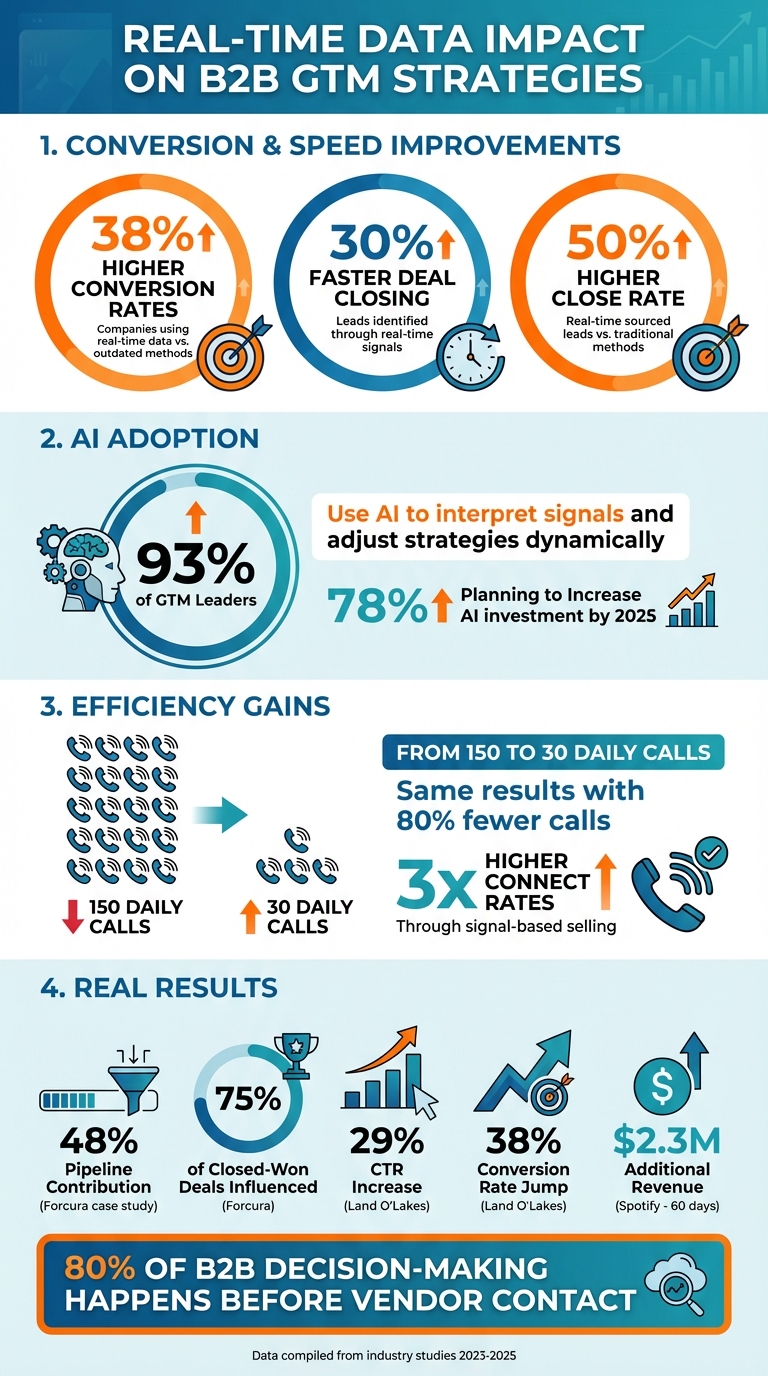
The results speak for themselves. Companies leveraging real-time data and unified customer profiles see 38% higher conversion rates compared to those using outdated methods. Leads identified through real-time signals close deals 50% more often and 30% faster than those sourced through traditional means.
Real-time Customer Data Platforms (CDPs) tackle a common B2B challenge: identity resolution. Buying decisions often involve multiple stakeholders - sometimes up to 10 people. These platforms connect anonymous website visits to known accounts and even pinpoint individual roles within a decision-making group. For example, instead of just knowing "ABC Corporation" visited your site, you’d see that the VP of Operations and two procurement directors engaged with your content in the same week.
"Traditionally, the process of building a target list can take weeks... We fix that problem by giving marketers one, easy-to-use tool that builds a real-time list of accounts and people that actually want to buy from you." - Alan Zhao, Co-Founder and CPO, Warmly
Dynamic audience building takes this further. Real-time systems constantly update as new signals emerge. If a target account secures funding, undergoes leadership changes, or moves to a new buying stage, your segmentation adjusts instantly - no manual updates or spreadsheet exports needed.
In B2B sales, speed is everything. Real-time data eliminates delays, letting teams act the moment something happens. Sales managers can track call activity, conversion rates, and pipeline velocity in real time, enabling them to tweak strategies before missing revenue goals.
In July 2025, Forcura revamped its GTM strategy around buyer intent data. The results? Marketing contributed 48% of the pipeline, influenced 75% of closed-won deals, and doubled the MQL-to-SQL conversion rate through better sales and marketing collaboration.
Land O'Lakes saw similar success when they adopted Contentstack's real-time CDP in 2025. Under Steve Rude's leadership, the company integrated customer data across channels, achieving a 29% increase in click-through rates and a 38% jump in conversion rates by delivering the right message to the right audience at the right moment.
"Impressions are the metric of a failed marketing campaign… If you're not getting the conversions, it means you weren't hitting the right audience." - Steve Rude, Land O'Lakes
The difference between batch and real-time processing is huge. Traditional systems update data daily or weekly, forcing teams to rely on outdated information. Real-time platforms, however, process data in milliseconds, allowing teams to allocate resources dynamically based on current campaign performance.
This speed doesn’t just improve decision-making - it also enables tailored, immediate engagement.
Generic outreach is a losing strategy. Today, 61% of B2B buyers prefer rep-free sales interactions, and a typical sales cycle involves 27 touchpoints with a brand. Real-time data ensures every interaction reflects a prospect's most recent activity, not actions from weeks ago.
For instance, if a high-value lead downloads your pricing guide, a real-time system can trigger immediate actions - like sending a personalized email, notifying a sales rep via Slack, or updating the website messaging they see during their next visit. This kind of behavior-based triggering ensures your outreach aligns with the prospect’s current stage and interests.
In March 2023, Spotify tackled email deliverability using Mailchimp's Email Verification API. Led by Sarah Chen, their team cleaned a 45-million-subscriber database and implemented real-time verification. Within 60 days, they reduced their email bounce rate from 12.3% to 2.1%, improved deliverability by 34%, and generated $2.3M in additional revenue.
"Real-time data gives businesses instant insights for quick decision-making, enhanced operational efficiency, and faster, more personalized outreach." - Amanda Laine, Author at Instantly.ai
This transition from broad, generic campaigns to signal-based selling allows teams to focus on prospects showing immediate intent. It’s a lean, efficient approach that respects the buyer’s journey while delivering value exactly when it’s needed.
To make the most of real-time data in your go-to-market (GTM) strategy, follow these three key steps: gather and unify your data, leverage AI to decode buyer intent, and use those insights to drive targeted outreach. Let’s break down how to incorporate real-time data effectively into your GTM approach.
Real-time insights are powerful tools for segmentation and speed, but it all starts with collecting the right data. To capture actionable signals, you need to consolidate your data sources.
Bring together first-party data (like website visits, email clicks, or content downloads), third-party data (such as external search queries or competitor analysis), and zero-party data (preferences shared directly by customers).
Use tools like tracking pixels to gather behavioral data, integrate bidstream data for third-party intent signals, and set up webhooks for instant notifications. Avoid relying on traditional API polling, which introduces delays that can cost you valuable opportunities.
Once collected, unify all data in a single platform, such as a customer data platform (CDP) or CRM. Use APIs or cloud warehouses to integrate the information. By combining multiple data points, you can identify strong buying signals. For instance, if a prospect opens an email and posts a relevant job listing, it could indicate active interest in your solutions.
To stay ahead, implement signal decay logic - prioritize recent activity while keeping an eye on the timeline. For example, a visit to your pricing page may call for action within 48–72 hours, whereas firmographic changes, like a new hire, might remain relevant for up to three weeks.
"Intent data isn't a one-size-fits-all solution. It's only as good as its granularity, directionality, and the context surrounding it. Without proper action, a signal simply becomes more noise." - Slash Experts
Once your data is unified, AI tools can help uncover patterns that might otherwise go unnoticed. Combining first- and third-party data allows you to identify buyers early in their research journey - even before they visit your website.
AI can detect derived intent by analyzing cross-channel activity. For example, if several stakeholders from a target account are researching related solutions in a short period, it signals a "topic surge" that could indicate high-priority intent. Focus on behavioral signals - like visits to your pricing page, webinar attendance, or feature downloads - rather than static data like company size or industry.
To refine your efforts, implement negative scoring to account for signs of declining interest, ensuring your team doesn’t waste time on low-value leads. Establish feedback loops between sales and marketing to evaluate which AI-identified signals result in successful deals. Companies that refresh their scoring models quarterly have reported a 35% boost in conversion rates.
The final step is turning insights into action. Modern GTM strategies thrive on trigger-based outreach - connecting with prospects at just the right moment of intent. Use automated workflows, often called "Plays", to launch outreach efforts as soon as a signal is detected.
Prioritize your leads with a three-tiered system:
Personalization is key. Reference the specific action the prospect took - whether it’s downloading a whitepaper or adopting a new technology - in your outreach. Avoid generic messages, and implement rules to prevent over-messaging. For example, remove prospects from sequences if they’ve replied or received a campaign within the past 7–14 days.
"In a market saturated with generic outreach, the only true competitive advantage left is timing." - GTM Signal Studio
Route high-intent leads (scores of 80–100) directly to sales for immediate follow-up, while mid-intent leads (scores of 50–79) should enter personalized nurture campaigns. By acting quickly and tailoring your approach, you can turn data-driven insights into meaningful connections.
After activating real-time data, the next logical step is measuring its performance to fine-tune your go-to-market (GTM) strategy. Real-time analytics give you the edge by identifying issues as they arise, allowing you to pivot quickly, unlike traditional weekly reporting, which often means missed opportunities.
Start by identifying the strategic goals your dashboard needs to support - whether it’s reducing churn, accelerating sales cycles, or boosting revenue growth. To get a complete picture, integrate live data from tools like your CRM, marketing automation systems, product analytics platforms, and third-party intent data providers.
Opt for a platform with user-friendly features like drag-and-drop interfaces and natural language search, which allow you to answer critical questions on the fly. Design the dashboard with clear visuals and an intuitive layout so stakeholders can quickly grasp key trends.
Use behavioral signals - such as visits to pricing pages or product feature activations - to trigger automated workflows for your GTM team.
"Over half (56%) of CSOs and sales leaders report significant misalignment between their sales tech stacks and the actual workflows of their sellers." – Salesloft
The real power of real-time dashboards lies in their speed. Unlike static dashboards that only reveal problems after the fact, real-time systems allow you to address issues as they happen. With these insights, you can fine-tune your messaging and strategies through controlled experiments.
A/B testing is a great way to replace guesswork with data-backed decisions. Real-time monitoring lets you quickly halt underperforming tests and focus on what works.
For accurate results, divide your budget evenly between test groups and establish a performance baseline before starting. Run tests for one to four weeks to account for variations in buyer behavior across different days.
Keep a close eye on engagement metrics like click-through rates (CTR) and bounce rates, as well as conversion metrics such as sign-ups and revenue. For instance, in one email campaign, introducing discount coupons boosted conversion rates from 5.0% to 12.0% and increased the average order value by $20.
"Controlled experiments can transform decision making into a scientific, evidence-driven process - rather than an intuitive reaction." – Harvard Business Review
Determine your sample size early - around 1,000+ conversions for B2B campaigns - to avoid skewed results from random fluctuations. Archive all test data in a centralized database to ensure your team can build on past experiments.
Using insights from dashboards and A/B tests, real-time data can help you identify where deals are stalling and uncover growth opportunities. For example, track metrics like Time to Engagement (TTE), which measures how quickly your team connects with leads. One company reduced daily sales calls from 100–150 to just 30 by leveraging real-time intent data, all while hitting their targets.
Monitor adoption rates and license usage to spot upsell opportunities. Similarly, spikes in support tickets or signs of leadership turnover at key accounts can signal churn risks before renewal periods.
On the marketing front, tracking metrics like conversion rates, CTR, and ROI in real time allows you to reallocate budgets from underperforming channels to those delivering better results. In one instance, using real-time data enrichment led to a 22% increase in quarterly pipeline growth.
To stay ahead, configure your dashboard to send alerts for sudden drops in engagement or spikes in high-intent activity. Route these alerts directly to the right team members so they can act quickly.
Visora takes the power of real-time data and transforms it into tangible results for your go-to-market (GTM) strategy. For U.S.-based B2B leaders in finance and real estate, the sheer volume of real-time data can feel overwhelming. That’s where Visora’s Trifecta Program steps in. This program builds a fully operational acquisition infrastructure in just 12 weeks, allowing you to focus on what matters most - closing deals. Tailored for companies generating over $3 million in annual revenue, it taps into a proprietary database of over 20,000 real-time market conversations, delivering results in as little as 7–14 days.
The outcomes speak for themselves: a $127.15M pipeline, 98%+ qualified opportunities, and a 50% reduction in sales cycles. For example, in 2024, a real estate firm based in New York City established 86 new relationships within 12 weeks - all without spending on paid ads. The cost per lead? Just $116.
The B2B Vortex Funnel is a game-changer for lead generation. It combines outbound campaigns, social engagement, lead targeting, scheduling, and CRM into a single, real-time system. This streamlined approach ensures prospects move smoothly through your pipeline. For instance, real-time intent signals - like a prospect visiting your pricing page or a target company announcing new funding - automatically trigger coordinated responses.
GPC Real Estate experienced this transformation firsthand. Visora implemented a custom HubSpot CRM for the firm, eliminating the need for manual spreadsheets. The result? A 40% reduction in manual work and scalable investor management - all without increasing headcount.
To further boost conversions, Visora employs AI-driven appointment setting. This system uses real-time analytics and success data from high-ticket sales to identify and engage prospects with high intent. It continuously tests and refines messaging and timing, ensuring outreach resonates with decision-makers. CoherentAI benefited from this approach through a targeted outbound campaign. By aligning audience data with a high-ROI offer, the company generated over $150,000 in pipeline.
"Danny was very communicative throughout the whole process and was very responsive to all questions and asks. Visora is a great agency to partner with." - CEO of NXT Team
Visora’s DD Strategy Consulting provides ongoing support to help you adapt your GTM strategy as market conditions shift. This includes sales training and operational system implementation to remove bottlenecks as you grow. The result? A scalable growth engine that doesn’t rely on referrals or expensive ad campaigns. Over time, this program has helped build more than 3,000 C-suite relationships for its partners.
"The Visora team is fast, reliable, and high-quality." - Partner at Pinnacle Realty
With Visora’s done-for-you approach, they handle the heavy lifting - building and managing the infrastructure - so you can concentrate on closing deals and scaling your business. These tools and strategies make it possible to fully harness real-time data for a faster, more efficient GTM strategy.
Real-time data has reshaped the way B2B companies approach their go-to-market (GTM) strategies. The days of relying on "spray and pray" methods are fading, replaced by signal-based selling - a smarter, more targeted approach. Instead of guessing which prospects to engage, businesses can now act on real buyer intent as it unfolds. Considering that 80% of B2B decision-making happens before a buyer even reaches out to a vendor, having access to these early signals can be the difference between staying ahead or falling behind. Companies that have embraced real-time data strategies report connect rates tripling and daily call volumes dropping from 150 to just 30 - all without compromising results. The takeaway? Focus on high-intent prospects and work smarter, not harder.
Throughout this guide, we've seen how transitioning from outdated tactics to real-time, signal-based selling transforms B2B GTM strategies. With 93% of GTM leaders already utilizing AI in some form and 78% planning to increase their investments by 2025, the question isn't if you should adopt data-driven approaches - it's how quickly you can make the shift.
Begin by assessing the buyer behaviors you're tracking and identifying gaps in your data. Consolidate your data sources, automate repetitive tasks, and empower your team to prioritize relationship-building. Once you've laid the groundwork, invest in the infrastructure needed to act on these insights in real time. The companies that master this evolution won't just enhance their GTM performance - they'll set new benchmarks for success in B2B sales.
Real-time data gives B2B teams the ability to fine-tune customer segments on an ongoing basis by analyzing changes in firmographic, technographic, and behavioral attributes. This constant adjustment allows businesses to craft outreach campaigns that are not only highly targeted but also feel timely and relevant to prospects.
By tapping into real-time insights, you can spot new opportunities as they arise, address evolving customer needs, and respond faster - helping you build stronger relationships and boost conversion rates. These dynamic updates make your go-to-market strategies sharper and more effective.
AI is transforming how businesses understand and act on buyer intent signals. By diving into behavioral patterns, engagement metrics, and interaction histories, it uncovers insights that businesses can use to create highly tailored and timely approaches.
This precision allows B2B leaders to fine-tune their go-to-market strategies to match their audience's needs. The result? Smarter decisions, improved efficiency, and stronger revenue growth. Plus, AI keeps your strategy flexible, adapting to shifts in customer behavior and helping you stay ahead of the competition.
Real-time data gives sales teams the tools they need to zero in on what truly matters. With up-to-the-minute insights into buyer behavior and market trends, reps can act quickly when prospects show signs of interest - whether that's visiting your website, securing fresh funding, or undergoing a key organizational shift. This immediacy allows salespeople to engage prospects while their interest is still high, cutting down on wasted time with outdated or unqualified leads and boosting conversion rates by focusing on high-intent opportunities.
It’s not just the reps who benefit - managers gain access to live performance metrics that help them make smarter, faster decisions. They can shift resources to high-performing regions, fine-tune outreach strategies, or allocate budgets to the most effective channels. By tapping into real-time buyer intent, platforms like Visora help sales teams target the right prospects, leading to shorter sales cycles, smarter resource allocation, and stronger revenue performance.
%20(5).png)
