%20Bold.png)

Predicting ROI with customer behavior is no longer guesswork. By analyzing historical data like purchase trends, digital engagement, and support interactions, businesses can forecast outcomes like churn, conversion rates, and customer lifetime value (CLTV). This approach helps reduce waste, improve targeting, and boost ROI.
Key takeaways:
To succeed, focus on integrating data from systems like CRM, website analytics, and support tools. Build predictive models that identify trends, prioritize high-value customers, and refine marketing strategies. Tools like Visora's Trifecta Program combine AI and strategic insights to deliver measurable results, such as a 172% increase in ROI for organizations like WWF.
Bottom line: Predictive analytics transforms customer data into actionable insights, helping businesses allocate resources effectively and stay competitive.
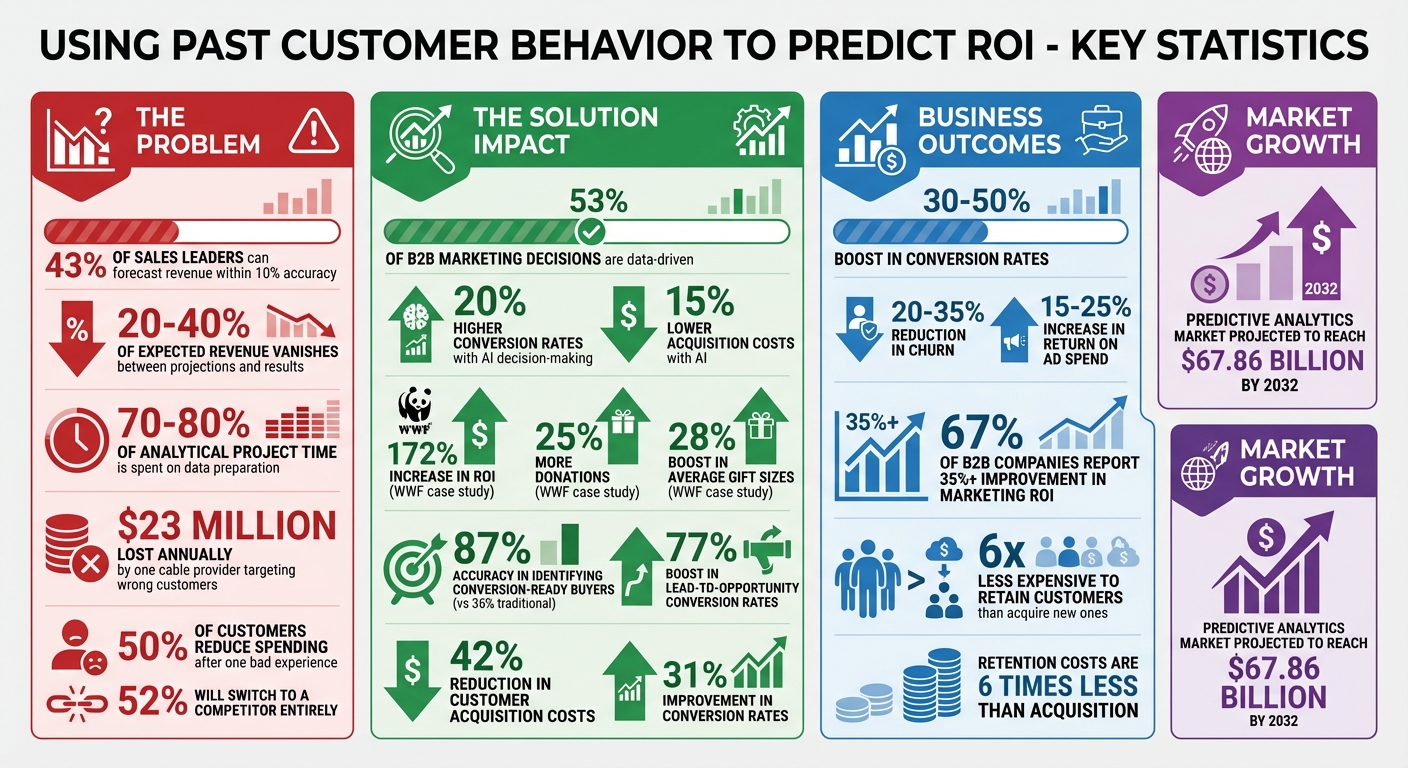
ROI Impact of Predictive Analytics: Key Statistics and Business Outcomes
When it comes to predicting ROI, many B2B leaders are flying blind. The numbers back this up: only 43% of sales leaders can forecast revenue within a 10% margin of accuracy [10].
What’s causing this disconnect? Traditional methods rely on isolated data points rather than analyzing behavioral trends over time. For instance, consider RFM analysis (Recency, Frequency, Monetary). While it provides a snapshot of how a customer is performing right now, it doesn’t account for how their engagement has evolved. A customer who made three purchases but is losing interest looks the same as one whose activity is steadily increasing when you’re only using static metrics [6].
Adding to the chaos, data often lives in silos - your CRM, email platform, and call recordings don’t naturally talk to each other. Teams spend hours trying to reconcile conflicting information. Richard Hren, Director of Product Marketing at SPSS, sums it up well:
"70% to 80% of the time devoted to an analytical project is devoted to data preparation" [2].
By the time your team has cleaned and organized the data, the moment to act has already passed. This is why integrating dynamic customer history into ROI forecasting is no longer optional - it’s essential.
The consequences of overlooking customer history go beyond missed forecasts - they hit your bottom line. Companies that fail to incorporate historical behavior data often see 20% to 40% of expected revenue vanish between initial projections and final results [9]. They overlook fluctuations and miss early warning signs hidden in customer interactions.
Take this example: A cable provider lost a staggering $23 million annually by targeting retention efforts at low-value customers [12]. On top of that, 50% of customers reduce their spending after just one bad experience, and 52% will switch to a competitor entirely [11][12].
On the flip side, organizations that embrace predictive modeling based on historical data see real results. WWF, for instance, saw a 172% increase in ROI, 25% more donations, and a 28% boost in average gift sizes after adopting this approach [2].
Ignoring customer history doesn’t just waste money - it drains time, resources, and opportunities. The gap between what you could predict and what you actually forecast is more than just a missed chance. It’s a direct handoff of revenue and competitive advantage to those who’ve mastered the art of reading the data.
To make accurate ROI predictions, you need a solid foundation of historical data. The real challenge lies in bringing together information from various systems - your CRM, email platform, website analytics, and support tools - all of which often produce data in different formats. By centralizing and aligning this data, you gain insights that static snapshots just can't provide.
Here are the key data categories you should focus on:
| Data Category | What to Track | Why It Matters |
|---|---|---|
| Purchase Behavior | Order frequency, order value, purchase dates | Helps uncover buying cycles and predict Customer Lifetime Value (CLTV) |
| Digital Engagement | Click-through rates, page drop-offs, search terms, CTA clicks | Indicates intent and identifies friction points in the customer journey |
| CRM/Sales Records | Deal history, firmographics, technographics, email interactions | Supports lead scoring and builds propensity-to-buy models |
| Customer Support | Ticket volume, resolution time, unresolved issues | Highlights churn risks and gauges customer satisfaction before problems escalate |
Purchase history is where it all starts. Metrics like Recency (how long since the last purchase), Frequency (how often purchases happen), and Monetary value (total spending) are essential for understanding customer behavior. While static RFM analysis gives you a snapshot, tracking how these metrics change over time provides a more dynamic picture.
On top of that, website and app interactions add an important layer of insight. Clickstream data - such as product views, search terms, page drop-offs, and clicks on calls-to-action (CTAs) - can reveal a customer's intent before they even make a purchase. This data helps pinpoint where potential customers get stuck and which touchpoints are driving conversions.
Your CRM is a goldmine of information, capturing every deal, email, and interaction. It also tracks firmographic details like industry, company size, and tech stack, all of which feed into models that predict which accounts are most likely to convert [14].
Campaign performance data adds another layer. Historical click-through rates and conversion metrics are invaluable for training models to predict which channels will deliver the best ROI in future campaigns [1]. Instead of relying on guesswork, you can use this data to simulate "what-if" scenarios and make smarter budget decisions.
Customer support data acts as an early warning system. For instance, SaaS companies often find that customers with multiple unresolved support tickets are far more likely to cancel within 30 days [1]. By analyzing ticket volume, response times, and overall sentiment, you can identify accounts that need immediate attention.
Interactions with your support team or chatbots also shed light on potential roadblocks in the sales process. The questions prospects ask often reveal sticking points that might be hindering conversions [15]. Tracking how these interactions evolve over time - what some call "segment route history" - provides a dynamic view of customer behavior. This approach is far more effective at predicting future value than relying on static snapshots [6].
Start by clearly defining your goal - whether it's predicting churn, forecasting deal sizes, or identifying cross-sell opportunities [17][18]. Using the historical customer behavior data we discussed earlier, these steps will help you create models that tackle the limitations of traditional ROI forecasting.
Focus heavily on data preparation. As Richard Hren, Director of Product Marketing at SPSS, points out:
"It's estimated that 70% to 80% of the time devoted to an analytical project is devoted to data preparation. It's just getting the data in the one place in the right form to actually start building models." [2]
This involves cleaning and organizing data from sources like your CRM, transaction logs, and support systems. You’ll need to handle missing data, remove duplicates, and standardize everything into a consistent format [16][2].
Next is feature engineering, where you create variables that reflect meaningful customer behaviors. Examples include purchase frequency, recency, monetary value, and engagement levels [17][6]. These variables help capture patterns that influence outcomes.
When it comes to model selection, choose an algorithm that aligns with your objective. For continuous variables like revenue or deal size, regression models are a good fit. For binary outcomes like churn versus retention, classification models (e.g., decision trees or random forests) are effective. Clustering can help group customers by shared characteristics, while time-series models are ideal for forecasting trends like demand or pipeline activity [16][18].
Validate your model using a hold-out sample before deploying it. This means testing it on data that wasn’t used during training. John Schwass, Director of Strategic and Financial Analysis at WWF, emphasizes why this step matters:
"I think our comfort level comes at the base level from how a model performs on that hold-out set. It's usually a pretty good indication if you're over-predicting or under-predicting or just mis-predicting." [2]
To gauge accuracy, track metrics like Precision, Recall, F1-score, and Area Under the ROC Curve (AUC-ROC) [3][17]. Once validated, integrate the model into your systems - such as your CRM, email platform, or marketing automation tool - and keep an eye on its performance. Customer behaviors change over time, so plan to retrain your model every 6 to 12 months [16][3]. With a validated model in place, the next step is to turn these predictions into actionable ROI metrics.
After validating your model, the key is to translate its outputs into ROI-focused insights. For example, a churn model can generate a churn risk score for each customer - a percentage that shows how likely they are to leave [17][18]. This allows you to focus retention efforts and budgets on high-risk accounts, avoiding unnecessary spending on customers who are likely to stay.
For revenue forecasting, use regression models to calculate predicted Customer Lifetime Value (CLTV) [16]. This metric helps you decide where to allocate acquisition budgets by estimating how much each customer is expected to spend over their relationship with your business.
Propensity scores are another powerful tool. These scores assign a probability to each customer for specific actions - such as making a purchase, referring others, or responding to a campaign [3][2]. Sales teams can prioritize leads using these scores, while marketing teams can direct budgets to the channels and segments with the highest likelihood of conversion, ensuring resources are spent wisely.
A real-world example comes from the World Wildlife Fund (WWF). In late 2007, they swapped their traditional RFM analysis for a predictive modeling approach in their direct mail campaigns. By targeting the top 25% of their list most likely to respond, they achieved a 172% higher ROI, 25% more donations, and a 28% higher average gift size compared to the previous year [2].
To keep improving, set up a feedback loop to track the outcomes of your actions. For instance, if you offer a discount to a customer flagged as high-risk for churn, monitor whether they stayed or left. Use this feedback to fine-tune your model [17]. Over time, this iterative process turns your predictive model into a reliable tool for optimizing ROI, with each cycle enhancing its accuracy and operational value.
Once your predictive models are validated, it's time to put them to work. These models can help you retain customers, boost their value, and fine-tune your campaigns - especially in high-stakes B2B environments.
Knowing which customers are likely to leave before they actually do gives you a chance to step in and keep them on board without overspending. Retaining customers is estimated to cost six times less than acquiring new ones [13]. Yet, churn rates can still hit as high as 70% for some customer groups [13]. In B2B settings, warning signs of churn often include reduced product usage, recurring billing or payment issues, negative interactions with support teams, and shifts in purchasing habits [17].
Machine learning can sort customers into risk categories - like high-risk, moderate-risk, or loyal - by analyzing demographic, purchase, and usage data [8]. This segmentation allows you to allocate retention resources where they’ll have the most impact. As Eric Siegel, President of Prediction Impact Inc., explains:
"Retention, to be effective, is generally going to incur costs... so you can't offer it to everybody. By creating a model that will determine the probability that a customer will renew... you don't waste the offer on somebody who's going to stay anyway." [2]
For high-risk accounts, proactive steps like targeted offers or preemptive support can make a big difference. In B2B SaaS or consulting, tracking "value realization" is key - if a customer isn’t meeting usage goals, step in with extra guidance or resources [17]. Modern tools can even automate these interventions based on real-time updates, keeping customers engaged without requiring constant manual effort [13].
Once you’ve addressed churn risks, you can turn your attention to increasing the value of each customer.
Predictive models can estimate the total revenue a customer is likely to bring over the course of their relationship with your business. This insight helps you focus resources on accounts that promise the highest returns [20][6]. By analyzing CLTV across different customer segments, you can craft tailored service packages and pricing strategies to maximize profits [20].
Taking it a step further, dynamic micro-segmentation updates customer groups based on evolving behavior patterns, often referred to as "segment route history" [6]. This approach enables teams to predict specific actions, such as whether a customer might refer others, accept an upsell, or even churn [3].
For B2B companies, this means prioritizing high-potential accounts during sales planning. Sales reps can focus on prospects with the highest revenue potential, making their efforts more efficient [3]. Additionally, predicted lifetime value can be shared with ad networks via APIs to implement "Value Optimization" strategies. This shifts your acquisition efforts from targeting average prospects to honing in on high-value ones [20].
Once you’ve identified your most promising customers, the next step is refining your marketing campaigns to make the most of these opportunities.
Predictive insights can help you stretch your marketing budget further by pinpointing prospects most likely to convert and identifying the best-performing channels. Propensity-to-buy modeling leverages firmographic, technographic, and historical data to rank prospects by their likelihood to purchase [3].
Instead of standard A/B testing, predictive models can help you choose the best offer or message for each customer. This approach, sometimes called "A/B selection", allows you to personalize at scale without the need for manual segmentation [2].
Lookalike modeling is another powerful tool. It enables you to find new audiences by targeting people who resemble your highest-value customers. Platforms like Facebook use this method to identify similar audiences, helping you lower acquisition costs while increasing reach [7]. Additionally, AI tools can optimize ad placements, bidding strategies, and audience targeting in real time [19].
To get the most out of these insights, consolidate data from your CRM, transaction history, and customer engagement into unified profiles [7][19]. Regularly update your models - every six to twelve months - to reflect market changes [3]. And always validate predictions with hold-out sets before rolling them out fully [2]. By channeling your budget toward the most promising customers and platforms, you can reduce waste and maximize your campaign ROI.
For leaders in B2B sectors like finance, real estate, and consulting, predicting ROI often hinges on uncovering the relationships that drive revenue. Visora’s Trifecta Program combines AI-powered tools with strategic advisory services to analyze historical customer behavior, enabling more precise ROI forecasting. With these insights, the program deploys customized AI solutions through three interconnected components, designed to identify high-value opportunities and simplify the acquisition process.
The B2B Vortex Funnel goes beyond basic firmographic data, using predictive scoring based on a wide range of behavioral inputs. This method identifies "conversion-ready" buyers with an impressive 87% accuracy rate, compared to just 36% for traditional approaches [21]. It prioritizes prospects showing strong buying signals, such as specific website activity, email engagement, and interactions on social media.
Companies adopting this predictive lead scoring method have seen an average 77% boost in lead-to-opportunity conversion rates [21]. For instance, Visora partnered with a corporate finance firm and uncovered a $50 million partnership opportunity in just 45 days. The system continuously refines its predictions by learning from past outcomes, ensuring it remains effective over time.
Building on the B2B Vortex Funnel, Visora’s appointment-setting tool automates the timing of outreach. By analyzing predictive buying intent, it detects subtle micro-signals that indicate readiness and selects the best channel, message, and timing for engagement [21].
Additionally, generative AI enables the creation of personalized emails and sales materials at scale, eliminating the need for manual customization. This efficiency can reduce customer acquisition costs by an average of 42% and improve conversion rates by 31% [21]. One notable example is a real estate syndicate that worked with Visora to generate $2.25 million in new project and partnership opportunities within 45 days by targeting high-potential accounts at precisely the right moment.
Visora’s strategic consulting service translates predictive insights into actionable strategies that drive ROI. This layer turns model outputs into decisions about budgets and campaigns, reinforcing the predictive framework. The team uses predictive customer lifetime value (PCLV) modeling to estimate the future value of prospects, guiding smarter budget allocation [21]. They also rely on attribution modeling to track every touchpoint in the often lengthy B2B sales cycles [21].
This data-driven approach allows for real-time reallocation of marketing spend to high-performing campaigns [22]. Chris Salazar, a marketing executive at UnboundB2B, emphasizes the importance of this capability:
"In 2025, CMOs who cannot show that link between spend and revenue will see budgets shrink" [22].
It’s no surprise that 67% of B2B companies using predictive AI report over a 35% improvement in marketing ROI [21]. For example, Visora’s combination of predictive modeling and strategic advisory helped a private equity firm uncover $20 million in new partnership opportunities over just 180 days.
Transforming historical customer behavior into future forecasts can lead to smarter marketing decisions and measurable results - like a 30–50% boost in conversion rates, a 20–35% reduction in churn, and a 15–25% increase in return on ad spend [23]. Knowing which prospects are likely to convert, which customers are at risk of leaving, and which campaigns will succeed directly impacts your bottom line.
Shifting from descriptive analytics (understanding what happened) to predictive analytics (anticipating what will happen) allows for more precise budget allocation. By pinpointing accounts with strong buying signals and identifying the best times for outreach, businesses can protect profit margins while improving campaign ROI [4]. This forward-looking approach transforms raw data into actionable insights that drive results.
These predictive capabilities translate into real-world applications. For instance, Visora's Trifecta Program leverages historical customer data to generate revenue-driving predictions. By combining tools like the B2B Vortex Funnel, AI-Augmented Appointment Setting, and DD Strategy Consulting, this program offers a complete framework designed to support sustained profitability.
The market for predictive analytics is growing fast, with projections estimating its value will reach $67.86 billion by 2032 [5]. Businesses that can clearly link marketing spend to revenue are poised to secure larger budgets and gain market share. Meanwhile, those clinging to outdated forecasting methods risk falling behind. The priority now is clear: adopting predictive modeling quickly to stay competitive.
Predictive analytics plays a key role in helping businesses keep their customers by using historical data to predict future behaviors and preferences. By examining past interactions, purchase patterns, and engagement levels, companies can identify customers who might be on the verge of leaving and take action to win them back.
For instance, machine learning models can flag customers likely to churn. With this insight, businesses can step in with personalized offers or targeted communication to rekindle their interest. Beyond retention, predictive analytics also helps companies anticipate what their customers might need next, allowing for more tailored marketing and relevant experiences. This approach not only strengthens customer loyalty but also helps reduce churn over time.
To create predictive models that accurately forecast ROI, you need to combine historical customer data with behavioral insights. Start with key data points like past customer interactions - clicks, views, and purchase history. These reveal trends and patterns that are invaluable for understanding customer behavior.
Dig deeper by incorporating firmographic and psychographic data. This includes demographic details, technology preferences, and the motivations driving your audience. Together, these insights provide a clearer picture of your customer segments.
Real-time behavioral signals, such as how customers engage with marketing channels or respond to campaigns, add another layer of precision. These signals capture current preferences and help refine your models. By applying machine learning to this rich dataset, businesses can predict actions like the likelihood of a purchase or the risk of churn. This makes it possible to craft highly targeted marketing strategies that deliver measurable ROI.
By examining previous customer behavior, businesses can uncover patterns and trends like how often customers make purchases, what they prefer, and potential signs of churn. These insights pave the way for creating more precise ROI predictions by anticipating future actions and spotting areas to refine marketing strategies.
When businesses have a detailed understanding of customer interactions, they can adjust campaigns to reach the right audience, cut down on unnecessary spending, and boost overall returns. This data-focused method ensures resources are used wisely, fueling growth both in the immediate and distant future.
%20(5).png)
