%20Bold.png)
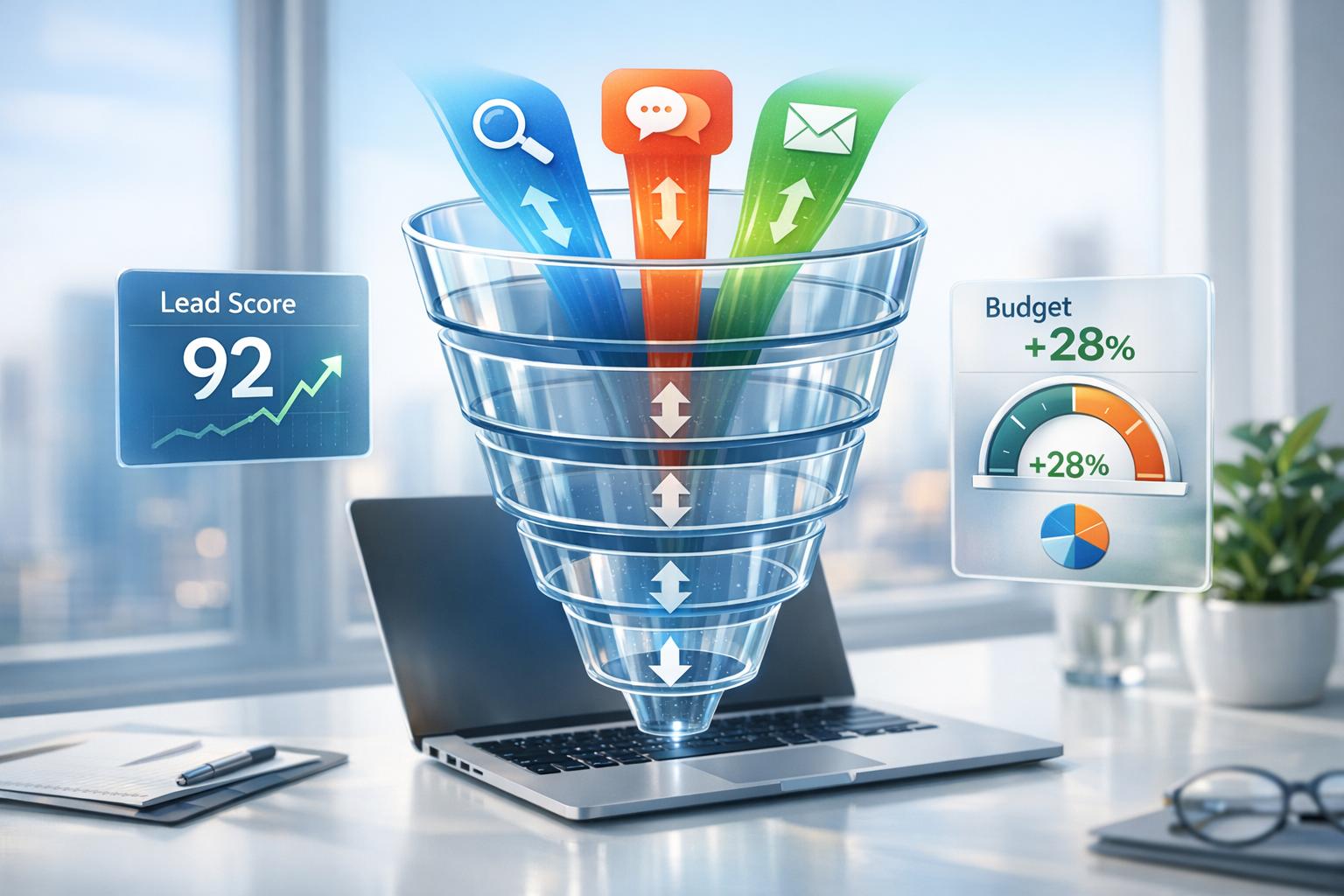
AI is transforming how businesses acquire customers by cutting costs and improving efficiency. Companies using AI-driven tools report a 37% reduction in Customer Acquisition Costs (CAC), thanks to smarter targeting, predictive lead scoring, and automated personalization. Traditional methods often waste budgets on unqualified leads, while AI ensures marketing dollars are spent on the right prospects.
AI also automates repetitive tasks like bid adjustments, A/B testing, and outreach, saving time while improving results. Companies adopting AI see faster deal cycles, better targeting precision, and lower acquisition costs overall.
Customer Acquisition Cost (CAC) refers to the total amount a company spends to bring in one new customer. This figure includes all marketing and sales-related expenses during a specific time period [8]. For B2B companies, CAC is a crucial metric that sheds light on profitability, scalability, and overall financial health [8].
"CAC is the number that ends fundraising conversations early. Investors look at it before LTV, before revenue growth, sometimes before anything else." - TechBullion [6]
The difference between a business that thrives and one that struggles often comes down to accurately calculating CAC. While some companies only track "Paid CAC" (focusing solely on ad spend), "Blended CAC" gives a fuller picture by factoring in additional costs like salaries, agency fees, software, creative production, sales commissions, and overhead [8][3]. For instance, a campaign showing a $50.00 Paid CAC might actually cost $200.00 when all expenses are considered [8]. Properly measuring CAC is critical, especially when using AI tools to fine-tune marketing investments.
For healthy B2B operations, the Lifetime Value (LTV) to CAC ratio should ideally be 3:1 or higher. A ratio of 1:1 or lower means you're losing money with every customer [8]. Additionally, the payback period - how long it takes to recover CAC through customer revenue - should stay under 12 months to maintain steady cash flow, particularly in B2B SaaS businesses [8].
To calculate CAC accurately, use the fully loaded formula, which accounts for all related expenses:
CAC = (Total Sales & Marketing Spend + Tools + Salaries + Overhead) ÷ New Customers Acquired [3]
For example, if a company spends $50,000.00 on ads, $30,000.00 on marketing salaries, $10,000.00 on software tools, and $10,000.00 on overhead in one quarter and acquires 50 new customers, the CAC is $2,000.00 - not just the $1,000.00 from ad spend alone.
Breaking down CAC by channel is also insightful. For instance, LinkedIn might show a $200.00 CAC, while organic content delivers a $50.00 CAC [3]. This detailed analysis helps businesses allocate resources more effectively, prioritizing high-performing channels over less efficient ones. Such precision is key to identifying and addressing common CAC tracking challenges.
One major issue is incomplete cost tracking. Ignoring expenses like marketing salaries or software tools can lead to overly optimistic CAC figures [8]. Another common mistake is relying solely on last-click attribution, which overlooks the value of earlier touchpoints that create demand [6].
Manual analysis of CAC is another roadblock. Traditional methods often require 12–18 hours of spreadsheet work, making it difficult to act quickly on insights [4]. By the time inefficiencies are spotted, budgets may have already been wasted.
Creative fatigue is another hidden factor. As ad performance declines over time without regular updates and testing, CAC naturally increases [6]. Long B2B sales cycles further complicate tracking, as expenses and customer acquisition often span multiple months, making it hard to align costs with results [8].
Lastly, there's the challenge of "dark matter" in attribution. With 67% of the buyer journey now happening in private AI-driven conversations on platforms like ChatGPT, Claude, and Perplexity, traditional tracking tools struggle to capture these interactions [10]. This often results in misattribution, where successful leads are marked as "Direct" traffic, obscuring the actual source. Addressing these challenges is essential for using AI to refine attribution models and optimize spending decisions effectively.
Traditional attribution models often rely on guesswork when it comes to assigning revenue to various marketing channels. AI takes the guesswork out of the equation by analyzing the entire customer journey - not just the first or last interaction - and accurately crediting each channel based on its real contribution. Without this level of precision, an estimated 26% of digital marketing budgets is wasted [15].
Businesses adopting AI-powered attribution report an average 27% boost in campaign performance across channels. Additionally, moving from single-touch to multi-touch attribution brings an average 22% increase in budget efficiency [15]. AI also dramatically reduces the time needed for manual analysis, cutting it from 25–40 hours to just 3–6 hours [14]. By shifting to this multi-touch approach, companies can leave outdated models behind and allocate their budgets more effectively in real time.
Last-click attribution tends to overemphasize bottom-funnel channels like branded search while completely overlooking the awareness campaigns that spark interest at the beginning of the buyer journey. AI changes this by replacing static, rule-based models with probabilistic frameworks like Markov Chains, which calculate the true impact of every touchpoint [11][13]. Instead of assigning all the credit to a single interaction, AI examines the entire journey, including "assists" - those touchpoints that generate demand without directly leading to a conversion. This is particularly vital in B2B sales, where journeys often include 600–3,000+ touchpoints [11][12][13].
"If you're still using last-click for budget decisions, you're flying blind while competitors have instruments." - Synergist Digital Media [16]
For enterprise-level sales, a W-shaped attribution model can be a great starting point. This model captures the first touch, key interactions in the middle of the funnel, and the final conversion [13]. Smaller businesses with at least 400 monthly conversions can use the free data-driven attribution feature in Google Analytics 4 as an entry-level solution [16]. These improved models don’t just refine attribution - they also lower customer acquisition costs (CAC) by ensuring budgets focus on channels with a proven return on investment. This sets the stage for continuous budget adjustments, as explored in the next section on real-time data analysis.
AI-powered machine learning evaluates key metrics like channel spend, conversion rates, sales cycle length, and revenue data to identify which touchpoints drive results and which inflate CAC [4][17]. With this insight, businesses can dynamically reallocate budgets in real time - shifting funds from underperforming channels to those that initiate high-value customer journeys [15][4]. This approach can boost overall return on ad spend (ROAS) by 23% [15].
A practical budget allocation strategy might look like this: dedicate 60–70% of the budget to proven high-performing channels, 20–30% to areas with optimization potential, and 10–15% to experimenting with new channels [16]. To measure success, businesses should monitor metrics like "Attribution Accuracy" (aim for 90%+), "Touchpoint Coverage" (target 100%), and "Model Confidence" [14][4]. Implementing standardized UTM tracking and server-side parameters can improve data accuracy by 13–27% [15], which is critical as the deprecation of cookies threatens to disrupt 78% of current attribution setups by 2026 [15].
Traditional BANT scoring uses fixed rules, but predictive analytics takes it up a notch by analyzing patterns from thousands of data points. This approach pinpoints the top 10–20% of leads that drive 80% of revenue [18]. Companies leveraging AI in sales have seen impressive results, generating over 50% more leads and appointments while slashing sales costs by 40–60% [18].
Switching to AI-driven models brings tangible benefits. Conversion rates increase by 25% to 75% [18], and high-value prospects are identified 3–5 times more accurately compared to outdated demographic-based methods [9]. This precision doesn't just boost efficiency - it also cuts customer acquisition costs (CAC) by 35–60% [9]. AI's ability to offer insights into behavior and intent takes targeting to a whole new level.
"The highest-value use case for AI scoring is not finding more buyers. Revenue acceleration comes from de-prioritizing leads that will never convert, freeing capacity for genuine opportunities." - Malay Gupta, growleads.io [18]
AI works by analyzing three key data layers simultaneously: firmographic signals (like company size and industry), behavioral engagement (such as email opens or website activity), and third-party intent data (like researching competitors or industry terms) [18]. This multi-layered approach identifies buying intent even before a lead engages directly [9].
For instance, AI can flag high-fit accounts early, enabling marketers to focus their media budgets and sales efforts on the most promising prospects [1]. It even detects complex behavioral patterns - like visiting pricing pages followed by feature pages - which can indicate a 300%+ higher likelihood of conversion [9]. Acting on these insights quickly is critical: responding to high-intent leads within 5 minutes makes qualification 21 times more likely compared to waiting an hour [18].
To implement AI effectively, you'll need 12–24 months of historical data covering customer journeys, touchpoints, and conversions [3]. Models should be refreshed every 10–30 days to stay accurate. High-scoring leads (80–100) should be routed with a 5-minute response SLA, while lower-tier leads can be placed in automated nurture workflows [18]. Aim for at least 70% predictive accuracy (measured by metrics like AUC or precision/recall) before rolling out the system at scale [18].
AI also refines targeting through dynamic lookalike modeling. Unlike traditional static models that rely on demographics, dynamic models continually update based on new conversion data [9]. This process involves analyzing top-performing customers - focusing on their behaviors, engagement patterns, and conversion pathways - to identify prospects with similar traits [7][2].
The secret to success lies in seeding these models with data from your highest Lifetime Value (LTV) customers, rather than just any converted lead [3]. Segmenting lookalike audiences based on specific actions, like demo requests or high-value purchases, sharpens targeting even further [9]. Negative audience refinement - using AI to exclude patterns linked to non-converting traffic - can cut wasted impressions by 60–75% [9].
Using intent data and first-party insights is a game-changer. Companies adopting these methods have seen CAC reductions of 30–50% [19]. AI-powered systems that self-optimize in real-time eliminate 70–80% of ad spend waste by constantly refining targeting parameters [9]. The trend is clear: B2B teams are shifting from chasing high volumes of Marketing Qualified Leads (MQLs) to building precision-focused pipelines that prioritize MQL-to-SQL conversion rates and pipeline velocity [18]. It's no wonder that 93% of B2B marketers now incorporate intent data into their strategies, reporting 38% higher win rates as a result [18].
AI is reshaping how marketing teams approach personalization and conversion optimization. By automating processes, it allows for tailored messaging, ad targeting, and layout adjustments in real time - without requiring additional team members. Companies leveraging AI for personalization have reported a 25% boost in conversion rates [7][19]. At the same time, AI-powered marketing solutions are reducing customer acquisition costs (CAC) by 37% on average, thanks to faster lead conversion [7].
One of the biggest challenges marketers face is manual segmentation, with 74% identifying it as a major barrier to maximizing ROI from promising campaigns [21]. AI eliminates this roadblock by analyzing massive datasets to create thousands of dynamic micro-segments. This ensures relevance at every interaction while keeping labor costs steady.
"AI isn't a shortcut. It's a multiplier. The most efficient B2B teams aren't chasing shiny tools, they're using AI to align efficiency with revenue." - pharosIQ [1]
AI takes personalization to the next level by analyzing a mix of firmographic data (like company size and industry), behavioral signals (such as page visits and email opens), and intent indicators (like time spent on specific content). Through this, it enables Dynamic Creative Optimization (DCO), which tests hundreds of ad variations simultaneously. The system automatically promotes the best-performing combinations of visuals and copy. DCO has been shown to improve conversion rates by 25% to 40%, while click-through rates can see a 35% to 60% lift through algorithmic adjustments [5][7].
Real-time landing page adjustments are another game-changer. AI tweaks value propositions, CTAs, and content based on a visitor's profile - factors like their industry or previous browsing behavior. For instance, a SaaS company might display finance-related case studies to visitors from financial services while showcasing real estate-specific examples to others. This approach has the potential to increase conversion rates by 15% to 30% and reduce bounce rates by 25% [7][19].
AI also enhances email workflows by analyzing individual engagement patterns. Instead of sending emails at fixed times, it optimizes send times and content for each recipient. This level of personalization can boost engagement rates by up to 74% [19][20], with open rates improving by 20% to 35% through predictive send-time optimization [7].
AI simplifies A/B testing by continuously rotating ad creatives and quickly identifying top-performing variations. It minimizes time spent on underperforming options while making real-time adjustments. This process can reduce ad waste by up to 30% [20].
In addition to testing, AI-powered bid management automates budget adjustments. Machine learning algorithms allocate spending to high-converting keywords and audiences while cutting back on ineffective segments. These systems dynamically distribute budgets across platforms like Google, Meta, and LinkedIn, directing funds to the channels with the lowest CAC at any given moment [6]. By refining targeting and reallocating resources, AI can eliminate 70–80% of ad spend waste [9].
The benefits extend beyond just campaign performance. By automating repetitive tasks like bid adjustments and reporting, AI saves marketers an average of 2.3 hours per campaign [19]. Financially, marketing automation delivers a return of $5.44 for every $1 invested [19]. AI-driven strategies also increase lead volume by 80% [19], with 86% of marketers reporting significantly lower CAC and 84% recovering more lost conversions through AI-powered retargeting [21].
Visora combines AI attribution, predictive analytics, and automated outreach to help B2B leaders in industries like investment firms, finance, real estate, SaaS, and consulting turn AI-driven insights into tangible pipeline results. Their strategy focuses on connecting marketing spend directly to outcomes, removing guesswork and reducing wasted budgets. By leveraging predictive modeling, Visora reallocates resources to the most effective channels in real time. This approach reveals connections between organic, paid, and account-based strategies that traditional attribution methods often overlook [1]. The backbone of this system is their Trifecta Program, which ensures structured and actionable execution.
Visora’s Trifecta Program is built around three essential components:
Visora’s Founder and Managing Partner, Danny Kim, brings a wealth of experience from his time leading growth initiatives at Deloitte for Fortune 500 companies like Meta, Disney, and Amazon. Under his leadership, Visora has achieved impressive outcomes:
These achievements include collaborations with executives from Citi Group, Morgan Stanley, Boston Consulting Group, NYC Housing Authority, Christie's, Kushner, and Sotheby's.
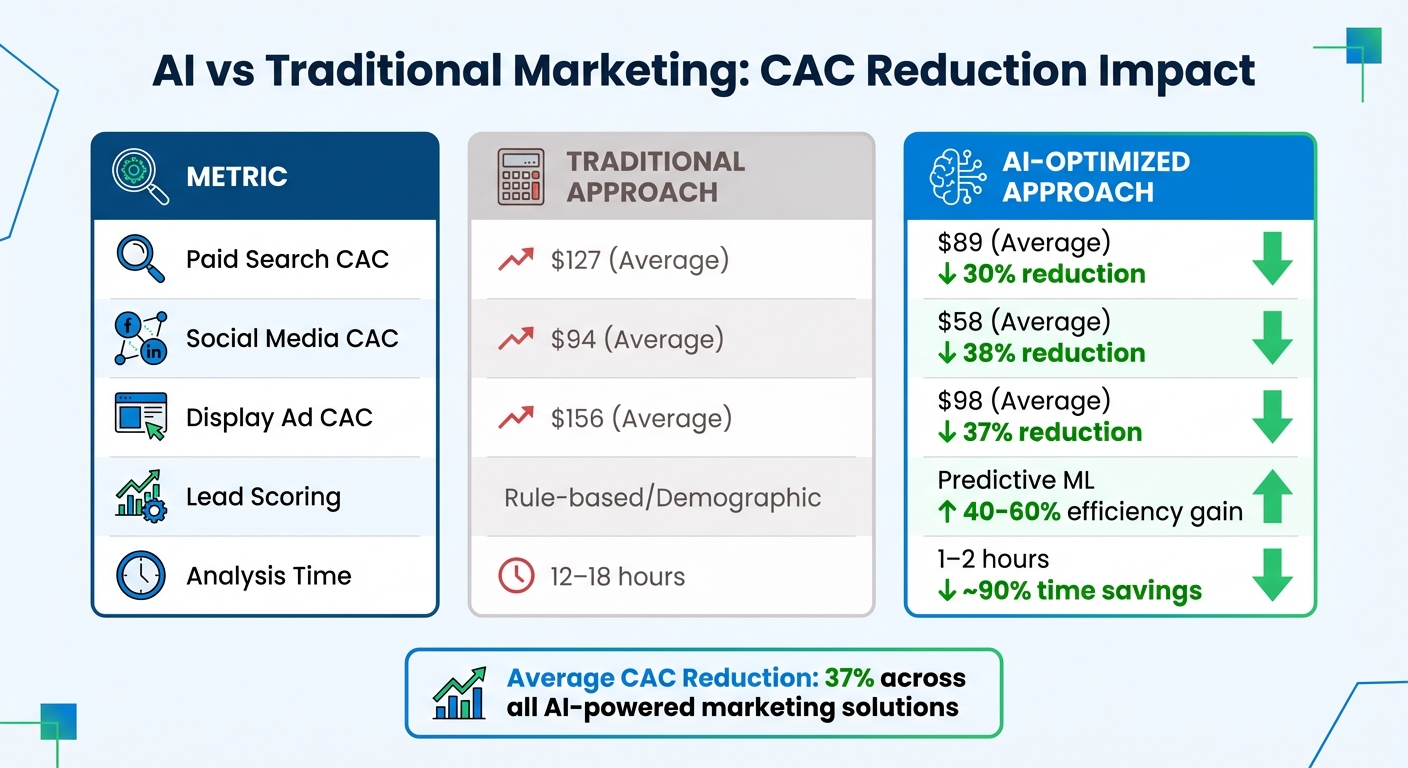
AI vs Traditional Marketing: CAC Reduction Impact Across Key Metrics
Tracking the right metrics is what sets apart businesses that simply use AI from those that actually cut acquisition costs. To get the most out of AI, combine Blended CAC (total acquisition cost across all channels) with channel-specific CAC. This approach helps pinpoint exactly where AI is driving efficiency. But don’t stop at volume - Quality-Adjusted CAC goes a step further by factoring in acquisition costs relative to predicted Customer Lifetime Value (CLV). This ensures your budget targets high-value customers, not just a high number of leads.
On average, companies using AI-powered marketing solutions see a 37% drop in CAC[7]. To replicate these results, monitor key metrics beyond just cost-per-acquisition. For instance, track conversion velocity - how quickly prospects move through your sales funnel. AI tools like lead scoring and personalization can speed up this process, reducing the time it takes to close a deal.
Another important metric is operational efficiency. AI can cut the time spent analyzing CAC from 12–18 hours down to just 1–2 hours[4]. This frees up your team to focus on strategy rather than getting stuck in manual data crunching.
| Metric | Traditional Approach | AI-Optimized Approach | Improvement |
|---|---|---|---|
| Paid Search CAC | $127 (Average) | $89 (Average) | 30% reduction [5] |
| Social Media CAC | $94 (Average) | $58 (Average) | 38% reduction [5] |
| Display Ad CAC | $156 (Average) | $98 (Average) | 37% reduction [5] |
| Lead Scoring | Rule-based/Demographic | Predictive machine learning | 40–60% sales efficiency gain [7] |
| Analysis Time | 12–18 hours | 1–2 hours | ~90% time savings [4] |
Set up automated alerts to track CAC drift - when your acquisition costs exceed historical averages or predicted thresholds. Use your fully loaded CAC as a baseline to catch these changes early[3].
These metrics create a foundation for real-time tracking and better data integration.
To track these metrics effectively, you need to break down data silos between your CRM, advertising platforms, website analytics, and email systems. AI-driven identity resolution models help connect fragmented data across these tools, giving you a unified view of the customer journey[1].
This unified data approach moves beyond outdated last-click attribution models. It also supports Multi-Touch Attribution (MTA)[3], which credits underappreciated touchpoints like email campaigns and content marketing[7]. Modern no-code analytics platforms can link all your marketing data sources in as little as 15 minutes, giving you instant visibility into CAC across channels[3].
Make sure these AI-driven insights integrate directly into your CRM (e.g., Salesforce, HubSpot). This allows for automatic routing of prospects based on AI-calculated propensity scores, removing delays caused by manual processes[1].
Using AI for multi-channel attribution transforms customer acquisition into a precise and efficient process. By moving away from outdated models and embracing real-time data analysis, businesses can identify exactly where their marketing investments yield the best returns. Predictive lead scoring helps uncover high-value prospects before competitors even notice, while automated personalization ensures every interaction feels tailored - without the need for time-consuming manual effort.
These advancements drastically cut customer acquisition costs (CAC) and reduce analysis time from hours to just minutes, allowing teams to focus on strategic goals instead of getting bogged down in spreadsheets.
For industries like investment firms, finance, real estate, SaaS, and consulting, solutions like Visora's Trifecta Program offer a way to leverage AI for business development. This program combines buyer-intent multi-channel campaigns, private market intelligence, and advanced CRM tools to help firms build proprietary deal flow in just 12 weeks. By targeting high-fit relationships and shortening deal cycles, Visora enables businesses to move beyond reliance on referrals, heavy ad spending, or large teams.
The key shift here is moving from a volume-based approach to one focused on precision. Companies that treat CAC as an ever-optimized system - using automated processes to test and refine strategies - are the ones gaining a competitive edge. Whether it’s through a pilot project or a full-scale rollout, AI is the clear path to achieving lower acquisition costs and better results.
To make the most of AI in reducing your customer acquisition cost (CAC), start by collecting key data points: your marketing and sales expenses, lead quality, conversion rates, and multi-channel attribution. On top of that, monitor real-time customer behavior and the performance of your campaigns. With this critical information, AI can pinpoint inefficiencies and fine-tune your acquisition strategies for better results.
To better track attribution in an era where buyers increasingly rely on AI tools like ChatGPT, consider using AI-driven multi-touch attribution models. These models leverage machine learning to break down complex customer journeys, analyzing interactions across multiple sessions, devices, and channels. By pinpointing the most impactful touchpoints, they help you understand what truly drives conversions.
On top of that, it's essential to set up tracking systems capable of capturing mentions and citations of AI tools. Traditional tracking methods often overlook these interactions, leading to gaps in your data. By addressing this, you'll ensure credit is allocated accurately, allowing you to refine your strategies with confidence.
Track metrics such as CAC payback period, LTV:CAC ratio, CAC trend accuracy, and multi-channel attribution accuracy. These metrics help assess how effectively AI contributes to improving efficiency, boosting profitability, enhancing trend reliability, and refining attribution accuracy. Together, they provide a clear picture of AI's impact on managing and reducing customer acquisition costs.
%20(5).png)
