%20Bold.png)

Most leads aren’t ready to buy - but intent data helps you focus on the ones who are. By analyzing online behaviors like website visits, content downloads, and search queries, intent data pinpoints which prospects are actively researching solutions like yours. This allows you to engage earlier, shorten sales cycles, and improve win rates.
Here’s what you need to know:
Key steps to leverage intent data:
Intent-driven strategies aren’t just helpful - they’re essential for staying competitive in today’s B2B landscape.
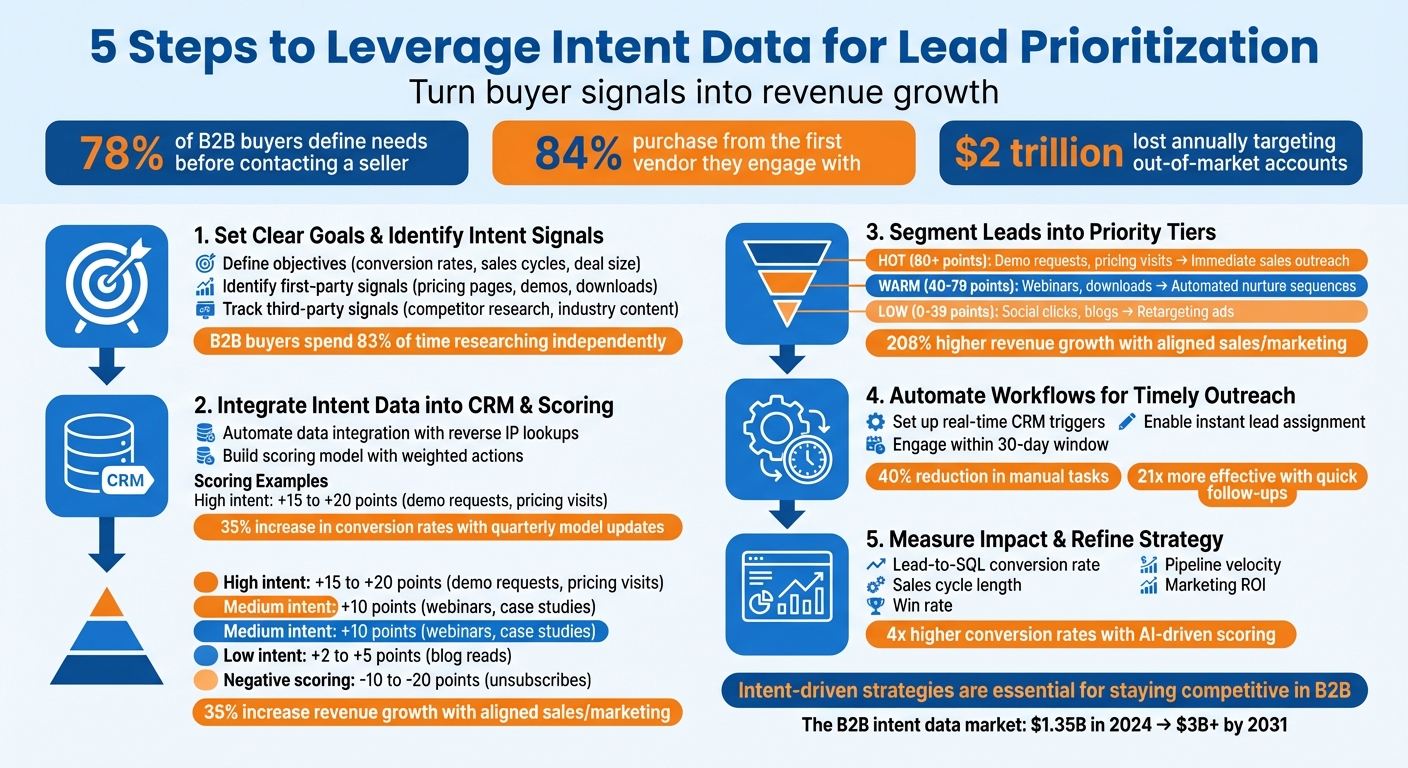
5 Steps to Leverage Intent Data for Lead Prioritization
Before you can effectively prioritize leads, it’s crucial to define your objectives. Without clear goals, your data can quickly become overwhelming and unhelpful. Start by analyzing your historical conversion data - look for patterns among the leads that closed quickly. What traits or behaviors did they share? This analysis will help you pinpoint the intent signals that matter most for your business.
Your goals should be both specific and measurable. For example, you might aim to increase conversion rates, shorten sales cycles, or boost your average deal size. A great example of this comes from Chargebee, which implemented a full-funnel, intent-based marketing strategy. By targeting high-fit accounts, they achieved an impressive 300% growth in their new sales pipeline.
To make this approach work, combine intent signals with firmographic data to zero in on high-fit leads. Your Ideal Customer Profile (ICP) should include filters like industry, company size, revenue range, and location. Jenny Thai from Clearbit explains the importance of this alignment:
"Your ICP shows who you want. Intent data shows who wants you. When the prospect you want wants you back, it's a perfect match".
This alignment ensures your focus remains on leads that have the highest potential to drive revenue.
Intent signals generally fall into two categories: first-party and third-party.
First-party signals come directly from your own digital assets. These include actions like visiting pricing pages, downloading case studies, opening emails, requesting demos, or conducting internal site searches. For instance, if a lead visits your pricing page twice in one day, that’s a strong indicator of interest and might warrant immediate follow-up.
Third-party signals, on the other hand, provide insight into activity happening outside your ecosystem. These might include prospects comparing your solution to competitors on review sites like G2, engaging with industry-specific content on publisher networks, or searching for related keywords online. These behaviors can help you identify buyers early in their journey. Keep in mind that B2B buyers spend approximately 83% of their time independently researching solutions before ever reaching out to a salesperson.
Once you've pinpointed the key intent signals, the next step is to integrate this data into your CRM. This creates a centralized space where your sales team can quickly identify which leads are actively showing buying intent. To put things into perspective, the B2B intent data market hit $1.35 billion in 2024 and is expected to surpass $3 billion by 2031.
Automating the integration process is essential. Tools like reverse IP lookups can identify the companies visiting your website - even if they haven't filled out a form. This information is then synced into your CRM on a regular basis, typically daily or weekly.
To ensure you're focusing on the right leads, use your Ideal Customer Profile (ICP) filters. By applying criteria such as company size, industry, and job role, you can narrow down the data to qualified accounts only. This step is especially important given that 77% of B2B buyers prefer to complete their own research before engaging with a salesperson. Starting with the right accounts saves time and resources.
Incorporate both first-party and third-party intent signals into your CRM. This provides your sales team with a well-rounded view of each lead's readiness to buy. Platforms offering real-time updates are particularly valuable - when a prospect's behavior changes, their score should adjust immediately within your CRM.
By streamlining this data integration, you lay the groundwork for a lead scoring system that truly works.
Lead scoring is all about assigning the right weight to different actions. For instance, high-value actions like demo requests or visits to your pricing page might earn scores of +15 to +20, while lower-value actions like reading a blog post might only add +2 to +5.
Negative scoring is equally important. Actions like unsubscribing from emails or visiting your careers page should deduct points (e.g., -10 to -20) to help your team avoid wasting time on leads that aren't potential buyers.
Time decay is another key feature - recent behaviors should carry more weight than older ones. Companies that update their lead scoring models quarterly report a 35% increase in conversion rates, while those using AI-driven scoring see a 40% improvement in sales efficiency.
Define clear thresholds for when a lead transitions from a Marketing Qualified Lead (MQL) to a Sales Qualified Lead (SQL). This triggers automated notifications for your sales team, ensuring timely follow-ups. When sales and marketing teams align on these criteria, businesses can achieve 208% higher revenue growth from priority leads.
| Intent Signal Type | Example Action | Score Weight |
|---|---|---|
| High Intent | Demo Request / Pricing Page Visit | +15 to +20 |
| Medium Intent | Webinar Attendance / Case Study Download | +10 |
| Low Intent | Social Media Click / Blog Post Read | +2 to +5 |
| Negative Intent | Unsubscribing / Visiting Careers Page | -10 to -20 |
Once you've established a lead scoring model, the next step is to organize leads into distinct priority tiers. This system ensures your team allocates time and resources where they’ll make the most impact. By segmenting leads, you can design outreach strategies tailored to each group, driving better engagement and results.
A simple three-tier system works well here. Hot leads (scoring 80+ points) are those showing strong buying intent - think demo requests, frequent visits to pricing pages, or even researching your competitors on platforms like G2 or Capterra. Warm leads (40–79 points) are in the consideration phase, engaging with webinars, downloading whitepapers, or frequently checking out your product pages. Low leads (below 40 points) are just beginning their journey, exploring blog posts or clicking on social media links.
To rank leads effectively, combine behavioral signals with firmographic alignment. For example, a lead with strong intent but poor alignment with your ideal customer profile (ICP) should rank lower than a lead with both high intent and a strong ICP match. Companies that align sales and marketing on these criteria see 208% higher revenue growth from priority leads.
| Lead Tier | Score Threshold | Key Intent Signals | Recommended Action |
|---|---|---|---|
| Hot | 80+ Points | Demo requests, pricing page visits, competitor comparisons | Immediate personalized sales outreach |
| Warm | 40–79 Points | Webinar attendance, whitepaper downloads, repeated site visits | Automated nurture sequences |
| Low | 0–39 Points | Social media clicks, top-of-funnel blog reads | Retargeting ads and monitoring |
Each tier requires a unique approach to outreach. Hot leads demand speed and precision. Since 84% of B2B buyers purchase from the first seller they connect with, quick, personalized outreach is critical. Forward these leads to sales reps immediately for customized demos that address their specific needs.
For Warm leads, focus on nurturing. Automated workflows that share case studies, customer success stories, and feature comparisons can help guide them toward a decision. Retargeting ads on platforms like LinkedIn ensure your brand stays top of mind while they continue their research. Remember, B2B buyers spend 83% of their time researching independently, so providing the right content at the right time is key.
Low leads require a long-term strategy. Keep them engaged with ongoing awareness campaigns, such as monthly newsletters, educational webinars, and industry insights. Retargeting ads can help maintain visibility without overwhelming them. While they may not be ready to buy now, tracking their activity ensures you’ll know when they show signs of moving into the next stage.
Since B2B purchasing decisions often involve multiple stakeholders, outreach for Hot leads should include multiple personas within the same account. By building consensus across the buying group, you increase the likelihood of closing the deal. With this clear segmentation in place, your team can automate timely outreach and refine engagement strategies for each priority tier.
When a lead shows buying intent, speed is everything. Automation tools can track online behavior to spot potential buyers before they even fill out a form. The trick is setting up real-time triggers that activate as soon as a lead reaches a specific intent level.
By integrating intent data directly into your CRM, you can replace clunky spreadsheets with automated workflows that instantly assign hot leads to your sales team. For example, you can set up Slack alerts or CRM notifications whenever a high-priority account visits your pricing page twice or downloads a competitor comparison guide. This way, you eliminate delays that could cost you a deal. As Vicky Antonenkova from Salesforge puts it:
"Intent without speed = lost deals".
AI-driven sales development reps (SDRs) can also step in to handle initial follow-ups automatically. These tools monitor buyer signals in real time and send personalized messages the moment intent spikes. Businesses using automated CRM systems have cut manual tasks by up to 40%. This time-saving approach allows sales teams to focus on meaningful conversations rather than administrative chores. Quick automation ensures you’re engaging leads during the crucial early moments when they’re most interested.
Buyer intent doesn’t last forever. A lead showing strong interest today might lose focus or shift priorities in just a few weeks. That’s why reaching out within 30 days of high-intent activity is so important - it’s your best chance to boost response rates and close deals. Keep in mind, 78% of B2B buyers have already defined their needs before they even contact a seller.
To stay ahead, automate workflows that prioritize leads based on recent and frequent activity. For instance, a lead who visited your pricing page yesterday should get immediate attention, while someone who downloaded a whitepaper three weeks ago might be better suited for a nurture campaign. Combine these intent signals with firmographic data - like company size, revenue, and tech stack - to ensure your automation focuses on leads that match your ideal customer profile. This targeted approach helps your team avoid wasting time on low-potential prospects and concentrate on high-conversion opportunities.
Once you've set clear goals and automated processes, it’s time to measure the outcomes of your intent-driven strategy. Start by tracking lead-to-SQL conversion rates - the percentage of leads that align with your sales criteria after showing intent signals. This metric helps confirm whether you're identifying genuine buying signals. Another key metric is sales cycle length, which reveals whether engaging buyers already in the consideration phase is helping you close deals faster. Companies leveraging AI for lead scoring often experience conversion rates that are nearly 4x higher than the average.
Pay attention to win rates to see if your prioritized leads are closing at a higher percentage. Similarly, monitor pipeline velocity, which measures how quickly deals progress through your sales stages. This can indicate whether personalized and timely outreach is speeding up the process. Lastly, evaluate marketing ROI by comparing the revenue generated from intent-driven campaigns to the costs, especially when compared to cold outreach efforts. Here's a quick breakdown of these metrics:
| Metric | What It Measures | Impact of Intent Data |
|---|---|---|
| Lead-to-SQL Rate | Percentage of leads meeting sales criteria | Improves by focusing on active buying signals |
| Sales Cycle Length | Time from first contact to deal closure | Decreases by targeting buyers already in the consideration phase |
| Win Rate | Percentage of opportunities that close | Increases by prioritizing high-propensity accounts |
| Pipeline Velocity | Speed of deal progression through stages | Gains momentum with personalized, timely outreach |
| Marketing ROI | Revenue generated per dollar spent | Becomes more efficient by avoiding cold or unqualified leads |
These metrics provide a foundation for refining your scoring model based on real-world buyer behavior.
Not all intent signals carry the same weight. Examine lead behaviors - like repeated visits to your pricing page, downloading guides, or attending webinars - to identify patterns that might be misleading. As Mark Roberge, former CRO at HubSpot, points out:
"A demo request from a non-fit company will distract the AE from working with the intern at a perfect company".
To avoid such distractions, keep separate scores for fit and intent. A lead might show high activity but lack the right firmographics, such as company size, revenue, or industry alignment. If your conversion rates are lagging, consider tightening your fit criteria and ensure sales teams have access to the specific actions driving each score. Jess Cody from MadKudu highlights:
"Sales teams don't always care about the number or letter of the score... but having visibility into why someone is scored a certain way and what they have done is essential in crafting personalized outreach".
Hold biweekly reviews between sales and marketing teams to fine-tune your scoring process. Quick follow-ups - ideally within minutes - are 21x more effective than delayed responses. By refining these signals, you’ll create a scalable and efficient lead strategy, paving the way for consistent growth.
Visora’s Trifecta Program offers a proven approach to transforming intent signals into measurable pipeline growth, specifically for U.S.-based B2B financial services and real estate firms. The program combines three key components: the B2B Vortex Funnel (integrating outbound, social, and CRM systems), AI-Augmented Appointment Setters trained with data from high-ticket success stories, and DD Strategy Consulting to eliminate operational bottlenecks. Visora achieves a 98%+ accuracy rate on qualified opportunities and helps clients cut deal cycles by over 50%.
For example, in 2025, GPC Real Estate transitioned from manual spreadsheets to a customized HubSpot CRM and automated systems under Visora’s guidance. This shift led to a 40% reduction in manual workload, enabling the company to scale investor management without increasing staff. Similarly, CoherentAI generated over $150,000 in new pipeline by implementing a strategy-focused outbound campaign that aligned demand, target audience, and offerings. A New York-based real estate firm also built 86 new high-fit relationships within just 12 weeks, achieving a cost-per-lead of $116 without relying on paid ads.
These examples highlight how intent-driven strategies, when executed with precision, can turn lead prioritization into a reliable engine for revenue growth.
Intent data is changing the game for B2B businesses by helping them zero in on leads that are actively exploring solutions. These prospects are often already 67% of the way through their buying journey before they even reach out to sales. By targeting accounts that show strong intent signals - like frequent visits to pricing pages, competitor research, or repeated content downloads - you can achieve tangible results, such as shortening deal cycles by over 50% and boosting marketing ROI by cutting down on efforts spent chasing unqualified leads.
The process boils down to five essential steps: defining clear objectives and identifying key intent signals, integrating those signals into your CRM with a scoring model, segmenting leads into priority groups, automating outreach within the critical 30-day window, and tracking performance through metrics like lead-to-SQL conversion rates and pipeline velocity. It's worth noting that 75% of B2B sales and marketing teams already leverage intent data in their account-based marketing strategies, making this approach more of a must-have than a nice-to-have in today’s competitive landscape.
Ready to put these insights into action? Start by auditing your current data sources and incorporating intent signals into your CRM. Use your Ideal Customer Profile (ICP) criteria - like revenue, industry, and company size - to focus on high-value accounts.
For U.S.-based B2B leaders in industries like financial services, real estate syndication, or commercial real estate, Visora's Trifecta Program offers a fast track to success. This program combines the B2B Vortex Funnel, AI-Augmented Appointment Setters, and DD Strategy Consulting to remove operational bottlenecks. With a proven track record of generating over $70 million in pipeline across 30+ partners, achieving 98% accuracy in identifying qualified opportunities, and slashing deal cycles by 50%, Visora provides a clear pathway to building revenue streams without relying on referrals, high ad spend, or inflated team sizes. Learn more at https://visora.co and see how intent-driven strategies can propel your growth.
Intent data helps pinpoint prospects who are actively looking into solutions similar to what you offer. This allows sales teams to zero in on high-priority leads. By reaching out at the right time, you can bypass the lengthy process of cold outreach and address their needs directly, speeding up the entire sales process.
This focused strategy not only boosts efficiency but also cuts down on wasted effort. It ensures qualified leads progress through the pipeline more quickly, effectively shortening the sales cycle.
To make the most of intent data in your CRM, think of it as a real-time layer that enriches your workflows - from lead scoring to segmentation and outreach. Start by linking intent signals to specific CRM fields like "Pricing Page Visit" or "Demo Request." Populate these fields consistently with both first-party data (like website visits or content downloads) and third-party insights (such as industry keyword tracking). Regularly clean and deduplicate your data to ensure accuracy and avoid inflated lead scores.
When incorporating intent signals into your lead-scoring model, assign clear point values based on engagement levels. For instance, high-value actions like requesting a demo might add +50 to +100 points, while mid-level activities such as reading multiple blog posts could add +20 to +50 points. Configure your CRM to automatically update scores as new data comes in, triggering workflows in real time. This could mean alerting sales teams for high-priority leads or launching nurture campaigns for prospects who need more engagement. This live syncing keeps your team working with the latest information, boosting efficiency and speeding up your sales pipeline.
Finally, ensure your sales and marketing teams are aligned on a shared scoring system and agree on clear thresholds for sales-qualified leads. Use your CRM’s reporting tools to analyze conversion rates by intent level, and add firmographic details to build a full picture of each account. For U.S.-based B2B companies, Visora’s AI-powered growth tools can help implement these intent-driven CRM strategies in just 12 weeks, streamlining your processes and delivering results without needing to expand your team.
The clearest indicators of a prospect's readiness to buy are actions that directly show intent. For instance, visiting a pricing page, requesting a demo, or downloading an ROI calculator are strong purchase signals and should be scored the highest. On the other hand, mid-level actions - like engaging with comparison content or frequently returning to a specific blog series - indicate interest and deserve moderate scores. Meanwhile, low-value signals, such as opening a single email or reading one blog post, should carry less weight since they don't strongly suggest intent.
To identify which signals matter most, dig into your historical data to uncover patterns in behaviors that led to successful conversions. Pay special attention to signals that consistently align with faster sales cycles, and adjust the scoring for those that show up frequently but rarely translate into closed deals. Regularly reviewing and updating this process helps ensure your lead-scoring model stays relevant and in tune with market dynamics.
Visora’s AI-powered tools make this process easier by automating the gathering, scoring, and refining of intent data. This allows sales teams to zero in on high-priority leads that are most likely to convert.
%20(5).png)
