%20Bold.png)

Lead scoring models help businesses focus on prospects most likely to convert, improving ROI and sales efficiency. By assigning scores based on demographic fit and behavioral intent, companies can prioritize high-value leads and save time on unqualified prospects. Modern systems, especially AI-powered ones, take this further by analyzing deeper patterns in data, reducing sales costs by up to 60% and increasing lead conversions by over 50%.
Key Insights:
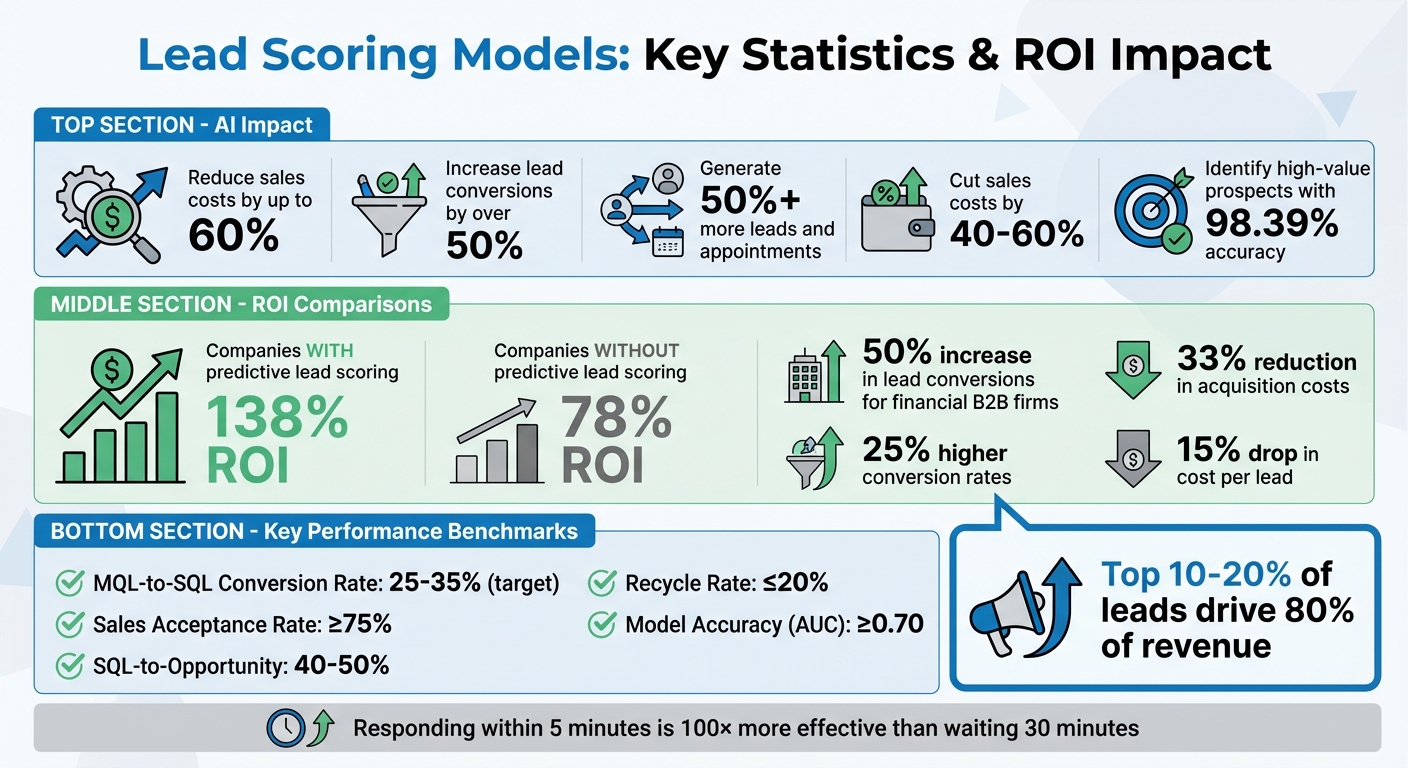
Lead Scoring ROI Statistics and Key Metrics
The first step in lead scoring is identifying potential customers using demographic and firmographic data. Demographic scoring focuses on individual traits like job title, seniority level, department, and location. For instance, a CFO at a mid-sized company would score higher than an analyst at the same firm because decision-making authority plays a critical role in lead qualification [4][9][11].
Firmographic scoring, on the other hand, evaluates the organization itself. Key factors include the industry, company size (often measured by employee count or annual revenue), and the technology stack they use. For example, a financial B2B firm would view a commercial real estate syndicate with $50 million in assets under management as a stronger lead than a two-person startup. This approach ensures you’re targeting the right companies, not just engaged individuals [4][9][11].
By combining demographic and firmographic scoring, you can measure "lead fit." Without this type of scoring, sales teams risk wasting time on prospects who are unlikely to convert. For example, in 2024, Dell Technologies used firmographic data alongside third-party intent signals to identify accounts researching specific server solutions. This strategy led to a 40% increase in campaign conversion rates [12]. Once a prospect's fit is confirmed, behavioral metrics can further assess their readiness to make a purchase.
While demographic and firmographic scoring determine if a prospect qualifies, behavioral scoring uncovers whether they’re ready to buy. This method tracks engagement activities such as website visits (especially to pricing or case study pages), email interactions, content downloads, webinar attendance, and demo requests. These actions reveal immediate interest: "Are they ready to buy now?" [4][8][10].
For instance, a demo request - often a strong buying signal - might earn a lead +25 to +50 points, while a simple newsletter signup or a single email open would only add +2 to +3 points [10][5][4]. The focus should be on bottom-of-the-funnel behaviors that indicate serious intent. MongoDB, for example, integrated G2 buyer intent data into their scoring process to identify leads actively evaluating solutions. This adjustment resulted in a 34% boost in demo-to-opportunity conversion rates [12].
Behavioral scoring also accounts for negative signals by deducting points for actions or attributes that suggest a lead is unlikely to convert. These include using competitor email domains (-20 to -50 points), personal email addresses like Gmail (-10 points), visiting your "Careers" page, or unsubscribing from email lists (-25 points) [10][5][4]. By filtering out unqualified leads, you can ensure your sales team focuses on opportunities that are more likely to deliver results.
A balanced scoring system combines fit and intent, with point values assigned to reflect their relative importance. Here’s a common breakdown:
| Category | Max Points | Rationale |
|---|---|---|
| Demographic Fit | 30 | Matches industry, company size, and geography |
| Role Fit | 20 | Indicates decision-making authority |
| Behavioral Engagement | 35 | Tracks actions like downloads and page visits |
| Sales Activity | 15 | Signals strong intent, such as demo participation |
Table: Point allocation across four categories on a 0–100 scale
Clear thresholds help determine lead readiness. For example, leads scoring 0–24 are considered cold, 25–49 go into nurture campaigns, 50–74 become Marketing Qualified Leads (MQLs), and 75+ are hot leads requiring immediate attention from senior reps [10]. In 2024, Stanley Black & Decker transitioned from manual lead scoring to Salesforce Einstein Lead Scoring, which uses predictive modeling to analyze historical conversion data. This shift led to a 30% increase in their overall lead conversion rates [12]. Proper point allocation not only streamlines the sales process but also maximizes return on investment by focusing efforts on the most promising leads.
Traditional lead scoring often depends on pre-defined criteria, which can overlook subtle, complex patterns. AI, on the other hand, dives deeper into historical deal data to make more accurate predictions. By leveraging machine learning algorithms like Gradient Boosting Classifiers, Random Forest, and Logistic Regression, AI analyzes factors such as firmographics, behavioral engagement, and third-party intent data to predict lead quality. This approach eliminates much of the guesswork, uncovering relationships that manual methods might miss - like how visits to a pricing page followed by a demo request within a short timeframe could indicate a high likelihood of conversion.
One of AI's standout benefits is its ability to identify the small percentage of leads - typically 10–20% - that drive the majority of revenue, allowing businesses to focus their energy where it matters most. For example, in early 2026, a mid-sized insurance company adopted AI-based lead scoring and achieved over 90% accuracy in identifying high-quality leads. The results? A 3.5× increase in conversion rates for top-tier leads, an 80% reduction in time spent on low-quality prospects, and a 1.5% boost in profits during the first quarter alone[14].
AI-driven systems can also deliver remarkable efficiency gains. Companies using AI in sales have reported generating over 50% more leads and appointments while cutting sales costs by 40–60%[1]. These systems can identify high-value prospects with up to 98.39% accuracy[14]. However, keeping these models accurate requires frequent updates - retraining every 10–30 days ensures they stay aligned with changing market conditions and buyer behavior. For custom models, having a robust dataset is critical. For instance, Salesforce Einstein suggests training with at least 1,000 leads and 120 conversions to achieve reliable predictions[1].
By automating lead identification and prioritization, AI not only sharpens targeting but also delivers measurable improvements in efficiency and cost savings.
Predictive lead scoring builds on AI's capabilities, offering businesses a more efficient, personalized, and profitable alternative to manual scoring. Financial B2B firms using predictive models have seen a 50% increase in lead conversions while reducing acquisition costs by 33%[14]. This precision allows sales teams to focus on high-potential opportunities rather than spreading their efforts thin across all incoming leads. The results are striking: companies often report 25% higher conversion rates and a 15% drop in cost per lead. Overall, firms with predictive lead scoring achieve a 138% ROI, compared to just 78% for those without such systems[14].
These models also enable smarter lead routing. For instance, A-tier leads (scoring 80–100) can be routed to senior sales reps with a rapid 5-minute response time, while B-tier leads might enter automated email sequences, and C-tier leads can be nurtured over the long term[1]. In 2025, a financial services company integrated real-time AI scoring with tools like calendar synchronization and auto-qualification. This streamlined process boosted their lead-to-meeting conversion rate by 35% within just six months - all without adding to their sales team[16].
"The highest-value use case for AI scoring is not finding more buyers. Revenue acceleration comes from de-prioritizing leads that will never convert, freeing capacity for genuine opportunities." - Malay Gupta, B2B Marketing Expert[1]
Lead decay, or score decay, refers to the gradual reduction of a lead's score over time due to inactivity [17][12]. Think of it like a half-life: a lead's score decreases by half after a certain period of no interaction [17].
While firmographic data - like company size or industry - remains static, behavioral data such as website visits or email clicks should naturally lose relevance over time. For instance, a lead who downloaded a whitepaper six months ago but hasn’t engaged since is unlikely to be sales-ready today [10]. Without a proper decay system, databases can become cluttered with outdated scores, causing sales teams to waste time on cold prospects and misaligning lead prioritization [12][7]. Decay helps maintain focus on leads that have shown recent activity, ensuring your scoring model stays accurate and actionable [12][7].
To manage this effectively, a structured negative scoring system is essential.
Negative scoring can be applied through time-based decay and action-based deductions. Start by setting up automated schedules that gradually reduce behavioral scores when engagement drops off. For example:
High-intent actions, like demo requests, should decay more quickly (within 30–45 days), while top-of-funnel activities, such as downloading a whitepaper, can decay over a longer period (90–120 days) [12]. If a lead's score drops below the Marketing Qualified Lead (MQL) threshold, an automated re-engagement sequence can help reignite their interest [12].
Additionally, deduct points for disqualifying behaviors. For instance:
Behavioral red flags, like visiting a "Careers" page or marking emails as spam, should also trigger point deductions, as they indicate reduced purchase intent [7][13]. By accurately applying score decay, sales teams can focus on leads with genuine, recent interest, ultimately improving ROI.
"Lead score decay is effectively a half-life, and represents the amount of time it should take for a lead to be half as important as it used to be."
- admin, Twopir Consulting [17]
This highlights the importance of keeping lead scores updated in real-time. Reacting to a lead within 5 minutes of a trigger event is 100× more effective than waiting 30 minutes [10]. By integrating decay into your scoring model, your team can prioritize prospects with fresh intent, avoiding wasted effort on outdated signals.
Getting the most out of your lead scoring system means consistently fine-tuning it using data-driven KPIs and insights from your sales team, much like lead generation for real estate agents requires tailored nurturing strategies.
To ensure your lead scoring system is on track, focus on metrics that provide clear validation. Start with the MQL-to-SQL conversion rate - a healthy range is 25–35% [7]. If your sales acceptance rate (or SDR accept rate) falls below 75%, it’s a red flag that your sales team may not trust the scoring model [7]. Another key metric is score band performance: leads scoring 80+ should convert at least three times better than those in the mid-range (e.g., 40–60) [18].
Don’t overlook sales cycle velocity, as high-scoring leads should move through the pipeline faster than lower-scoring ones [2]. For AI-driven models, check the Area Under the Curve (AUC) - a score below 0.70 suggests your model isn’t outperforming random chance [7].
Here’s a real-world example: In 2025, TechFlow Inc., a SaaS company, adopted AI lead scoring through Optifai. Over 18 months, they boosted close rates from 18% to 28%, reduced "Hot" lead response times to under an hour, and added $102,000 in monthly revenue [15].
| Metric | Target Benchmark | What It Measures |
|---|---|---|
| MQL-to-SQL Conversion | 25–35% | Are high-scoring leads truly sales-ready? [7] |
| SQL-to-Opportunity | 40–50% | Does the SQL definition predict deal potential? [7] |
| SDR Accept Rate | ≥75% | Do sales reps trust the scoring model? [7] |
| Recycle Rate | ≤20% | Are leads being qualified too early? [7] |
| Model Accuracy (AUC) | ≥0.70 | Is the model better than random guessing? [7] |
These metrics are just the start. To refine your scoring further, you’ll need input from the sales team.
Your sales team can flag issues that data alone might miss, like mismatched job titles or hidden budget constraints. A simple but effective step is adding a disqualification field in your CRM. This requires sales reps to specify why an MQL was rejected - whether it’s "wrong persona", "no budget", "competitor", or "timing issue" [4]. Over time, this structured feedback becomes a goldmine for improving your scoring model.
Monthly calibration sessions between sales and marketing are another must. These meetings allow both teams to review lead quality and adjust scoring criteria based on actual outcomes [13]. Companies that hold quarterly calibration sessions have reported up to a 28% boost in SQL conversion rates [12]. For example, in 2025, Marketo’s marketing team conducted bi-annual scoring audits, which kept their MQL-to-SQL conversion rate consistently above 90% [12].
To avoid misalignment, establish a Service Level Agreement (SLA) that clearly defines MQLs, SQLs, score thresholds, and response times. This minimizes finger-pointing and ensures accountability [13]. Additionally, empower your sales reps to manually override scores when they spot deal-specific nuances that the model misses [2].
"If leads scoring 80+ aren't converting 3x better than leads scoring 40, your model is broken. That's the simplest diagnostic test you can run."
- Prospeo Team [18]
Lead scoring isn’t a "set it and forget it" process. Both KPIs and sales feedback should drive ongoing improvements. As markets shift, buyer behavior changes, and your product evolves, your model will need regular updates to stay accurate. Experts recommend retraining models every 10–30 days to prevent performance degradation [1].
Set aside time each month to audit for false positives and negatives. Testing different MQL thresholds - like 75+ versus 85+ - over a month can reveal which settings yield better results [13]. Keep a detailed change log to track every adjustment, including the date, approver, and reason for the update [13].
Real-world examples show the power of continuous refinement. In 2025, Dell Technologies used Bombora’s intent data to identify accounts interested in specific server solutions, driving a 40% increase in campaign conversion rates [12]. Similarly, MongoDB integrated G2 buyer intent data into their scoring model, increasing their demo-to-opportunity conversion rate by 34% [12]. These cases highlight how incorporating new data sources can directly boost ROI.
Refining lead scoring is an ongoing process that blends smart model design, AI-driven insights, and consistent updates. Financial B2B firms that embrace this approach often see measurable progress, with AI-powered models boosting pipeline efficiency and conversion rates.
To get started, focus on creating a clear Ideal Client Profile that zeroes in on the key decision-makers in your niche. These might include High-Net-Worth Individuals, CFOs of mid-market companies, or business owners seeking commercial lending solutions [3]. Pair this with a two-dimensional scoring model that differentiates between "Fit" (firmographic data like industry and revenue) and "Behavior" (engagement signals such as downloads or tool usage) [6]. This ensures you prioritize leads that not only match your target profile but also show genuine buying intent.
"Most lead scoring models fail not because the math is wrong, but because they score too many things, never decay, and set MQL thresholds that nobody trusts." - Rome Thorndike, Author, The RevOps Report [6]
AI takes this further by uncovering patterns in historical data that might otherwise go unnoticed. However, the technology alone won't deliver results. A strong lead scoring model needs continuous input from your sales team, quarterly calibration sessions, and retraining every 10–30 days to avoid model drift [1]. Regular feedback and KPI reviews, as discussed earlier, are critical for keeping your model in sync with market changes.
The real edge comes from quickly deprioritizing low-value leads. Using techniques like negative scoring, score decay, and tiered response SLAs, you can free up your sales team to concentrate on the top 10–20% of leads that drive 80% of your revenue [1]. This ongoing, data-informed process turns your pipeline into a revenue-generating machine, leading to higher close rates, faster sales cycles, and improved profitability - aligning with the strategies covered in this guide.
To determine the right MQL (Marketing Qualified Lead) score threshold, start by digging into your historical data. Identify the score range where leads are most likely to convert. Your CRM can be a powerful tool here - use it to track performance across different scores and find the sweet spot where conversion rates spike.
Make sure this threshold aligns with how your sales and marketing teams define an MQL. Collaboration between these teams is key to setting a score that makes sense for everyone. And don’t stop there - keep an eye on performance metrics and gather feedback from your teams regularly. Adjust the threshold as needed to ensure you're maximizing ROI.
To get started with AI lead scoring, focus on gathering high-quality data about your prospects. This includes both demographic and behavioral information. Some key details to collect are:
By collecting this data, the AI can analyze patterns, assign accurate scores, and predict how likely a prospect is to convert.
Lead scores should decrease over time based on how recently a lead interacted with your business. Recent engagements should carry more weight, while older ones gradually lose significance. Typically, scores decline over a few months to keep your pipeline accurate. This approach helps your model stay focused on leads that are actively showing interest.
%20(5).png)
