%20Bold.png)

Intent signals help B2B teams identify prospects who are actively researching solutions. Instead of wasting time on cold leads, these signals highlight accounts closer to making a purchase. By analyzing behaviors like pricing page visits, competitor comparisons, or demo requests, you can prioritize outreach and improve sales efficiency.
Intent signals let you focus on the 3–5% of your target market actively looking to buy, saving time and boosting results.
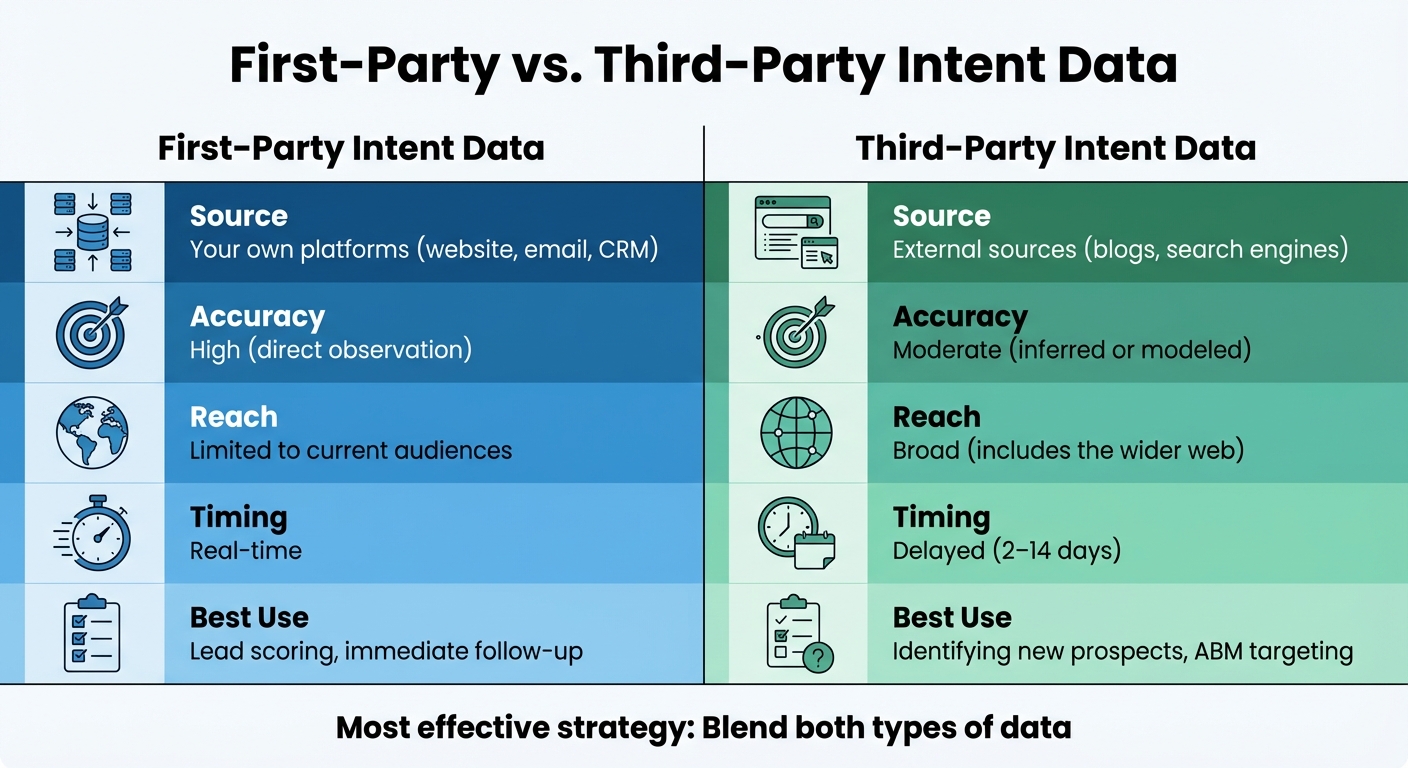
First-Party vs Third-Party Intent Data Comparison for B2B Marketing
Intent signals are behavioral breadcrumbs - specific online actions that hint at a prospect's interest in a topic, product, or solution. These signals provide insight into both what someone is researching and their level of intent to make a purchase [8]. For instance, a casual blog reader might just be gathering information, but when the same person checks out a pricing page, downloads a competitor comparison, or requests a demo, their intent becomes much clearer.
"Intent signals don't just show what someone is doing; they reveal why they're doing it." – Samuel Thimothy, VP at OneIMS [8]
The strength of these signals depends on factors like how quickly someone is researching, how deeply they engage with specific topics, and actions that indicate serious interest, such as visiting a pricing page or using an ROI calculator [9]. While a single blog visit might not mean much, a pattern of actions - like multiple downloads across a few days by employees from the same company - points to real buying intent and should trigger immediate follow-up.
Now, let’s break down the two main sources of intent data: first-party and third-party signals.
Intent data generally comes from two key sources, each with its own strengths. First-party intent data is gathered directly from your own platforms, such as your website, email campaigns, CRM, or product usage [8]. Actions like viewing a pricing page, downloading a whitepaper, attending a webinar, or clicking through an email fall into this category. Because this data comes straight from your audience interacting with your brand, it’s considered highly reliable [2].
In contrast, third-party intent data is collected from external sources, including publisher networks, search engines, industry blogs, and review platforms like G2 or TrustRadius [8]. Providers like Bombora and 6sense aggregate this data to identify buyers actively researching solutions but who haven’t yet landed on your site. This broader data can help pinpoint potential customers early in their buying journey. However, third-party data often has a time lag of 2–14 days and is less precise since it’s based on inferred or modeled behavior rather than direct observation [9].
| Feature | First-Party Intent Data | Third-Party Intent Data |
|---|---|---|
| Source | Your own platforms (website, email, CRM) | External sources (blogs, search engines) |
| Accuracy | High (direct observation) | Moderate (inferred or modeled) |
| Reach | Limited to current audiences | Broad (includes the wider web) |
| Timing | Real-time | Delayed (2–14 days) |
| Best Use | Lead scoring, immediate follow-up | Identifying new prospects, ABM targeting |
There’s also second-party data, which comes from trusted partners like review sites or event organizers. For example, if someone compares your product to competitors on G2, that activity can be shared with you as second-party data [8].
The most effective strategy blends both types of data. First-party data helps you act quickly on known prospects, while third-party data uncovers new opportunities, even before potential buyers engage with your brand.
Intent signals provide clues about where a prospect is in their buying journey, helping you tailor your approach. These signals fall into three categories: Engagement, Research, and Purchase Readiness. Each reflects a different stage of the buyer's process and requires a specific strategy to move the prospect closer to a decision.
Engagement signals are actions that show someone's initial interest in your brand. These might include reading blog posts, attending webinars, clicking on email links, downloading whitepapers, or interacting with your social media content. Typically, these behaviors indicate that prospects are in the Awareness stage, where they're exploring a problem or learning about potential solutions but aren't ready to make a purchase.
For instance, a single blog visit might be casual, but repeated interactions - like forwarding an email to colleagues - can suggest growing interest. This could even point to the formation of a buying committee.
Lindsay Hasz, Director of Insights and Optimization at SAP Concur, leveraged Demandbase to segment audiences by their journey stage, using first-party behavioral data. By personalizing web experiences based on these engagement signals, SAP Concur achieved a 4X increase in funnel velocity [3].
The best strategy here is to nurture these prospects with educational content and targeted campaigns. Instead of pushing for a sale, focus on building trust and helping them understand their challenges. This approach lays the groundwork for future conversions as part of a broader B2B strategy.
Research signals indicate that prospects are actively comparing solutions. These behaviors often occur on third-party platforms like G2, Capterra, or TrustRadius, where buyers read reviews, download guides, or evaluate competing products. They might also visit industry blogs or competitor websites.
This stage aligns with the Consideration phase, where buyers are narrowing down their options. Research shows that 94% of buying groups have their preferred vendor list finalized before they even make contact [2]. If you notice multiple employees from the same company engaging with comparison content, it's a good time to activate account-based marketing (ABM) campaigns and alert your SDR team. The goal is to position your brand early in their evaluation process.
"Intent signals let you engage accounts while they are still forming opinions, not after the shortlist is set." – Salesmotion [2]
It's critical to look for patterns of activity rather than acting on a single signal. Clusters of interest across an account signal broader engagement, giving you a stronger foundation to work from.
Purchase readiness signals are the clearest indicators that a prospect is ready to buy. These include actions like:
These behaviors suggest the prospect is in the Decision stage, where the buying window is open - but it won’t stay open for long. A pricing page visit from two days ago holds far more weight than one from a month ago, as these signals lose value quickly.
For these high-intent actions, same-day sales outreach is ideal. When reaching out, reference the content or topic they engaged with, but avoid directly mentioning their tracked activity. For instance, instead of saying, "I saw you visited our site", try something like, "I noticed your team was exploring our Salesforce integration documentation." This approach feels more helpful and builds credibility, increasing your chances of closing the deal.
| Signal Type | Buying Stage | Example Actions | Recommended Response |
|---|---|---|---|
| Engagement | Awareness | Blog reads, webinar attendance, email clicks | Marketing nurture; retargeting ads |
| Research | Consideration | Reviews on G2, competitor comparisons | Activate ABM campaigns; SDR alerts |
| Purchase Readiness | Decision | Pricing page visits, demo requests | Direct sales outreach (same day) |
Intent signals aren't just theoretical - they're actionable tools that can transform how businesses approach marketing and sales. By collecting, analyzing, and acting on these signals, you can turn behavioral data into targeted strategies that drive revenue.
The first step is to track behaviors across your website, review platforms, and B2B publisher networks to pinpoint active prospects [3]. Look for signal clusters - patterns where multiple stakeholders from the same company engage with related content in a short period. For instance, if three employees from the same organization visit your pricing page, download a whitepaper, and read competitor reviews within a week, it’s a strong indicator that a buying committee might be forming [2].
Once you've identified these active prospects, the next move is to rank them based on their level of intent.
Not all intent signals are created equal. For example, downloading a general industry report doesn’t carry the same urgency as someone repeatedly visiting your pricing page. To make sense of this, create a signal hierarchy that categorizes actions by urgency [2].
For example, Meritt saw their weekly pipeline jump from $100,000 to $300,000 by layering intent topics onto verified professional profiles and refreshing the data weekly. They also reduced email bounce rates from 35% to under 4% [6].
Timing is critical. A pricing page visit from 48 hours ago signals immediate interest, while one from 18 days ago might just be background noise [10][11].
After prioritization, the next step is to craft outreach that aligns with each prospect’s stage in the buying journey.
Generic outreach is no longer effective, especially when B2B buyers are already 70–80% through their decision-making process before contacting a vendor [2]. Intent signals give you the edge to personalize your messaging based on what prospects are actively researching.
For instance, if someone visits your security documentation page, send them a SOC 2 compliance guide instead of a generic product brochure [2][12]. Personalization can happen at three levels:
Lindsay Hasz, Director of Insights and Optimization at SAP Concur, used intent signals to segment audiences by their journey stage and personalize web experiences. This approach led to a 4X increase in funnel velocity [3]. Campaigns driven by intent data also achieve 93% higher conversion rates compared to traditional methods [6].
Speed is equally important. The first vendor to engage a prospect during their evaluation process often secures the majority of deals [2]. To stay competitive, set response-time SLAs based on signal strength: respond to hot signals within 1 hour and warm signals within 4 hours [4]. When reaching out, reference recent activities like a new executive hire or an earnings call mention to make your opener stand out [2][5].
"Intent signals let you engage accounts while they are still forming opinions, not after the shortlist is set." – Salesmotion [2]
Intent signals bring clarity and precision to every part of the B2B buying journey, from identifying quality leads to speeding up sales and refining account targeting. By turning behavioral data into actionable insights, they help businesses identify, prioritize, and engage with buyers more effectively.
Intent signals take lead qualification beyond basic firmographic data and add a layer of behavioral insight. Instead of focusing solely on static factors like industry or company size, these signals highlight real actions that show a prospect is actively exploring solutions. For instance, if a company posts a relevant job opening, browses your category on review sites like G2, and revisits your pricing page, these combined actions - known as signal clustering - paint a clearer picture of buyer intent. This approach dramatically cuts down on false positives and boosts lead quality. Companies using intent data have reported up to a 37% increase in lead conversion rates and campaigns that are 93% more effective at converting [2][4][6].
"We're no longer fishing. We know who the right customers are, and we can qualify them quickly." – Andrew Giordano, VP of Global Commercial Operations at Analytic Partners [2]
This improved qualification process lays the groundwork for faster and more efficient sales efforts.
In B2B sales, timing is everything. Many buying decisions are already in motion before sales teams even make contact [2]. Intent signals give sales teams the visibility they need to engage buyers during their active evaluation phase, not after they've made a decision. By tracking spikes in activity, sales reps can focus on high-potential opportunities and avoid wasting time on unproductive leads. This targeted approach has been shown to shorten sales cycles by 30–40% [4].
For example, if a prospect visited your pricing page 48 hours ago, that’s a strong signal for immediate follow-up. But if the same visit happened three weeks ago, it’s likely too late. Setting clear response-time goals - like contacting hot leads within one hour and warm leads within four - helps sales teams act quickly and keep the momentum going [4].
Shorter sales cycles not only drive revenue faster but also make account-based strategies more impactful.
Intent signals turn account-based marketing (ABM) into a dynamic, real-time strategy. With only 3–5% of potential customers actively shopping for solutions at any given time [3], intent data ensures your efforts are laser-focused on accounts that are both a good fit and currently in-market. This is especially valuable considering that up to 70% of the B2B buyer journey happens in the "dark funnel", where prospects research anonymously long before engaging with your company [4].
Using intent signals can unlock valuable insights, but doing so effectively often involves navigating some common hurdles. In fact, only 24% of organizations report strong returns on their intent data investments, largely due to challenges in activating and interpreting these signals effectively [2]. Let’s break down some strategies to avoid pitfalls and make the most of intent data.
A common error is assigning equal importance to all signals. For instance, a single blog post view isn’t as impactful as a visit to a pricing page. However, when alerts pile up, it’s easy to lose sight of the signals that truly matter [2][6].
Relying on isolated data points can also lead to mistakes. A single website visit might suggest interest - or it could just as easily be a student researching, a competitor snooping, or even a random click. Research shows that only 5–10% of "buyer intent" signals indicate an active buying cycle [5]. To address this, use signal clustering, which groups related actions from the same account within a short timeframe. For example, three high-value actions within seven days is a much stronger indicator of intent [6][10].
Timing is equally crucial. Intent signals lose relevance quickly - what was valuable last week may no longer hold weight. As MarketBetter Guide puts it: "A signal that is three weeks old is not a signal. It is history" [4]. Implement a tiered response system to act on signals promptly:
A siloed approach to intent data is another common challenge. Many companies keep first-party data (e.g., website activity) and third-party data (e.g., broader topic research) separate, which prevents a comprehensive view of the buyer’s journey [1]. Combining these with contextual signals - like job postings or leadership changes - into a unified scoring system can make a huge difference [2][4][10].
To score signals effectively, consider three key dimensions:
For example, a pricing page visit from two days ago should rank far higher than a blog view from a month ago [6]. Automating this scoring process through tools like Salesforce or HubSpot can streamline workflows by triggering tasks, updating pipelines, or enrolling prospects in sequences - without manual handoffs [10].
Take the example of Analytic Partners, which implemented Salesmotion in 2025. By automating the tracking of hiring trends and earnings commentary, Andrew Giordano, VP of Global Commercial Operations, reduced the time spent researching each account from three hours to just 15 minutes. This shift contributed to a 40% year-over-year increase in qualified pipeline [2]. Similarly, the sales team at Meritt used Bombora intent topics to refresh contact profiles weekly, tripling their pipeline from $100,000 to $300,000 and cutting email bounce rates from 35% to under 4% [6].
Intent data can tell you what someone is researching, but it doesn’t explain why. Without context, you might waste time chasing prospects who don’t fit your Ideal Customer Profile (ICP) or mistake casual browsing for serious interest [5][4][10].
To filter out noise, align intent signals with your ICP. For instance, if a small agency researching enterprise tools doesn’t meet your firmographic criteria, they’re more likely a distraction than an opportunity [5]. Additionally, look for account-level patterns. In B2B, buying decisions often involve committees, so when multiple stakeholders from the same company engage with related content in a short period, it’s a stronger indicator of organizational interest than individual actions [1][10].
"We're no longer fishing. We know who the right customers are, and we can qualify them quickly." – Andrew Giordano, VP of Global Commercial Operations, Analytic Partners [2]
Use this enriched context to personalize your outreach. Instead of generic messages like "saw you visited our site", reference specific actions, such as a recent job posting, a product they explored, or a public initiative they’ve mentioned [2][1].
Intent signals are transforming how B2B teams approach lead prioritization and prospect engagement. Instead of relying on static firmographic data, teams can zero in on the small percentage of buyers actively in the market. This shift - from guessing "who might buy" to identifying "who is buying right now" - helps sales and marketing teams allocate their time and resources more effectively, steering clear of the 95% of accounts that aren't ready to purchase.
The impact of this shift is hard to ignore. Companies leveraging intent data report 38% higher win rates, 25–40% shorter sales cycles, and 30% lower acquisition costs. Salesforce, for example, achieved a 20% higher conversion rate and cut their sales cycle by 30% using this approach [7][4]. These numbers highlight just how powerful intent signals can be in turning interest into closed deals.
But it’s not just about revenue. Intent data also enables highly personalized outreach at scale. By using these insights, teams can address specific challenges prospects face - whether it’s SOC 2 compliance, comparing competitors, or managing implementation timelines. This tailored approach avoids the discomfort of overly invasive tracking while showing a real understanding of what matters most to prospects [2][7].
Consider this: 94% of buying groups finalize their vendor lists before ever making contact [2]. Relying solely on inbound leads or passive events means missing out on key opportunities. Intent signals also shine a light on the "dark funnel" - the hidden research phase where up to 70–80% of the buyer journey happens and opinions take shape [2][4].
To stay competitive, adopting an intent-driven strategy is no longer optional. Start by leveraging your first-party data, like website visits and email engagement, and expand to include third-party signals as you scale. By acting quickly on high-intent signals and combining insights from multiple sources, your team can stay agile and relevant throughout the buyer’s journey. This approach ensures every interaction is meaningful - fueling growth in today’s fast-paced B2B landscape.
To evaluate intent signals, observe behaviors such as website visits, content downloads, keyword searches, and interactions across various channels. Pay attention to patterns like frequent visits to important pages, increased resource downloads, or noticeable spikes in specific keyword activity. Assign scores to these actions based on their engagement levels and behavior trends. Leveraging AI-driven tools can streamline this process, allowing you to focus on leads that show the strongest potential for conversion through their actions and overall engagement.
The quickest way to tap into high-intent opportunities is by leveraging real-time buyer intent signals. These signals capture actions like website visits, content interactions, and data from your CRM or third-party sources. By automating your responses with AI, you can engage prospects instantly, boosting your chances of turning interest into conversions.
To merge first- and third-party data effectively, start by combining behavioral signals from your own sources - like website visits or content downloads - with external intent data, such as industry research or competitor analysis. By aligning these data types, you can uncover patterns. For example, if a prospect visits your pricing page while simultaneously researching competitors, that’s a strong indicator of intent. This approach refines lead scoring, allowing you to focus on high-intent accounts and engage prospects at the most opportune stage of their buying journey.
%20(5).png)
